
Early Renaissance – Exploring the Early Italian Renaissance Art Period

Early Renaissance art describes the major developments in fifteenth-century Italian painting, sculpture, and architecture that preceded the High Renaissance. Centered especially in Florence but never limited to one city or a single uniform style, it joined sustained religious imagery with new approaches to pictorial space, naturalistic bodies, classical form, and civic and private patronage. This guide explains the period’s boundaries, its defining visual problems, and the artists and artworks that made those changes visible.
Early Renaissance Art in Fifteenth-Century Italy
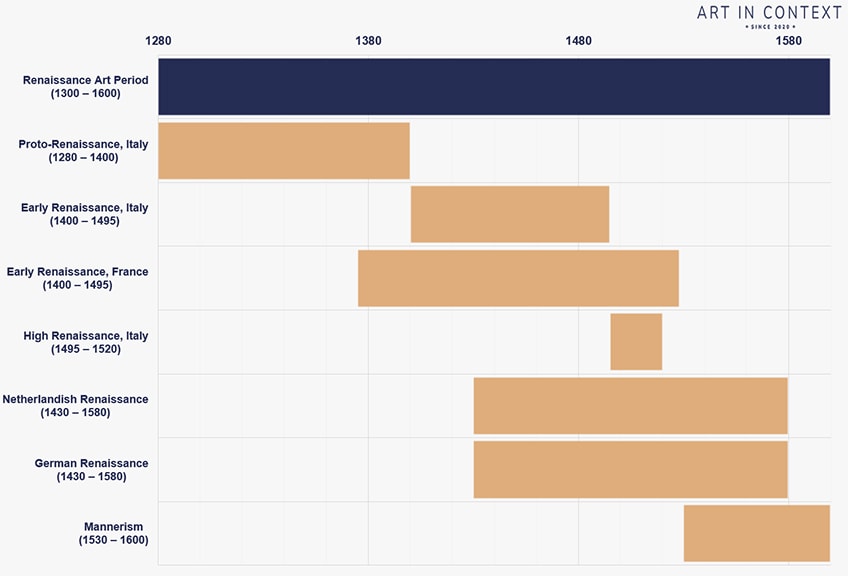
The Early Renaissance is usually placed in the fifteenth century, with boundaries that vary according to region, medium, and historian. The Italian term Quattrocento means the 1400s and is broader than a rigid stylistic label: not every work made in that century looks “Early Renaissance,” and older Gothic conventions continued alongside new experiments. Florence was a leading center of early Italian Renaissance art, while courts and cities including Siena, Urbino, Padua, Mantua, and Venice developed distinct forms of the Renaissance.
Fifteenth-century Italy was divided among republics, duchies, kingdoms, and papal territories rather than united as a nation. Florence’s wealth came from banking, textile production, and trade, and commissions were shaped by guilds, religious institutions, confraternities, civic bodies, and families. The republic was governed by a relatively small political elite, not by universal participation; after 1434, Cosimo de’ Medici exercised powerful informal influence while the republican framework remained. The Medici family became especially important as patrons, but they were part of a much larger network of commissioners.
The Early Renaissance did not replace medieval art overnight. Late Gothic elegance, Byzantine-derived conventions, classical models, workshop practice, new mathematical systems, and local patronage overlapped throughout the fifteenth century.
Renaissance humanism was not simply a doctrine that put humanity above religion. It was an educational and intellectual program grounded in the studia humanitatis—grammar, rhetoric, poetry, history, and moral philosophy—through renewed study of Greek and Latin texts. Humanist learning could coexist with Christian devotion, and most visual art still served religious, civic, or commemorative purposes. Classical architecture, ancient sculpture, and literary subjects nevertheless offered artists and patrons a broader vocabulary of bodies, buildings, virtues, myths, and histories.
The change is therefore better understood as a reworking of inherited visual languages than as a move from “flat” medieval art to universally realistic Renaissance art. Artists developed measurable space, more weighty bodies, observed light, portrait likeness, and classical form, but they used those devices selectively. Gold grounds, decorative pattern, hierarchy, and late Gothic line did not suddenly disappear. Byzantine art remained an important historical source rather than a simple opposite to Renaissance naturalism.
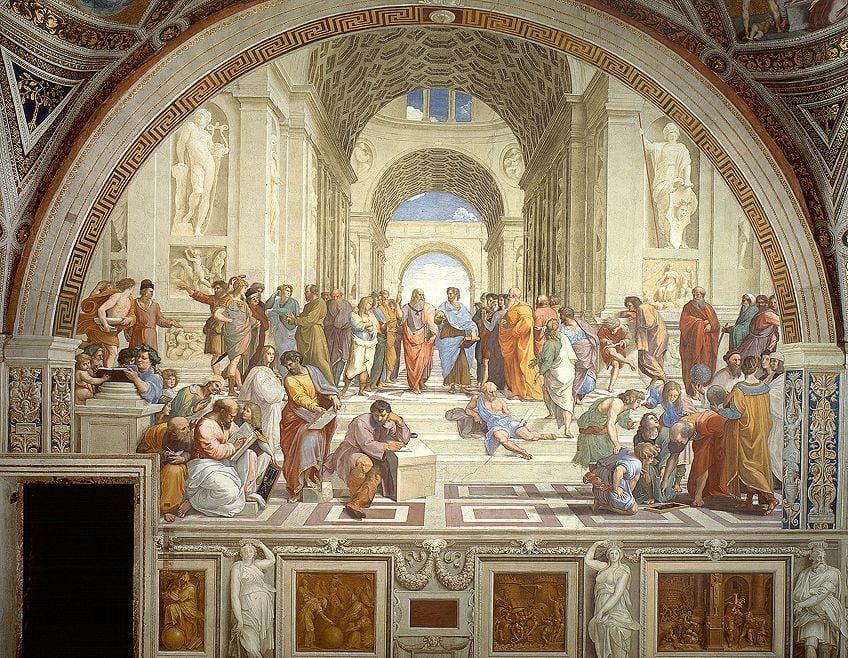
Early Renaissance Art
It is worthwhile exploring how the visual arts evolved in Florence as one leading center of the Early Renaissance. First, let us consider the earlier developments that shaped fifteenth-century art, followed by the period’s common characteristics and several important artists.
Pre-Renaissance Artwork
“Proto-Renaissance” is a retrospective label most often applied to important developments in Italian art of the late thirteenth and fourteenth centuries. The century called the Trecento—the 1300s—contained several regional traditions, including Florentine and Sienese painting, and cannot be reduced to one bridge between “medieval” and “Renaissance” art. Gothic Art and Italo-Byzantine conventions remained productive languages rather than obstacles that artists simply discarded.
Cimabue and Giotto are useful precursors because their works test bodily weight, emotion, and spatial coherence, not because every fifteenth-century innovation can be traced to a single linear break with medieval art.
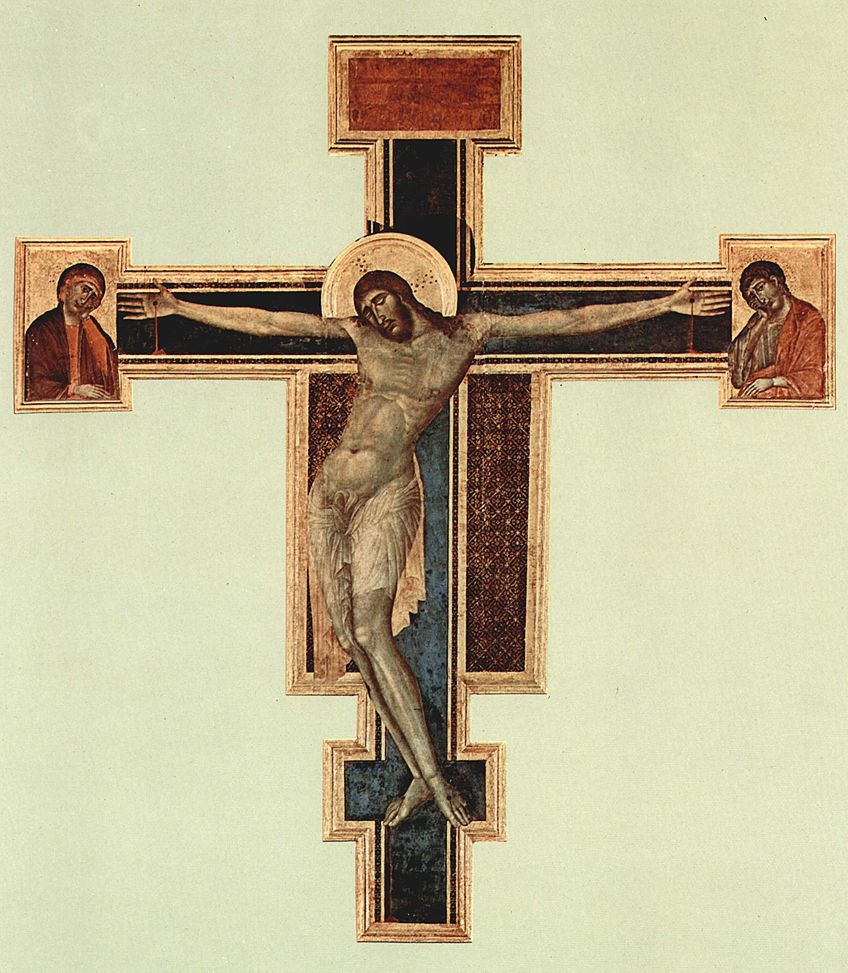
Cimabue (also known as Cenni di Pepo) and Giotto di Bondone gave sacred figures greater bodily presence and emotional force within established religious formats. Cimabue’s large painted Santa Croce Crucifix (c. 1287-1288), for example, bends Christ’s body across the cross and intensifies the sense of suffering.
Giotto’s reputation was later central to the historical narrative developed by the painter and biographer Giorgio Vasari in the sixteenth century. Giotto’s Lamentation (The Mourning of Christ) (c. 1305) does not use the mathematically unified one-point system associated with fifteenth-century Florence. Its overlapping figures, modeled bodies, rock ledge, and foreshortening nevertheless organize a legible space and direct attention toward the dead Christ through gesture and gaze.
Characteristics of Early Renaissance Art
Early Renaissance art is recognized through relationships among space, bodies, materials, and use—not through one checklist that every object must satisfy. In painting, artists constructed more coherent interiors and landscapes through overlap, scale, atmospheric recession, foreshortening, and, increasingly, linear perspective. They modeled figures with light and shadow so bodies appear to occupy space rather than float on a surface. Masaccio’s frescoes are especially clear demonstrations, but painters such as Fra Angelico retained brilliant color and devotional intensity while also building rational space.
Sculptors studied classical contrapposto, free-standing figures, portrait likeness, and narrative relief. Donatello’s very shallow rilievo schiacciato can suggest distant space with minute changes in depth. Architects such as Brunelleschi adapted columns, round arches, proportional bays, and other classical forms to contemporary hospitals, churches, sacristies, and palaces. Across media, artistic naturalism was selective: an anatomically convincing body could coexist with symbolic scale, ideal beauty, decorative line, or an intentionally timeless setting.
Subject matter also diversified, although religious commissions remained predominant. Portraits, civic monuments, domestic decoration, history, and classical mythology gained visibility among courtly and elite patrons. Classical subject matter did not simply replace the culture of the Medieval period; sacred, civic, dynastic, and humanist meanings often overlapped in the same commission.
How to Distinguish Early Renaissance Art
To distinguish Early Renaissance art from International Gothic, look beyond the date. International Gothic works often privilege elegant contour, costly surfaces, courtly detail, and ornamental pattern, while many Early Renaissance works give bodies firmer weight and make architecture or landscape behave as measurable space. The categories overlap: Ghiberti, Fra Angelico, and Botticelli can combine decorative refinement with Renaissance naturalism, so a single flowing line or gold detail does not settle the classification.
The boundary with the High Renaissance is equally gradual. Early Renaissance compositions often make the construction of space, anatomy, and classical reference visibly experimental or diverse from one workshop to another. Around the 1490s and early 1500s, Leonardo, Michelangelo, Raphael, and contemporaries pursued more monumental bodies, integrated movement, and highly unified compositions. Geography matters as well: developments in Venice, northern Italian courts, and central Italy do not follow Florence’s sequence exactly.
Early Renaissance Artists
Brunelleschi, Donatello, and Masaccio are often used to introduce Early Renaissance architecture, sculpture, and painting because their works make major formal changes especially clear. They did not work in isolation. Ghiberti, Fra Angelico, Fra Filippo Lippi, Paolo Uccello, Luca della Robbia, Andrea del Verrocchio, and many workshop collaborators also shaped fifteenth-century art, while Piero della Francesca and Botticelli show how differently Renaissance principles could be developed beyond the period’s first Florentine experiments.
Filippo Brunelleschi (1377 – 1446)
Filippo Brunelleschi studied ancient Roman architecture and developed buildings whose columns, arches, bays, and surface contrasts made proportional order easy to perceive. His perspective demonstrations in Florence are credited with an important early formulation of one-point linear perspective; Leon Battista Alberti subsequently published a systematic account of constructing pictorial space in De pictura (1435).
Brunelleschi did not design the whole Cathedral of Santa Maria del Fiore, whose construction began under Arnolfo di Cambio in 1296. His defining contribution was the double-shell masonry dome, built from 1420 to 1436 over the cathedral’s enormous octagonal crossing.
Although this cathedral was started by the designs of architect Arnolfo di Cambio in 1296, in the typical Gothic style, it was Brunelleschi who engineered the innovative solutions for the dome, which was completed around 1434 to 1436.
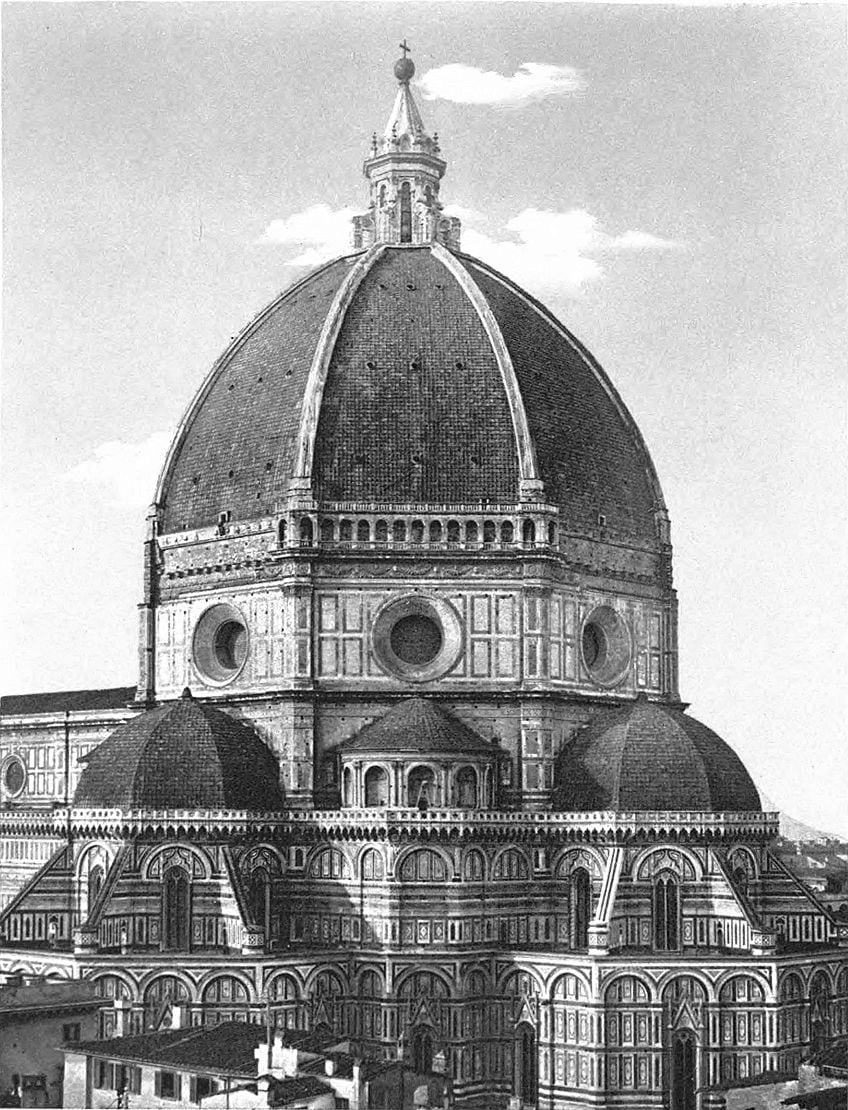
The dome consists of inner and outer shells joined by ribs, with stone and brick arranged to manage the structure’s weight without the full wooden centering normally required for a vault of this scale. Brunelleschi also designed hoists and other machinery for the building site. The completed cupola became both a feat of engineering and a civic emblem visible across Florence; it remains the world’s largest masonry vault.
Donatello (1386 – 1466)
Donato di Niccolò di Betto Bardi, known as Donatello, was a Florentine sculptor whose career ranged across marble, bronze, wood, terracotta, and stucco. A documented trip to Rome with Brunelleschi is not certain in every detail, but Donatello’s work shows sustained engagement with ancient classical architecture and sculpture. His works include the bronze sculpture David (often dated to around the 1440s) and the wooden Penitent Magdalene (c. 1453-1455).
Donatello’s bronze David is an approximately 158-centimeter figure widely treated as the first monumental free-standing male nude made since antiquity. Its in-the-round design differs from sculpture bound to an architectural niche, although free-standing medieval sculpture and many other formats also existed.

The biblical hero stands over Goliath’s severed head, holding the giant’s sword and wearing a hat and boots. His relaxed classical contrapposto distributes weight asymmetrically, encouraging the viewer to walk around the sculpture rather than read it only from the front.
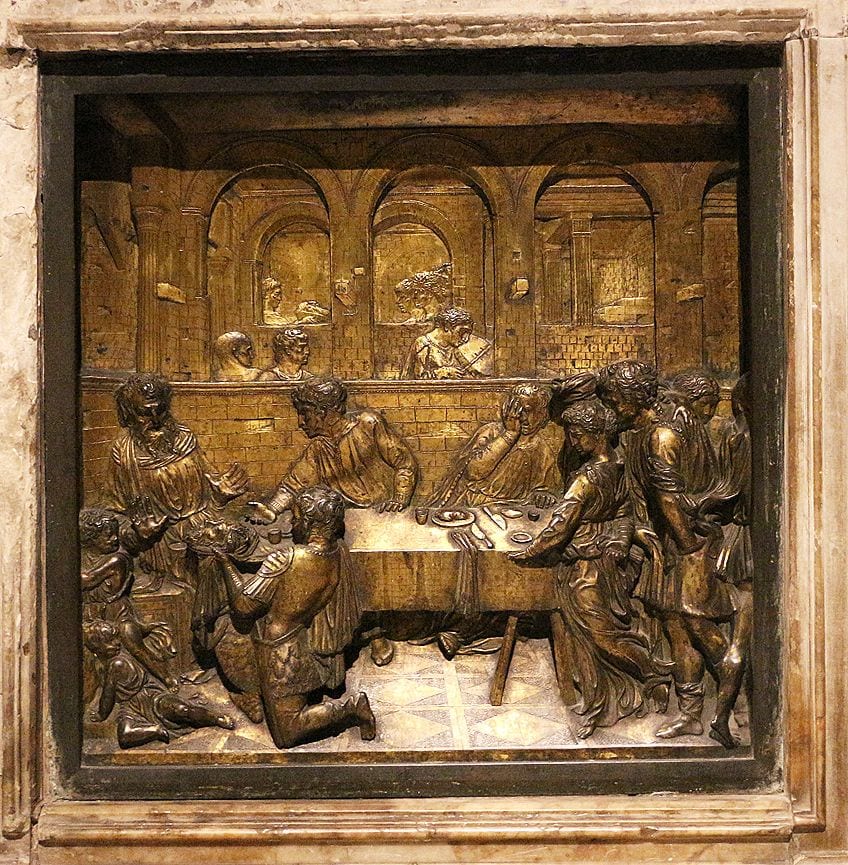
Donatello also developed rilievo schiacciato, an extremely shallow relief in which slight changes of depth and incised lines can suggest atmosphere and recession. In the gilded-bronze Feast of Herod (1423-1427) for the Siena Baptistery, orthogonals and transversal lines organize several architectural zones. The empty foreground gap intensifies the court’s recoil from the presented head of John the Baptist, joining spatial construction to narrative emotion.
Masaccio (1401 – 1428)
Tommaso di Ser Giovanni di Simone, known as Masaccio, transformed Florentine painting during a career that lasted only a few years. He used a consistent light source, cast shadows, weighty figures, and measured architecture to make sacred narratives appear continuous with the viewer’s physical world. His work is closely associated with Brunelleschi’s perspective experiments and influenced later painters including Piero della Francesca, Michelangelo, and others across Renaissance art.
Major works include the San Giovenale Triptych (1422), the Brancacci Chapel frescoes made with Masolino, and the Holy Trinity (c. 1427) in Santa Maria Novella. The Holy Trinity aligns a painted barrel-vaulted chapel with a low vanishing point near the viewer’s eye level, turning linear perspective into part of the fresco’s devotional encounter.
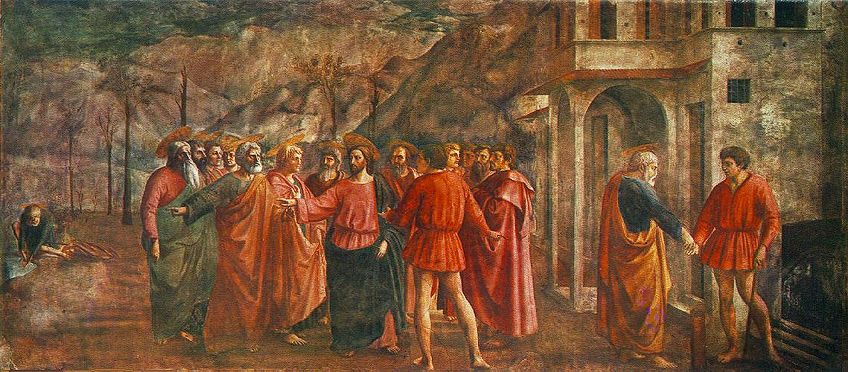
The Tribute Money represents Matthew 17:24-27 through continuous narrative: Christ instructs Peter in the central group; at left Peter takes a coin from the fish’s mouth; at right he pays the tax collector. Repeating Peter across one landscape lets successive moments share a single, coherent setting.
The architecture’s orthogonals converge near Christ’s head, while overlapping figures, cast shadows, and atmospheric recession in the mountains reinforce depth. Masaccio therefore uses perspective for more than technical display: spatial order also directs attention to the narrative’s central exchange.
Masaccio’s innovation lies in the coordination of space, light, bodily weight, and narrative emphasis—not in the unsupported claim that earlier European painting lacked every means of representing depth.
Piero della Francesca (c. 1415/1420 – 1492)
Piero della Francesca worked in Sansepolcro and at several central Italian courts. Painter, geometer, and author of a treatise on perspective, he organized figures and architecture through lucid proportion, measured light, and restrained gesture. His work demonstrates that Early Renaissance art was not only a Florentine story.
The Flagellation of Christ is generally dated to the mid-fifteenth century, although proposed dates and interpretations vary. Christ’s flagellation occupies a deep architectural setting at the left, while three unidentified men stand in the shallow foreground at the right. The precise relationship between the two groups remains debated, so the painting should not be reduced to one definitive hidden narrative.
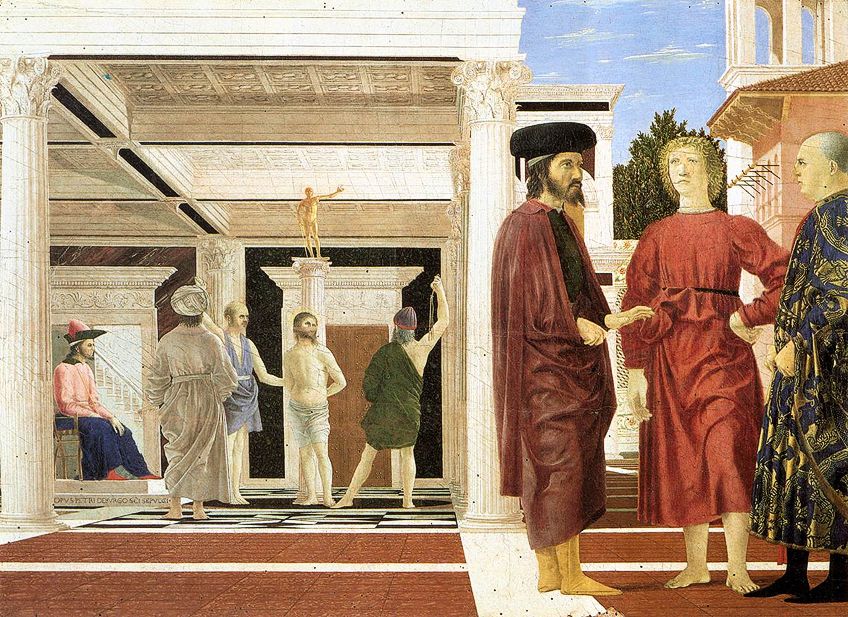
The pavement, coffered ceiling, and aligned columns divide the panel into carefully measured zones. Piero uses proportion and interval as expressive devices: the apparent calm, distance, and separation between the biblical event and the foreground figures create the painting’s enduring tension.
The whole scene has a mysterious quality, yet it is portrayed with a keen observance of perspectival and spatial laws.
Other works by Piero include The Baptism of Christ (probably c. 1437-1445), the Death of Adam in the Legend of the True Cross cycle (c. 1450s-1460s), and The Resurrection (c. 1463-1465). Across these works, geometrically ordered composition supports stillness, monumentality, and legible relations among figures rather than serving as an abstract demonstration alone.

In The Resurrection, Christ rises frontally above four sleeping soldiers and the horizontal edge of the tomb. The landscape changes from bare trees at left to leafy growth at right, while Christ’s vertical body and steady gaze dominate the composition. The soldiers wear forms of armor familiar to a fifteenth-century audience, bringing the sacred event into a visual world close to the work’s original civic setting in Sansepolcro.
Sandro Botticelli (1445 – 1510)
Alessandro di Mariano di Vanni Filipepi, known as Sandro Botticelli, demonstrates why Early Renaissance naturalism should not be mistaken for a single march toward optical realism. His paintings combine spatial construction and studied bodies with emphatic contour, patterned drapery, and deliberately elongated or idealized figures.
Botticelli’s line is not a failure to achieve the naturalism of Masaccio or Piero; it is a different Renaissance choice, using rhythm and contour to organize beauty, movement, and meaning.
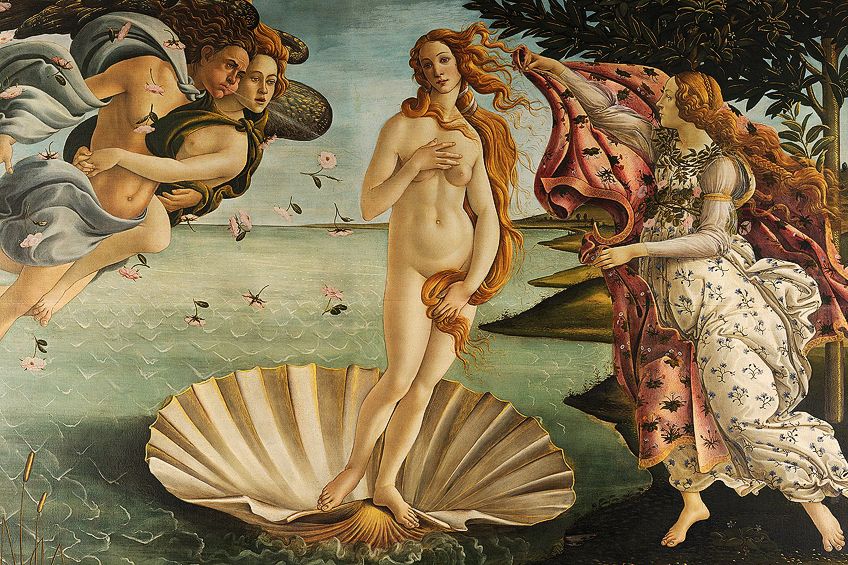
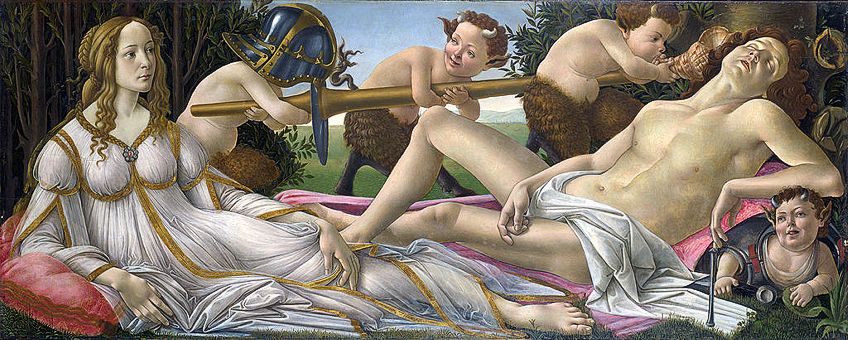
Botticelli worked extensively on Christian subjects and portraits as well as mythological paintings associated with elite Florentine culture. His works include Primavera (c. 1480), Venus and Mars (c. 1485), and The Birth of Venus (c. 1485).
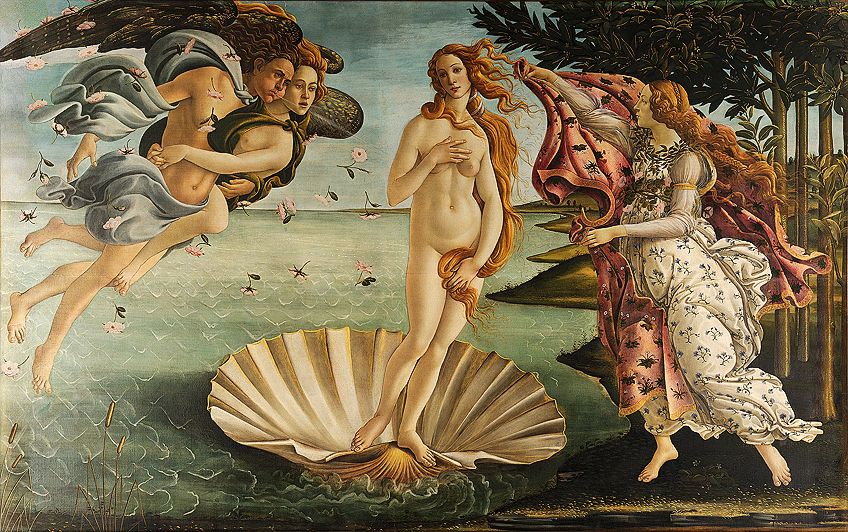
These mythological paintings use classical subjects without copying ancient art literally. In The Birth of Venus, the goddess’s elongated body, improbable balance on the shell, wind-driven drapery, and repeated flowing contours create an intentionally poetic image. The work is therefore evidence for the range of Renaissance representation, not for a period-wide rule that accurate anatomy always governed beauty.
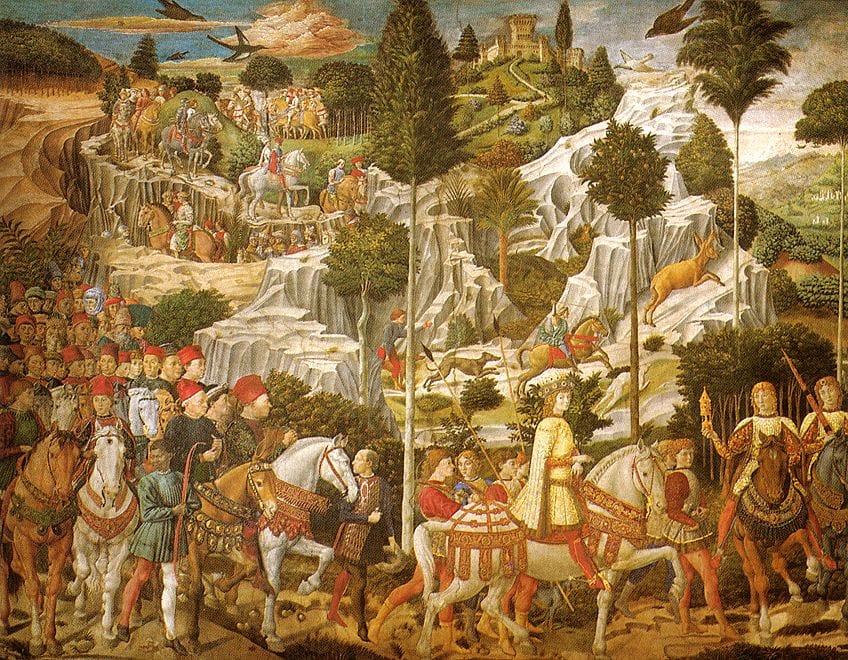
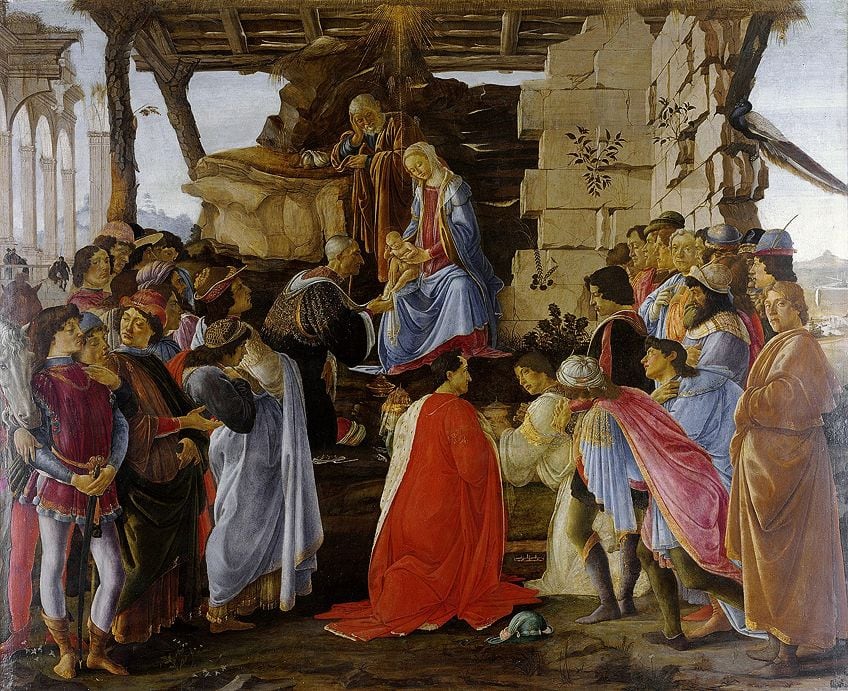
Botticelli’s Adoration of the Magi (1470-1475) was commissioned by Gaspare di Zanobi del Lama for a chapel in Santa Maria Novella. The Uffizi notes that Vasari identified the kneeling Magus with Cosimo de’ Medici; several other portraits have also been associated with the Medici circle, and the figure at far right is traditionally identified as Botticelli. Its crumbling classical architecture joins a Christian Epiphany, contemporary portraiture, and Florentine social memory without making those layers identical.
From the Early to the High Renaissance
The transition to the High Renaissance was gradual rather than a simple upgrade from an unfinished to a perfected style. By the 1490s and early sixteenth century, Leonardo da Vinci, Michelangelo, Raphael, and contemporaries drew on fifteenth-century investigations of perspective, anatomy, classical form, and patronage while pursuing new monumentality and compositional unity. Leonardo’s sfumato, Michelangelo’s powerful bodies, and Raphael’s large, balanced figure groups represent distinct solutions, not one common technique.
Florence remained important, but papal Rome became a major center for large architectural and fresco commissions. Venice and other Italian courts followed different trajectories. Treating the Early Renaissance as a varied field of experiments—rather than merely a prelude to three later masters—makes its paintings, sculptures, buildings, and patronage systems easier to see on their own terms.
Early Renaissance art is best understood through coexistence: religious continuity and classical revival, workshop tradition and mathematical experiment, decorative line and bodily weight, local identities and mobile artists all shaped fifteenth-century Italian visual culture.
Frequently Asked Questions
When Was the Early Renaissance?
The Early Renaissance is generally associated with fifteenth-century Italian art, especially developments from the early 1400s into the 1490s, but its boundaries vary by city, medium, and historian. Quattrocento means the 1400s and is a chronological term rather than the name of one uniform style.
What Are the Main Characteristics of the Early Renaissance?
Early Renaissance art often features more coherent pictorial space, weighty and expressive bodies, observed light, classical forms, and renewed interest in portraiture and the individual. Artists used devices including linear and atmospheric perspective, foreshortening, modeling, chiaroscuro, and trompe l’oeil , but not every work uses every device, and late Gothic conventions continued alongside them.
Who Were Some Famous Early Renaissance Artists?
Major Early Renaissance artists include Masaccio and Fra Angelico in painting, Filippo Brunelleschi and Leon Battista Alberti in architecture and theory, and Donatello and Lorenzo Ghiberti in sculpture. Piero della Francesca, Sandro Botticelli, Fra Filippo Lippi, Paolo Uccello, Luca della Robbia, and Andrea del Verrocchio show the period’s broader regional and stylistic range.
What Were the Main Techniques Used During the Early Renaissance?
Early Renaissance painters used fresco and tempera while refining linear perspective, atmospheric recession, foreshortening, and light-dark modeling to organize bodies and space. Sculptors worked in marble, bronze, wood, and terracotta; Donatello’s extremely shallow rilievo schiacciato created depth with minute changes in relief. Architects adapted classical columns, arches, proportions, and centralized forms to contemporary buildings.

Isabella studied at the University of Cape Town in South Africa and graduated with a Bachelor of Arts majoring in English Literature & Language and Psychology. Throughout her undergraduate years, she took Art History as an additional subject and absolutely loved it. Building on from her art history knowledge that began in high school, art has always been a particular area of fascination for her. From learning about artworks previously unknown to her, or sharpening her existing understanding of specific works, the ability to continue learning within this interesting sphere excites her greatly.
Her focal points of interest in art history encompass profiling specific artists and art movements, as it is these areas where she is able to really dig deep into the rich narrative of the art world. Additionally, she particularly enjoys exploring the different artistic styles of the 20th century, as well as the important impact that female artists have had on the development of art history.
Learn more about Isabella Meyer and the Art in Context Team.
Cite this Article
Isabella, Meyer, “Early Renaissance – Exploring the Early Italian Renaissance Art Period.” Art in Context. June 15, 2021. URL: https://artincontext.org/early-renaissance/
Meyer, I. (2021, 15 June). Early Renaissance – Exploring the Early Italian Renaissance Art Period. Art in Context. https://artincontext.org/early-renaissance/
Meyer, Isabella. “Early Renaissance – Exploring the Early Italian Renaissance Art Period.” Art in Context, June 15, 2021. https://artincontext.org/early-renaissance/.