

Medieval Art – Visual and Literary Arts of the Middle Ages

Medieval art spans roughly a thousand years of visual culture, from the transformation of the Roman world in late antiquity to the Renaissance in different parts of Europe. It is not one movement or a single style. The term covers changing traditions in architecture, painting, sculpture, metalwork, textiles, manuscripts, mosaics, and stained glass across Western Europe and the Byzantine world, with important exchanges involving Islamic and Jewish cultures.
The most useful way to understand Middle Ages art is to ask what an object was made to do, where it was seen, who commissioned it, and how its materials shaped its meaning. This overview explains the main periods, characteristics, media, and landmark works while correcting the idea that medieval artists simply abandoned naturalism or produced only religious images.
What Is Medieval Art?
Medieval art is an umbrella term for art made during the Middle Ages. In Western European art history, the period is commonly placed between about 500 and 1500, but its boundaries vary by region and medium. Italian Renaissance developments appeared before 1500, for example, while Byzantine art continued after the end of the Western Middle Ages and beyond the Ottoman conquest of Constantinople in 1453.

The period grew from several inheritances rather than from one point of origin. Artists and patrons adapted the visual languages of ancient Rome, early Christianity, the Eastern Roman or Byzantine Empire, and regional traditions associated with communities across Europe. Trade, diplomacy, migration, pilgrimage, warfare, and the movement of objects also connected medieval Europe to the Mediterranean, North Africa, and Western Asia.
Medieval art is best understood as a network of regional traditions shaped by function, belief, patronage, material, and place—not as a single movement with one uniform appearance.
Religious institutions were major patrons, and many surviving objects were made for Christian worship. Yet medieval visual culture was not exclusively ecclesiastical. Rulers, aristocrats, merchants, guilds, urban governments, and private households commissioned palaces, tombs, jewelry, textiles, manuscripts, civic buildings, and objects for daily use. Jewish and Islamic makers and patrons likewise contributed to the wider artistic landscape of medieval Europe and the Mediterranean.
Survival can distort our view of the period. Stone buildings, manuscripts kept in treasuries, and objects preserved in churches often outlasted wall paintings, wood, textiles, and ordinary possessions. Precious materials such as gold, silver, ivory, enamel, gems, and silk signaled value, but their importance depended on context: a small reliquary, a monumental portal, and a painted book performed very different kinds of work.
The transition from medieval to Renaissance art was gradual and geographically uneven. Renaissance artists did not simply recover skills that medieval artists had forgotten. Medieval makers repeatedly studied and reinterpreted classical art, and their choices between abstraction, pattern, hierarchy, naturalism, and illusion often served specific devotional, political, or narrative purposes.
A History of Medieval Art
The dissolution of Roman imperial rule in the West during the fifth century changed political institutions, settlement patterns, patronage, and artistic production, but it did not erase Roman culture. The Eastern Roman Empire continued from Constantinople, while rulers, bishops, monasteries, and local communities in the West reused Roman buildings, materials, imagery, and administrative traditions. These overlapping developments make the Middle Ages an especially varied art period .
From the early Middle Ages onward, monasteries and cathedral communities became important centers of book production, metalwork, architecture, and learning. Courts also sponsored workshops and transported artists and luxury objects across long distances. The Carolingian and Ottonian realms deliberately invoked Roman imperial imagery, while Insular art in Britain and Ireland developed striking combinations of interlace, animal ornament, script, and Christian imagery.
During the Romanesque centuries, expanding monastic networks, pilgrimage, urban growth, and elite patronage supported major building programs. In the Gothic period, cathedrals, parish churches, courts, cities, and wealthy lay patrons created new opportunities for architects, masons, sculptors, glass painters, illuminators, goldsmiths, embroiderers, and other specialists.
Christian worship shaped much surviving medieval art, but courts, cities, households, and non-Christian communities also commissioned objects with political, commemorative, civic, literary, and personal functions.
Images could teach, commemorate, focus prayer, proclaim authority, mark sacred space, or organize a complex story. It is misleading, however, to explain medieval images only as substitutes for reading. Literacy varied by place, language, social group, and period, and visual programs—including fresco wall paintings—often addressed audiences who could interpret gestures, saints, heraldry, liturgy, inscriptions, and familiar narratives at several levels.
Manuscripts were copied by hand long before European movable-type printing. Monastic scriptoria were important, but bookmaking increasingly involved cathedral schools, courts, universities, and urban commercial workshops. Text and image were planned together on parchment pages, and books could be practical tools, luxury possessions, devotional objects, or signs of learning and status.
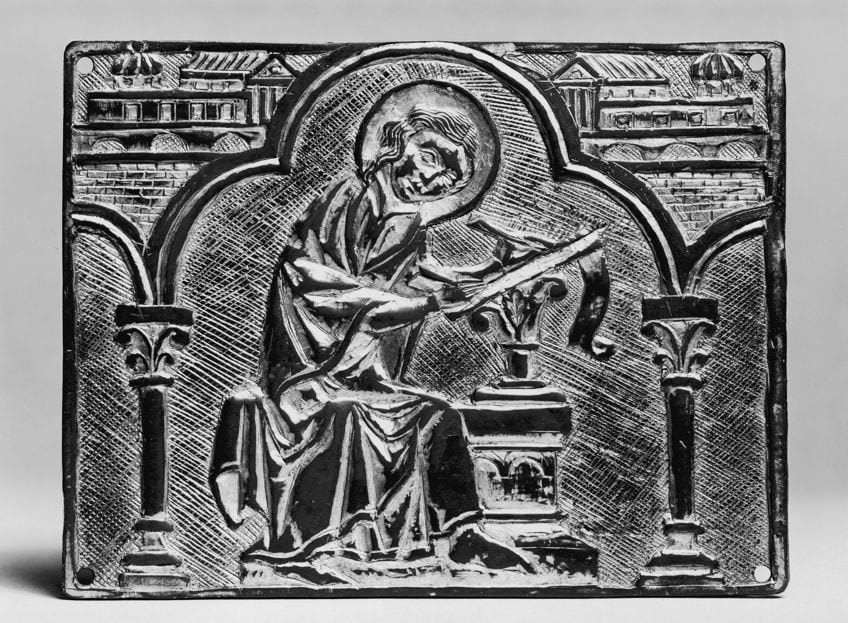
Medieval artists commonly worked within collaborative systems. A patron might define a building or object’s purpose, while designers, master masons, painters, sculptors, metalworkers, carpenters, glaziers, scribes, parchment makers, and assistants contributed specialized labor. Many names were not recorded, but anonymity does not imply a lack of artistic agency or skill.
Early Medieval Art
Early medieval art in Western Europe is generally associated with the fifth through tenth centuries, although period boundaries differ by region. These Medieval artworks developed through the interaction of late Roman and early Christian traditions, Byzantine models, and the visual cultures of peoples who formed new kingdoms in the former Western Roman Empire.
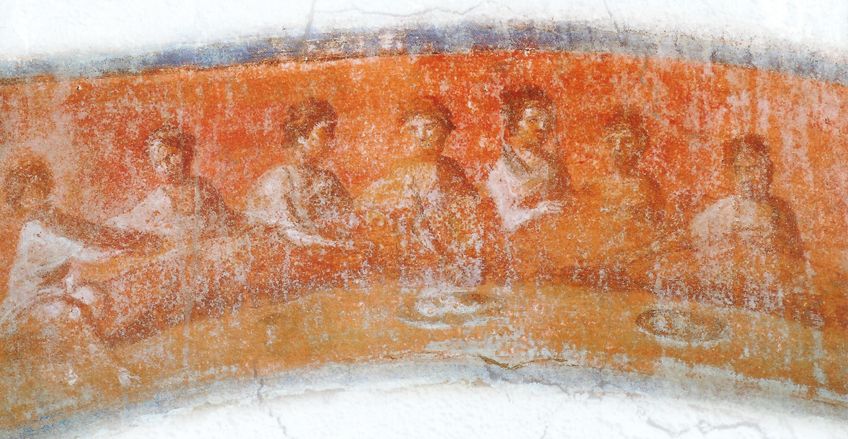
The catacomb fresco below dates from the second to fourth century, so it is late antique rather than early medieval. It remains relevant as a precursor: early Christian artists established subjects, signs, and communal imagery that later medieval makers reworked in churches, manuscripts, mosaics, and portable objects.
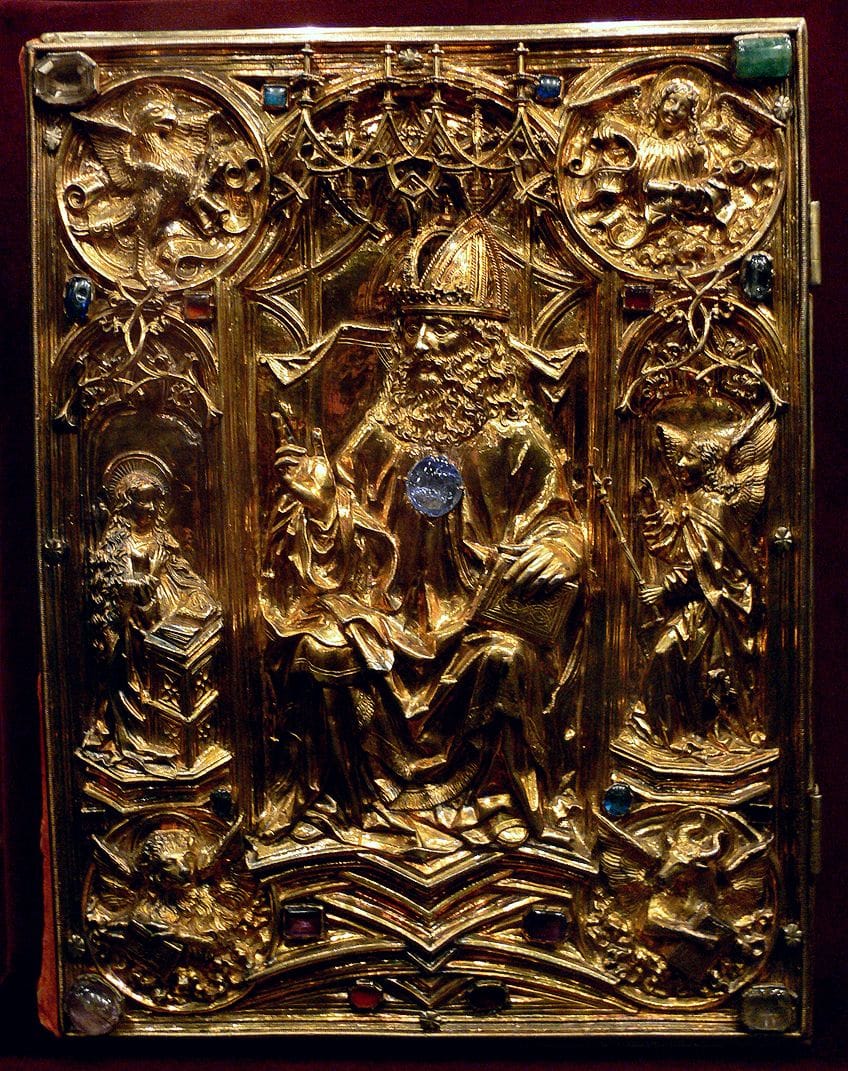
Portable works are especially important for the early medieval period. Metal fittings, jewelry, weapons, reliquaries, carved ivory panels, and decorated books could travel with rulers, clerics, diplomats, and pilgrims. Their ornament ranges from interlaced animals and geometric pattern to imperial portraits and Christian narrative scenes.
Roman mosaics and frescoes also continued, especially in Italy and the Byzantine world. Their degree of naturalism varies greatly. A frontal figure, gold ground, compressed space, or enlarged sacred person was not necessarily a failed attempt at realism; such choices could establish hierarchy, timelessness, visibility, or devotional focus.
The photograph below shows Siena Cathedral, a later medieval building with interiors altered and enriched over subsequent centuries. It should not be read as evidence for an early medieval fresco program.
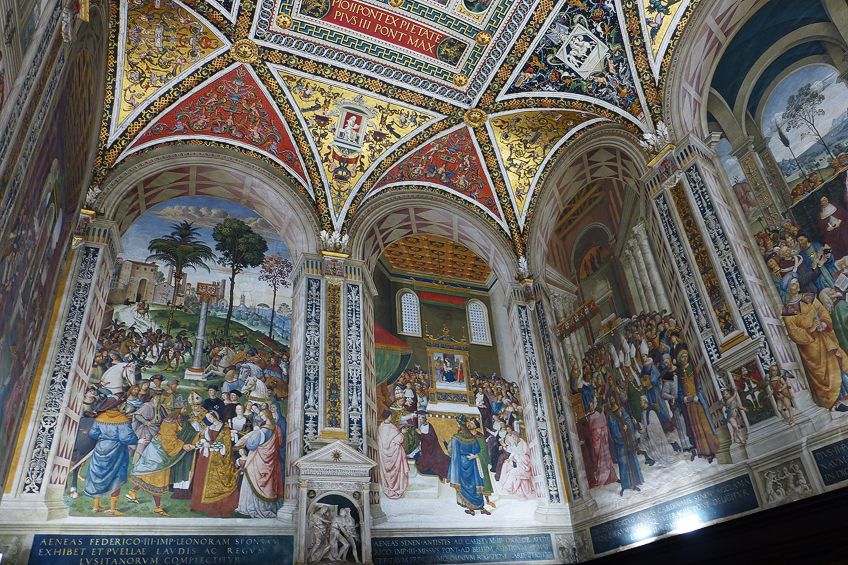
Early medieval art preserved and transformed older forms while developing new regional combinations of script, ornament, image, material, and ritual function.
Main Divisions of Middle Ages Art
No four-part scheme can represent every region, but Early Christian, Byzantine, Romanesque, and Gothic art provide a useful orientation. Early Christian art is primarily a late antique foundation; Byzantine art follows the Eastern Roman tradition; and Romanesque and Gothic are conventional labels for broad, overlapping developments in medieval Western Europe.
Early Christian Art and Late Antiquity
Early Christian art emerged within the Roman world, especially from the third century onward, before the conventional beginning of the Western Middle Ages. After Christianity gained imperial support in the fourth century, patrons adapted Roman basilicas for worship and developed baptisteries, mausoleums, mosaics, sarcophagi, and illustrated books.
Surviving catacomb paintings are only one part of this history. Churches in Rome, Ravenna, and other Mediterranean centers preserve evidence for monumental programs, while small objects and manuscripts show how biblical narratives, symbols, portraits, and imperial visual conventions were reinterpreted in Christian artworks.
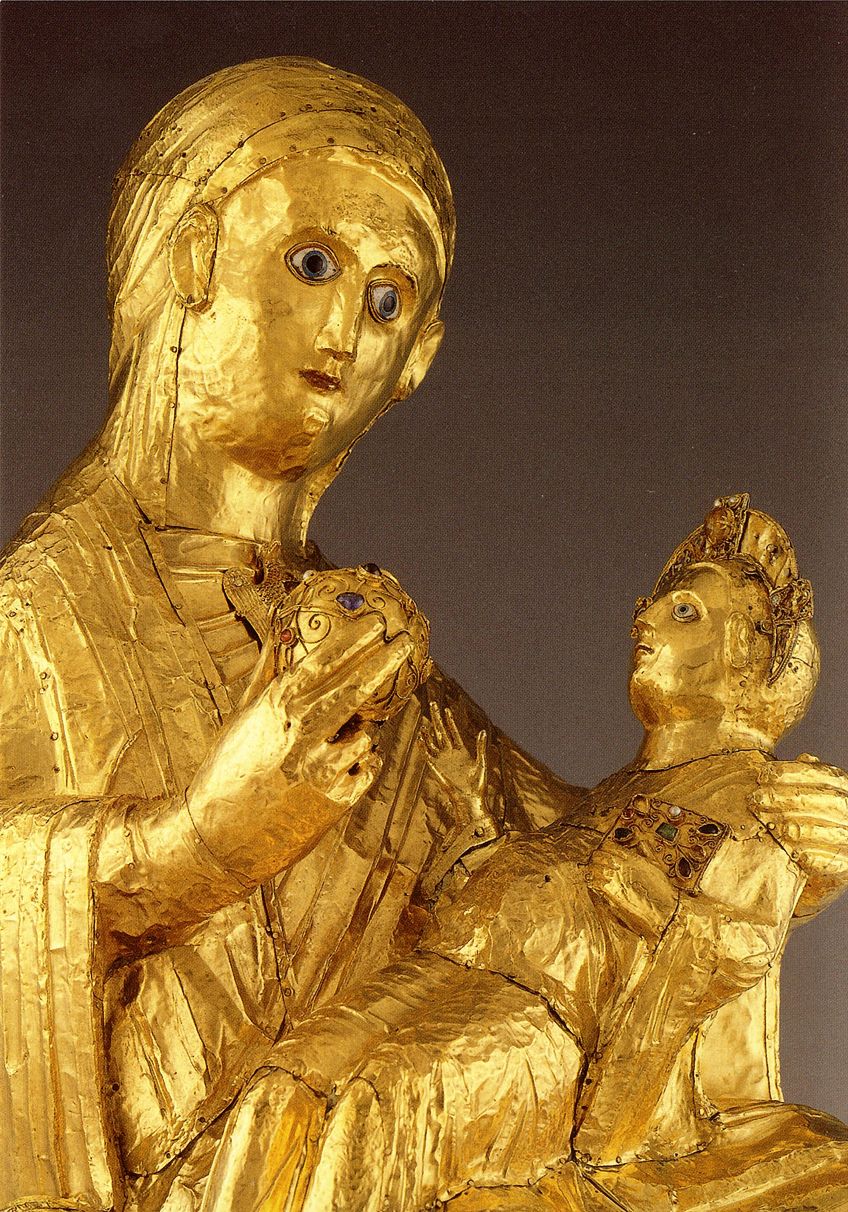
The Golden Madonna of Essen was made around 980–990 and belongs to Ottonian art, not the Early Christian period. Its wooden core covered in gold sheet nevertheless demonstrates how early medieval patrons continued to connect precious material, sacred presence, and inherited Christian iconography.
Byzantine Art
Byzantine art developed in the Eastern Roman Empire, whose capital was Constantinople. Its chronology extends from late antiquity through the empire’s fall in 1453, and related Orthodox traditions continued beyond that date. Mosaics, icons, manuscripts, ivories, metalwork, textiles, and churches combined classical inheritance with changing theological and courtly priorities.
Byzantine representation was not defined by a “complete lack of realism.” Some works use modeled bodies and spatial suggestions; others emphasize frontal poses, gold grounds, repeated types, and carefully controlled gestures. These conventions helped communicate sacred authority and continuity. The history of Byzantine images also includes periods of iconoclasm and later restoration of icon veneration.
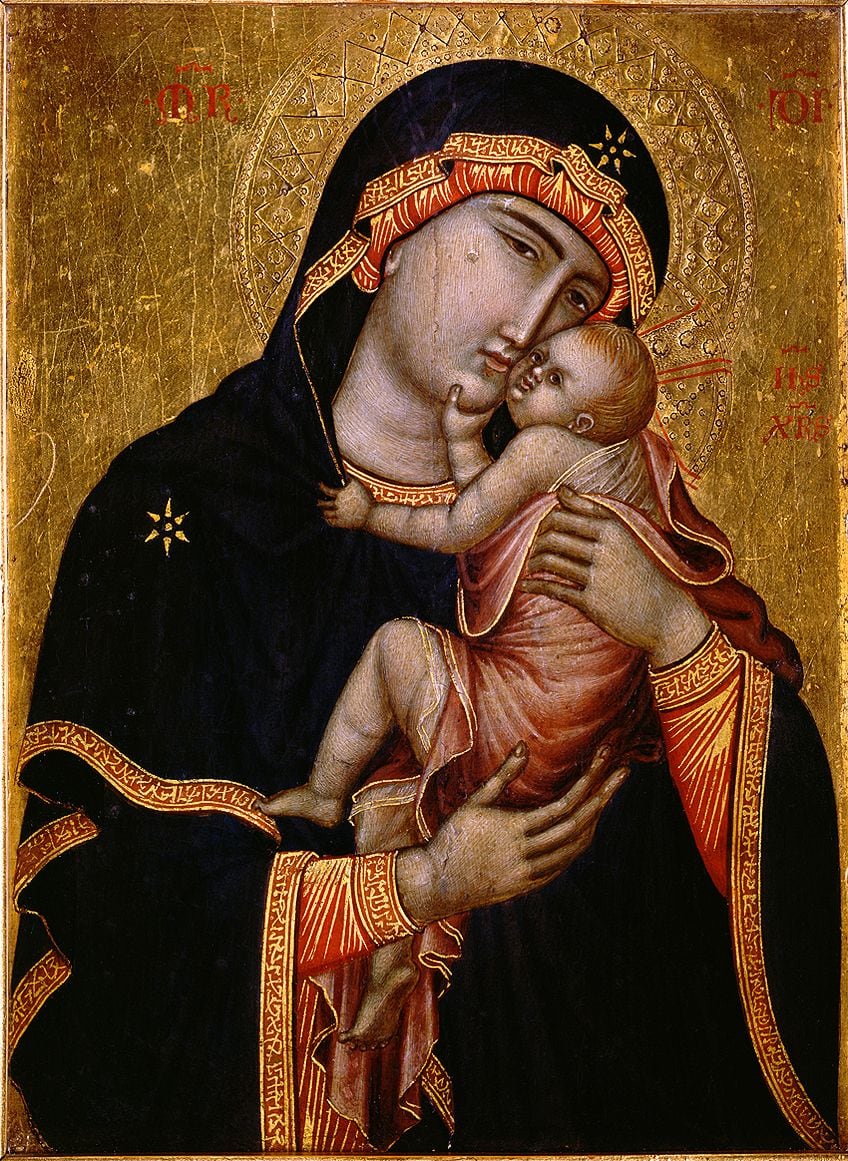
The Cambrai Madonna is a fourteenth-century Italo-Byzantine image that reached northern Europe rather than a work made in Constantinople. Its reception shows how Byzantine icon types circulated, acquired new devotional meanings, and influenced Western artists.
Byzantine art was an evolving Eastern Roman tradition whose images, materials, and architectural ideas circulated widely across the medieval Mediterranean and Europe.
Romanesque Art
Romanesque art is a modern label for interconnected developments across much of Western Europe from about 1000 into the twelfth century, with regional variations and later survivals. The term points to renewed use of round arches, barrel and groin vaults, massive masonry, and other forms associated with Roman architecture, but Romanesque art was not a simple copy of ancient Rome.
Monastic reform, pilgrimage, ecclesiastical competition, court patronage, and growing towns supported major churches and their sculpted portals, capitals, frescoes, metalwork, and books. Romanesque imagery often uses compressed space, emphatic gesture, and hierarchical scale to make narratives legible in architectural settings.
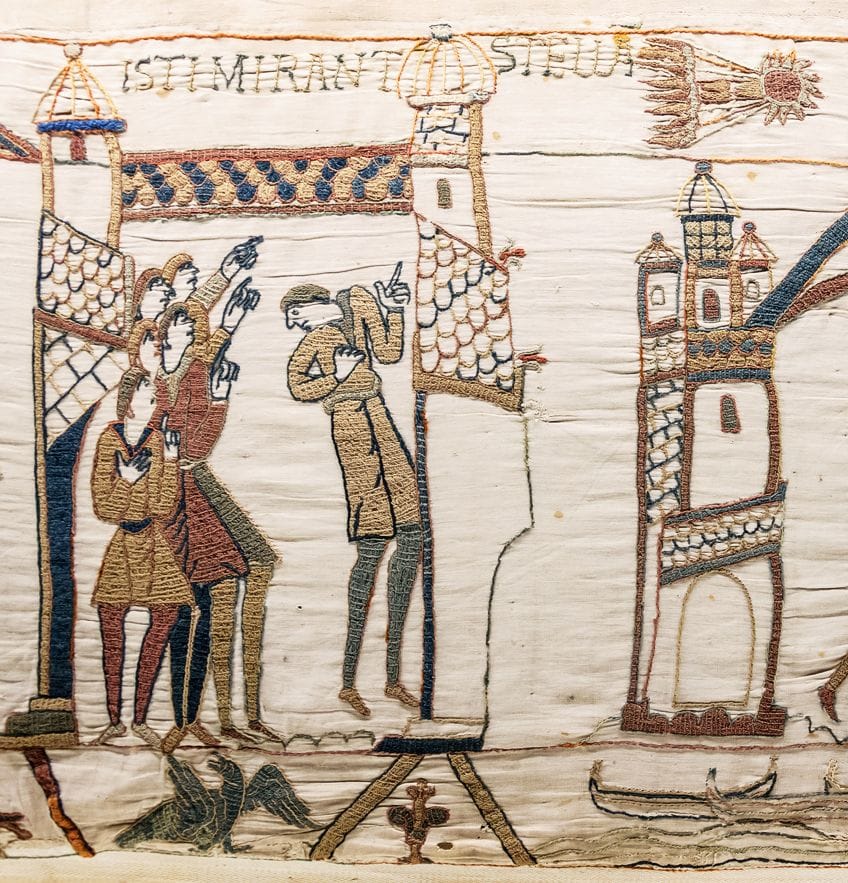
The embroidered Bayeux Tapestry combines text and sequential images to narrate the Norman conquest of England. Although commonly called a tapestry, it is wool embroidery on linen. Its political story, border imagery, ships, clothing, weapons, and depiction of Halley’s Comet make it a major record of eleventh-century visual culture.
Gothic Art
Gothic art began in the Île-de-France in the mid-twelfth century and spread through regional adaptations across Europe. In architecture, pointed arches, rib vaults, buttressing systems, and coordinated masonry could open walls for larger windows and create taller interiors. These features developed over time rather than appearing all at once.
Gothic art remained deeply religious, even as courtly, civic, domestic, and literary commissions expanded. Sculpture became increasingly responsive to the body, drapery, movement, and emotion in many centers, while manuscript painting, panel painting, ivory carving, goldsmith work, and textiles cultivated both sacred and secular subjects.
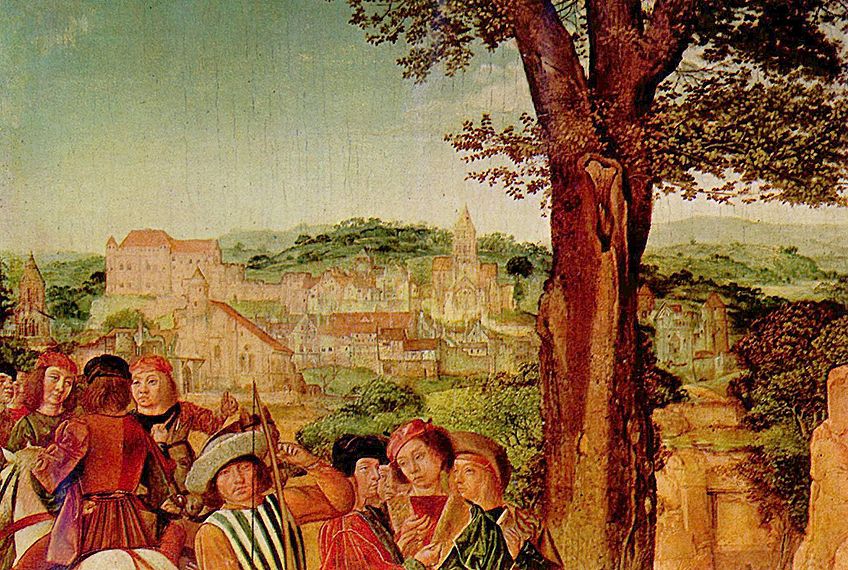
The image above is a late Gothic work near the conventional boundary with the Renaissance. Its careful observation of setting and costume demonstrates why a simple opposition between “flat medieval art” and “realistic Renaissance art” is historically misleading.
Medieval Architecture
Medieval architecture was a collaborative art that organized worship, government, defense, trade, residence, memory, and civic identity. Medieval buildings included churches, monasteries, synagogues, mosques, castles, palaces, bridges, halls, hospitals, universities, and domestic structures. Churches dominate many surveys because so many survive and because their decoration coordinated sculpture, painting, metalwork, textiles, stained glass, and ritual performance.
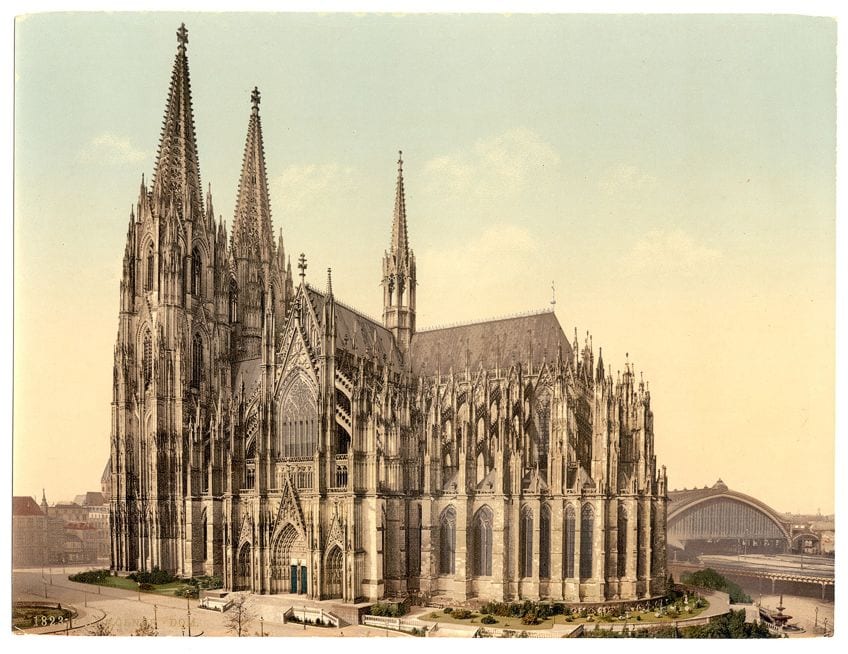
Patrons and clergy established needs and resources, while master masons and specialized workshops solved problems of structure, material, light, acoustics, circulation, and imagery. Construction could continue for generations, so a single building may combine Romanesque, Gothic, Renaissance, and later restoration campaigns.
Romanesque churches often emphasize thick masonry, rounded arches, and clearly articulated bays. Gothic builders developed pointed arches, rib vaults, and forms of buttressing that could redirect loads and support larger windows. These are broad tendencies, not a checklist that identifies every building, and regional materials and workshop traditions produced substantial variation.
A medieval building is rarely the product of one moment: its fabric can preserve successive campaigns, changing rituals, repairs, political ambitions, and modern restorations.
Characteristics and Media of Medieval Art
There is no universal medieval “look.” A Byzantine icon, an Insular gospel book, a Romanesque portal, a Gothic ivory, and a courtly tapestry can differ sharply. Instead of relying on flatness or religious subject matter alone, use this recognition framework:
- Function: Was the work made for worship, devotion, commemoration, government, display, storytelling, or daily use?
- Setting: How would a church, court, city, household, tomb, or book page shape its scale and visibility?
- Material: What did stone, wood, parchment, gold, ivory, silk, wool, glass, or pigment communicate?
- Visual system: Does the work use hierarchy, pattern, inscription, heraldry, narrative sequence, naturalism, or symbolic color?
- Context: Which region, community, date, and artistic tradition provide the closest comparison?
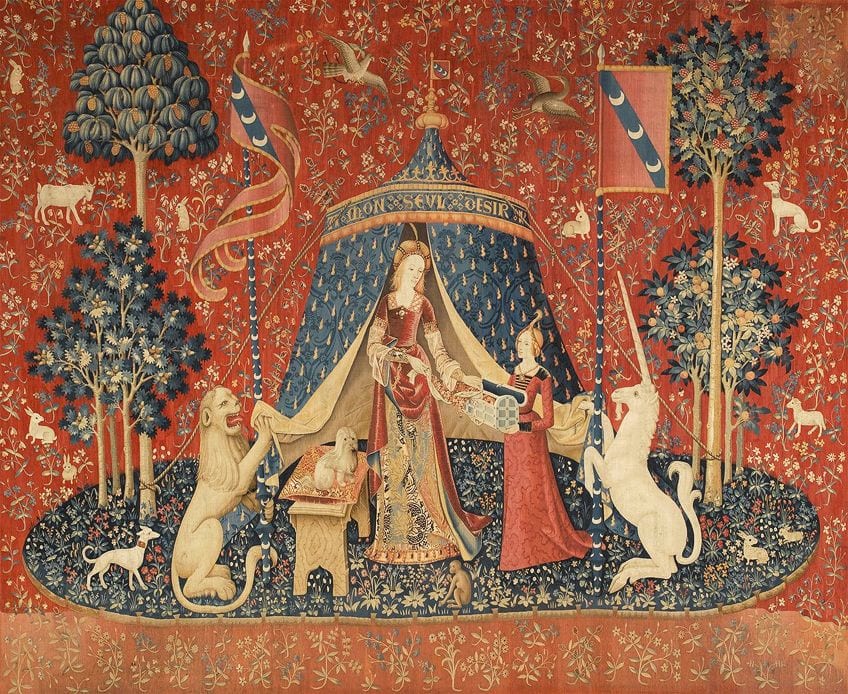
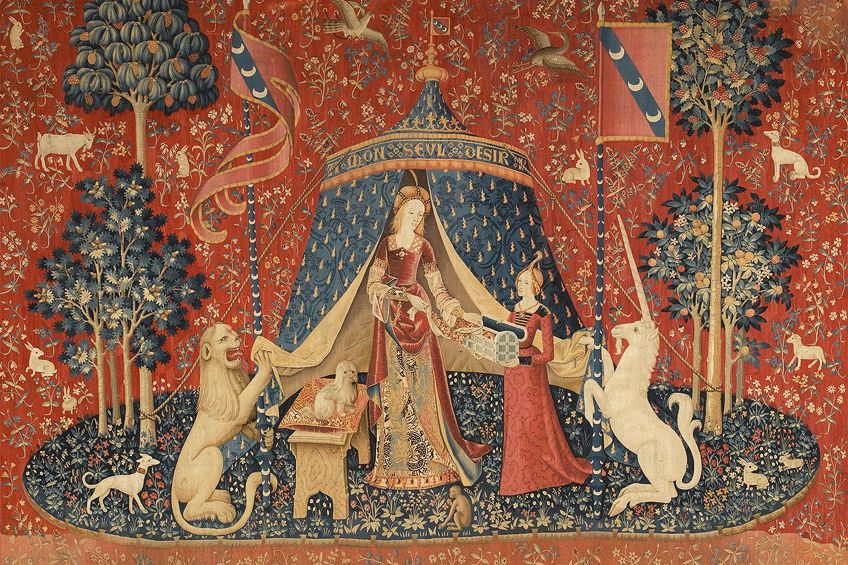
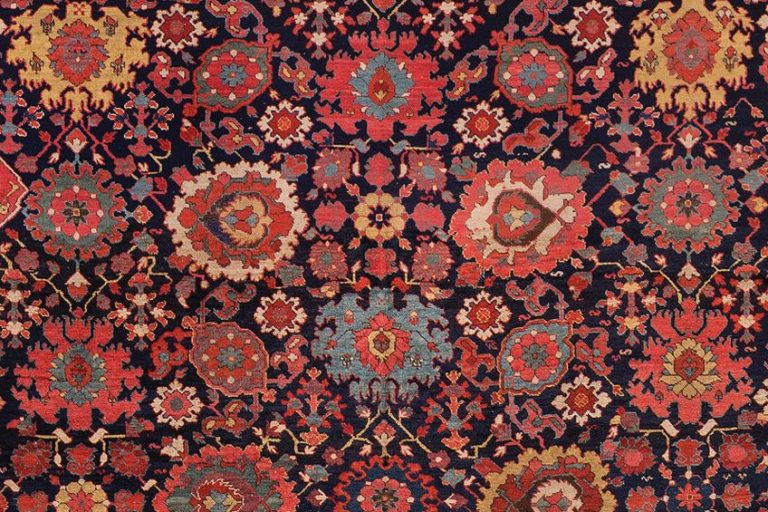
The Lady and the Unicorn cycle brings several of these questions together. Its luxury wool-and-silk medium, heraldry, courtly dress, animals, flowers, and enigmatic inscriptions belong to a late medieval elite setting. Its imagery has been interpreted through the five senses and a sixth scene commonly associated with desire or free will.
Medieval Paintings
Medieval painting includes wall frescoes, mosaics, icons, manuscript illumination, and painted panels. Styles range from highly patterned and hieratic to strongly modeled and spatially suggestive. Religious narratives were prominent, but portraits, histories, romances, allegories, animals, calendars, labor, and courtly life also appeared.
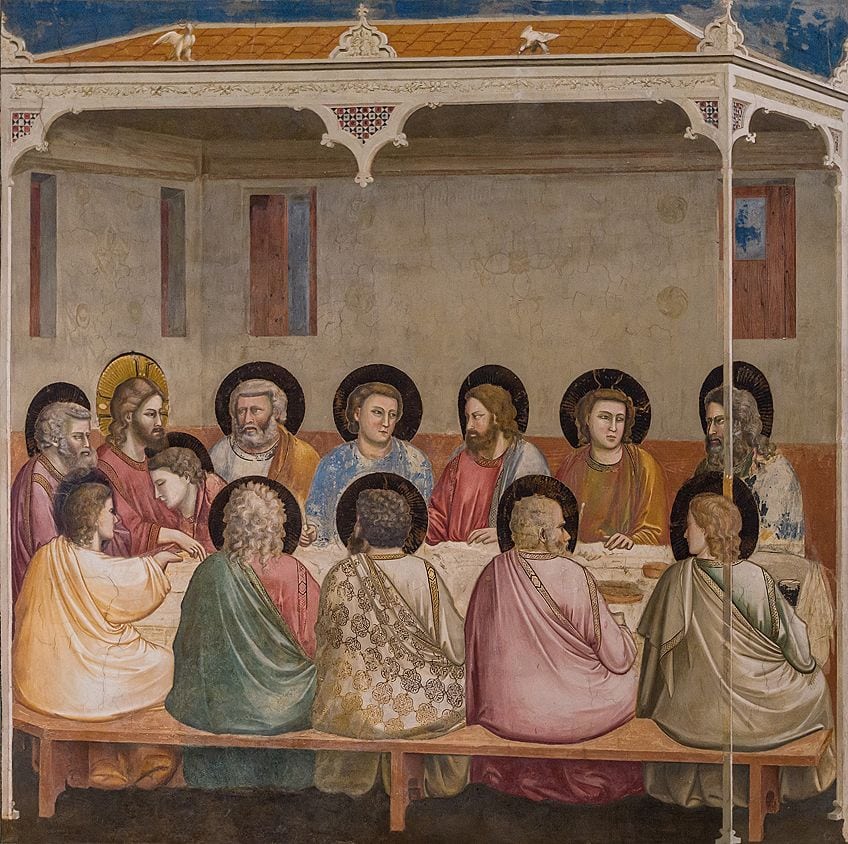
Giotto di Bondone’s Last Supper in the Scrovegni Chapel belongs to a fresco cycle painted in the early fourteenth century. Its figures occupy a constructed interior and communicate through gesture, gaze, and grouping. This naturalistic emphasis was innovative in its setting, but it emerged from medieval workshop practice and religious narrative rather than from a sudden recovery after centuries without observation.
Medieval Sculptures
Medieval sculpture ranged from monumental stone portals and tombs to wooden cult figures, bronze doors, metal reliquaries, and small ivory devotional objects. The many types of sculpture depended on placement: a column figure viewed from below required different proportions from an ivory held in the hand.
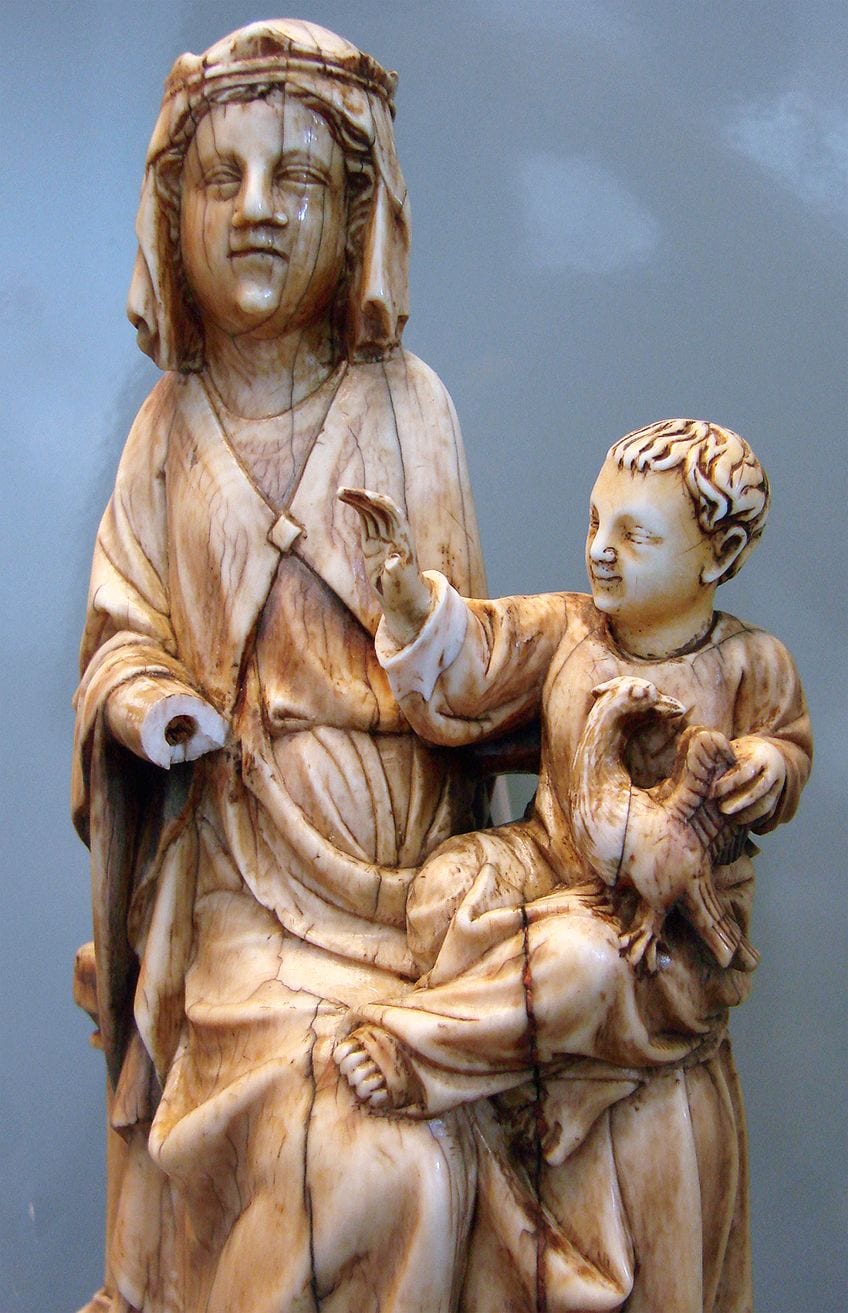
Stylization and naturalism coexisted throughout the period. Romanesque sculptors often adapted bodies to architectural frames and used emphatic gestures for narrative clarity. Gothic sculptors in many regions explored weight shift, facial expression, deep drapery, and intimate interaction, as seen in numerous images of the Virgin and Child.
Scale did not map neatly onto wealth. Monumental tombs and portals required substantial resources, but small ivories, gems, and metal objects could also be extraordinarily costly because of rare materials and specialized labor.
Illuminated Manuscripts
Illuminated manuscripts combine handwritten text with painted or drawn decoration. Parchment was made from prepared animal skin rather than paper in most European luxury books. Production could involve a patron, scribe, rubricator, illuminator, binder, and specialists who prepared parchment, pigments, gold leaf, and other materials.
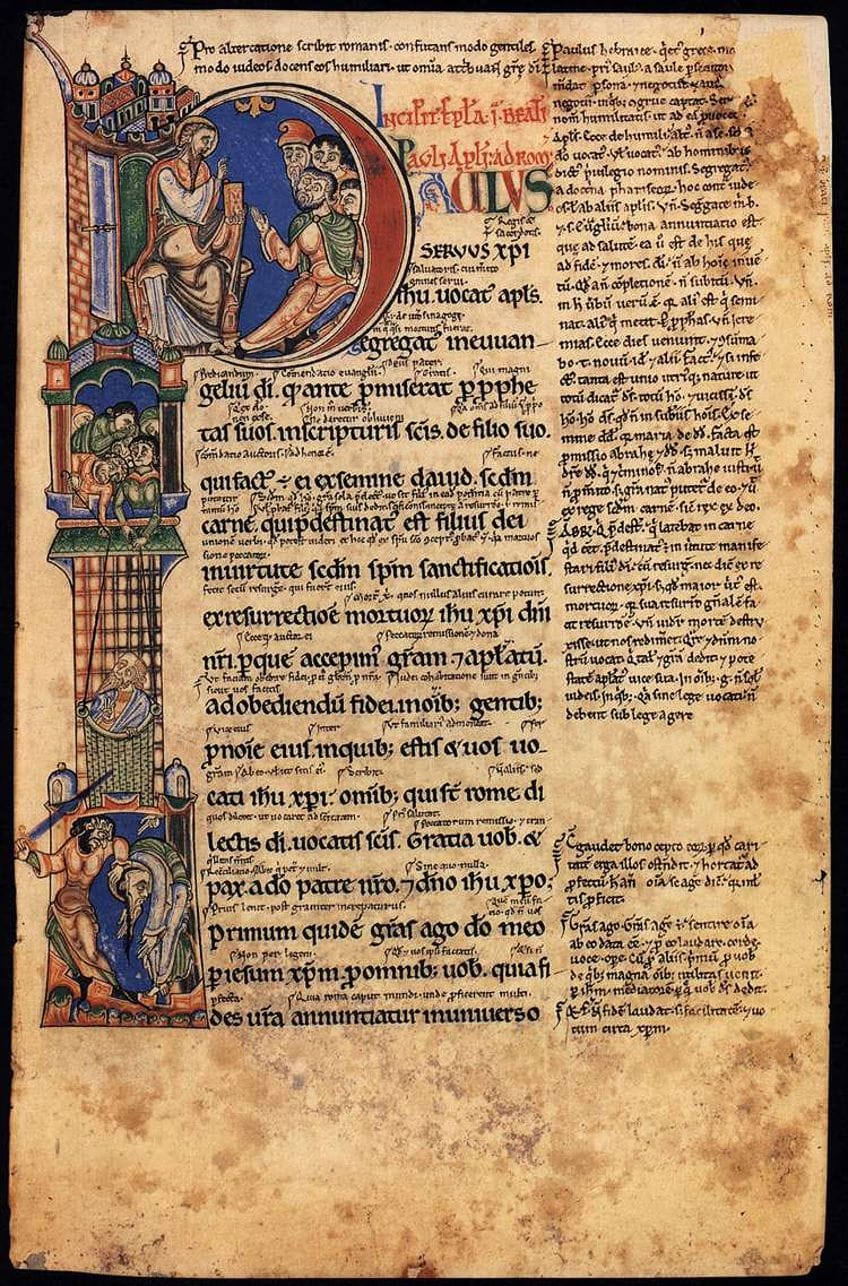
Design began before decoration. Scribes ruled pages, established text columns, and left spaces for initials and pictures. Gold leaf or powdered gold could be applied alongside mineral, plant, and manufactured pigments. Marginal notes, glosses, diagrams, calendars, and images helped readers navigate, interpret, and use a book.
A historiated initial contains a recognizable figure or scene inside an enlarged letter. Other initials may be inhabited by figures or animals, decorated with foliage, or built from interlace. These devices did more than embellish a page: they marked divisions, guided reading, and connected text with interpretation.
Stained Glass
Medieval stained glass was assembled from pieces of colored and clear glass cut to a design and joined with lead cames. Color could be produced in the glass using metallic compounds, while details such as faces, folds, and inscriptions were painted with vitreous paint and fired. Panels were then reinforced and installed within a window opening.
Large windows could organize biblical narratives, saints’ lives, donor portraits, trades, heraldry, and ornamental pattern across multiple panels. Their appearance changed with daylight, viewing distance, repairs, and later rearrangements. Stained glass therefore worked as architecture, image, colored light, and material display at once.
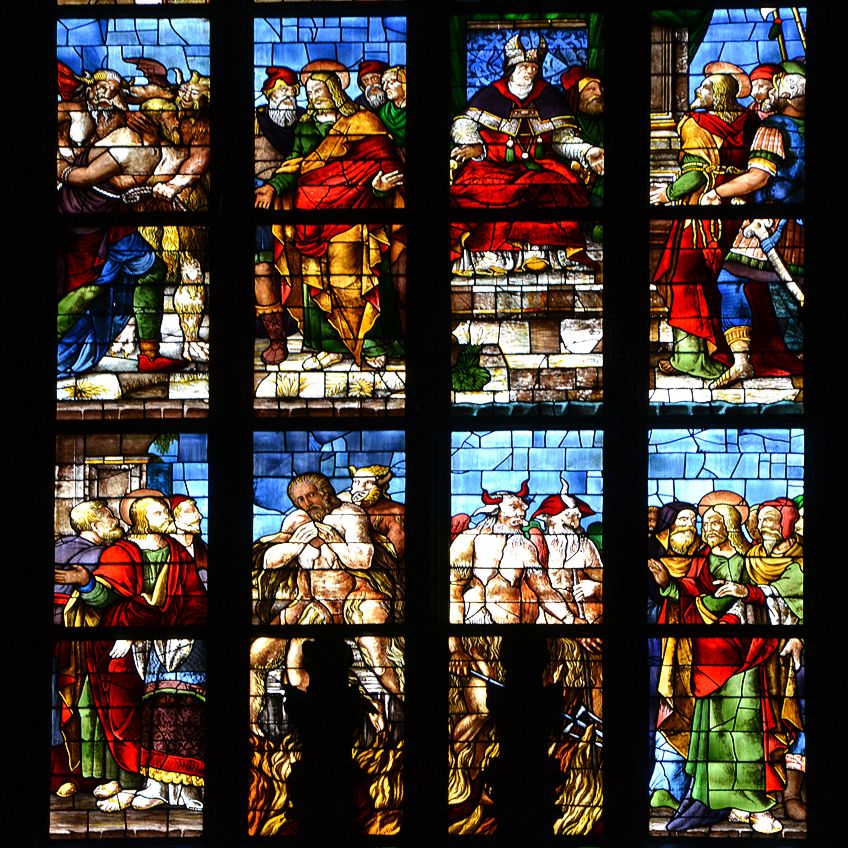
The window pictured above dates from 1554–1564 and is therefore Renaissance rather than medieval. It demonstrates the continuation of stained-glass techniques at Milan Cathedral, but a medieval example would be more appropriate for this section.
Famous Medieval Artworks and Monuments
Famous medieval works survive because buildings and objects were maintained, altered, treasured, collected, excavated, or restored. Their present condition is part of their history. The following examples represent different media and traditions rather than a ranked list of the period’s “best” works.
Hagia Sophia (Built 532–537)
Emperor Justinian I commissioned Hagia Sophia in Constantinople after an earlier church was destroyed during the Nika revolt. Designed by Anthemius of Tralles and Isidore of Miletus and completed in 537, the building joined a vast central dome to a longitudinal basilica. Its structure, marble revetment, light, and mosaics made it a central monument of Byzantine architecture.
After the Ottoman conquest in 1453, Hagia Sophia became a mosque and acquired minarets and other Ottoman additions. It operated as a museum from 1935 until 2020, when it was reconverted for use as a mosque. It remains open as the Hagia Sophia Grand Mosque while also forming part of the UNESCO-listed Historic Areas of Istanbul.
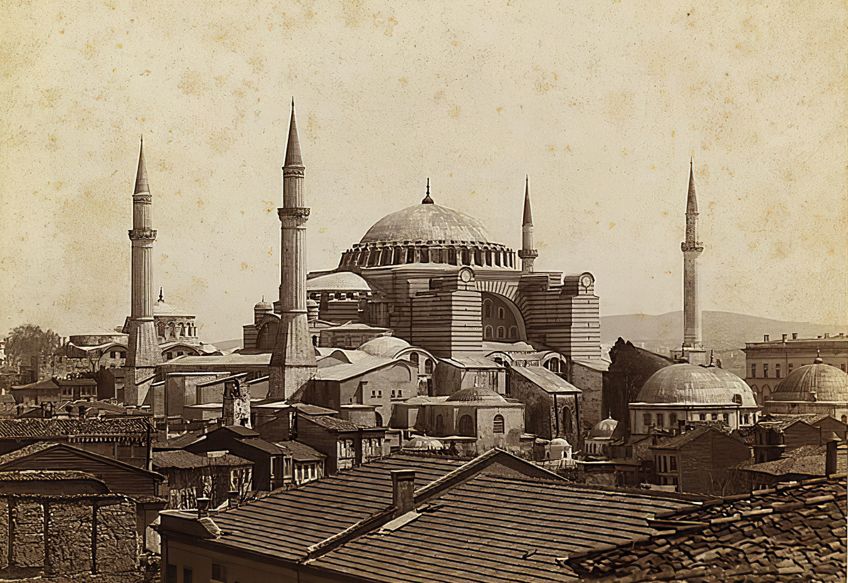
The building influenced religious architecture across Eastern Christianity and the Ottoman world, although calling it the first church with a “fully penetrative dome” is inaccurate. Its achievement lies in the ambitious integration of piers, arches, pendentives, semi-domes, and a dome that appears visually light despite the enormous structural forces involved.
The Lindisfarne Gospels (Made c. 700)
The Lindisfarne Gospels is an illuminated Gospel book made in Northumbria around 700. A later colophon attributes its production to Eadfrith, bishop of Lindisfarne. The manuscript contains the four Gospels in Latin and combines Mediterranean book traditions with Insular interlace, animal ornament, cross-carpet pages, and elaborately constructed initials.
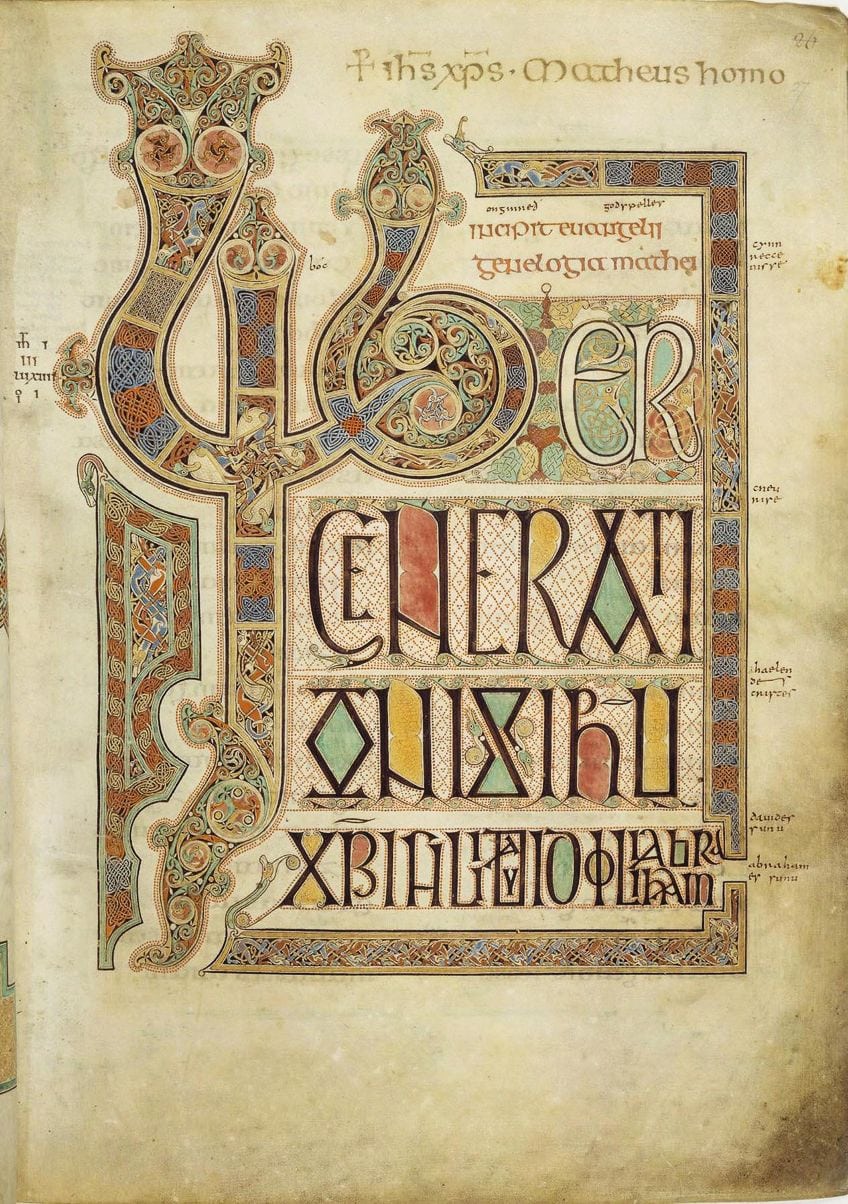
Its text follows the Latin Vulgate tradition associated with Jerome. An Old English gloss added in the tenth century by Aldred is the earliest surviving translation of the Gospels into English. The original jeweled binding was lost; the present binding is nineteenth-century, so it should not be described as the manuscript’s surviving medieval cover.
Palatine Chapel at Aachen (Built c. 790–800)
Charlemagne’s Palatine Chapel was built at Aachen around 790–800 and consecrated in 805. Its octagonal core, surrounding ambulatory, upper gallery, dome, and reused columns drew on classical, Byzantine, and Roman period of art precedents while serving a new Carolingian imperial setting. Later additions transformed the chapel into the complex now known as Aachen Cathedral.
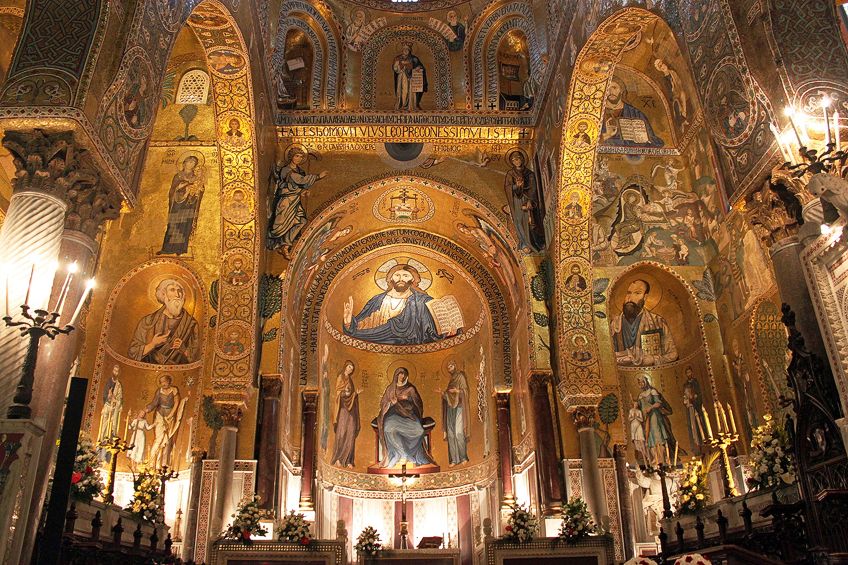
The photograph above does not show the Palatine Chapel at Aachen. It shows the twelfth-century Cappella Palatina in Palermo, Sicily, a different royal chapel renowned for its Norman, Byzantine, and Islamic artistic synthesis. The image should be replaced with a verified view of Aachen Cathedral’s Carolingian core.
Aachen Cathedral was the first German property inscribed on the UNESCO World Heritage List, in 1978. The designation applies to the cathedral, including the Carolingian chapel and later additions, rather than to a separate surviving palace complex.
Notre-Dame de Paris (Begun in the 1160s)
Construction of Notre-Dame de Paris, one of the most influential Gothic cathedrals, began in the 1160s and continued through major campaigns into the following centuries. Its choir, nave, west façade, portals, sculpture, rose windows, rib vaults, and flying buttresses document the development of Gothic architecture. Later alterations and Eugène Viollet-le-Duc’s nineteenth-century restoration also shaped the building known today.
The cathedral is part of the UNESCO World Heritage property Paris, Banks of the Seine, inscribed in 1991; it is not a stand-alone World Heritage listing. The building remains a Catholic cathedral dedicated to the Virgin Mary and a working place of worship as well as a major historical monument.
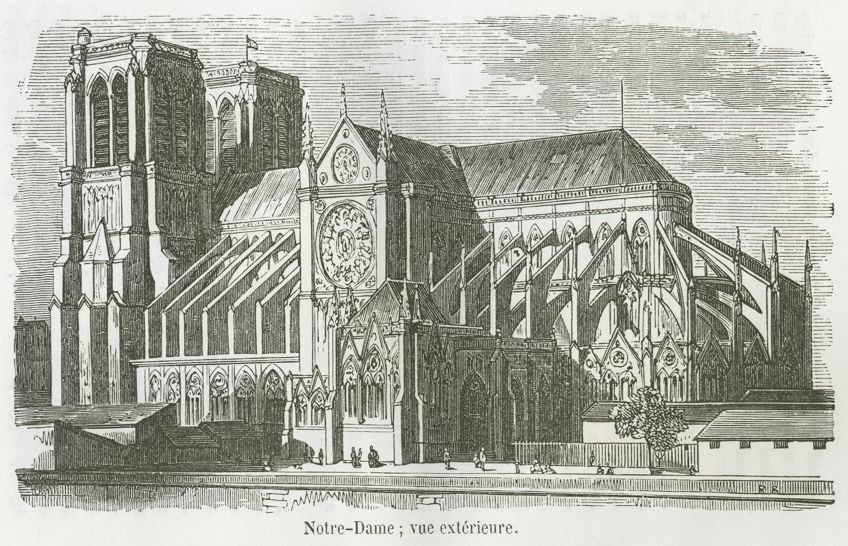
The fire of April 15, 2019 destroyed the timber roof and spire and damaged vaulting, but the main structure, towers, and much of the art were saved. After five years of restoration, Notre-Dame reopened in ceremonies held on December 7 and 8, 2024. Restoration and conservation remain part of its continuing history.
Medieval Books and Literary Culture
Literary culture in the Middle Ages was multilingual and extended beyond monasteries. Clerics and monastic communities copied scripture, theology, saints’ lives, histories, law, science, and classical texts, while courts, universities, and urban workshops supported works in Latin and vernacular languages. Reading could be private or communal, silent or spoken aloud, and many stories circulated orally as well as in manuscripts.
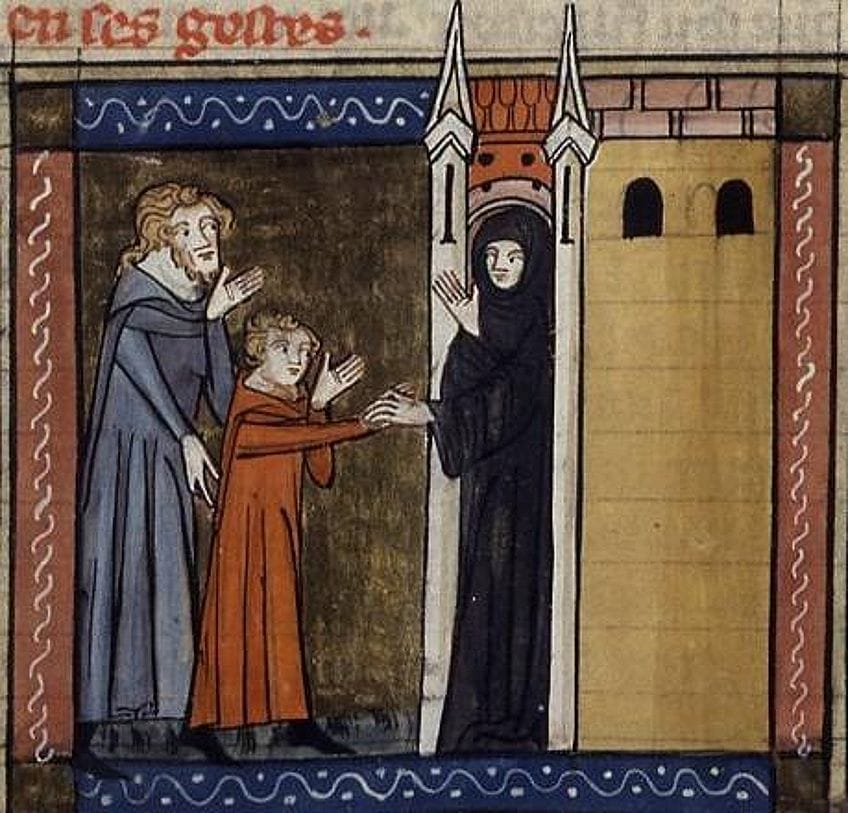
Jacobus de Voragine compiled the Golden Legend in the thirteenth century. Its accounts of saints circulated widely in Latin and vernacular versions, and illustrated copies connected written narratives with the visual attributes by which audiences recognized individual saints.
Secular and religious categories frequently overlap. Dante Alighieri’s Divine Comedy is a vernacular poem structured by Christian cosmology, while Geoffrey Chaucer’s Canterbury Tales combines pilgrimage with social observation and varied literary genres. Courtly romances, chronicles, bestiaries, medical texts, legal books, and poetry all generated distinctive relationships between words and images.
Medieval art was neither a uniform style nor a dark interval between antiquity and the Renaissance. It was a diverse visual culture in which materials, images, buildings, and books made belief, power, memory, knowledge, and social identity visible.
Take a look at our Middle Ages art webstory here!

Isabella studied at the University of Cape Town in South Africa and graduated with a Bachelor of Arts majoring in English Literature & Language and Psychology. Throughout her undergraduate years, she took Art History as an additional subject and absolutely loved it. Building on from her art history knowledge that began in high school, art has always been a particular area of fascination for her. From learning about artworks previously unknown to her, or sharpening her existing understanding of specific works, the ability to continue learning within this interesting sphere excites her greatly.
Her focal points of interest in art history encompass profiling specific artists and art movements, as it is these areas where she is able to really dig deep into the rich narrative of the art world. Additionally, she particularly enjoys exploring the different artistic styles of the 20th century, as well as the important impact that female artists have had on the development of art history.
Learn more about Isabella Meyer and the Art in Context Team.
Cite this Article
Isabella, Meyer, “Medieval Art – Visual and Literary Arts of the Middle Ages.” Art in Context. June 8, 2021. URL: https://artincontext.org/medieval-art/
Meyer, I. (2021, 8 June). Medieval Art – Visual and Literary Arts of the Middle Ages. Art in Context. https://artincontext.org/medieval-art/
Meyer, Isabella. “Medieval Art – Visual and Literary Arts of the Middle Ages.” Art in Context, June 8, 2021. https://artincontext.org/medieval-art/.


Take a look at Emperor Leo VI (886–912) adoring Jesus Christ. Imperial Gate mosaic in Hagia Sophia.
Even though mosaic art is a more difficult medium, Jesus feet and knees are more prominent because they are closer. His clothing has a plethora of shadows. His blessing hand, face and neck have the depth with shadows. His face is as realistic as any art work. Emperor Leo VI’s expression is that of a supplicant. The only thing that they had not mastered is perspective as attempted in the throne.