

Expressionism Art – A History of the Expressionist Movement

Expressionism is a broad modernist tendency that favors emotional and psychological intensity over descriptive accuracy. It flourished internationally in the early 20th century, especially in Germany and Austria between about 1905 and 1920, and reached painting, printmaking, sculpture, architecture, literature, theater, dance, and film. German Expressionism is its best-known historical center rather than a separate “niche”: groups such as Die Brücke in Dresden and Der Blaue Reiter in Munich used distortion, non-naturalistic color, angular form, and experimental technique for sharply different artistic aims. This guide explains how to recognize Expressionism, where it came from, and how its major artists and works fit together.
An Introduction to Expressionism Art
The formation of Die Brücke in Dresden in 1905 is often used as a starting point for German Expressionism, although expressive approaches appeared earlier and developed across several European centers. This avant-garde movement used exaggeration and distortion to convey modern life as it was felt rather than simply as it looked. Expressionism remained influential through the First World War and into the Weimar period; its prewar groups dissolved, but the broader movement did not end neatly in 1920. In addition to painting, it transformed printmaking, sculpture, architecture, literature, theater, dance, and cinema.
As a modernist movement, Expressionism developed during rapid industrialization, urban growth, political tension, and changing attitudes toward sexuality and the individual. These conditions did not produce a single shared ideology, but they gave many German artists urgent subjects: metropolitan crowds, alienation, nightlife, intimacy, spirituality, nature, war, and social conflict.
New technologies and expanding cities altered how people worked, traveled, communicated, and encountered one another. Expressionist artists answered those changes with compressed spaces, unstable viewpoints, and bodies that seem tense, exposed, or estranged.
These vivid emotions began filtering into art production at the time, as artists expressed their anxieties through a heightened use of color, jagged angles, flattened forms, and heavily distorted figures.
As the First World War approached, grotesque and fractured imagery became more prominent. Printmaking was central, not secondary: woodcuts, lithographs, and etchings offered direct marks, strong contrasts, and a practical means of circulating manifestos, portfolios, and political images to wider audiences.
Some Expressionist artists, including Franz Marc and August Macke, initially imagined war as a force that might overturn a materialistic social order; others did not share that enthusiasm. Military service, death, injury, bereavement, and political collapse soon made triumphalist ideas untenable for many artists. The art of the war and postwar years records trauma and disillusionment in sharply individual ways.
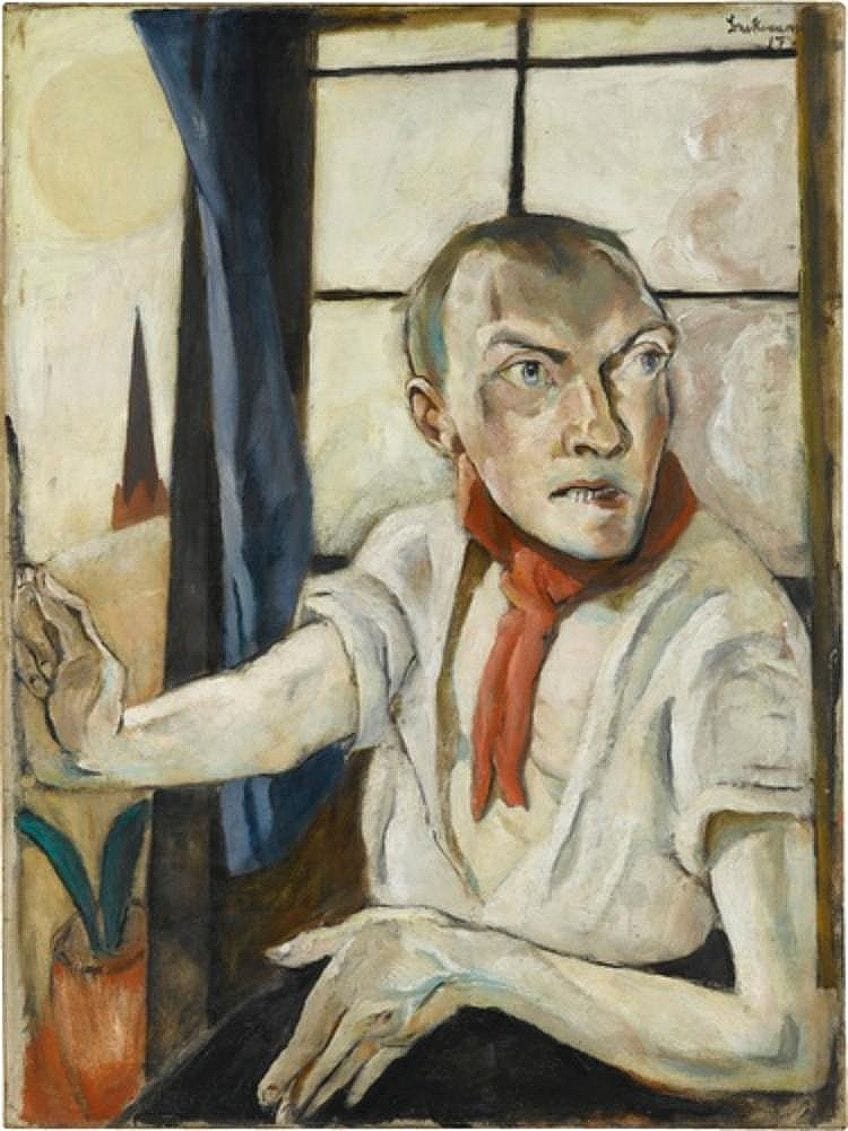
Expressionist works therefore do not provide a neutral record of the battlefield or the modern city. Their distortions are interpretive devices: a stretched face, acid color, or splintered street can communicate fear, grief, desire, revulsion, or spiritual aspiration more forcefully than literal description.
In their quest for authenticity, Expressionist painters depicted the world exactly as it felt rather than how it looked, taking inspiration from the bold, vibrant, and introspective paintings that were created in the Post-Impressionist era. Artists dismissed the predominant stylistic conventions that had dictated visual creation at the turn of the 20th century in an attempt to reinvigorate art with conviction and an expressive force.
Precursors of the Expressionism Movement
Expressionism drew on the emotionally charged work of Edvard Munch, Vincent van Gogh, and James Ensor, as well as Symbolism, Post-Impressionism, Fauvism, medieval art, European folk traditions, and art encountered in ethnographic collections. Artists such as Emil Nolde and Henri Matisse are better understood as contemporaries in overlapping modernist networks than as simple steps in one linear origin story.
Thus, the style of Expressionism made subjective thoughts a defining aspect of the movement, as artists rejected realistic and precise representations in favor of exaggerations and distortions that they believed to carry a greater impact.
Munch and Van Gogh were especially important models because their non-naturalistic colors, dynamic brushwork, and heightened textures made inward experience visible. Expressionists adapted these strategies rather than copying a single style. It is also important to describe their borrowing from African and Oceanic objects critically: artists often called these sources “primitive,” a colonial framework that reduced complex cultures while treating their art as raw material for European modernism.
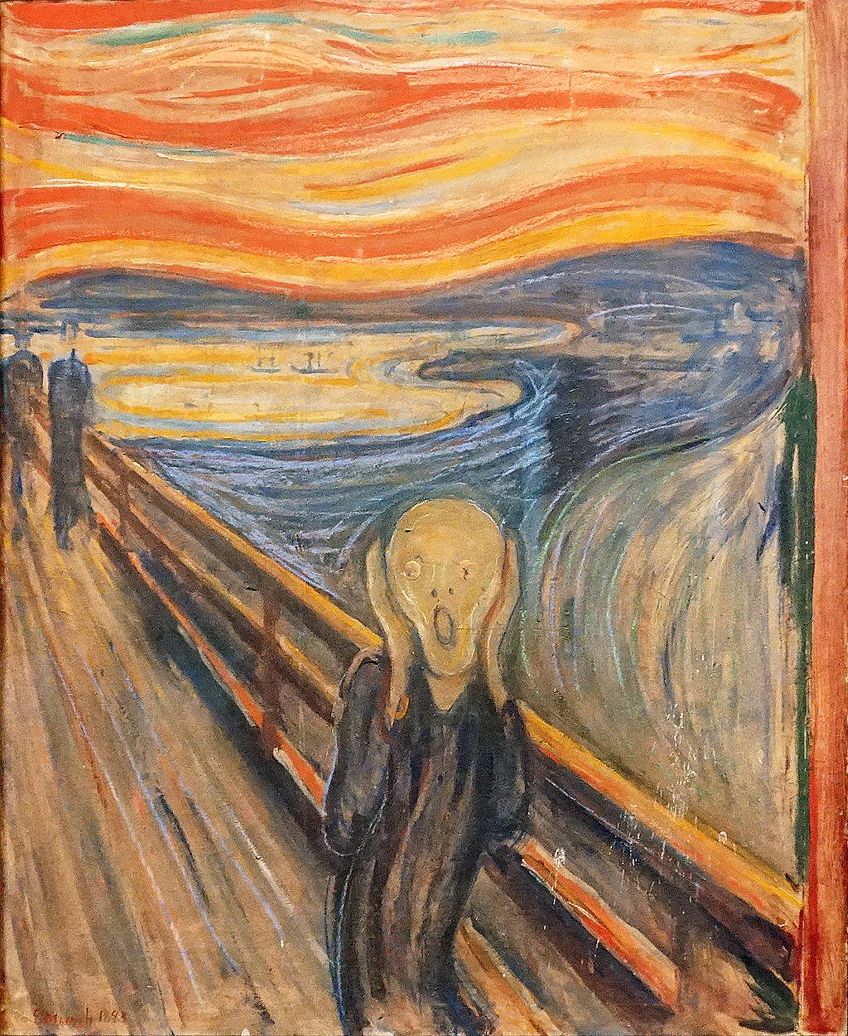
Munch’s The Scream is an important precursor rather than a product of a movement formally established in 1893. Its curving figure, compressed bridge, and agitated bands of sky and water turn a remembered experience into an image of psychological crisis. Composition is not discarded; it is deliberately reorganized to make sensation and anxiety the work’s subject.
Coining the Name of the Movement
The history of the term “Expressionism” is contested. It circulated around 1910 and 1911 and was popularized by writers including Czech art historian Antonín Matějček and Berlin critic and publisher Herwarth Walden. Matějček framed it as an opposite to Impressionism: where the Impressionist looked outward, the Expressionist searched inward. Early usage was inconsistent and could include French modernists who would not now be classified as German Expressionists.
Free brushwork, jagged or elongated form, intense color, and psychologically charged subjects became common markers, but no single checklist fits every artist. Many did not call themselves Expressionists. In the 1920s, Neue Sachlichkeit, or New Objectivity, developed partly in reaction to the perceived subjectivity and excess of prewar Expressionism.
Exploring an Expressionism Art Definition
Expressionism as an art movement is difficult to define because the label covers distinct groups, independent artists, countries, media, and dates. It intersected with Cubism, Futurism, Symbolism, Fauvism, and later Dada, but those movements are not interchangeable.
The capitalized term normally refers to early-20th-century historical developments, while the lowercase adjective “expressionistic” can describe art from other periods that intensifies form for emotional effect. Not every Expressionist work is a social critique, and not every response to industrialization is Expressionist.
The label “Expressionism” sometimes conjured up feelings of angst, as depicted by the artwork that was created, as the movement existed as an artistic style that sought to portray subjective emotions and responses of ordinary people.
The Development of German Expressionism
The best-known history of German Expressionism centers on two short-lived groups: Die Brücke, established in Dresden in 1905, and Der Blaue Reiter, formed in Munich in 1911. Austrian Expressionists such as Oskar Kokoschka and Egon Schiele developed related but independent approaches in Vienna.
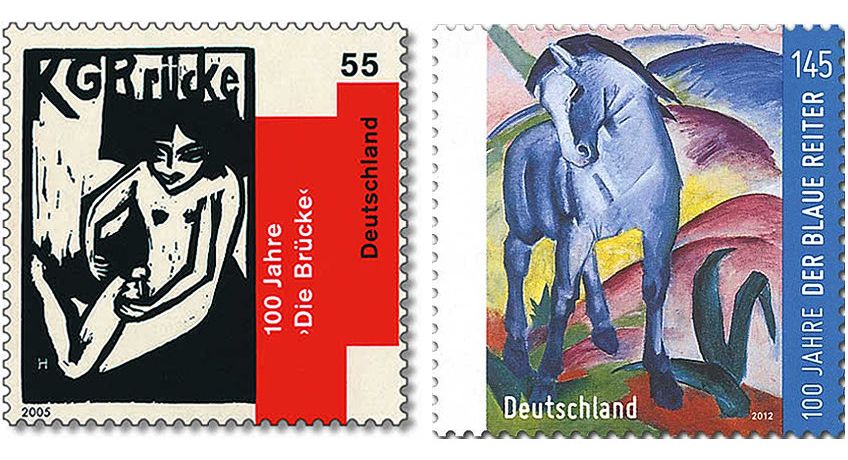
Die Brücke is often treated as the founding collective of German Expressionism, while Der Blaue Reiter began six years later. Neither group initially organized itself under the label “German Expressionism,” and they were not two branches of one shared organization: they arose in different cities, had different memberships, and pursued different programs.
Expressionism emerged in several centers and answered modernity with more than anxiety alone. Die Brücke often emphasized bodily freedom, bohemian life, the street, and social friction; Der Blaue Reiter pursued color, music, spirituality, nature, and abstraction. Later movements reused the name and some of its strategies, but Abstract Expressionism and Neo-Expressionism arose in different historical circumstances and should not be treated as direct continuations.
Characteristics and Influences of Expressionism Art
Expressionism is recognized by what formal choices do, not merely by the presence of bright color or visible brushwork. Artists distorted bodies and spaces, flattened depth, sharpened angles, simplified contours, and used arbitrary colors to make emotional or spiritual experience palpable. Some works are explosive; others are spare, somber, or nearly abstract.
Striking colors and bold brushstrokes were used to emphasize the emotions that were present, which highlighted the importance of emotional expression over a realistic interpretation.
Expressionists learned from Post-Impressionism, Fauvism, Symbolism, Cubism, German woodcuts, medieval art, folk culture, and non-European objects. Arbitrary color and discordant composition were part of a wider modernist exchange rather than techniques owned by one movement.
Exaggeration is one recurring feature, but its purpose varies. A tilted street can make a city feel unstable; an elongated hand can intensify a portrait’s nervous energy; a field of blue can suggest transcendence rather than observed light. Expressionist form does not “accurately” report an artist’s mental state. It constructs an experience for the viewer.
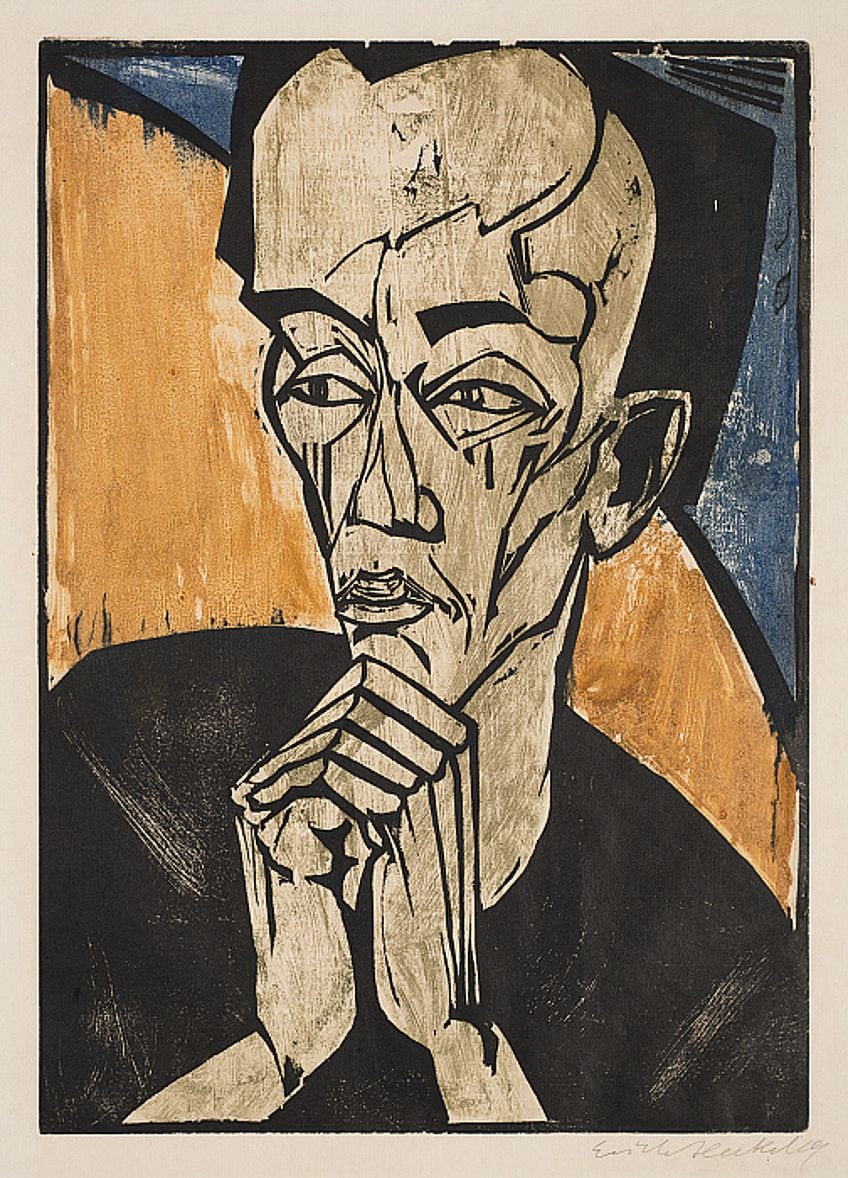
Composition remained crucial. Expressionist artists deliberately arranged color, line, scale, and rhythm to direct attention and pressure the viewer. The difference is that those elements were no longer expected to produce harmonious illusion alone; they could become abrasive, unstable, or confrontational.
Urban scenes frequently convey crowding, speed, spectacle, isolation, or commercialized intimacy, yet nature was equally important. For the Brücke artists, outdoor bathing scenes could imagine freedom from bourgeois convention; for Franz Marc, animals and landscape could embody spiritual renewal.
How to Recognize and Analyze Expressionist Art
Begin with four questions. First, identify the departure from naturalistic description: are color, anatomy, perspective, or scale deliberately altered? Second, ask what the medium contributes. The resistant grain of a woodblock, a scratched paint surface, or a broken contour can carry meaning. Third, compare subject and mood rather than assuming every distortion signifies anxiety; a work may express desire, satire, grief, ecstasy, or spiritual aspiration. Finally, place the work in its particular network—Die Brücke, Der Blaue Reiter, Vienna, theater, or film—because “Expressionism” describes related approaches rather than one universal visual formula.
Important Groups Within German Expressionism
Two collectives organize the familiar history of German Expressionism: Die Brücke and Der Blaue Reiter. Comparing them reveals why the larger movement cannot be reduced to one style. The first often favored bodily immediacy and urban friction; the second more often pursued spirituality, music, symbolism, and abstraction.
Die Brücke
Ernst Ludwig Kirchner, Karl Schmidt-Rottluff, Erich Heckel, and Fritz Bleyl founded Die Brücke in Dresden on June 7, 1905. The young architecture students worked communally and rejected academy conventions, drawing inspiration from Van Gogh, Munch, German woodcuts, medieval and folk art, and objects they encountered through colonial-era ethnographic collections. Their lack of academic painting training encouraged direct experimentation, but their work was learned, collaborative, and historically self-conscious rather than simply untutored.
The name Die Brücke means “The Bridge” and signaled a passage toward a new generation and future art. It is often connected to Friedrich Nietzsche’s writing, although the precise origin of the name is not documented beyond dispute.
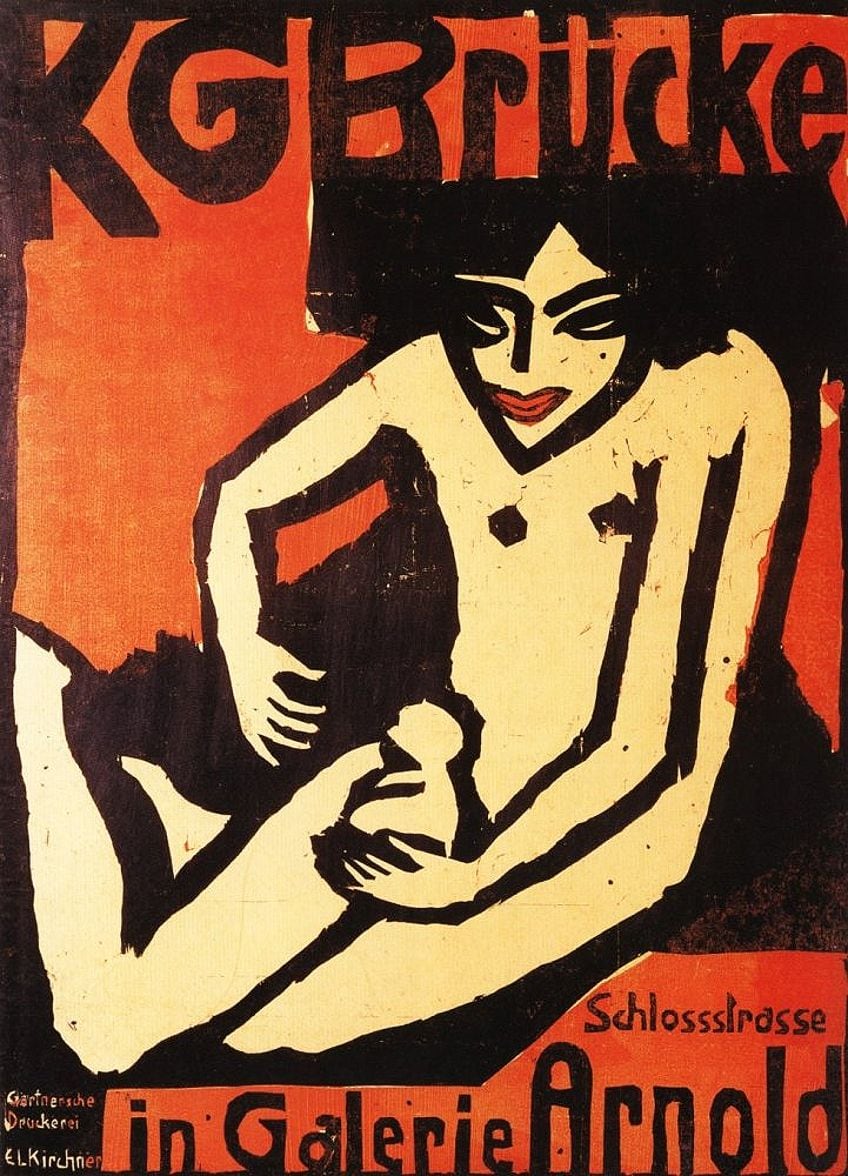
The artists within Die Brücke sought freedom from contemporary middle-class conventions through communal studios, outdoor excursions, and experimentation with heightened color and simplified form. Their images of nudes and bohemian life challenged public decorum, but they also deserve critical scrutiny for unequal power relations between adult artists and some very young models.
The group portrayed studio models, dancers, nightlife, bathers, and city crowds. Their artificial colors and rough contours could make modern experience feel immediate, erotic, or unsettling. Die Brücke worked collectively until 1913, when disputes over Kirchner’s self-serving account in the Chronik der Brücke intensified existing tensions and the group dissolved.
Der Blaue Reiter
Der Blaue Reiter formed in Munich in 1911 as a loose association led by Wassily Kandinsky and Franz Marc after tensions within the Neue Künstlervereinigung München. Gabriele Münter, August Macke, Alexej von Jawlensky, Marianne von Werefkin, Paul Klee, and others participated in its wider exhibition and intellectual network. The Der Blaue Reiter artists pursued spiritual, symbolic, and increasingly abstract possibilities in color and form.
The association published the influential Der Blaue Reiter Almanac in 1912 rather than a conventional manifesto. It brought visual art into dialogue with music, theater, folk traditions, children’s art, medieval art, and non-European objects, as well as Fauvism and Cubism. Its name joined Kandinsky’s recurring horse-and-rider motif with a color valued by both Kandinsky and Marc. The title is linked to a field of shared symbols, not securely to the 1903 painting alone.
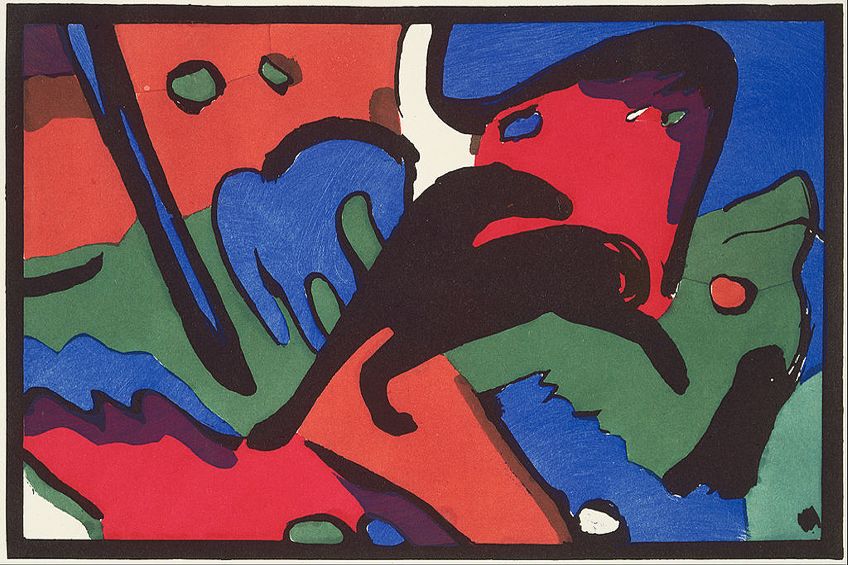
Kandinsky argued that color, line, and shape could act with a force analogous to music, encouraging his move toward abstraction. The artists nevertheless retained distinct styles; Der Blaue Reiter was a flexible exhibition and publishing network, not a school with one prescribed appearance.
The First World War ended the association’s activities in 1914. Kandinsky, a Russian citizen, had to leave Germany; Macke was killed in 1914 and Marc in 1916. The group’s exhibitions and almanac had lasting influence even though its active life was brief. Expressionist approaches continued after the war, while Dada and New Objectivity offered increasingly prominent alternatives during the 1920s.
Neo-Expressionism revived forceful figuration and painterly gesture in the late 1970s and 1980s, but Abstract Expressionism had already emerged independently in the United States during the 1940s.
Famous Expressionist Artists and Their Artworks
Throughout the lifespan of the Expressionism movement, many significant artworks were made notable artists, which went on to define the trajectory of the movement. A few of these important artists have been listed below, along with their Expressionism painting that remains iconic today.
Edvard Munch (1863 – 1944)
Seen as one of the greatest influences and principal precursors of the Expressionism movement, Norwegian artist Edvard Munch created frenzied artworks that expressed the anxiety of European individuals due to the recent modernization of society. The late 19th-century painter emerged as a prominent source of inspiration for other Expressionist artists, as his energetic and emotion-filled artworks created new potential for introspective expression within art.
Before Expressionism, Munch was part of the Symbolist movement and created artworks that were heavily influenced by Impressionism and post-Impressionism. Throughout his career, which spanned almost 60 years, Munch targeted scenes of agony, death, and anxiety within his works. He achieved this through creating deformed and emotionally charged portraits, with this style going on to inform the primary characteristics of Expressionism.
The Scream is Munch’s most recognizable image. He developed the composition in four colored versions between 1893 and 1910 and also made an 1895 lithograph. Munch’s written account describes walking with two friends when the sky turned red and he sensed “a great scream in nature.” The central figure is therefore not simply a literal portrait of Munch screaming; figure, landscape, and remembered sensation fuse into an image of inward and outward crisis.
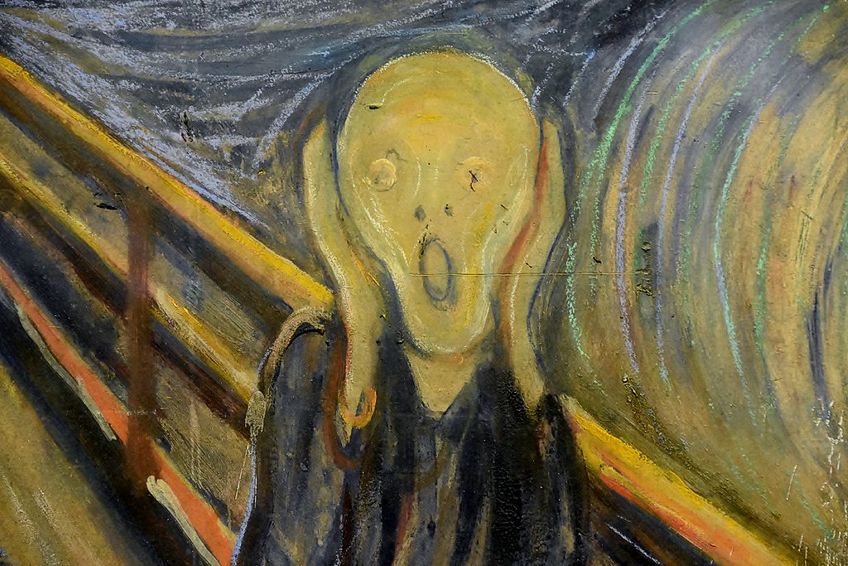
The scene’s force comes from formal control: the bridge’s steep diagonal drives toward the viewer, while the figure echoes the curves of sky and water. Whether read as hearing, emitting, or embodying the scream, the figure turns an autobiographical memory into a widely legible image of anxiety.
Munch’s exhibitions and reputation in Germany made his art an important reference for younger Expressionists. Today, all four colored versions survive: three are held by museums in Norway and one 1895 pastel remains in private hands.
Wassily Kandinsky (1866 – 1944)
Russian-born painter Wassily Kandinsky co-founded Der Blaue Reiter and became a leading theorist of abstraction. His work moved from symbolist and Post-Impressionist landscapes toward compositions in which color, line, and rhythm carry much of the meaning without depending on recognizable objects.
Kandinsky’s 1903 The Blue Rider is an early work from before the group formed. It should not be called his first or most important Expressionist painting, and the association’s name cannot be traced to this canvas alone. The small rider and landscape nevertheless anticipate motifs and contrasts that Kandinsky continued to transform as he moved toward abstraction.
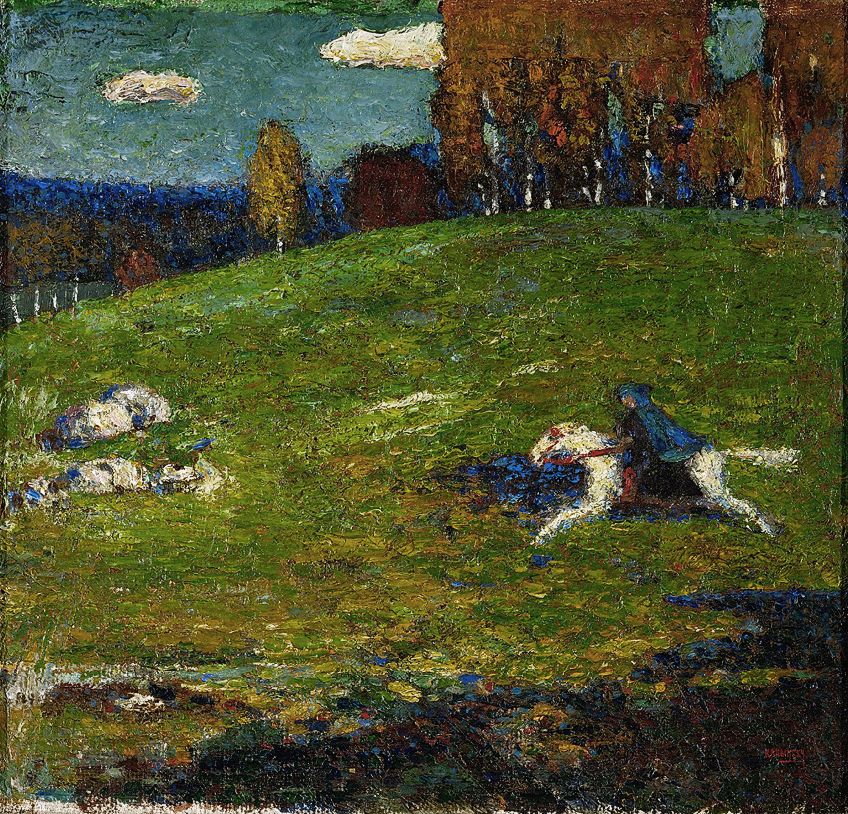
The Blue Rider shows a horse and rider crossing a sloping landscape. Broken color and a blurred figure make motion more important than precise narrative. Seen within Kandinsky’s development, the painting demonstrates how a recognizable motif could become a vehicle for increasingly autonomous color and form.
The work’s abstracted character invites viewers to interpret the scene, with this canvas becoming the symbol of the expressive possibilities that were welcomed by the Expressionism artists.
Franz Marc (1880 – 1916)
Another founding member of Der Blaue Reiter was German artist Franz Marc, who was fascinated with animals and known for his use of animal symbolism within his artworks. Practicing art as a painter, printmaker, and watercolorist, Marc was a key member of the Expressionist group who gave a deep emotional and psychological meaning to the colors he used within his works. Marc made use of the color blue within his most well-known works, as he believed it to symbolize potent masculinity and spirituality.
Marc depicted his animal subjects in a profoundly emotional way, with his work utilizing vivid colors in an attempt to move away from realistic depictions towards a more spiritual and authentic portrayal of his subjects. Due to the symbolism within color, Marc carefully selected his palette to accurately convey the emotive qualities he aimed to express, so as to correctly convey his vision.
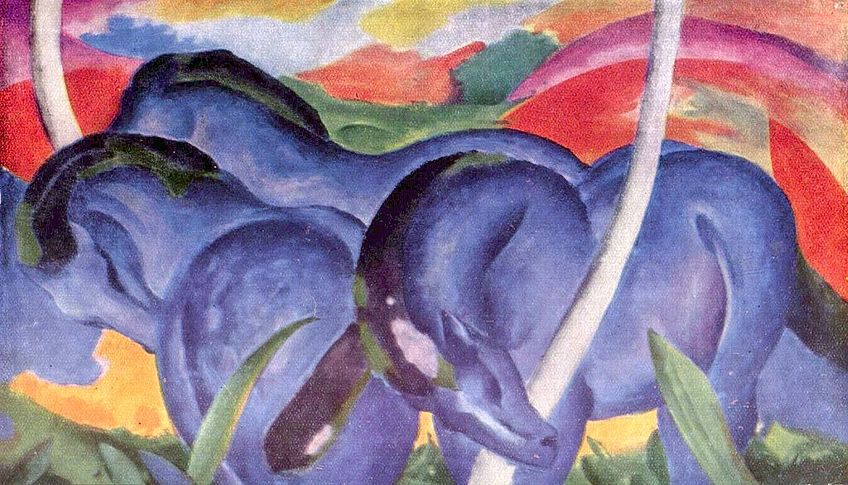
His most well-known work, painted in 1911, was titled Large Blue Horses and was shown in the first exhibition put on by Der Blaue Reiter. This artwork featured many vivid and contrasting primary colors encompassing the main subject, which includes three blue horses. The color of the horses, which was seen as symbolic, along with the soft curvature depicted within their bodies, established feelings of harmony, serenity, and balance against the harsh red hue of the background and hills.
Marc stated that this noticeable difference demonstrated the contrast that existed between peaceful spirituality and violence, with his serene artwork evoking a sense of superiority. This artwork, which made more use of bright colors and cubist techniques than some other artworks at the time, belonged to a series of works that centered around the theme of horses. Marc regarded horses to be symbols of spiritual renewal, hence their prominence within the series.
Ernst Ludwig Kirchner (1880 – 1938)
A notable artist belonging to Die Brücke was Ernst Ludwig Kirchner, whose work was typically defined by bold and blocking colors, wide and conflicting brushstrokes, and sharp-edged angular forms. Kirchner took inspiration from the works of post-Impressionist artists such as Edvard Munch, who influenced his use of expressive colors.
Kirchner was most famous for his numerous depictions of Berlin street scenes, with these scenes becoming the most famous within his catalog of work. Additionally, his most notable artwork, painted in 1913, came from this street scene category and was titled Street, Berlin. This artwork depicted Kirchner’s disdainful outlook on life in Berlin, demonstrated by the extremely sharp brushstrokes and unsettling color contrasts used.
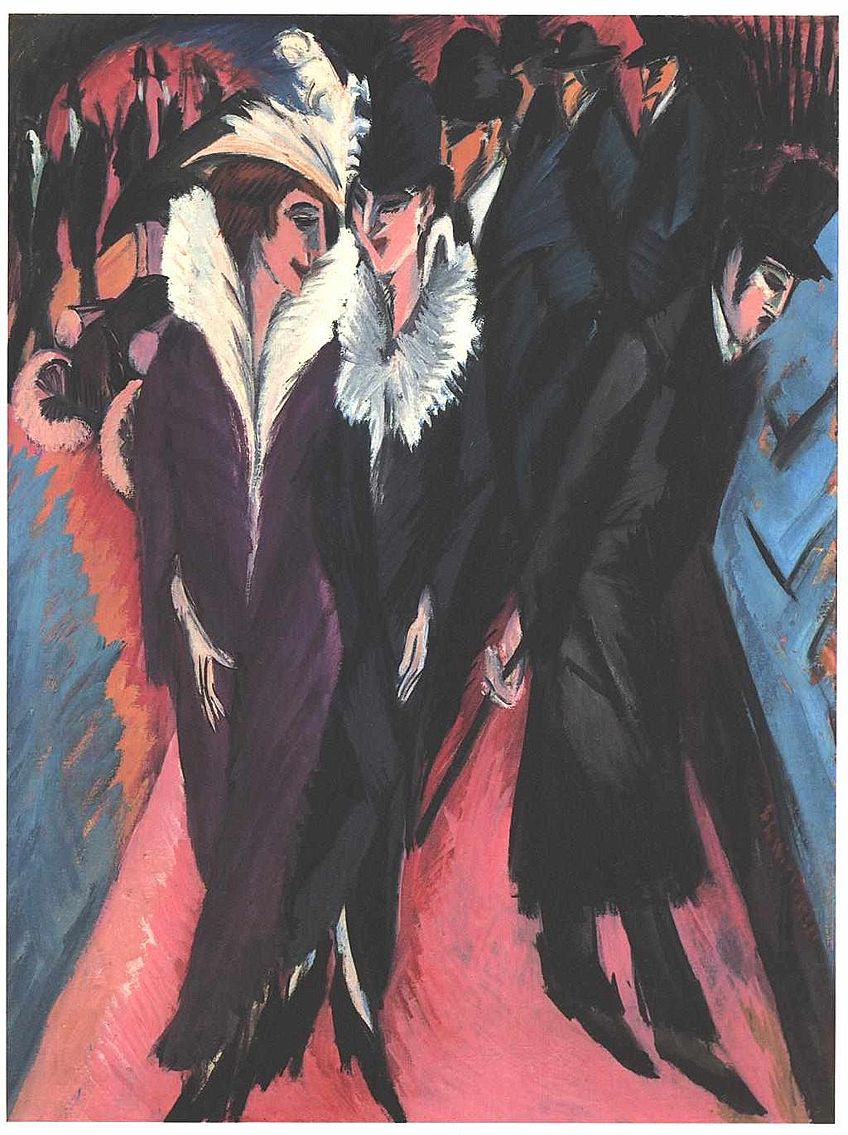
Within this artwork, repeated mask-like faces and compressed bodies turn the fashionable street into a claustrophobic stage. The tilted ground and cropped figures deny stable recession, so the crowd appears both near and inaccessible. Kirchner’s urban scene can be read as a study of spectacle, social performance, and estrangement rather than a documentary view of Berlin.
Two elaborately dressed women, often identified as sex workers or “cocottes,” form the painting’s focal point. Their towering hats, elongated bodies, and direct proximity dominate the men who press around them. The composition links commercial display, gender, and the anonymity of metropolitan crowds.
Kirchner emphasized the rapid development of urban culture by depicting individuals who were seen as “simple commodities” and prostitutes, who were considered worthy subjects.
As a founding member of Die Brücke, Kirchner established a new way of painting that visibly rejected Impressionistic inclinations and the need to accurately portray figures within paintings. This was demonstrated through his use of sharp colors, jagged brushstrokes, and lengthened forms that were adopted by members of Die Brücke to change the stylistic traditions of painting.
The following short video, created by The Museum of Modern Art and presented through Khan Academy, analyzes how these formal decisions structure Street, Berlin.
Karl Schmidt-Rottluff (1884 – 1976)
An additional co-founder of Die Brücke was Karl Schmidt-Rottluff, whose paintings represented the urban alienation and turmoil that existed within contemporary life at the time. His artworks were often exaggerated and sharp as he reduced the figures and scenes within his works to their simplest forms to produce what he viewed to be “authentic” expressions.
Schmidt-Rottluff moved to Berlin in 1911. His 1912 painting Houses at Night depicts an abstracted city block in which an empty street and sharply angled buildings make the built environment feel unstable. The work is now in the Museum of Modern Art’s collection.
The glowing colors of the buildings give off an intensity and energy that seems to seep away within the composition, creating an uncomfortable juxtaposition between the bright blocks and the empty street. Additionally, the primitive shape of the buildings permeates the canvas with a pervasive unease and alienation, which was depicted as the essence of modern life within this Expressionist painting.

Oskar Kokoschka (1886 – 1980)
Austrian artist Oskar Kokoschka developed an independent Expressionist practice in Vienna and later elsewhere in Europe. He is best known for psychologically intense portraits, landscapes, prints, and plays. His work shared Expressionism’s rejection of academic polish without belonging to either Die Brücke or Der Blaue Reiter.
The 1909 double portrait Hans Tietze and Erica Tietze-Conrat was commissioned by the Viennese art historians themselves. Kokoschka painted the sitters separately and joined them within a thin, atmospheric field. Their tense hands and distinct poses produce psychological distance as well as intimacy.
Kokoschka stated that his depiction of the couple was based on how he perceived their psyche as opposed to their physical attributes.
The colorful background and concentrated brushstrokes of the figures were representative of the techniques used within Expressionism, as well as the heightened emotion that Kokoschka included. Additionally, the swirling and abstracted colors obscured the background and enclosed the subjects in a frenzied and depthless depiction of space within the painting.
Egon Schiele (1890 – 1918)
Egon Schiele was a central figure of Austrian Expressionism. He learned from Gustav Klimt’s example but developed a harsher language of exposed contour, cropped limbs, awkward poses, and confrontational sexuality. In 1912, Schiele was detained for 24 days during an investigation involving minors; the most serious charges were dismissed, but he was convicted because an erotic drawing had been accessible to children. Reducing the episode to imprisonment for “indecent paintings” obscures that legal and ethical context.
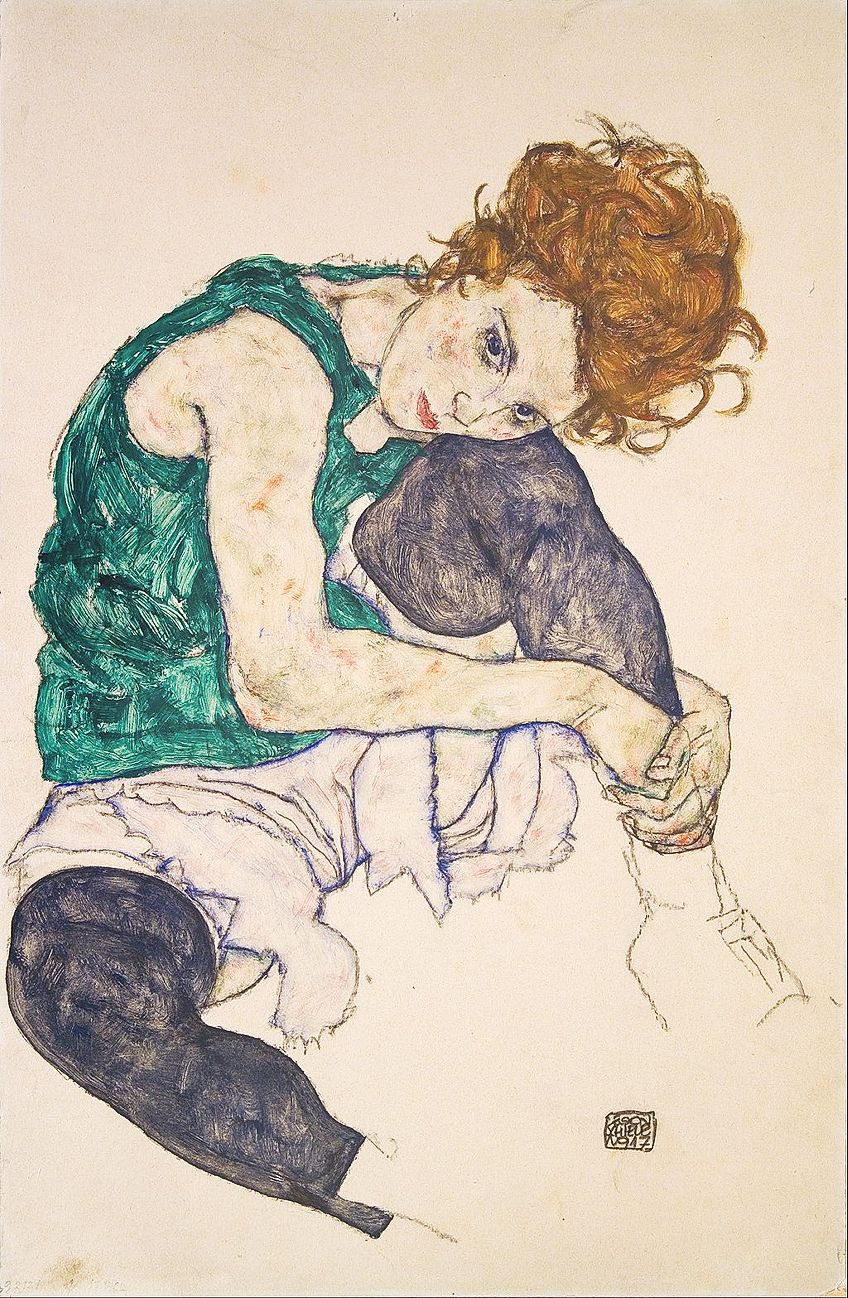
Schiele continued to make erotic and psychologically charged works. The 1917 drawing usually titled Seated Woman with Bent Knee or Seated Woman with Legs Drawn Up depicts Adele Harms, the sister of Schiele’s wife Edith—not Edith herself. The sitter is partially dressed and turns an unconventional floor pose into a tightly controlled arrangement of contour and color.
Her direct gaze challenges conventional ideals of passive feminine beauty. Red hair and stockings contrast with the green garment, while blank paper isolates the body and intensifies every shift in outline. The image is erotic, but its effect also depends on cropping, negative space, and the sitter’s active gaze.
Despite being blatantly controversial throughout his artistic career, Schiele is nevertheless recognized for the skills he possessed and the emotive quality of his line work and color choice, which placed him decidedly in the Expressionist movement. Thus, Schiele portrayed images exactly as he saw them as opposed to how they appeared to the outside world.
The Legacy of Expressionism Art
Expressionism reshaped modern art by treating distortion, color, material, and performance as carriers of psychological and social meaning. It developed alongside Cubism and Futurism and overlapped with later Dada and Surrealism, but it did not simply cause all of them. Its legacy is strongest in the continuing idea that form can embody an emotional position rather than neutrally describe an object.
The First World War killed artists including Franz Marc and August Macke and transformed the work of survivors. During the 1920s, Dada and New Objectivity challenged prewar Expressionism’s spiritual and subjective claims. After the Nazis came to power in 1933, modernist artists were removed from teaching posts and public institutions. Thousands of works were confiscated from German museums, and the 1937 “Degenerate Art” exhibition used Expressionism and other modern art as targets of state propaganda.
However, Expressionist art paved the way for the development of later art movements with its characteristics still existing in artistic practices today.
American Abstract Expressionism emerged in the 1940s and 1950s under different political and artistic conditions. Its name acknowledges an emphasis on gesture, scale, and affect, but artists such as Jackson Pollock were not members of the earlier European movement. Neo-Expressionism of the late 1970s and 1980s renewed forceful figuration and painterly surfaces after the dominance of Conceptual art and Minimalism, again adapting rather than simply reviving the historical movement.
Expressionism Art in Other Forms
Due to the rapid expansion of Expressionism art, this style influenced the development of a variety of other art forms. Of these different forms, the most notable artistic spheres, where characteristics of Expressionism can be seen includes cinema and drama.
Cinema
German Expressionist cinema developed most visibly during the Weimar period. It used stylized sets, stark lighting, theatrical performance, and distorted space to externalize fear, power, and instability. Its visual language became foundational for later horror and film noir.
Rather than developing mainly before the First World War, the canonical films appeared after it amid the political and economic volatility of Weimar Germany. Their international circulation carried Expressionist lighting, set design, and psychologically charged space into European and American filmmaking.
After experiencing the horrors caused by the war, Expressionist cinema began to blossom. Notable examples of this type of cinema include The Cabinet of Dr. Caligari, produced in 1920, The Golem: How He Came into the World, produced in 1920, and Metropolis, produced in 1927. All three films have a sinister and unsettling undertone, which was said to represent the turmoil and horror that existed within society after the war had ended.
The following Crash Course video places German Expressionist cinema within film history and explains how its design strategies traveled beyond Weimar Germany.
Drama
Expressionism strongly influenced early-20th-century German-language theater, especially the work of Ernst Toller, Georg Kaiser, and Walter Hasenclever. During the 1920s its episodic structure, stylized character types, and rejection of realistic staging influenced American modern drama, including plays by Eugene O’Neill and Elmer Rice.
In addition to producing visual art, Oskar Kokoschka wrote Murderer, Hope of Women, first performed in 1909 and often described as an early Expressionist drama. Its archetypal Man and Woman, violent struggle, compressed action, and rejection of psychological realism anticipate devices that later became central to Expressionist theater.
Expressionist plays often dramatized spiritual awakening, generational conflict, and suffering through episodic structures rather than continuous realistic action. Some borrowed the station-drama format associated with the Passion of Christ, while others turned the father, industrialist, or official into a type embodying oppressive authority.
Characters were often simplified into mythic or social types. Choral effects, clipped or ecstatic dialogue, abrupt scenes, and non-naturalistic staging heightened emotional intensity. Later playwrights such as Tennessee Williams, Arthur Miller, and Samuel Beckett absorbed selected Expressionist devices, but they are not all best classified as Expressionist playwrights.
Expressionism was not one visual style or one emotional mood. Its artists altered color, line, space, language, and performance to make modern experience feel urgent—whether their subject was the city, the body, nature, spirituality, war, or social conflict.
Frequently Asked Questions About Expressionism
What Is Expressionism?
Expressionism is a broad modernist tendency that uses formal distortion to intensify emotional, psychological, spiritual, or social meaning. It flourished internationally in the early 20th century, especially in Germany and Austria from about 1905 to 1920, and extended beyond painting into printmaking, theater, architecture, literature, dance, and film.
What Are the Main Characteristics of Expressionist Art?
Common characteristics include non-naturalistic color, angular or elongated forms, flattened or unstable space, visible brushwork, and the direct textures of printmaking. These features are not a rigid formula: artists used them for anxiety, desire, satire, grief, spiritual aspiration, and other aims. The key question is how formal alteration changes the viewer’s experience of the subject.
How Is Expressionism Different From German Expressionism?
Expressionism is the broader international category, while German Expressionism refers to developments centered in Germany and often associated with Die Brücke in Dresden and Der Blaue Reiter in Munich. Austrian artists such as Oskar Kokoschka and Egon Schiele are central to Expressionism but belonged to neither German group. The terms overlap, but they are not interchangeable.
Who Were the Major Expressionist Artists?
Major figures include Ernst Ludwig Kirchner, Erich Heckel, Karl Schmidt-Rottluff, Wassily Kandinsky, Franz Marc, Gabriele Münter, Oskar Kokoschka, Egon Schiele, and Käthe Kollwitz. Edvard Munch and Vincent van Gogh were crucial precursors. Because Expressionism was a network of groups and independent practices, any short list is selective rather than definitive.

Isabella studied at the University of Cape Town in South Africa and graduated with a Bachelor of Arts majoring in English Literature & Language and Psychology. Throughout her undergraduate years, she took Art History as an additional subject and absolutely loved it. Building on from her art history knowledge that began in high school, art has always been a particular area of fascination for her. From learning about artworks previously unknown to her, or sharpening her existing understanding of specific works, the ability to continue learning within this interesting sphere excites her greatly.
Her focal points of interest in art history encompass profiling specific artists and art movements, as it is these areas where she is able to really dig deep into the rich narrative of the art world. Additionally, she particularly enjoys exploring the different artistic styles of the 20th century, as well as the important impact that female artists have had on the development of art history.
Learn more about Isabella Meyer and the Art in Context Team.
Cite this Article
Isabella, Meyer, “Expressionism Art – A History of the Expressionist Movement.” Art in Context. April 13, 2021. URL: https://artincontext.org/expressionism-art/
Meyer, I. (2021, 13 April). Expressionism Art – A History of the Expressionist Movement. Art in Context. https://artincontext.org/expressionism-art/
Meyer, Isabella. “Expressionism Art – A History of the Expressionist Movement.” Art in Context, April 13, 2021. https://artincontext.org/expressionism-art/.


