


Franz Marc – A Brief Look at This Famous German Painter

Franz Marc was a German Expressionist painter and printmaker best known for vivid animal images such as Blue Horse I and The Large Blue Horses. As a co-editor of Der Blaue Reiter, Marc helped shape an international modern-art network in Munich. His non-naturalistic colors, simplified forms, and increasingly abstract compositions used animals and nature to explore spiritual and emotional ideas.
Artist In Context: Who Was Franz Marc?
| Date of Birth | 8 February 1880 |
| Date of Death | 4 March 1916 |
| Place of Birth | Munich, Germany |
| Art Movements | German Expressionism (Der Blaue Reiter) |
| Genre / Style | Expressionist, Symbolic, Increasingly Abstract |
| Mediums Used | Oil Painting, Gouache, Drawing, Woodcut, Lithography |
| Dominant Themes | Animals, Nature, Color Symbolism |
Franz Moritz Wilhelm Marc, usually known as Franz Marc, was a German painter and printmaker. Born in Munich on 8 February 1880, he became one of the leading figures associated with German Expressionism. Animals, landscape, color symbolism, and the relationship between living beings and their surroundings became central to his mature work.
Marc’s best-known paintings do not simply give animals unusual colors; they use color, rhythm, and interlocking forms to imagine nature as an active, spiritual whole.

Marc’s career was cut short by World War I. Drafted into the German Army in 1914, he was killed by shell shrapnel near Braquis, east of Verdun, on 4 March 1916. He was 36 years old.
The Birth and Early Life of Franz Marc
Franz Marc was born in Munich on 8 February 1880. His father, Wilhelm Marc, was a landscape painter who had studied at the Academy of Fine Arts in Munich, while his mother, Sophie Maurice, came from a French-speaking Protestant family. Franz grew up with his older brother, Paul.
Art and religion were both present in Marc’s upbringing, interests that later converged in his search for a spiritual language of color and form.
Education and Career
Marc initially considered theology and philology before deciding on art. After a year of military service, he enrolled at the Munich Academy of Fine Arts in 1900, studying under Gabriel von Hackl and Wilhelm von Diez. The academy’s naturalistic training gave him a technical foundation, but he soon looked beyond its conservative curriculum.

Travel widened Marc’s frame of reference. During a 1903 stay in Paris he studied the Impressionists in museums and galleries, and after returning to Munich he left the academy to develop independently.
Marc’s encounters with French modernism encouraged him to move from academic naturalism toward freer brushwork, brighter color, and simplified form.
Marc traveled to Greece with his brother Paul in 1906 and returned to Paris in 1907. There he studied artists including Vincent van Gogh and Paul Gauguin; the expressive color of Post-Impressionism and Fauvism proved more important to his development than any single stylistic model.

Marc absorbed aspects of Impressionism, Post-Impressionism, and Fauvism before engaging with Cubism, Orphism, and Futurism. These contacts did not produce a simple sequence of borrowed styles: Marc adapted their color and formal experiments to his own study of animals, nature, and spiritual perception.
Der Blaue Reiter
In 1910 Marc met August Macke, another German Expressionist artist, and their close friendship became an important exchange of ideas about color and French modernism. Marc met the Russian artist Wassily Kandinsky and Gabriele Münter at the beginning of 1911.
Marc and Kandinsky became the co-editors of Der Blaue Reiter (“The Blue Rider”), an almanac and exhibition project rather than a group with fixed membership.

Kandinsky proposed the almanac in June 1911, and he and Marc developed it as a wide-ranging record of modern art. The project emerged from tensions within the Neue Künstlervereinigung München (NKVM); after Kandinsky’s Composition V (1911) was rejected under the association’s size rules, Kandinsky, Münter, and Marc left and organized the first Blue Rider editorial exhibition, which opened in Munich on 18 December 1911.
The circle did not share one visual style. Its exhibitions and 1912 almanac brought together painting, prints, music, theater, folk art, children’s art, and work from different cultures to argue for artistic freedom and spiritual expression.
For Marc, the Blue Rider’s openness connected modern formal experiment with a larger search for meaning in color, animals, and nature.
Kandinsky later recalled that the name arose because both men loved blue: Marc loved horses and Kandinsky loved riders. Kandinsky’s earlier painting Der Blaue Reiter (1903) also gave the phrase an existing place in his imagery.

Marc contributed essays and woodcuts to the almanac, while Macke helped assemble its ethnographic images. The collaboration linked Marc’s paintings to a broader debate about how modern art could communicate across media and cultures.
Robert Delaunay, Cubism, and Futurism
The work of Robert Delaunay, a French artist associated with Orphism, helped Marc push color and form toward greater abstraction. Marc and Macke visited Delaunay’s Paris studio in October 1912, after Delaunay’s paintings had already appeared in Blue Rider exhibitions.
Delaunay’s luminous color rhythms, Cubist faceting, and the movement suggested by Futurism gave Marc formal tools for joining animals and landscape into a single pictorial structure.
The shift is visible in Red Deer II (1912) and The Tiger (1912), then more fully in Animal Destinies (1913), The Tower of Blue Horses (1913), and the abstract compositions of 1914.

Later Life and World War I
Marc married his long-term partner Maria Franck in June 1913. When World War I began in 1914, he was drafted into the German Army and assigned to the cavalry; he later served with an artillery unit.
In 1916, Marc painted nine pointillist camouflage tarpaulins intended to conceal artillery positions from aerial observation.
In a letter to Maria, Marc described testing camouflage designs that progressed from an approach associated with Manet to one associated with Kandinsky, and he wondered whether the most abstract patterns would work best from the air. The episode shows how the visual fragmentation of modern painting acquired an unexpectedly practical wartime use.
On 4 March 1916, while reconnoitering a route near Braquis during the Battle of Verdun, Marc was mortally wounded when shell shrapnel struck his head. His close friend August Macke had been killed in France in September 1914.
Important Exhibitions by Franz Marc
Marc’s first solo exhibition was held at Kunsthandlung Brakl in Munich in 1910. The support of collector Bernhard Koehler, August Macke’s uncle by marriage, gave Marc financial stability and helped place his work before a wider public.
Marc exhibited with the NKVM in 1910 and with the first Blue Rider editorial exhibition at Heinrich Thannhauser’s Moderne Galerie in 1911. That exhibition subsequently traveled to Cologne, Berlin, Bremen, Hagen, and Frankfurt, extending the project beyond Munich.

From 4 October 2018 to 21 January 2019, the Neue Galerie New York presented Franz Marc and August Macke: 1909 – 1914 in partnership with the Musées d’Orsay et de l’Orangerie. A related presentation followed at the Musée de l’Orangerie in Paris from 6 March to 17 June 2019.
The exhibition examined the friendship Marc and Macke formed in 1910, their shared engagement with French art, and the different directions each artist took within the Blue Rider network.
The Franz Marc Museum in Kochel am See, Bavaria, Germany, displays numerous Franz Marc artworks.
The museum opened in 1986 and added a major extension in 2008. Its collection places Marc’s work in dialogue with artists including Wassily Kandinsky, Paul Klee, Gabriele Münter, August Macke, and members of Die Brücke.
For the centenary of Marc’s death in 2016, the Franz Marc Museum organized the exhibition cycle Franz Marc – Between Utopia and Apocalypse, centered on The Unfortunate Land of Tyrol, Grazing Horses, and Fighting Forms.
Artistic Characteristics of Franz Marc
Franz Marc is best known for animals built from sweeping contours, saturated non-naturalistic color, and increasingly fractured space. These formal choices were not merely decorative: he used them to suggest an inner relationship between animals, landscape, and spiritual life.
Animals, symbolic color, and rhythmic form gave Marc a language for imagining nature beyond ordinary human vision.
His early academic training emphasized naturalistic observation. Portrait of the Artist’s Mother (1902), painted while he was still a student, demonstrates that conventional foundation before his later experiments with color and structure.

Marc also encountered Jugendstil, the German-speaking form of Art Nouveau. Its flowing outlines and synthesis of geometric and organic design helped open a path away from strict academic realism.
Animals and Pantheism
Marc’s visits to Paris accelerated that change. Two Women on a Hillside (1906) combines loose brushwork with a strong linear rhythm, showing how he absorbed modern French painting without simply imitating it.
Even before animals dominated his work, Marc was learning to make color and contour carry emotional weight.

The same transition is visible in Self-Portrait in Breton Costume (1905). Marc turns to his left in a blue-toned outfit; the fluid handling and compressed detail matter more than an exact academic likeness.

The animal painter Jean-Bloé Niestlé encouraged Marc to consider animals as subjects with their own perceptual worlds. Marc studied animal anatomy closely, but accurate structure became a starting point rather than an end.
Marc combined anatomical study with an imaginative attempt to see nature from the animal’s point of view.
The Fauves’ expressive color gave him another way to bridge observed form and inner experience. Rather than copy an animal’s local color, Marc could use hue, outline, and repetition to convey character and spiritual force.

Marc’s animals are often interpreted through his pantheistic outlook: the conviction that spiritual meaning permeates nature rather than belonging only to human life. Horses, deer, cows, foxes, and tigers occupy landscapes whose curves and colors echo their bodies.
For Marc, the animal was neither a decorative motif nor a human allegory; it offered another way of imagining consciousness in nature.
This aim separated his work from conventional animal painting. He increasingly rejected a landscape organized solely for a human viewer and tried instead to picture the animal’s relation to its environment.

Herschel B. Chipp’s Theories of Modern Art (1968) reproduces Marc’s essay How Does a Horse See the World?, in which the artist asked:
“Is there a more mysterious idea for an artist than to imagine how nature is reflected in the eyes of an animal? How does a horse see the world, how does an eagle, a doe, or a dog? It is a poverty-stricken convention to place animals into landscapes as seen by men; instead, we should contemplate the soul of the animal to divine its way of sight.”
Works such as Blue Horse I, Large Blue Horses, Yellow Cow, The Dream, Tiger, and The Foxes show how persistently he pursued that question between 1911 and 1913.

In Large Blue Horses (1911), three monumental animals bend their heads into a compact group. Their overlapping bodies fill most of the canvas and turn grooming or resting into a unified, almost sculptural rhythm.
The rounded hills repeat the horses’ backs and necks, binding animal and landscape into one continuous pattern.
Dark contour lines articulate muscles, legs, and manes without breaking that unity. The horses are recognizable, yet their blue bodies and compressed scale signal that Marc is painting an idea of animal harmony rather than a literal rural scene.
Color Symbolism
In Yellow Cow (1911), a leaping animal stretches across a landscape of pointed mountains and rolling bands. The curving body, lifted legs, and repeated diagonals make the composition feel buoyant and dynamic.

The landscape undulates beneath the cow, while dark vertical accents at the edges interrupt the broad horizontal movement.
The cow’s unnatural yellow is the key: Marc uses color to describe an expressive and symbolic reality, not the animal’s observed coat.
The painting’s joy comes from the interaction of color and motion. Yellow does not operate alone; it gains force from the surrounding blues, greens, reds, and violet tones.

Color was one of Marc’s most deliberate artistic tools. In a letter to August Macke, he explained that “blue is the male principle, severe and spiritual. Yellow is the female principle, gentle, cheerful and sensual. Red is matter, brutal and heavy”. These gendered associations belong to Marc’s own period-specific theory; they should not be read as universal meanings.
Marc placed these primary colors in large, contrasting areas and adjusted their meaning through combination. Blue horses can suggest spiritual severity; yellow can communicate warmth or sensual vitality; red may introduce weight, danger, or conflict.
Materials and Techniques
Marc worked primarily in oil, but his practice also included gouache, watercolor, pencil, ink, woodcut, and lithography. Drawings and studies helped him understand animal anatomy, while prints encouraged the simplification of silhouettes into strong black-and-white shapes.
His paintings often begin with broad interlocking masses, reinforced by dark contours and transparent or opaque passages of color. In works from 1912 onward, faceted planes associated with Cubism, Futurism, and Delaunay’s color experiments increasingly cut through those curves. Marc’s woodcuts used the resistance of the block to similar effect: compact forms, directional cuts, and stark contrast turned animal bodies into rhythmic signs.
From Beautiful to Ugly: An Abstracted Perception
Marc’s confidence in animal purity did not remain simple or fixed. In a letter dated 12 April 1915, he described the turn toward abstraction in stark terms:
“Very early I found people to be ugly; animals seemed more beautiful, more pure. But then I discovered in them, too, so much that was ugly and unfeeling – and instinctively, by an inner compulsion, my presentation became more schematic or more abstract.”
He continued by describing how nature itself had come to reveal “deformity and repulsiveness” and questioned whether a European viewpoint made the world appear poisoned and distorted.

That shift is visible in the 1914 series Playing Forms, Fighting Forms, Cheerful Forms, and Broken Forms. Color, direction, and collision become the principal subjects. Earlier works such as The Tower of Blue Horses and The Fate of the Animals (both 1913) retain animals but press them into fractured, unstable structures.

In The Fate of the Animals, shards and diagonals seem to trap the creatures they once unified with nature. The canvas predates World War I, so it is not a direct record of combat; its later damage and Marc’s wartime death have nevertheless intensified its apocalyptic reception. A warehouse fire destroyed roughly the right third in 1917, and Paul Klee restored the missing section in 1919.
Marc initially invested war with hopes of renewal, but his wartime letters grew increasingly disillusioned as destruction replaced that ideal.
Franz Marc Paintings
| Title | Date | Dimensions | Medium |
| Portrait of the Artist’s Mother | 1902 | 99 x 70.5 centimeters | Oil on canvas |
| Two Women on a Hillside | 1906 | 16 x 24.6 centimeters | Oil on canvas |
| Woman in the Wind by the Sea | 1907 | 24.8 x 15.8 centimeters | Oil on paperboard |
| Monkey Frieze | 1911 | 75.5 x 135.5 centimeters | Oil on canvas |
| Blue-Black Fox | 1911 | 50 x 63 centimeters | Oil on canvas |
| The Yellow Cow | 1911 | 140.5 x 189.2 centimeters | Oil on canvas |
| The Steer (The Bull) | 1911 | 100 x 135.2 centimeters | Oil on canvas |
| The Large Blue Horses | 1911 | 105.7 x 181.1 centimeters | Oil on canvas |
| Blue Horse I | 1911 | 112 x 84.5 centimeters | Oil on canvas |
| Girl with Cat II | 1912 | 71.5 x 66.5 centimeters | Oil on canvas |
| Little Yellow Horses | 1912 | 66 x 104 centimeters | Oil on canvas |
| In the Rain | 1912 | 81.7 x 10⁶ centimeters | Oil on canvas |
| Tiger | 1912 | 111.7 x 101.8 centimeters | Oil on canvas |
| The Tower of Blue Horses | 1913 | 200 x 130 centimeters | Oil on canvas |
| The Fate of the Animals | 1913 | 194.7 x 263.5 centimeters | Oil on canvas |
| Animals in a Landscape | 1914 | 110.2 x 99.7 centimeters | Oil on canvas |
| Deer in the Forest II | 1914 | 110 x 100.5 centimeters | Oil on canvas |
| Fighting Forms | 1914 | 91 x 131.5 centimeters | Oil on canvas |
| Broken Forms | 1914 | 112 x 84.5 centimeters | Oil on canvas |
| Tyrol | 1914 | 135.7 x 144.5 centimeters | Oil on canvas |
Book Recommendations
These three books offer complementary routes into Franz Marc’s work: artists’ writings, a focused study of horses, and an exhibition catalog about his dialogue with August Macke.
Theories of Modern Art: A Source Book by Artists and Critics (1968) by Herschel B. Chipp
Chipp’s sourcebook gathers letters, essays, and manifestos central to modern art. Its value for Marc lies in encountering the artist’s ideas alongside documents from Post-Impressionism, Symbolism, Expressionism, and later debates leading toward Contemporary art. It is best suited to readers who want primary texts and scholarly context rather than a picture-led biography.

- A collection of texts from letters, manifestos, notes, and interviews
- Sources include a variety of artists, critics, and political figures
- A wonderful resource and insight into the way artists think and work
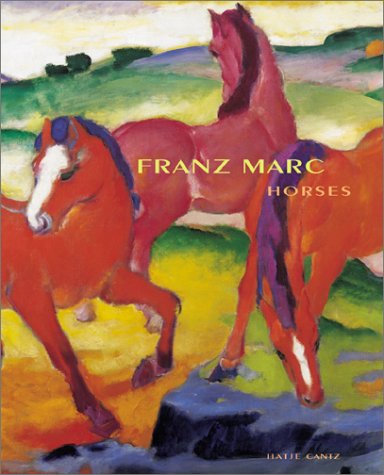
Franz Marc: Horses (2000) by Andreas Schalhorn et al.
This illustrated study follows the horse through Marc’s paintings, drawings, and prints. The focused subject makes it useful for tracing how observation, anatomy, color symbolism, and abstraction changed across his short career. It is a strong choice for visual readers and artists interested in animal form.
- An overview of Marc's paintings, drawings, gouaches, and more
- With 231 illustrations and a series of essays on the artist
- A discussion of Marc's unique adaptations of various media
Franz Marc and August Macke: 1909 – 1914 (2018) by Vivian Endicott Barnett
Published for a major exhibition, this catalog places Marc beside his friend August Macke. Its essays and reproductions clarify their exchanges about color, French modernism, and non-representational form while preserving the differences between their approaches. The paired format is especially useful for understanding the wider Blue Rider network.

- Illustrated volume on the friendship of Franz Marc and August Macke
- Includes paintings, drawings, and documents from both artists
- Explores the artists' influence on the Expressionism movement
Franz Marc Making His Mark on the World
Franz Marc’s career lasted little more than a decade, yet his combination of symbolic color, animal perception, and abstraction remains a defining contribution to German Expressionism. The Blue Rider’s international outlook also helped connect Munich to broader experiments in modern art. Later painters such as Jackson Pollock pursued abstraction under very different historical conditions, so Marc is better understood as an important precursor than as a documented direct influence on every later movement.
Marc made familiar animals newly strange. His blue horses, yellow cow, and fractured forests ask viewers to consider how color and form can express a world beyond literal appearance.
Frequently Asked Questions
Who Painted the Famous Blue Horse Paintings?
Franz Marc painted the best-known blue-horse images associated with German Expressionism. Blue Horse I (1911) shows one upright horse and belongs to the Lenbachhaus in Munich. Large Blue Horses (1911), now at the Walker Art Center, groups three bending horses in a rolling landscape. They are separate oil paintings, not alternate titles for the same work.
How Did Franz Marc Die?
Franz Marc died on 4 March 1916 while serving in the German army during World War I. He was conducting reconnaissance near Braquis, in the Verdun sector, when shell fragments struck him in the head and killed him. He was 36. Marc was first buried near the front; his remains were later moved to Kochel am See in Bavaria, where the Franz Marc Museum now stands.
Did Franz Marc Influence Abstract Expressionism?
Franz Marc helped establish expressive, non-naturalistic color and abstraction as major concerns of early modernism, but a simple line of direct influence to Abstract Expressionism is difficult to prove. Later developments such as Color Field Painting share an interest in color’s emotional force, while painters including Willem de Kooning worked in different networks and decades. It is most accurate to call Marc a significant precursor within the broader history of abstraction.

Isabella studied at the University of Cape Town in South Africa and graduated with a Bachelor of Arts majoring in English Literature & Language and Psychology. Throughout her undergraduate years, she took Art History as an additional subject and absolutely loved it. Building on from her art history knowledge that began in high school, art has always been a particular area of fascination for her. From learning about artworks previously unknown to her, or sharpening her existing understanding of specific works, the ability to continue learning within this interesting sphere excites her greatly.
Her focal points of interest in art history encompass profiling specific artists and art movements, as it is these areas where she is able to really dig deep into the rich narrative of the art world. Additionally, she particularly enjoys exploring the different artistic styles of the 20th century, as well as the important impact that female artists have had on the development of art history.
Learn more about Isabella Meyer and the Art in Context Team.
Cite this Article
Isabella, Meyer, “Franz Marc – A Brief Look at This Famous German Painter.” Art in Context. November 29, 2021. URL: https://artincontext.org/franz-marc/
Meyer, I. (2021, 29 November). Franz Marc – A Brief Look at This Famous German Painter. Art in Context. https://artincontext.org/franz-marc/
Meyer, Isabella. “Franz Marc – A Brief Look at This Famous German Painter.” Art in Context, November 29, 2021. https://artincontext.org/franz-marc/.


