

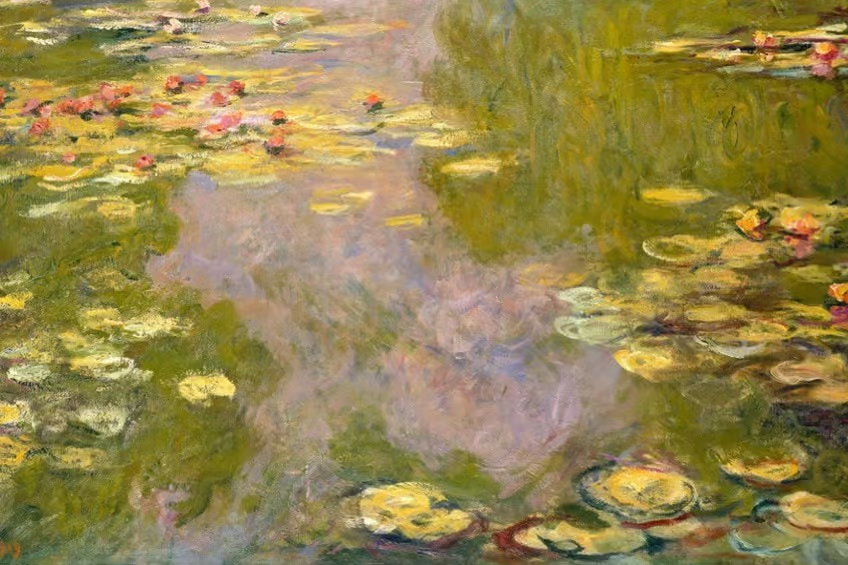
Claude Monet – The Impetus for Impressionism

Claude Monet (1840–1926) was a French painter and a central figure in Impressionism. He transformed close observation of landscape, light, weather, and reflection into paintings with visible brushwork and shifting color. Impression, Sunrise (1872) supplied the movement’s name, while his later series—from stacks of wheat and Rouen Cathedral to the Thames and Water Lilies—show how he repeatedly reworked a motif to study change over time.
Claude Monet’s Biography
| Date Born | 14 November 1840 |
| Date Died | 5 December 1926 |
| Place Born | Paris, France |
| Associated Movements | Impressionism |
| Place Died | Giverny, France |
| Nationality | French |
| Principal Medium | Oil painting |
| Known For | Impression, Sunrise, series paintings, and Water Lilies |
Claude Monet was a central organizer and exhibitor within French Impressionism. His commitment to painting outdoors helped make changing natural light a primary subject, as can be observed in one of Monet’s famous paintings, Impression, Sunrise (1872). The title later supplied critics with a name for the movement.
Monet eventually made serial painting one of his practice’s cornerstones. By moving among canvases and revisiting a subject under different conditions, he turned stacks, buildings, rivers, and his garden into records of perception rather than fixed descriptions. The expansive scale and all-over surfaces of his late Water Lilies later attracted successive generations of abstract artists, although Monet remained grounded in observed nature.

Early Life of Claude Monet
Oscar Claude Monet was born on 14 November 1840 in Paris. His family moved around 1845 to Le Havre, the Normandy port where his father worked in the family ship-supplies business. The coastline, harbor, and changeable northern light became formative subjects. Monet’s mother died in 1857, when he was 16.
At school in Le Havre, Monet received drawing instruction from Jacques-François Ochard, a former student of the Neoclassical painter Jacques-Louis David. As a teenager, Monet became locally known for caricature portraits, which he displayed and sold through a stationer’s shop. That early success gave him confidence in both his draftsmanship and his ability to earn money from art.
Before he became a landscape painter, Monet built a local reputation in Le Havre through sharp, commercially successful caricatures.
The Career of Monet the Artist
Claude Monet’s long career links the emergence of Impressionism with important developments in twentieth-century modern art. He helped organize independent exhibitions, painted modern leisure and industry as well as nature, and treated atmosphere as a structure that could alter an entire composition. The term Impressionism derives from the title of Impression, Sunrise, not from a manifesto written by Monet.

Early Training
Around 1856, Monet met Eugène Boudin, a landscape painter known for views of northern French seaside towns. Boudin encouraged him to work directly before the motif. This en plein air training taught Monet to observe rapidly changing skies and light, though he would later combine outdoor study with extensive studio revision.
Boudin’s example taught Monet to build landscapes from sustained observation outdoors, a principle he later combined with studio work.
Monet traveled to Paris in 1859. Rather than enrolling at the École des Beaux-Arts, he attended the Académie Suisse, where he met Camille Pissarro. After military service in Algeria from 1861 to 1862, Monet returned to France; Johan Barthold Jongkind further sharpened his approach to light, atmosphere, and coastal landscape.
Mature Period
In 1862, Monet joined Charles Gleyre’s Paris studio, where he met future Impressionists Pierre-Auguste Renoir, Alfred Sisley, and Frédéric Bazille. The Paris Salon accepted two large seascapes for his debut in 1865, including Mouth of the Seine at Honfleur. Despite its immediate sense of weather, that painting was executed in the studio from sketches made on site—a useful reminder that Monet’s process was never simply “outdoors versus indoors.”

Monet began the monumental Women in the Garden around 1866, working outside on a canvas more than eight feet high and finishing it in the studio. Camille Doncieux modeled for the three figures on the left. The Salon rejected the painting in 1867, objecting in part to its visible brushwork. The image below is a different work, Woman in the Garden, Sainte-Adresse (1867), and not the rejected group composition.
Women in the Garden applied the scale of history painting to modern dress, colored shadows, and sunlight filtered through foliage.

During the Franco-Prussian War, Monet took refuge in London with Camille, whom he had married in 1870, and their son Jean. He studied paintings by J. M. W. Turner and John Constable, although the precise extent of their influence on his work remains debated. More immediately important was his meeting with dealer Paul Durand-Ruel, who would become a major supporter of Monet and other Impressionists.

After the war, Monet settled at Argenteuil, near the Seine, from 1871 to 1878. There he painted railways, bridges, factories, boats, and riverside leisure, often from a studio boat. Works such as Le bassin d’Argenteuil (c. 1872) register the rapidly changing suburb through broken reflections and high-keyed color.
At Argenteuil, modern infrastructure and leisure entered Monet’s landscapes without displacing his central interest in light and reflection.
Monet joined Degas, Renoir, Pissarro, Morisot, Sisley, and other artists in organizing an exhibition independent of the Salon in 1874. It took place in the former studio of photographer Nadar. Louis Leroy’s mocking review used the title Impression, Sunrise—painted at Le Havre in 1872—to label the group “Impressionists,” a term the artists later accepted.

The movement’s name was accidental, but Monet’s role was not: he exhibited in five of the eight Impressionist exhibitions and remained one of the group’s most persistent landscape painters. His commitment to modern subjects, visible brushwork, and changing atmosphere helped define the movement without reducing it to a single uniform style.
Monet experienced serious financial hardship in the 1860s and 1870s, but sales through dealers and collectors later made him financially secure.

By 1878, the Monet and Hoschedé families were sharing a house at Vétheuil. Camille gave birth to Michel that year and died in 1879. Alice Hoschedé continued to manage the combined household; she married Monet in 1892, after her first husband’s death. Monet’s paintings of the frozen Seine at Vétheuil belong to this difficult transition, but no single biographical event fully explains their restrained palette and fractured ice.
The combined Monet-Hoschedé household included eight children: Monet’s two sons and Alice’s six children.

In 1883, Monet rented a house at Giverny for Alice and their combined family. He bought it in 1890 and acquired adjacent land for a water garden in 1893. The flower garden, pond, water lilies, and Japanese bridge became both living environment and working motif. Monet planned plantings for successive color effects and employed gardeners, turning cultivated nature into a controlled but constantly changing subject.
At Giverny, garden design and painting became connected practices: Monet shaped the motif, then studied how weather, growth, and reflection transformed it.
Growing sales brought Monet financial security at Giverny. His Impressionist paintings found collectors in France, Britain, and the United States, while the property supported an expanding household and gardening staff. He was not a nobleman; his status came from sustained artistic and commercial success.
Monet’s garden was not merely decorative scenery. Its paths, pond, plants, and reflections formed a long-term system of motifs.

Monet’s series of stacks, made in 1890 and 1891, marked a breakthrough. He worked among several easels in the field and refined the canvases in the studio. Fifteen were shown together at Durand-Ruel’s Paris gallery in May 1891, allowing viewers to compare the same solid forms under different seasons, times, and atmospheric effects. He soon extended this comparative method to poplars and Rouen Cathedral.
Viewed together, the series makes the apparently stable motif register changes in season, weather, color, and the artist’s own attention.

Later Years and Death of the Artist
Although Giverny remained Monet’s base from 1883, he continued to travel and paint in Normandy, the Mediterranean, Norway, London, and Venice. Alice died in 1911, his son Jean died in 1914, and cataracts increasingly impaired his vision after their diagnosis in 1912. These losses and World War I complicated his work, but they did not end it.
From 1914, Monet returned to the water-lily motif on a new scale, developing the large panels he called his Grandes Décorations.
Monet built a large studio at Giverny to accommodate the panels and worked across them for years, layering, scraping, revising, and sometimes destroying canvases. On 12 November 1918, the day after the Armistice, he offered two decorative panels to the French state as a symbol of peace. Friend and statesman Georges Clemenceau helped expand the idea into the full Orangerie installation; a formal deed for 19 panels was signed in 1922.

The Musée de l’Orangerie houses eight compositions assembled from Monet’s panels in two elliptical rooms designed with his involvement. They opened in 1927, a few months after his death. Monet underwent cataract operations in 1923 and continued revising the decorations afterward. He died at Giverny on 5 December 1926, aged 86, and was buried in the cemetery beside the village church.
In 1966, Monet’s surviving son Michel bequeathed the house, gardens, and works kept at Giverny to the Académie des Beaux-Arts.
After restoration, the house and gardens opened to the public in 1980 through the Fondation Claude Monet. The property preserves the flower garden, water garden, household interiors, and Monet’s collection of Japanese prints, making the relationship between the designed site and the paintings unusually legible.

Claude Monet’s Legacy
Monet’s legacy rests on more than the popularity of Impressionism. His paintings demonstrate how a motif can become a sustained field of investigation: the subject stays recognizable while color, brushwork, cropping, scale, and surface reorganize what the viewer sees. That principle connects the early seascapes and Argenteuil views to the late Water Lilies without making his career a simple march toward abstraction.
The late Water Lilies initially received limited public attention, but their scale and all-over surfaces were reassessed in the 1950s.

In 1955, the Museum of Modern Art became the first museum in the United States to acquire one of Monet’s large Water Lilies panels. The work’s scale, cropped space, and continuous painted field made it newly relevant alongside the Abstract Expressionists. This is best understood as a mid-century critical affinity—not proof that Monet directly caused the work of Jackson Pollock, Mark Rothko, or every later abstract painter.
Monet’s late paintings occupy a productive threshold: their subjects remain garden, water, sky, and reflection even as the painted surface becomes increasingly immersive.
Claude Monet’s Art Style and Method
Monet’s art is recognizable through visible brushwork, close tonal and color relationships, cropped compositions, and sustained attention to atmosphere. He did not merely record the “local color” of an object. Instead, surrounding light, reflected color, fog, snow, water, and shadow alter how every part of the motif appears. This makes the conditions of seeing part of the subject itself.
Impression, Sunrise does not abandon its harbor subject; its broken reflections and compressed tonal contrasts make atmosphere the painting’s organizing structure.
Monet often worked before the motif, but the familiar image of a canvas completed spontaneously in one outdoor session is misleading. His process ranged from rapid field studies to paintings developed across repeated sessions and refined in the studio. Mouth of the Seine at Honfleur, the Stacks, Thames series, and monumental Water Lilies all involved different combinations of observation, memory, comparison, and revision.
Light was a central theme, but Monet also painted the changing environments of modern France. Railways, bridges, factories, steam, suburban leisure, and engineered gardens appear throughout his work. His landscape paintings therefore join natural phenomena to modern materials and spaces rather than separating nature from contemporary life.
Figures in Monet’s landscapes usually belong to the same field of light and color as the setting; they rarely dominate it as narrative protagonists.
This integration is visible in garden paintings of the 1860s. In Adolphe Monet in the Garden of Le Coteau at Sainte-Adresse (1867), the figure, flowers, architecture, and sea are organized through bands of color and changing sunlight rather than conventional storytelling.

At Argenteuil, Monet’s floating studio allowed him to work from the Seine and examine reflections at close range. Short, varied marks distinguish water, sky, foliage, smoke, and masonry while also binding them into a single surface. Industrial motifs were not exceptions to his landscape practice: a railway bridge could become a framework through which moving air, water, and steam were perceived.
Monet’s brushwork does two jobs at once: it describes a motif and makes the viewer aware of paint as a material surface.

Monet absorbed lessons from Boudin, Jongkind, Camille Corot, Gustave Courbet, and his Impressionist colleagues, but he resisted a fixed academic method. At Saint-Lazare station in 1877, he used steam and smoke to dissolve and reveal the iron structure in turn. The motif let him study how atmosphere could be opaque in one passage and transparent in another.
From stations to gardens, Monet selected motifs that could generate many different relationships among light, color, structure, and atmosphere.
During the 1870s, Monet generally lightened his palette and used smaller, more varied touches, as seen in Woman with a Parasol—Madame Monet and Her Son (1875). Dark accents did not disappear, however, and his palette continued to change with subject, weather, and period rather than following a single progression from dark to light.

In his Thames paintings, Monet balanced warm and cool color to make fog, reflected light, and architecture interdependent. He painted Waterloo Bridge and Charing Cross Bridge from the Savoy Hotel and the Houses of Parliament from across the river, then continued refining the canvases in Giverny. Thirty-seven London works were exhibited at Durand-Ruel’s gallery in 1904.

Cataracts affected Monet’s color perception and working conditions, but they do not provide a complete explanation for the scale or apparent abstraction of his late paintings. His failing vision was diagnosed in 1912, he underwent operations in 1923, and he continued to revise earlier canvases. At the same time, the immersive format of the Great Decorations had been deliberately planned and required broad handling, layered surfaces, and long studio work.
Monet’s late style reflects an interaction among artistic ambition, decades of work on the garden motif, large-scale studio practice, and impaired vision.

How Monet’s Series Method Changed
Monet’s series were not produced by one unchanging formula. The comparison below shows a development from bounded motifs observed through changing conditions to an immersive environment assembled and revised over many years.
| Series and Period | Working Method | What Repetition Reveals |
| Stacks of Wheat, 1890–1891 | Several easels used in the field, followed by studio refinement; 15 canvases shown together in 1891. | Seasonal and atmospheric change acts on a stable, compact form. |
| Rouen Cathedral, 1892–1894 | Canvases switched as the façade’s light changed, then reworked in the studio; 20 exhibited in 1895. | Colored light appears to soften and reconstruct monumental stone. |
| Thames, 1899–1904 | Views observed from London vantage points and developed together over years in Giverny. | Fog links bridge, river, smoke, and sky into one changing field. |
| Water Lilies, late 1890s–1926 | A designed garden motif expanded into layered studio paintings and panoramic panels. | Horizonless reflections surround the viewer and blur boundaries among water, sky, plants, and paint. |
Across the series, repetition shifts from comparing separate views of a motif to constructing an environment that unfolds around the viewer.

The development was not linear. Monet continued to move between small and large canvases, travel motifs and garden subjects, direct observation and studio revision. What changed most decisively was the viewer’s relation to the work: the Stacks invite comparison among discrete pictures, while the Orangerie Water Lilies use scale, continuity, and the oval rooms to make viewing itself durational.
Monet’s series do not freeze a single instant; they show perception as cumulative, comparative, and subject to revision.
A List of Monet’s Famous Paintings
Claude Monet was famous for his Impressionist paintings, but the works below also show the range of his career—from large figure compositions and modern bridges to serial landscapes and horizonless garden reflections.
- Women in the Garden (c. 1866)
- The Thames Below Westminster (1871)
- Impression, Sunrise (1872)
- Woman with a Parasol—Madame Monet and Her Son (1875)
- Stacks of Wheat (End of Day, Autumn) (1890–1891)
- Rouen Cathedral: The Portal (Sunlight) (1894)
- Morning on the Seine near Giverny (1897)
- Waterloo Bridge, London, at Dusk (1904)
- The Grand Canal, Venice (1908)
- Water Lilies (1919)

Claude Monet’s paintings make changing light, weather, and reflection active parts of their subjects. From early seascapes to late Water Lilies, his loose handling and repeated motifs reveal that seeing is neither instantaneous nor fixed: it develops through observation, comparison, and revision.
Frequently Asked Questions
What Art Movement Did Claude Monet Belong To?
Claude Monet was a central figure in French Impressionism. He helped organize the independent 1874 exhibition and participated in five of the group’s eight exhibitions. The movement’s name came from Louis Leroy’s satirical response to Monet’s Impression, Sunrise (1872). Monet shared the group’s interest in modern life, visible brushwork, and changing light, but his long career and sustained series practice remained distinctly his own.
How Did Monet Paint the Same Scene More Than Once?
Monet worked on multiple canvases and changed from one to another as light and weather shifted. He developed some paintings further in the studio, comparing them and adjusting their color relationships over months or years. The method varied by series: stacks and cathedral façades remained bounded motifs, London fog joined architecture and atmosphere, and the Water Lilies eventually expanded into panoramic panels designed to surround the viewer.
Did Cataracts Cause Monet’s Late Paintings to Become Abstract?
Cataracts affected Monet’s vision, but they do not fully explain his late style. His failing eyesight was diagnosed in 1912, and he had operations in 1923. Yet the large scale, layered surfaces, and horizonless format of the Water Lilies also grew from decades of garden painting and a deliberate plan for an immersive decoration. The late work therefore combines impaired vision with sustained artistic choices and demanding studio revision.

Isabella studied at the University of Cape Town in South Africa and graduated with a Bachelor of Arts majoring in English Literature & Language and Psychology. Throughout her undergraduate years, she took Art History as an additional subject and absolutely loved it. Building on from her art history knowledge that began in high school, art has always been a particular area of fascination for her. From learning about artworks previously unknown to her, or sharpening her existing understanding of specific works, the ability to continue learning within this interesting sphere excites her greatly.
Her focal points of interest in art history encompass profiling specific artists and art movements, as it is these areas where she is able to really dig deep into the rich narrative of the art world. Additionally, she particularly enjoys exploring the different artistic styles of the 20th century, as well as the important impact that female artists have had on the development of art history.
Learn more about Isabella Meyer and the Art in Context Team.
Cite this Article
Isabella, Meyer, “Claude Monet – The Impetus for Impressionism.” Art in Context. December 22, 2021. URL: https://artincontext.org/claude-monet/
Meyer, I. (2021, 22 December). Claude Monet – The Impetus for Impressionism. Art in Context. https://artincontext.org/claude-monet/
Meyer, Isabella. “Claude Monet – The Impetus for Impressionism.” Art in Context, December 22, 2021. https://artincontext.org/claude-monet/.


