

Faith Ringgold – An Exploration of the Artistic Life of Faith Ringgold

Faith Ringgold (1930-2024) was an American artist, author, educator, and activist best known for painted story quilts that combine images, fabric, and written narratives. Across painting, sculpture, performance, printmaking, and children’s books, she addressed racism, sexism, family history, and Black life in the United States. Her political paintings of the 1960s and later works such as Tar Beach expanded who and what could enter the history of American art.
A Brief Faith Ringgold Biography
Faith Ringgold was a painter, sculptor, performance artist, quiltmaker, teacher, and writer whose work joined personal narrative with political history. From the American People series, which examined race relations during the Civil Rights era, to the Slave Rape series and her story quilts, Ringgold centered Black women’s experiences while challenging the exclusions of American society and the art world.
Growing Up in Harlem
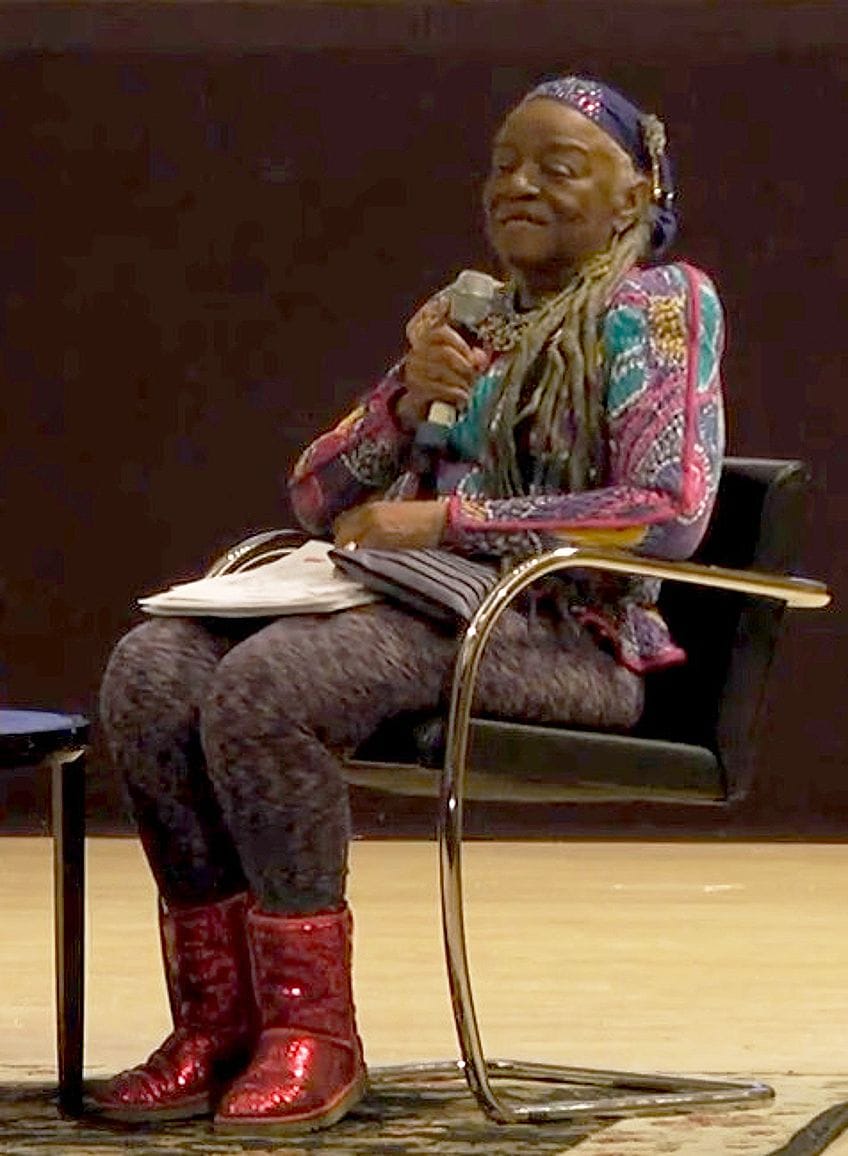
Faith Willi Jones was born on October 8, 1930, in Harlem, New York. Her childhood overlapped with the later Harlem Renaissance, and the neighborhood’s writers, musicians, and artists became an enduring cultural reference in her work. Severe asthma often kept her indoors, where her mother, the dressmaker and fashion designer Willi Posey, encouraged her to draw and taught her to sew. Ringgold died on April 13, 2024, at her home in Englewood, New Jersey, at age 93.
Ringgold studied at the City College of New York when women were barred from its fine arts program. She therefore pursued art education, earning a B.S. in 1955 and an M.A. in art in 1959. The restriction shaped both her professional path and her later determination to confront racial and gender barriers in cultural institutions.
Her early adulthood also included marriage to musician Robert Earl Wallace and the birth of their daughters, Barbara and Michele. After the marriage ended, Ringgold supported her family by teaching art in New York City public schools from 1955 to 1973 while continuing to paint.
Faith Ringgold Art Career
Ringgold traveled in Europe during the early 1960s and then developed her first sustained body of political paintings, the American People Series (1963-1967). She presented her first and second solo exhibitions at New York’s Spectrum Gallery in 1967 and 1970.
After seeing Tibetan and Nepalese thangkas – paintings mounted in brocaded fabric – in Amsterdam in 1972, Ringgold began painting on unstretched canvas with sewn fabric borders. That portable format led into her masks, soft sculptures, and masked performances of the 1970s and 1980s.
Ringgold’s engagement with African art preceded her travels to Ghana and Nigeria in the 1970s. Encountering West African mask traditions firsthand deepened, rather than began, an influence already present in her practice.
In 1980, Ringgold and her mother collaborated on Echoes of Harlem, her first quilt: Ringgold painted its portraits and Willi Posey quilted the fabric. Ringgold then combined painted scenes, pieced borders, and text in Who’s Afraid of Aunt Jemima, completed in 1983. This first story quilt let her publish her own words when conventional publishers had shown little interest in her autobiography.
Ringgold also wrote and illustrated children’s books, beginning with Tar Beach, published by Crown in 1991. Based on the 1988 story quilt from her Woman on a Bridge series, the book follows Cassie Louise Lightfoot as she flies above Harlem and claims imaginative freedom. In 1992, it received both a Caldecott Honor and the Coretta Scott King Illustrator Award.
In 1992, Crown published Aunt Harriet’s Underground Railroad in the Sky. A year later, Hyperion Books published Dinner at Aunt Connie’s, based on Ringgold’s The Dinner Quilt (1986). She ultimately authored 20 children’s books as well as the memoir We Flew Over the Bridge. Ringgold was a professor in the Visual Arts Department at the University of California, San Diego, from 1984 to 2002.
Faith Ringgold Art: A Multimedia Exploration of Black Lives in America
Across seven decades, Ringgold used multiple media to examine Black life, gender, family, freedom, and the stories that conventional histories left out. Her images could be confrontational or joyful, but painting, fabric, text, and performance consistently worked together as forms of visual storytelling.
Faith Ringgold Paintings
Ringgold began with landscapes and figurative paintings shaped by her formal training in European art, including Cubism and Impressionism. By the early 1960s, however, she rejected neutral subjects and developed a flat, hard-edged figurative style suited to the racial and political conflicts she wanted to address.
Ringgold’s childhood overlapped with the later years of the Harlem Renaissance, but her political paintings responded most directly to the Civil Rights and Black Power eras.
The American People Series (1963-1967) was Ringgold’s first sustained collection of political paintings. Across the series, she examined interracial encounters, class, gender, and the violence beneath respectable appearances. Jacob Lawrence’s narrative approach was important to her, but Ringgold’s perspective as a Black woman gave the series its own place within the visual history of the Civil Rights Movement.
I felt called upon to create my vision of the black experience we were witnessing.
— Faith Ringgold, We Flew Over the Bridge
As a Black female artist, Ringgold used the series to depict experiences that galleries and museums routinely ignored. Other oil paintings in the series, including Watching and Waiting, For Members Only, The Civil Rights Triangle, and Neighbors, expose distance, suspicion, and unequal power within everyday social settings.
While completing the American People Series , Ringgold began the Black Light Series (1967-1969). She sharply reduced the use of white paint and built faces and words from subtle variations of dark color. The experiment challenged Western conventions that treated white as the basis of light and contrast while developing what she described as a more affirmative Black aesthetic.
Ringgold concluded her American People Series in 1967 with mural-scale paintings including Die, U.S. Postage Stamp Commemorating the Advent of Black Power, and The Flag is Bleeding. Their compressed figures, flag imagery, and scenes of conflict turn national symbols into arguments about who is protected by the United States and who is endangered within it.
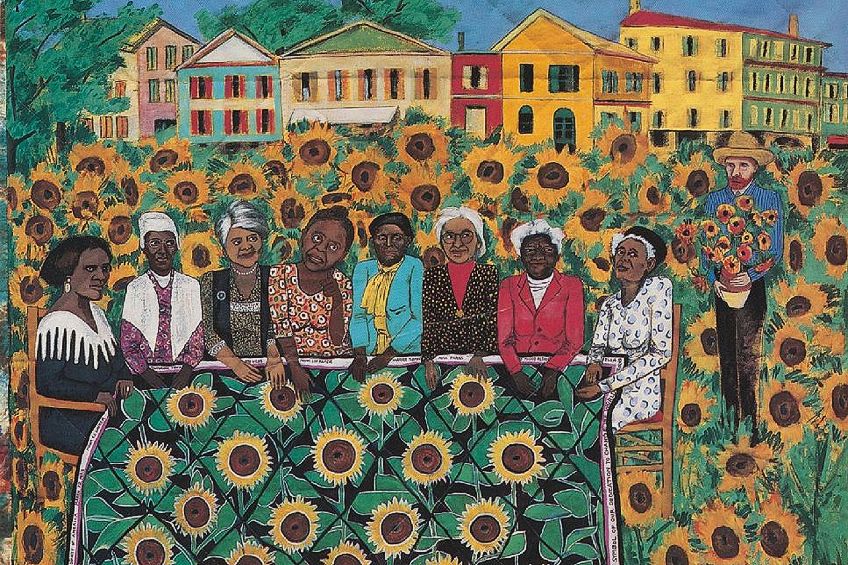
The 12 story quilts in the French Collection (1991-1997) follow the fictional artist Willia Marie Simone from Harlem to Paris in the 1920s. By placing Black women inside scenes associated with Picasso, Matisse, Van Gogh, and the Louvre, Ringgold did more than celebrate European modernism: she rewrote an art history that had marginalized Black subjects and makers.
For the Women’s House (1972)
Ringgold created For the Women’s House in 1971 and installed it at the women’s facility on Rikers Island in January 1972. Sponsored through a public-service art program, the mural presents women as doctors, athletes, clergy members, construction workers, and political leaders – futures that the incarcerated women Ringgold interviewed wanted represented.
The mural’s triangular divisions draw on Kuba textile designs from Central Africa, while its subjects replace punishment with possibility. As Ringgold’s first public commission and an early explicitly feminist painting, it joined her activism to the aspirations of a specific audience rather than treating the prison merely as a backdrop.
Faith Ringgold Self-Portrait (1965)
Completed as Ringgold was developing her political style, this 1965 self-portrait belongs to the period between the Civil Rights Movement and the rise of Black Power. Its flat shapes, firm contours, and frontal pose reject decorative softness.
Ringgold presents herself with folded arms and a steady gaze. The pose is guarded but self-possessed, asserting the authority of a modern Black woman artist at a time when that identity was largely absent from major museums and art-history texts.
Faith Ringgold Quilts
Ringgold’s move into fabric began in the early 1970s as she sought an alternative to the stretched, framed canvas associated with European painting. During a 1972 trip to Europe, she encountered Tibetan and Nepalese thangkas at Amsterdam’s Rijksmuseum. Their portable combination of image and brocaded border suggested a structure she could adapt without abandoning painting.
Back in New York, Ringgold made acrylic paintings on unstretched canvas with fabric frames and extended the same materials into soft sculpture and cloth dolls. The Slave Rape Series (1972-1973) was not a quilt series; it consisted of thangka-inspired fabric paintings that narrated an African woman’s capture, resistance, and survival from a Black feminist perspective.
Ringgold’s mother taught her to sew and later collaborated on Echoes of Harlem, quilting the fabric around Ringgold’s painted portraits.
After publishers rejected her autobiography, Ringgold made storytelling part of the physical structure of her art. Echoes of Harlem (1980) was her first quilt, while the story quilts that followed added handwritten narratives. Her best-known example, Tar Beach, is the first of five works in the Woman on a Bridge series, completed in 1988.
Other narrative quilts include the Michael Jackson tribute Who’s Bad? (1988). In Who’s Afraid of Aunt Jemima (1983) , Ringgold transformed a racist stereotype into the story of a successful Black businesswoman with a complex family history. Several quilts later became children’s books; The Dinner Quilt (1986), for example, inspired Dinner at Aunt Connie’s, published by Hyperion Books in 1993.
Ringgold’s French Collection expanded the form into a historical fiction about art, race, gender, and cultural authority. Works such as The Sunflower Quilting Bee at Arles gather influential African American women inside an imagined European art history. The written borders make the pictured encounters part of a larger narrative rather than isolated scenes.
Change: Faith Ringgold’s Over 100 Pounds Weight Loss Performance Story Quilt (1986)
Completed in 1986, this autobiographical performance story quilt traces Ringgold’s weight-loss experience through changing ideas about health, beauty, and self-determination. She activated it with masks, costumes, singing, and dance, showing how a quilt could function simultaneously as image, written narrative, stage set, and record of a performance.
Faith Ringgold Sculpture
Ringgold began experimenting with sculpture in the early 1970s and left public-school teaching in 1973 to focus on her art. Her works range from freestanding and hanging soft portraits to dolls and costumed masks. The Witch Mask Series is among the best-known examples because it joins sculpture, clothing, and the possibility of performance.
The later Family of Woman Mask Series commemorated women and children Ringgold had known while growing up in Harlem. She also made dolls with painted gourd heads and costumes sewn in collaboration with her mother, bringing family memory and traditionally feminized materials into the field of sculpture.
The dolls led to life-sized soft sculptures, beginning with Wilt (1974). Ringgold later carved and painted foam faces for portrait masks representing both prominent figures, including Martin Luther King Jr., and people associated with her Harlem community.
As Ringgold described in her autobiography, the exposed foam eventually deteriorated. She restored the faces by covering and carefully remolding them in cloth, an adaptation that preserved their likenesses while changing their surfaces.
The Witch Mask Series (1973)
Ringgold began making masks after her students asked why an artist so engaged with African sources had not already done so. Created with her mother, the Witch Mask Series developed into a group of 11 mask costumes that could be displayed as sculptures or worn.
Ringgold constructed the mixed-media masks from painted linen canvas, beads, and woven raffia hair. Long pieces of cloth formed dresses, while painted gourds supplied breasts and emphasized the costumes’ female bodies.
Ringgold noted that men often performed female roles in the African masking traditions she studied. Her own costumes gave any wearer feminine characteristics while retaining what she called both a spiritual and a sculptural identity. Their wearability was therefore not incidental: movement transformed the masks from decorative objects into characters.
Wilt (1974)
Wilt is a life-sized soft-sculpture installation portraying basketball player Wilt Chamberlain with a fictional white wife and mixed-race daughter. Ringgold made it in response to disparaging comments about African American women in Chamberlain’s autobiography.
The three figures have baked and painted coconut-shell heads and clothed foam-and-rubber bodies. Suspended from the ceiling on nearly invisible lines, they shift the authority of a monumental male sports figure into an unsettling family tableau devised by the artist.
Faith Ringgold Performance Art
Because Ringgold’s masks were designed to be worn, their transition into performance art was a natural one. Her approach drew on African traditions that combine masks, costume, dance, music, and storytelling, while also incorporating family memories and the call-and-response energy of the Black church.
From the mid-1970s onward, Ringgold used performance to animate characters and narratives that also appeared in her paintings, masks, and quilts. Works associated with The Bitter Nest used a fictional Harlem family to explore generational conflict, creativity, and the cultural memory of the Harlem Renaissance.
In 1986, Ringgold turned her weight-loss journey into a multidisciplinary performance using masks, costumes, dance, song, and Change: Faith Ringgold’s Over 100 Pounds Weight Loss Performance Story Quilt. Audience participation was integral to many of these works. Inviting viewers to sing or dance made storytelling a collective event rather than a fixed image observed at a distance.
For Ringgold, performance extended storytelling into real space: masks became characters, quilts became settings, and audiences could become participants.
The Wake and Resurrection of the Bicentennial Negro
Conceived in response to the 1976 American Bicentennial, The Wake and Resurrection of the Bicentennial Negro was Ringgold’s first multimedia masked performance. It confronted the contradiction between a national celebration of freedom and a history marked by slavery and racial oppression.
The work stages a Black family’s symbolic death and rebirth through masks, soft sculptures, painted backdrops, gospel music, and mime. By combining objects from her studio with live action, Ringgold made history feel embodied and unfinished rather than safely contained in a commemorative pageant.
Faith Ringgold: Activism Through Art
Ringgold’s art and activism developed together. In 1970, she helped organize the Ad Hoc Committee of Women Artists with critics and artists including Lucy Lippard and Poppy Johnson. The group protested the Whitney Museum’s annual exhibition, demanding that women constitute half of the exhibitors and that Black women receive meaningful representation.
Their actions used chants, whistles, eggs, and sanitary napkins marked with the 50-percent demand to disrupt business as usual. Ringgold’s 1970 arrest occurred in a different action: she, Jon Hendricks, and Jean Toche organized the antiwar People’s Flag Show at Judson Memorial Church and became known as the Judson Three after being charged under flag-desecration laws. Ringgold also participated in Women Artists in Revolution.
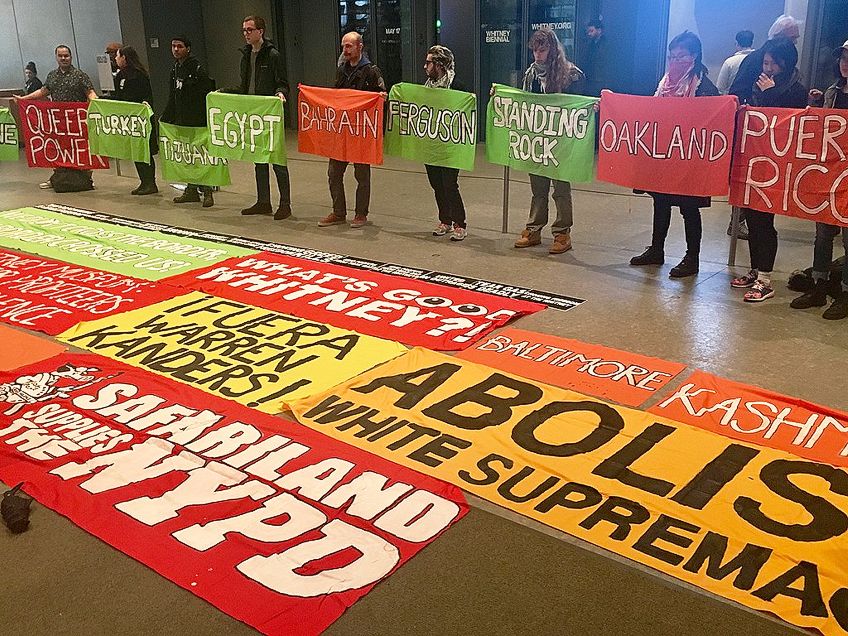
In 1970, Ringgold and her daughter Michele Wallace co-founded Women Students and Artists for Black Art Liberation. The following year, Ringgold joined Kay Brown and Dindga McCannon in founding the New York collective “Where We At” Black Women Artists, which created exhibition opportunities and community for Black women. Ringgold also participated in the National Black Feminist Organization after it formed in 1973.
Ringgold conceived the Coast-to-Coast Women of Color National Artists’ Projects in 1987 and organized its first major exhibition with Clarissa Sligh and Margaret Gallegos in 1988. The initiative connected women artists of color across the United States through exhibitions, artists’ books, panels, and workshops.
Ringgold wrote the catalog introduction, entitled History of Coast to Coast. The project brought together hundreds of participants, and its 1990 catalog documented more than 100 women artists of color. Contributors included Ringgold, Sligh, Beverly Buchanan, Martha Jackson Jarvis, Adrian Piper, Deborah Willis, Emma Amos, Howardena Pindell, Joyce J. Scott, and Elizabeth Catlett.
Ringgold also carried her historical project into public space. Her Flying Home: Harlem Heroes and Heroines mosaics celebrate Black cultural figures in a Harlem subway station, while People Portraits presents dozens of figures in a Los Angeles Civic Center station. These works made transit spaces into sites of collective memory.
The Continuing Significance of Faith Ringgold
Ringgold’s images remain historically specific without becoming closed records of the past. The Museum of Modern Art acquired Die from the American People Series in 2016 and displayed it in 2019 in dialogue with Les Demoiselles d’Avignon, one of the best-known paintings by Picasso. The pairing acknowledged both Ringgold’s engagement with modernism and the museum’s belated recognition of a Black woman artist who had protested its exclusions.
The touring retrospective Faith Ringgold: American People, which opened at the New Museum in 2022 and traveled through 2024, brought together more than six decades of paintings, sculptures, performances, quilts, and books. Its breadth reinforced a key point: Ringgold’s story quilts are central to her reputation, but they belong to a much larger practice that repeatedly joined formal invention to struggles over race, gender, and cultural authority.
Faith Ringgold made personal memory, political protest, and imaginative freedom part of the same visual language. Her influence rests not only on what she represented, but on how she dissolved boundaries among painting, craft, literature, performance, and public art.

Isabella studied at the University of Cape Town in South Africa and graduated with a Bachelor of Arts majoring in English Literature & Language and Psychology. Throughout her undergraduate years, she took Art History as an additional subject and absolutely loved it. Building on from her art history knowledge that began in high school, art has always been a particular area of fascination for her. From learning about artworks previously unknown to her, or sharpening her existing understanding of specific works, the ability to continue learning within this interesting sphere excites her greatly.
Her focal points of interest in art history encompass profiling specific artists and art movements, as it is these areas where she is able to really dig deep into the rich narrative of the art world. Additionally, she particularly enjoys exploring the different artistic styles of the 20th century, as well as the important impact that female artists have had on the development of art history.
Learn more about Isabella Meyer and the Art in Context Team.
Cite this Article
Isabella, Meyer, “Faith Ringgold – An Exploration of the Artistic Life of Faith Ringgold.” Art in Context. March 3, 2021. URL: https://artincontext.org/faith-ringgold/
Meyer, I. (2021, 3 March). Faith Ringgold – An Exploration of the Artistic Life of Faith Ringgold. Art in Context. https://artincontext.org/faith-ringgold/
Meyer, Isabella. “Faith Ringgold – An Exploration of the Artistic Life of Faith Ringgold.” Art in Context, March 3, 2021. https://artincontext.org/faith-ringgold/.


