


Chiharu Shiota – How Thread Makes Invisible Connections Visible

Chiharu Shiota transforms galleries into dense networks of thread that surround boats, keys, dresses, beds, shoes, suitcases, and other objects marked by human use. Drawing on performance, installation, and her early training in painting, she gives physical form to memory, connection, absence, uncertainty, and the boundaries of the body.
Key Takeaways
- Shiota is a Japanese installation and performance artist born in Osaka in 1972 and based in Berlin.
- She describes thread as a means of drawing in three-dimensional space rather than simply as a textile or craft material.
- Her installations frequently combine red, black, or white thread with objects that retain traces of absent owners.
- Red can evoke blood and relationships, black the night sky or cosmos, and white beginnings and endings, but Shiota does not treat these associations as an inflexible code.
- Recurring themes include memory, migration, identity, life, death, uncertainty, and what the artist calls presence in absence.
- Her major projects include Memory of Skin, In Silence, The Key in the Hand, Uncertain Journey, and the touring survey The Soul Trembles.
Who Is Chiharu Shiota?
Chiharu Shiota was born in Osaka, Japan, in 1972. She entered Kyoto Seika University in 1992 to study painting and spent 1993–94 as an exchange student at the Canberra School of Art in Australia. She subsequently continued her education in Germany, including study at the Braunschweig University of Art with performance artist Marina Abramović and at the Berlin University of the Arts.

After moving to Germany in 1996, Shiota developed an internationally oriented practice from Berlin. Her work now encompasses large-scale installation, sculpture, drawing, photography, video, performance, and stage design. This range is important because the thread environments for which she is best known grew from experiments involving painting and the body rather than from conventional weaving alone. Shiota represented Japan at the 56th Venice Biennale in 2015.
Institutional presentations have included the Smithsonian’s Arthur M. Sackler Gallery in Washington, DC, the Mori Art Museum in Tokyo, Gropius Bau in Berlin, the Queensland Art Gallery | Gallery of Modern Art in Brisbane, the Hammer Museum in Los Angeles, and the Grand Palais in Paris.
From Painting to Performance and Installation
Shiota initially intended to become a painter, but she became dissatisfied with placing color on a bounded canvas. During her exchange in Canberra, she produced parallel-line drawings titled One Line and began extending thread through physical space as though a drawn line had left the paper. Her 1994 performance Becoming Painting followed a dream in which she had entered a painting and viewed herself from inside it. Shiota covered her body and a sheet with red paint, making the body part of the painted field.

Instead of representing a figure, the work placed the artist physically inside the material and process of painting. This shift established a problem that continues throughout her practice: how can an artwork register bodily presence without relying on a conventional image of the body? Early performances supplied the body directly. Later installations often remove it, allowing dresses, beds, chairs, shoes, and other used objects to indicate that someone was once present.
Thread as Drawing in Three-Dimensional Space
Shiota frequently describes working with thread as drawing in the air. An individual strand functions like a line, but repetition turns those lines into planes, cavities, clusters, routes, and apparently impenetrable volumes. Dense areas can resemble shadow or solid matter, while open sections allow visitors to see through several spatial layers at once. The installations are not woven like cloth on a loom. Thread is stretched, knotted, crossed, and anchored to architectural surfaces or supporting structures.
Shiota and an installation team respond to the proportions, entrances, ceiling height, sight lines, and circulation of each venue. Construction is therefore both planned and adjusted through physical work inside the space.
This process links the installations to performance. Although visitors usually encounter the finished network after the artist and team have left, its accumulation records repeated bodily gestures: reaching, fastening, crossing, climbing, and moving between anchor points. The thread is both the completed image and evidence of the labor that produced it.
Why Density Matters
The networks often seem to oscillate between protection and obstruction. Thread can connect one point to another, but knots and accumulated crossings can also restrict movement or conceal an object. A web may resemble a shelter, circulatory system, cloud, trap, map, or field of energy without resolving into any single representation.

That ambiguity gives the installations much of their force. Connection is not automatically presented as harmonious. Relationships can become tangled, break, or lead in uncertain directions. The same material can suggest intimacy and distance, continuity and separation, or memory and forgetting.
What Do the Red, Black, and White Threads Mean?
Red Thread
Shiota has associated red with blood and the connections carried through it, including family, identity, and relationships between people. The color also recalls the East Asian story of an invisible red thread linking individuals whose lives are destined to intersect. In the installations, red often has an anatomical immediacy. Lines spreading from a boat, key, or personal object can look like arteries or branching nerves.
This resemblance is a direct visual observation rather than proof that every red installation illustrates the human circulatory system.
Black Thread
Shiota has compared black thread to a drawn line and to the darkness of the night sky or cosmos. When many strands accumulate, a gallery can appear shadowed even though the thread remains materially thin. Black also helps works such as In Silence create a visual field in which burned objects seem surrounded by smoke, darkness, or arrested sound.

White Thread
White has been connected in Shiota’s statements with beginnings and endings and with the cycle of life and death. It can make suspended forms appear lighter and less materially fixed, as in the boat-like structures of Where Are We Going?.
These associations are useful, but they are not a decoding system in which one color always guarantees one meaning.
Shiota has explained that she does not necessarily begin an installation by selecting a color to impose a predetermined interpretation. Similar objects and existential questions appear in red, black, and white works, while the architecture and specific project alter how each color operates.
Objects as Traces of Absent Lives
Shiota’s used objects do more than provide recognizable shapes within abstract thread. Shoes bend according to their wearers’ feet, keys pass repeatedly through hands, suitcases accompany journeys, and chairs or beds register the scale of a missing body. Their previous use cannot be reconstructed completely, but signs of wear establish that they have histories beyond the exhibition.
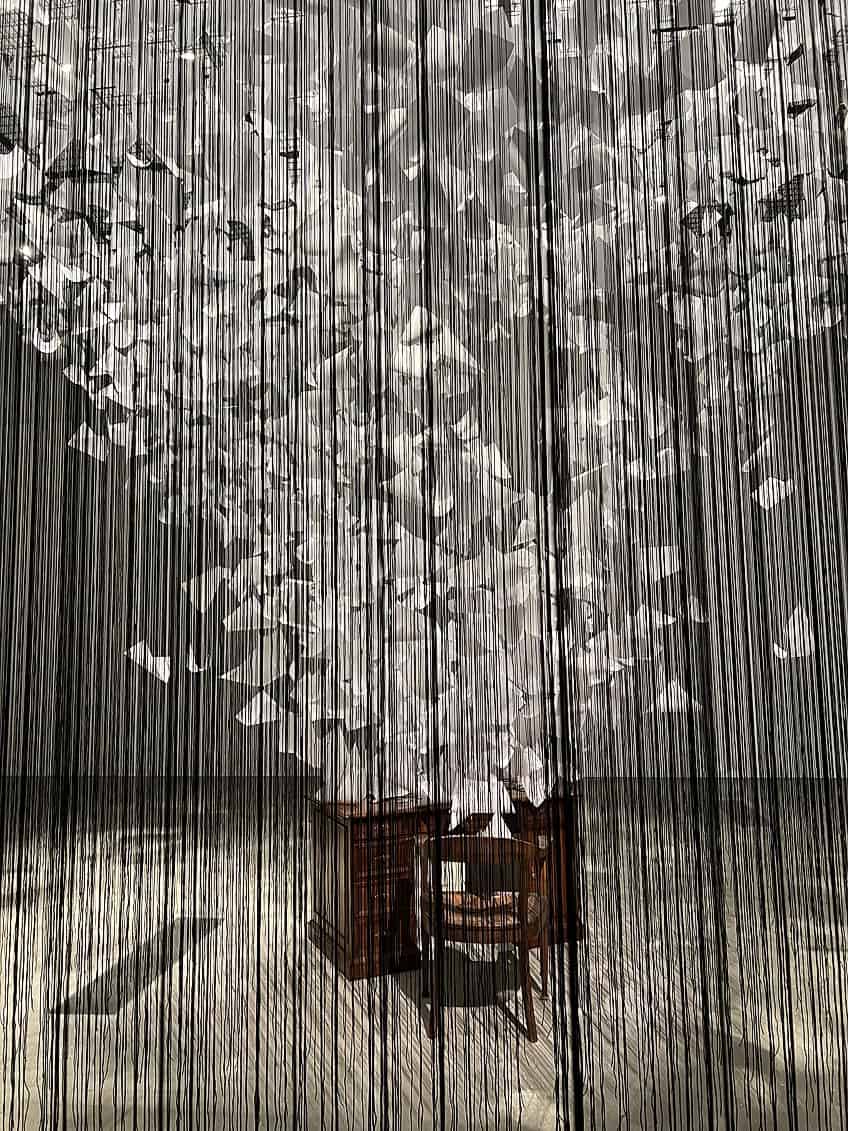
This relationship between an object and a person who is no longer there is central to Shiota’s idea of presence in absence. The installations do not restore the absent owner. Instead, they make that absence perceptible by arranging what remains.
- Shoes retain physical traces of individual owners and can be accompanied by written memories.
- Keys suggest access, protection, trust, homes, and memories accumulated through touch.
- Suitcases carry associations with travel, migration, movement, and uncertain destinations.
- Boats give journeys a bodily scale while emphasizing that their routes and outcomes remain unknown.
- Dresses indicate the outline or boundary of a body without containing one.
- Beds and chairs mark spaces of sleep, waiting, illness, performance, or communal gathering.
- Windows divide inside from outside while retaining connections to buildings and their former occupants.
Major Installations
Memory of Skin
Shiota first attracted broad attention in Japan with Memory of Skin at the inaugural Yokohama Triennale in 2001. The installation used monumental empty dresses, dirt, and water. Their exaggerated scale separated the garments from ordinary clothing while retaining an unmistakable relationship to the human body. The title joins memory to skin, the surface that separates a person’s interior from the surrounding world while recording contact, injury, and age. Because the dresses are empty, they present the body through its absence.
Dirt and water add a cycle of staining and attempted cleansing without converting the work into a literal narrative about a particular wearer.
In Silence
The first version of In Silence was created in 2002 with a burned grand piano, a burned chair, and black wool. Shiota connected the work to a childhood memory of seeing a neighboring house destroyed by fire. In later versions, the charred piano and rows of burned seating are engulfed by a dense black network. A piano normally produces sound through touch and coordinated movement. Once burned, it remains recognizable but can no longer perform that function. The empty chairs similarly imply listeners who are not present.
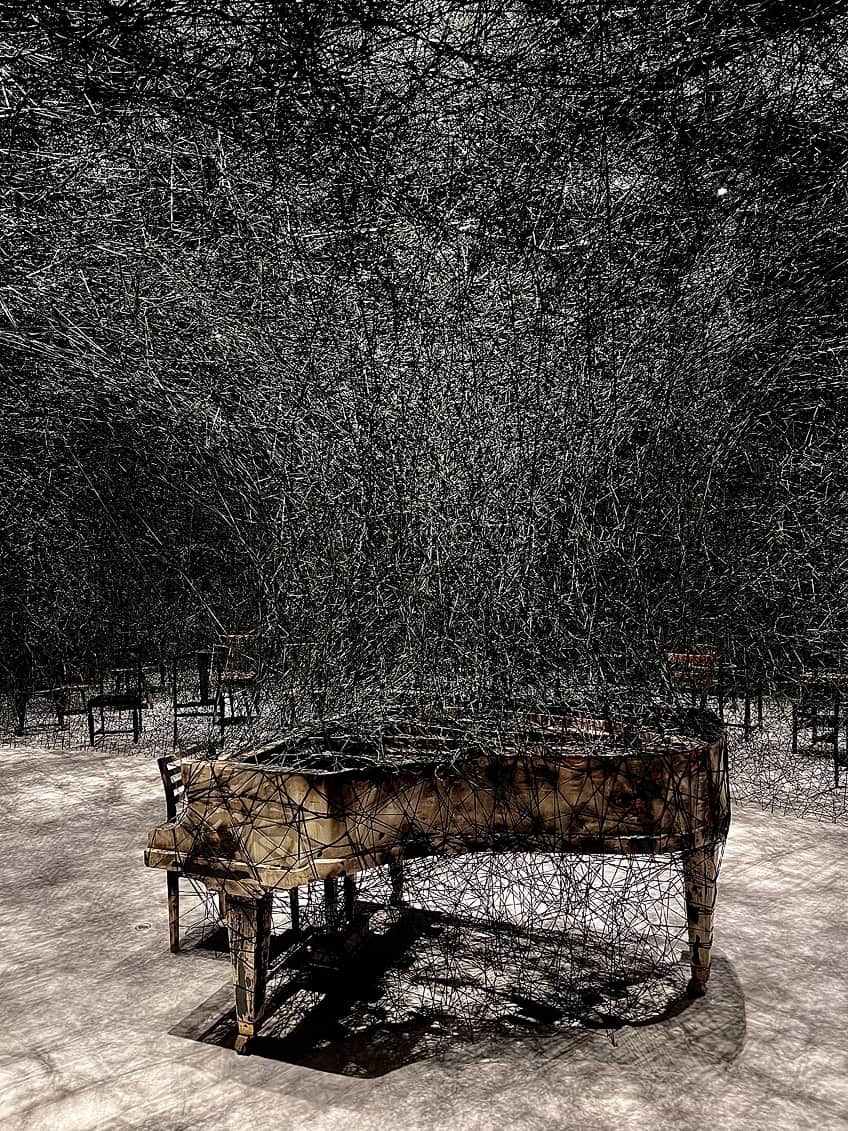
Black thread connects instrument, audience, and architecture, giving silence a visible structure without pretending that the lost sound can be recovered. The work demonstrates how Shiota uses an object’s failed function as part of its meaning. The piano matters not only because it looks dramatic after burning, but because viewers understand what it once allowed people to do. Its material survival makes its acoustic absence more apparent.
Over the Continents
For Over the Continents at the Smithsonian’s Arthur M. Sackler Gallery in 2014, Shiota arranged hundreds of donated shoes and connected them with red yarn. Handwritten notes described memories associated with individual pairs. The work developed from earlier shoe installations, including Dialogue from DNA. Collecting both shoes and accounts of their owners made the Smithsonian version more specific than a generalized image of anonymous footwear.
Each object belonged to the collective arrangement while retaining evidence of an individual life.
The red lines converged visually while the shoes remained separate. That structure provides a concise model of Shiota’s treatment of relationships: people may share networks, places, and histories without becoming interchangeable.
The Key in the Hand
Shiota represented Japan at the 2015 Venice Biennale with The Key in the Hand. Approximately 180,000 used keys collected from contributors around the world hung from an extensive canopy of red yarn above two old Venetian boats. Other keys lay across the floor, while photographs and videos in the pavilion’s lower area considered children’s earliest memories.

Keys are intimate tools whose significance exceeds their size. They secure homes and possessions, are warmed through repeated handling, and may be entrusted to another person. Once separated from their locks, the keys in Shiota’s installation no longer provide practical access, but they retain signs of unknown relationships and places.
The boats beneath the suspended keys were presented as hand-like forms receiving a rain of memories. Their local association with Venice also grounded the installation in its site. Personal objects gathered internationally entered a structure that combined individual memory, collective accumulation, and physical journey.
Uncertain Journey
First presented in Berlin in 2016, Uncertain Journey places skeletal metal boats beneath an expanding network of red thread. Unlike the recognizable wooden vessels in The Key in the Hand, these boats are reduced to open frames.
The threads rise from and move between them, filling the space with possible routes that never settle into a readable map.
The work connects the boat motif to uncertainty rather than to a specific destination. The vessels imply departure and passage, but they have no solid hulls and cannot function on water. What appears to propel or connect them may also hold them in place.
Accumulation – Searching for the Destination
In versions of Accumulation – Searching for the Destination, hundreds of suitcases hang from red ropes and move gently through mechanical means. Shiota developed the work after discovering old newspapers inside a suitcase found in Berlin.
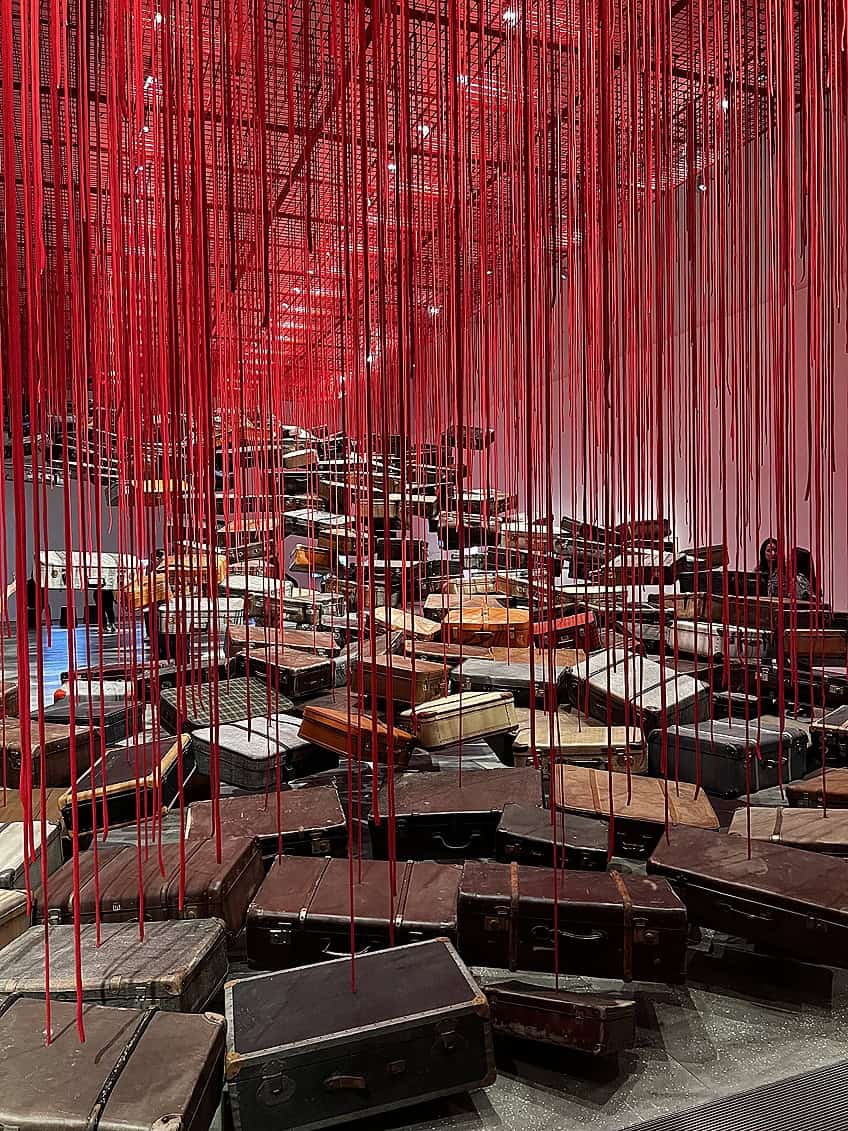
A suitcase usually concentrates selected possessions into a portable container. Presented empty and in large numbers, the cases suggest journeys whose travelers, origins, and endpoints are unavailable. Their motion makes the installation feel temporarily suspended between departure and arrival.
Site-Specific Work and Multiple Dates
Shiota’s thread installations are generally created in response to particular buildings and dismantled when exhibitions close. A work can therefore be reconstructed with a different arrangement, number of objects, thread density, or spatial scale while retaining its title and central concept. This explains why museum labels sometimes present a work with two years, such as In Silence 2002/2019 or Uncertain Journey 2016/2022.
The first date commonly identifies the original conception or version, while the second identifies its new realization for a particular exhibition.
Calling these installations ephemeral does not mean they leave no durable record. Objects, metal frameworks, drawings, plans, models, photographs, and videos can survive. What disappears is the exact relationship between thread and architecture. That loss is consistent with a practice concerned with memory: the installation persists through partial evidence rather than remaining physically unchanged.
Presence in Absence
Shiota’s early work placed her own body directly within performances. As her practice developed, the body largely disappeared from the installations while objects assumed a greater role. An empty dress, burned chair, hospital bed, or worn shoe can establish bodily scale and previous contact without depicting a person. This transition is more than a change of medium. Performance makes the artist’s presence temporary because the action ends; the installations make absence their starting condition.

Thread then connects the remaining objects without filling the missing body itself. After the return of Shiota’s cancer in 2017, questions concerning the body and soul became especially explicit. For the 2019 Mori Art Museum survey, she developed Out of My Body, connecting body fragments within a larger installation. The work emerged from her documented experience of surgery and treatment and her feeling that bodily processes and the location of the soul had become uncertain.
Stage Design and Theatrical Space
Shiota has created stage designs for opera, theater, and dance since the early 2000s. Productions have included Toshio Hosokawa’s opera Matsukaze and stagings of Wagner’s Tristan und Isolde, Siegfried, and Twilight of the Gods. Stage design gives her spatial vocabulary a different function. Performers must move through the environment, lighting alters the thread, and the installation changes in relation to music and dramatic time.
Her experience with performance and theater helps explain why even unoccupied gallery installations can appear prepared for an action that has ended or has yet to begin.
The Soul Trembles and the Shape of a Career
The Mori Art Museum organized Shiota Chiharu: The Soul Trembles in Tokyo in 2019 as a survey of approximately twenty-five years of work. It combined large installations with sculpture, drawings, photography, performance documentation, and stage-design material.

The exhibition subsequently traveled internationally, with presentations including the Gallery of Modern Art in Brisbane and the Grand Palais in Paris. Reinstalling works such as In Silence, Uncertain Journey, and Accumulation – Searching for the Destination allowed the survey to preserve a coherent career narrative while adapting its central installations to different architectures. The exhibition also corrected a common reduction of Shiota’s practice to spectacular red webs.
It placed those environments beside black and white installations, early performances, small sculptures, bodily imagery, drawings, moving objects, and theatrical projects. Thread remains central, but its role changes according to the objects, colors, spaces, and forms of absence it encounters.
How to Recognize Chiharu Shiota’s Work
- Room-scale networks made from red, black, or white thread, yarn, or rope
- Lines that move from delicate and transparent to dense and apparently solid
- Used objects whose absent owners remain important to the installation
- Boats, keys, suitcases, shoes, dresses, beds, chairs, windows, and letters
- Site-specific arrangements that alter routes, sight lines, and architectural boundaries
- A tension between connection and entanglement rather than a simple celebration of unity
- Recurring questions about memory, mortality, identity, migration, and presence in absence
A Common Misconception: The Threads Are Not a Fixed Symbolic Code
Shiota’s installations are often summarized as red threads symbolizing human connection. That association is documented, but it explains only part of the practice. A thread can connect objects, obstruct access, record labor, divide space, resemble a drawn line, or make a gallery appear deeper and less stable. The colors are similarly flexible. Red may evoke blood or relationships, black the cosmos or night, and white the cycle of beginnings and endings.

Shiota has also cautioned that these meanings were partly articulated in response to repeated questions about color and do not dictate every work in advance. Interpretation must begin with the complete installation rather than color alone. Chiharu Shiota uses thread to make relationships visible without pretending that they are simple. Her networks connect objects while concealing parts of them, preserve traces while acknowledging loss, and fill spaces with the felt presence of bodies that are no longer there.
Through this balance of material density and physical absence, ordinary possessions become structures for thinking about memory, identity, movement, and mortality.
Frequently Asked Questions
Is Chiharu Shiota a Japanese or German Artist?
Shiota is a Japanese artist born in Osaka. She moved to Germany in 1996 and has developed her practice from Berlin, so institutional profiles commonly describe her as a Japanese-born, Berlin-based artist.
Are Her Installations Made Only From Wool?
No. Wool is common, but individual installations can use other forms of thread, rope, or fiber, including polypropylene and specialized synthetic materials. They may also incorporate metal frameworks, motors, furniture, clothing, boats, keys, shoes, or architectural fragments.
What Happens to the Thread After an Exhibition?
The site-specific network is normally dismantled because it was constructed for that space. Frameworks, objects, plans, documentation, and other components may be retained, while a later version is newly configured for its next venue.
Why Do Some Works Have More Than One Date?
A label such as 2002/2019 generally distinguishes an original version or conception from a later reconstruction. The title and principal idea continue, but the installation is adapted to a new building and exhibition.
Does Shiota Work Only With Installations?
No. Her practice includes performance, sculpture, drawing, painting, photography, video, and stage design. These media clarify how the thread installations developed from bodily action, spatial drawing, and theatrical experimentation.
Cite this Article
artincontext, , “Chiharu Shiota – How Thread Makes Invisible Connections Visible.” Art in Context. September 2, 2026. URL: https://artincontext.org/chiharu-shiota/
, a. (2026, 2 September). Chiharu Shiota – How Thread Makes Invisible Connections Visible. Art in Context. https://artincontext.org/chiharu-shiota/
, artincontext. “Chiharu Shiota – How Thread Makes Invisible Connections Visible.” Art in Context, September 2, 2026. https://artincontext.org/chiharu-shiota/.


