Colors That Start With X: 22 Names, Codes, and Swatches

X is a difficult letter for color names, but it is not an empty one. This atlas gives 22 traceable digital references, from subdued Xanadu to bright Xanthic and near-black Xiketic, with one controlling HEX value, matching RGB data, and a swatch for each. It also shows which labels recur across catalogs, which belong to a single curated list, and how to use them without mistaking a name for a formal standard.
What Counts as a Color That Starts With X?
A color qualifies for this collection when its displayed name begins with X and a public color catalog pairs it with a complete six-digit HEX value. Applying that rule produces 22 distinct names. The list stops there rather than inflating the total with trademarks, vendor paint codes, spelling variants, or unsupported inventions.

These are digital references for sRGB displays. HEX is the controlling value in each row, and the RGB entry expresses the same red, green, and blue channels as decimal numbers. Neither format defines a paint mixture, printing-ink recipe, dye, or physically measured sample.
The Short Answer
The selection ranges from pale warm neutrals and clear yellows to blues, reds, muted greens, purple, and colors close to black. Xanadu, Xanthic, and Xanthous have name-and-code associations repeated across more than one catalog. Most of the remaining entries come from a maintained, human-curated name catalog, while Xander, Xiketic, and Xumo are supplemental references.
Anyone learning basic color theory should treat the names as convenient labels, not intrinsic properties of the colors. A catalog can assign a memorable name to a numeric value, but that does not make the association universal.
Standardized, Cataloged, and Informal Names
CSS has an established table of named color keywords, but it contains no keyword beginning with X. A browser therefore will not interpret names such as Xanadu or Xiketic as colors. Use their numeric HEX values in CSS instead.
The naming-status column distinguishes three useful evidence levels. “Cross-catalog” means the same name and selected value recur in multiple references, but it still does not mean the name is an official standard. “Curated catalog” identifies an association from a maintained public collection. “Supplemental” marks an association documented in an encyclopedia or software catalog outside that base collection.
Colors That Start With X: Name, HEX, RGB, and Swatch
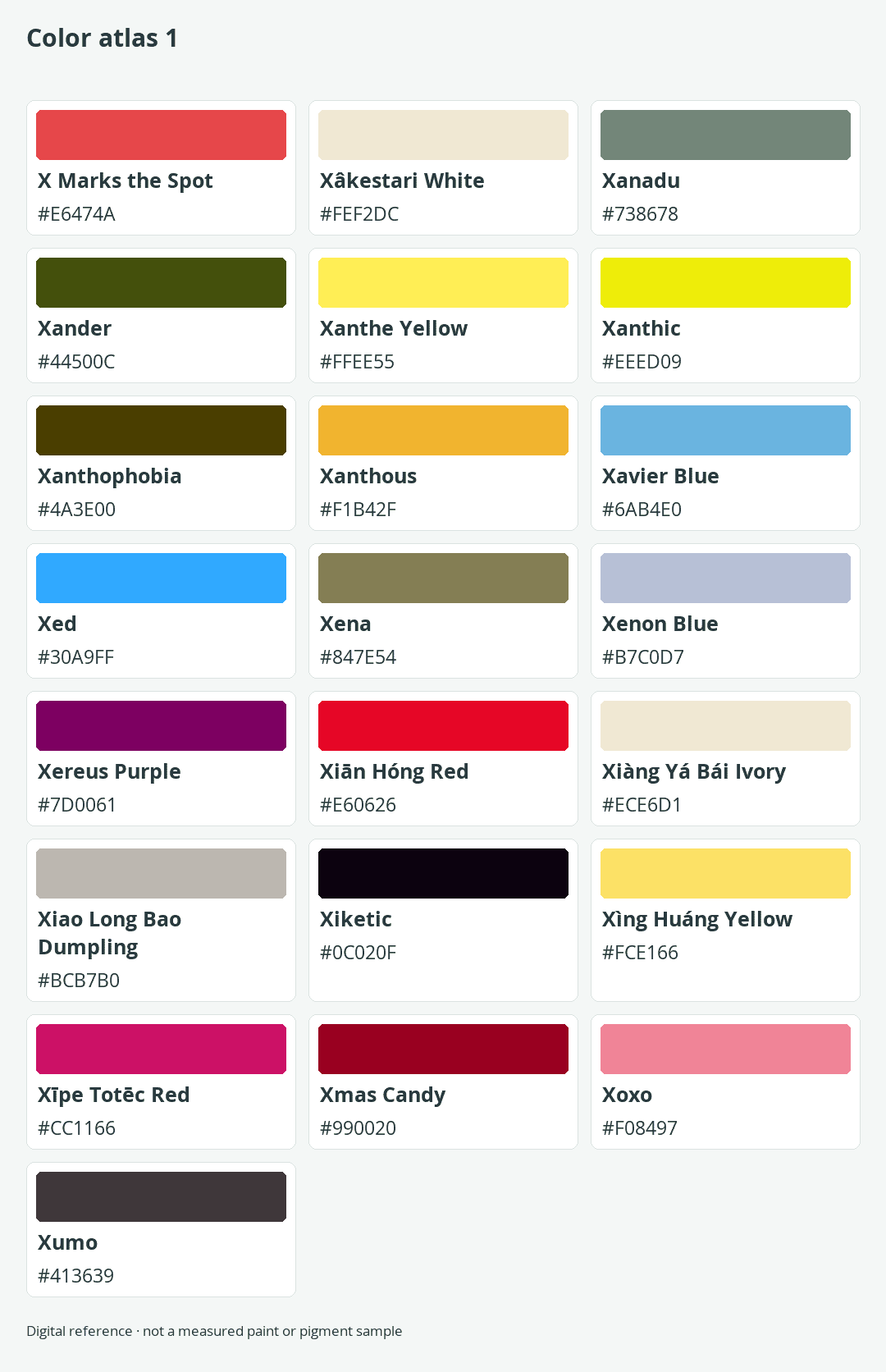
The table is ordered alphabetically by displayed name. Every RGB triplet and visible swatch corresponds to the single HEX value in its row.
| Name | HEX | RGB | Color | Naming Status |
|---|---|---|---|---|
| X Marks the Spot | #E6474A | 230, 71, 74 | Curated catalog | |
| Xâkestari White | #FEF2DC | 254, 242, 220 | Curated catalog | |
| Xanadu | #738678 | 115, 134, 120 | Cross-catalog reference | |
| Xander | #44500C | 68, 80, 12 | Supplemental encyclopedia reference | |
| Xanthe Yellow | #FFEE55 | 255, 238, 85 | Curated catalog | |
| Xanthic | #EEED09 | 238, 237, 9 | Cross-catalog reference | |
| Xanthophobia | #4A3E00 | 74, 62, 0 | Curated catalog | |
| Xanthous | #F1B42F | 241, 180, 47 | Cross-catalog reference | |
| Xavier Blue | #6AB4E0 | 106, 180, 224 | Curated catalog | |
| Xed | #30A9FF | 48, 169, 255 | Curated catalog | |
| Xena | #847E54 | 132, 126, 84 | Curated catalog | |
| Xenon Blue | #B7C0D7 | 183, 192, 215 | Curated catalog | |
| Xereus Purple | #7D0061 | 125, 0, 97 | Curated catalog | |
| Xiān Hóng Red | #E60626 | 230, 6, 38 | Curated catalog | |
| Xiàng Yá Bái Ivory | #ECE6D1 | 236, 230, 209 | Curated catalog | |
| Xiao Long Bao Dumpling | #BCB7B0 | 188, 183, 176 | Curated catalog | |
| Xiketic | #0C020F | 12, 2, 15 | Supplemental software-catalog reference | |
| Xìng Huáng Yellow | #FCE166 | 252, 225, 102 | Curated catalog | |
| Xīpe Totēc Red | #CC1166 | 204, 17, 102 | Curated catalog | |
| Xmas Candy | #990020 | 153, 0, 32 | Curated catalog | |
| Xoxo | #F08497 | 240, 132, 151 | Curated catalog | |
| Xumo | #413639 | 65, 54, 57 | Supplemental encyclopedia reference |
X Marks the Spot to Xanthous
The opening group contains the collection’s strongest concentration of yellows. Xanthe Yellow and Xanthic are sharp digital yellows, while Xanthous leans warmer. Xanthophobia is much darker, so its name does not imply that it should resemble the other xantho-prefixed entries. Xanadu and Xander move instead toward muted green and olive territory.
Xavier Blue to Xenon Blue
Xavier Blue and Xed provide clearer, brighter blues, while Xenon Blue is considerably paler and grayer. Xena sits apart as a muted olive-gray. These differences show why a numeric reference is more useful than relying on the second word of a creative color name.
Xereus Purple to Xumo
The final group spans dark purple, red, ivory, gray, yellow, pink, and near-black. The broader guide to ivory color explains how warm off-whites relate to cream and neighboring neutrals.
Why X Color Lists Do Not Agree
Color words, catalog entries, technical keywords, and commercial product names perform different jobs. A dictionary can document a word without assigning one digital value. A catalog can attach a HEX code to a creative label without making it a standard. A paint maker can reuse an ordinary word for a product whose appearance depends on physical materials.

Xanthic as a Catalog-Conflict Case Study
This atlas uses Xanthic #EEED09 because that pairing recurs in an alphabetical color reference and an open-source implementation. A current curated color-name catalog instead associates Xanthic with #F4E216. The second value is a documented alternative, not a duplicate color entry and not an error that can be resolved by the word alone.
The history of the word helps explain the flexibility. “Xanthic” has been used in English since 1817 for something tending toward yellow, with its deeper root connected to the Greek word xanthos, meaning yellow. That linguistic meaning describes a broad direction, not one uniquely fixed screen color.
Why a Familiar Name Is Not Necessarily a Standard
Repeated use can make a label recognizable, but recognition and standardization are separate questions. Xanadu and Xanthous have relatively strong cross-catalog support in this collection, yet neither is a CSS color keyword. Conversely, a catalog-specific name remains useful when a designer records its exact value alongside it.
How to Use X Colors in Digital Design
Begin with the HEX code, then judge the rendered color within the actual interface or artwork. Names help people discuss a palette, but software needs a recognized keyword or numeric value.
Use the HEX Value, Not the Label
In CSS, write a declaration such as background-color: #738678; for Xanadu. Writing background-color: Xanadu; does not select this color because Xanadu is absent from the CSS named-color table. The same rule applies to all 22 names in the atlas.
Pair by Role and Test Contrast
Assign each color a job before building a palette. For example, Xiàng Yá Bái Ivory can serve as a broad surface, Xanadu as a supporting color, and Xanthic as a small accent. Another starting point could place pale Xenon Blue on large areas, Xavier Blue in supporting graphics, and Xereus Purple in selected accents. These are compositional suggestions, not preapproved text-and-background combinations.
Related reading includes the guides to analogous colors and complementary colors. Test every final foreground and background pair directly.
WCAG 2.2 Level AA calls for a contrast ratio of at least 4.5:1 for normal text and 3:1 for large text. Do not assume that black or white lettering passes merely because a background looks light or dark. Color should also never be the only cue for an error, status, action, or category; add text, icons, patterns, or another visible distinction.
Moving From Screen to Print or Paint
HEX and RGB describe digital color, while process printing commonly works through CMYK. Displays and printers have different gamuts, meaning they cannot necessarily reproduce the same range of colors. A value that glows on a screen may print duller or shift after conversion, depending on the devices, inks, paper, and color-management workflow.
For print, convert through the intended production workflow and inspect a proof. For paint, select or mix a physical sample and compare it under the lighting where it will be used. Illumination changes how an object’s color appears, so a screen swatch is a useful target reference, not a paint recipe or guarantee of an identical physical result.
Frequently Asked Questions
These questions add practical guidance for recording, comparing, and applying the listed colors while keeping catalog labels separate from technical specifications.
Which Names Need Their Diacritics Preserved?
Xâkestari White, Xiān Hóng Red, Xiàng Yá Bái Ivory, Xìng Huáng Yellow, and Xīpe Totēc Red appear with diacritics in the selected catalog. Preserve those display spellings when referring to the listed associations. If a project needs a simpler internal label, keep it separate from the published color name and HEX value.
How Should an X Color Be Recorded in a Design System?
Record a project token, the exact six-digit HEX value, and the source display name as separate fields. This keeps a convenient internal label from replacing the numeric specification or silently turning a catalog-specific name into a supposed standard.
Which Entries Are Useful Light and Dark Surface Candidates?
For light surfaces, preview Xâkestari White #FEF2DC and Xiàng Yá Bái Ivory #ECE6D1. For dark surfaces, preview Xiketic #0C020F and Xumo #413639. These are starting points for visual testing, not automatic approval for any text color.
Should Similar-Looking X Colors Be Combined?
Not in a reference atlas when their documented values differ. Xiketic #0C020F and Xumo #413639 may both read as very dark, but they are separate associations. A project can choose one for its own palette without treating the other name as an alias.
Download the digital color reference sheets: Color atlas 1

Matthew Matthysen is an educated multidisciplinary artist and illustrator. He successfully completed his art degree at the University of Witwatersrand in South Africa, majoring in art history and contemporary drawing. The focus of his thesis was to explore the philosophical implications of the macro and micro-universe on the human experience. Matthew uses diverse media, such as written and hands-on components, to explore various approaches that are on the border between philosophy and science.
Matthew organized various exhibitions before and during his years as a student and is still passionate about doing so today. He currently works as a freelance artist and writer in various fields. He also has a permanent position at a renowned online gallery (ArtGazette) where he produces various works on commission. As a freelance artist, he creates several series and successfully sells them to galleries and collectors. He loves to use his work and skills in various fields of interest.
Matthew has been creating drawing and painting tutorials since the relaunch in 2020. Through his involvement with artincontext.org, he has been able to deepen his knowledge of various painting mediums. For example, watercolor techniques, calligraphy and lately digital drawing, which is becoming more and more popular.
Learn more about Matthew Matthysen and the Art in Context Team.
Cite this Article
Matthew, Matthysen, “Colors That Start With X: 22 Names, Codes, and Swatches.” Art in Context. October 26, 2026. URL: https://artincontext.org/colors-that-start-with-x/
Matthysen, M. (2026, 26 October). Colors That Start With X: 22 Names, Codes, and Swatches. Art in Context. https://artincontext.org/colors-that-start-with-x/
Matthysen, Matthew. “Colors That Start With X: 22 Names, Codes, and Swatches.” Art in Context, October 26, 2026. https://artincontext.org/colors-that-start-with-x/.