


Stress Relief Coloring Pages – 57 Relaxing Coloring Sheets

Explore our collection of 57 stress-relief coloring pages, designed to inspire relaxation and mindfulness. From serene nature scenes to intricate mandalas, these pages offer a creative way to unwind and find peace. Each page is thoughtfully crafted to promote calmness, allowing you to focus, reduce stress, and enjoy the soothing process of coloring. Simply download, print, and let your creativity flow.
Our 57 Stress Relief Coloring Pages for Free
Stress-relief coloring sheets offer a simple and effective way to relax and unwind. By focusing on coloring intricate designs or calming scenes, you can shift your mind away from stress and anxiety. This creative activity encourages mindfulness, improves concentration, and promotes a sense of peace, making it a great tool for reducing tension and boosting mental well-being.
To use these coloring sheets, first, download the PDF of your chosen design. Then, print it on your preferred paper and gather your coloring tools, such as colored pencils, markers, or crayons. Find a quiet, comfortable space and begin coloring. Focus on the details of the design to help calm your mind. Enjoy the process without rushing, and take breaks if needed, returning to it whenever you want more relaxation.


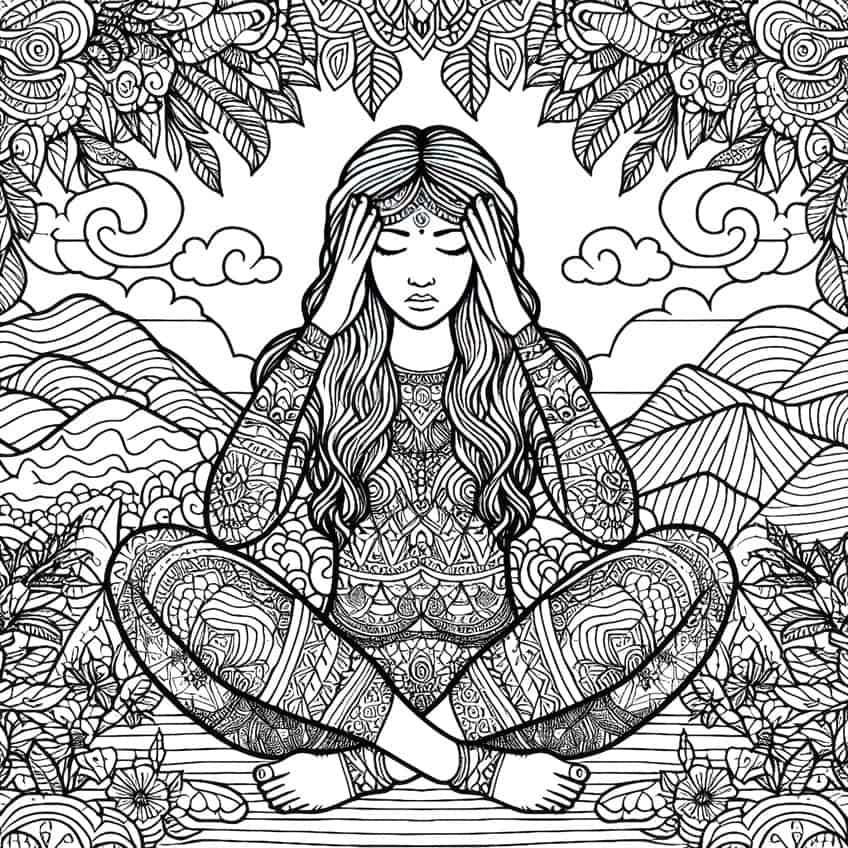 A woman seated in meditation, touching her temples with closed eyes, surrounded by intricate floral and mountain designs. This detailed scene promotes mindfulness and relaxation.


New Stress Relief Coloring Pages with Mandalas and Moths
24 new sheets now join the collection: a mandala of vintage keys and keyholes, three balanced stone stacks in water, layered moths with eyespot wings, flowering vines with curling tendrils, and a stained glass arch window full of spirals. They keep the same calm, repetitive line work as the rest of the set, with enough fine detail to slow you down. Each one prints as a PDF in A4.


🖍️ Color it online

🖍️ Color it online

🖍️ Color it online

🖍️ Color it online

🖍️ Color it online

🖍️ Color it online

🖍️ Color it online

🖍️ Color it online

🖍️ Color it online

🖍️ Color it online

🖍️ Color it online

🖍️ Color it online

🖍️ Color it online

🖍️ Color it online

🖍️ Color it online

🖍️ Color it online

🖍️ Color it online

🖍️ Color it online

🖍️ Color it online
What Stress Relief Coloring Is and Why It Calms
Why Certain Designs Feel Calming
Stress relief coloring pages share a few features. They use repeating shapes, clear outlines, and small enclosed sections, so every choice is small and the whole page stays manageable. That structure gives the mind a simple, steady task, which is a large part of why the activity feels restful.
Mandalas are one example. The word mandala comes from Sanskrit and means circle. A mandala builds outward from a central point in rings of repeating petals, shapes, and lines, as in the key mandala and the layered mandalas in this set. The Swiss psychiatrist Carl Jung wrote about circular designs like these in the early twentieth century and drew them himself, which helped bring the form into Western psychology.
Other designs here draw on older symbols. In Buddhist art, the lotus a Buddha sits on often stands for purity, because the flower rises clean from muddy water. Nature scenes such as the rivers, waterfalls, and mountains work for a different reason: they show places many people already connect with rest.
What Research Suggests
A 2005 study by Nancy Curry and Tim Kasser, published in the journal Art Therapy, tested 84 college students. Students spent 20 minutes coloring a mandala, coloring a plaid pattern, or drawing freely on a blank sheet, and their anxiety was measured before and after. Those who colored the mandala showed a significant drop in anxiety, while free drawing made little difference.
A 2016 study from Drexel University by Girija Kaimal, Kendra Ray, and Juan Muniz measured cortisol, a stress hormone, in saliva samples from 39 adults before and after 45 minutes of making art with markers, clay, or collage materials. Cortisol levels dropped significantly overall, and previous art experience made no significant difference. That study looked at open art making rather than coloring sheets specifically.
Both studies were small, so treat the results as encouraging rather than conclusive. Coloring is a relaxing break, not a treatment, and anyone dealing with ongoing anxiety should talk with a doctor or counselor.
Practical Facts for Printing and Coloring
The pages download as PDF files sized for A4 paper, which measures 210 by 297 millimeters. US Letter paper is a little wider and shorter, so choose the “fit to page” option in the print dialog to keep the whole design on the sheet.
Standard copy paper handles colored pencils, crayons, and gel pens well. Water-based markers can bleed through thin paper, so slip a spare sheet underneath or print on heavier paper or cardstock. Colored pencils suit the fine detail of mandalas and moth wings, while crayons and thick markers work better for young children and for simple pages such as the cupcake, kite, and teapot.
In a classroom, one printed page per student makes a quiet activity of about 15 to 20 minutes. The students in the Curry and Kasser study colored for 20 minutes, so that is a sensible length to try first.
Best Colors for Stress Relief Coloring Pages
There is no wrong palette, but some colors suit calming scenes better than others. Research on color and mood is mixed, so the main rule is to choose shades that feel calm to you. These pairings are a good place to start:
- Blue and teal for rivers, waterfalls, ponds, and sky, since they match the colors of water and open air.
- Sage green and moss green for leaves, vines, trees, and meadows, because they echo living plants.
- Lavender and soft violet for mandala petals, lotus flowers, and evening skies.
- Warm gray, tan, and brown for stacked stones, the log cabin, and tree trunks.
- Soft yellow and peach for suns, balloons, and the glow of a window.
- Saffron orange for Buddha robes, a color long linked with monks’ robes in Buddhist traditions.
For the stained glass window, try jewel tones such as ruby red, sapphire blue, emerald green, and amber. On the moths, pale gold, cream, and dusty brown look natural, with a darker brown or deep blue on the eyespots. If a page feels too busy, limit yourself to two or three related colors and let the white of the paper do the rest.
Where Stress Relief Coloring Came From and the Forms It Takes
From Children’s Books to Adult Bestsellers
Coloring books began as children’s products. In the late nineteenth century, the McLoughlin Brothers publishing house in New York printed some of the earliest ones. For decades after that, coloring was treated mainly as a classroom and nursery activity.
Adults got their own coloring books in the 1960s, but those were mostly jokes. The Executive Coloring Book, published in 1961, poked fun at office life and corporate routine. It was a gag gift, and it was not designed for relaxation.
The shift toward coloring for calm came in 2013, when the Scottish illustrator Johanna Basford published Secret Garden, a book of dense ink drawings of plants, flowers, and hidden creatures. Millie Marotta’s Animal Kingdom followed in 2014. By 2015, adult coloring books regularly appeared on bestseller lists, and Nielsen BookScan reported about 12 million copies sold in the United States that year, compared with roughly 1 million in 2014. Many of the pages in this collection follow the style those books made familiar: fine black outlines, small enclosed spaces, and very little open background.
The Main Styles of Stress Relief Pages
Most stress relief pages fall into a few recognizable styles, and each one asks something slightly different of the person coloring it:
- Mandalas are round and symmetrical, so the same shape repeats in each section of a ring. In Tibetan Buddhism, monks build mandalas from colored sand over days or weeks and then sweep them away, which is a practice centered on impermanence.
- Zentangle-style patterns fill a shape with small repeating marks such as dots, stripes, and scallops. The Zentangle method was created in the early 2000s by Rick Roberts and Maria Thomas. The moth wings and flowering vines in this set use the same kind of filled bands.
- Stained glass designs divide a picture into panes separated by thick lines, like lead came in a real window. Since each pane is closed off, colors never have to blend across a border.
- Nature scenes such as rivers, cabins, and waterfalls offer bigger areas and less repetition. They suit people who would rather shade a sky than fill in hundreds of tiny shapes.
- Simple single objects such as a teapot, kite, or cupcake have wide spaces and few lines, so they work for short breaks and for young children.
How Coloring Differs from Art Therapy
Coloring a printed page at home is not art therapy. Art therapy is a clinical profession, and in the United States it is represented by the American Art Therapy Association, founded in 1969. Sessions are led by a trained therapist, who usually asks the client to create original work and then talks about it with them. Coloring sheets leave out that therapist and that conversation.
The research behind mandala coloring has been repeated as well. In 2012, Renee van der Vennet and Susan Serice published a replication of the Curry and Kasser experiment in Art Therapy. They also found that coloring a mandala lowered anxiety more than coloring a plaid pattern or drawing freely. Like the original, it was a small study of adults in one setting.
Several features set a stress relief page apart from a typical children’s page. The lines are thinner, the sections are smaller, and the design often fills the entire sheet from edge to edge. As a result, one page can take an hour or more to finish. Many people work on it across several short sittings instead of completing it at once.
Building a Calm Color Scheme Step by Step
Colors look more relaxed together when you plan a scheme rather than picking at random. The color wheel offers three methods that suit these pages well.
Analogous schemes use three or four colors that sit next to each other on the wheel, such as blue, blue green, and green, or yellow, yellow orange, and orange. Because neighboring hues share a base color, they blend gently. They suit the waterfall, the river scenes, and the rings of a mandala, where each ring can move one step further around the wheel.
Monochrome schemes use light, medium, and dark versions of a single color. Try pale lilac, lavender, and deep purple on the lotus mandala, or mint, sage, and forest green on the flowering vines. With only one hue to manage, you can concentrate on pressure and shading instead of decisions.
Complementary accents pair colors that sit opposite each other, such as blue and orange or purple and yellow. Keep one of the pair for most of the page and save the other for small spots: a few orange stones in a blue pond, or yellow centers in purple blossoms. Used this sparingly, the contrast pulls the eye without making the page loud.
Before you start a large page, test your chosen pencils on a scrap strip of the same paper. Printer paper can make colors look lighter or darker than the pencil barrel suggests, and a two-minute test saves you from discovering a mismatch halfway through a mandala.
Frequently Asked Questions
Does coloring really reduce stress?
Many people find it relaxing, and small studies such as the 2005 mandala experiment by Curry and Kasser found lower anxiety after coloring. The likely reason is that you give your attention to one simple, absorbing task instead of your worries. It makes a good everyday habit, but it does not replace professional care for ongoing anxiety.
How long should a stress relief coloring session last?
Ten to twenty minutes is a good starting point, and 20 minutes was the length used in the Curry and Kasser study. Stop when you feel calmer rather than when the page is finished. Detailed mandalas are easy to finish over several days.
Are mandalas better than other designs for relaxing?
Mandalas were the pattern tested in the 2005 study, and their repeating structure gives a steady rhythm to follow. Later studies comparing them with other designs have produced mixed results. Choose the design that draws you in, because a waterfall or a teapot may relax you more than a complex pattern.
What supplies work best for these pages?
Colored pencils give the most control for small sections and fine line work. Crayons and washable markers are easier for children, and gel pens add shine to small areas. Print on heavier paper if you plan to use markers, so the ink does not bleed through.
Are these pages suitable for children?
Yes, with a little sorting by difficulty. Simple pages such as the cupcake, kite, kitten, teapot, and hot air balloon have large open areas that suit younger children. The intricate mandalas, moths, and stained glass window have many small sections and are better for older children, teens, and adults.
Related Coloring Pages


Matthew Matthysen is an educated multidisciplinary artist and illustrator. He successfully completed his art degree at the University of Witwatersrand in South Africa, majoring in art history and contemporary drawing. The focus of his thesis was to explore the philosophical implications of the macro and micro-universe on the human experience. Matthew uses diverse media, such as written and hands-on components, to explore various approaches that are on the border between philosophy and science.
Matthew organized various exhibitions before and during his years as a student and is still passionate about doing so today. He currently works as a freelance artist and writer in various fields. He also has a permanent position at a renowned online gallery (ArtGazette) where he produces various works on commission. As a freelance artist, he creates several series and successfully sells them to galleries and collectors. He loves to use his work and skills in various fields of interest.
Matthew has been creating drawing and painting tutorials since the relaunch in 2020. Through his involvement with artincontext.org, he has been able to deepen his knowledge of various painting mediums. For example, watercolor techniques, calligraphy and lately digital drawing, which is becoming more and more popular.
Learn more about Matthew Matthysen and the Art in Context Team.
Cite this Article
Matthew, Matthysen, “Stress Relief Coloring Pages – 57 Relaxing Coloring Sheets.” Art in Context. September 17, 2024. URL: https://artincontext.org/stress-relief-coloring-pages/
Matthysen, M. (2024, 17 September). Stress Relief Coloring Pages – 57 Relaxing Coloring Sheets. Art in Context. https://artincontext.org/stress-relief-coloring-pages/
Matthysen, Matthew. “Stress Relief Coloring Pages – 57 Relaxing Coloring Sheets.” Art in Context, September 17, 2024. https://artincontext.org/stress-relief-coloring-pages/.


