Indian Yellow Color: History, Pigment, and Modern Uses

Indian yellow can glow like late sunlight, yet the name hides three different things: a historic pigment, a modern paint label, and a digital color. Separate them, and the famous origin story becomes clearer while paint choices become far more practical. This guide shows what the evidence supports, how present-day formulas differ, and how to build reliable mixes and palettes.
What Color Is Indian Yellow?
Indian yellow is a warm yellow-orange associated with transparent, luminous passages of color. Historic pigment, present-day tube paint, and an on-screen swatch can share that general appearance without being chemically or visually identical.
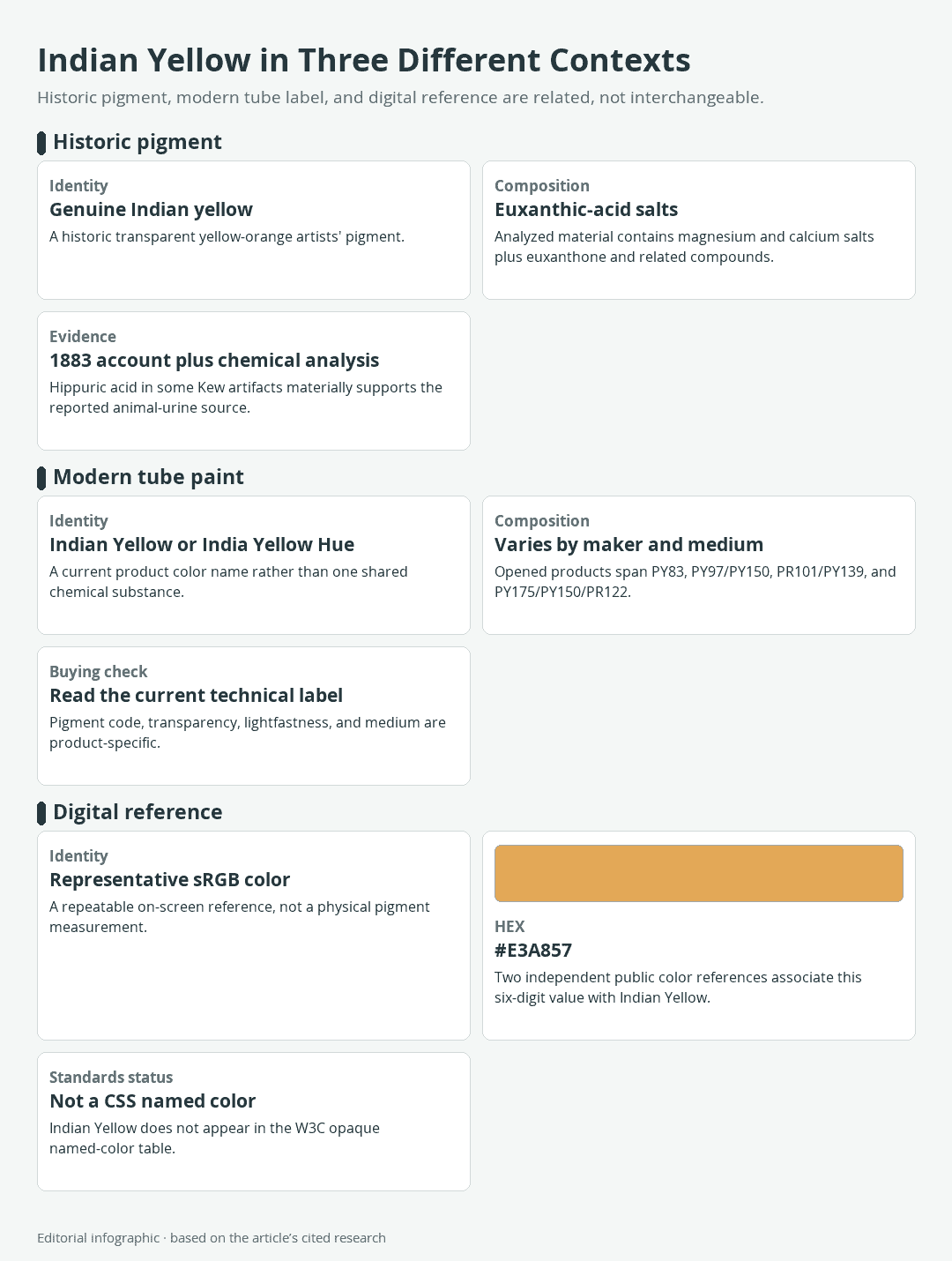
Download the complete color reference sheet (PNG): Indian Yellow in Three Different Contexts (PNG)
For digital work, #E3A857 provides a useful representative Indian Yellow. It is an informal sRGB association rather than an official standard, a measurement of historic pigment, or a specification for artists’ paint.
| Name | HEX | RGB | Color |
|---|---|---|---|
| Indian Yellow | #E3A857 | 227, 168, 87 |
A Representative Digital Reference
The value #E3A857 is repeatable within sRGB, the standard digital color space commonly used for screens and the web. This makes it useful for layouts, mockups, and palette planning. Indian Yellow is not one of the named colors in the W3C CSS color table, however, so a designer should enter its HEX or RGB value instead of expecting a browser to recognize the words IndianYellow.
This reference leans toward orange more than a clear lemon yellow does, but it remains lighter and more golden than many ochres or browns. That position makes it useful as a warm accent, a sunlit midtone, or a bridge between pale neutrals and deeper earth colors.
Why One HEX Code Cannot Define the Historic Pigment
A HEX value controls a screen color, not the behavior of a physical material. Historic Indian yellow varied in composition, while paint appearance also changes with concentration, binder, ground, film thickness, lighting, and aging. Tests made with an authenticated nineteenth-century sample included transparent oil drawdowns and progressively lighter mixtures with titanium white, visibly demonstrating that one material produces a range rather than a single flat swatch.
Modern tubes add another layer of variation because manufacturers use different pigments and binders. Treat #E3A857 as a design reference only. It should not be used to authenticate an artwork, match a museum specimen, or predict an exact dried paint color.
The Historic Pigment and the Cow-Urine Evidence
Historic Indian yellow was an organic artists’ pigment prized for its yellow-orange color and transparent handling. Records also call it purree, piuri, peori, or gogili, although spellings and usage vary. The chemistry and recovered historical evidence support part of its unusual origin story, but not every dramatic claim repeated about it.

What Genuine Indian Yellow Contained
The principal colorant consisted of crystalline magnesium and calcium salts of euxanthic acid. In simple terms, the acid joined mineral ions to form the colored material. Analyses have also detected euxanthone and a related sulfur-containing compound, and the relative amounts differed among surviving samples.
Those chemical findings define the historic substance more precisely than a color name can. A modern warm yellow may resemble it, but resemblance does not turn a synthetic mixture into the same historical material.
The 1883 Account and the 2019 Chemical Test
In 1883, Trailokyanath Mukhopadhyay investigated Indian yellow production in Monghyr, now Munger in Bihar. His report described cows fed mango leaves and a process in which their urine was collected, heated, filtered, concentrated, and dried into pigment balls.
For many years, that account was difficult to verify chemically. A study published in 2019 examined artifacts recovered from the Royal Botanic Gardens, Kew, and found hippuric acid in some samples. Hippuric acid is a substance produced by mammals and passed in urine, so its presence supplied substantial chemical support for an animal-urine connection and strengthened Mukhopadhyay’s report.
The wording matters: hippuric acid appeared in some of the recovered material, and the samples were not uniform. The result supports the reported production route without proving that every substance ever traded as Indian yellow came from an identical source or recipe.
What the Evidence Does Not Establish
The familiar statement that Indian yellow was legally banned in 1908 should not be repeated as settled fact. Kew reports that it could not locate a record of the alleged ban. Scholarly research instead places the end of historic production around the late nineteenth or beginning of the twentieth century without establishing one secure cutoff date.
Physical specimens do survive. The Powerhouse Collection, for example, records a small Indian pigment specimen called Purree that was made around 1887 and acquired that year. Such objects help researchers study the material, but they do not make the entire trade history uniform or fully documented.
Where Indian Yellow Appears in Art
Technical study offers firmer ground than lists of famous paintings assembled from tradition or visual guesswork. Researchers have identified Indian yellow in South Asian art and in particular European paint mixtures, while also showing why identification requires more than seeing a glowing yellow passage.

Bundi Wall Paintings and Pichwais
Indian yellow has been identified in Mughal and Rajput painting. It occurs extensively in yellow areas and mixtures in the Badal Mahal wall paintings at Garh Palace in Bundi, which date from about 1620 to 1630.
A Smithsonian investigation of 14 pichwais, devotional cloth paintings associated with the worship of Krishna, traced a change over time. Indian yellow appeared alone and in mixtures in most of the nineteenth-century examples studied. Early twentieth-century works used it less often and showed greater use of chrome yellow. This evidence describes the examined group rather than every pichwai ever produced.
Documented European Landscape Mixtures
National Gallery technical catalogues record Indian yellow in several landscape mixtures. In At Handeck, it was combined with Prussian blue in dark foliage and with French ultramarine in paler green paint. In Sunny Days in the Forest, researchers found mixtures with viridian as well as combinations with emerald green in highlights.
These findings show that artists did not reserve the pigment for pure yellow passages. Its warm transparency could modify blues and greens to create varied foliage. They also provide useful historical precedents for painters experimenting with blue and yellow mixtures, although a modern tube may behave differently from the historic pigment.
How Conservators Identify It
Indian yellow can show strong ultraviolet-induced fluorescence, meaning that it emits visible light when examined under ultraviolet radiation. That response can help conservators locate promising passages for further study. It is a screening clue, not a conclusive identification, because other organic colorants can produce similar responses.
Researchers therefore interpret imaging alongside evidence such as chemical analysis, microscopy, and the layer from which a sample was taken. A cautionary example comes from Woman Holding a Balance by Johannes Vermeer: a published Indian-yellow conclusion concerned an overpaint sample near the curtain’s edge. It should not be expanded into an unqualified claim that the pigment belongs to the original curtain or composition.
How Modern Indian Yellow Paints Differ
Current Indian Yellow paints are modern interpretations, not one standardized replacement for the historic substance. Even products with nearly identical names can contain unrelated pigment combinations. Their medium also matters because oil, watercolor, and acrylic paints suspend colorants in different binders and are formulated for different handling.
One Name, Several Pigment Formulas
Paint labels use Color Index codes to identify pigments. PY means Pigment Yellow and PR means Pigment Red; the number identifies a particular colorant within that group.
| Manufacturer and product | Medium | Listed pigment codes |
|---|---|---|
| Gamblin Indian Yellow | Oil | PY83 |
| Daniel Smith Indian Yellow | Watercolor | PY97, PY150 |
| Winsor & Newton Indian Yellow | Oil | PR101, PY139 |
| Golden India Yellow Hue | Fluid acrylic | PY175, PY150, PR122 |
These pigment codes demonstrate why the name alone cannot predict hue bias, tinting behavior, drying appearance, or the color of a mixture. “Hue” generally signals an imitation assembled from alternative pigments, but a product without that word can also use a modern formulation rather than genuine historic Indian yellow.
What to Check on a Tube
Start with the pigment index codes, then confirm the medium and the manufacturer’s transparency and lightfastness information. Lightfastness describes a color’s resistance to fading when exposed to light. These specifications belong to that exact formulation, so a rating published for an oil color should not be transferred to a watercolor or acrylic that happens to carry the same color name.
For a substitution, make a small test chart on the surface used for the final work. Include a full-strength stroke, a thin application, a blend with white where the medium permits it, and a mixture with the intended companion color. This reveals more than comparing names on two labels and fits naturally into a broader paint-mixing workflow.
How to Mix and Use Indian Yellow
Indian Yellow is most useful when its transparency and warm bias serve a deliberate role. Because current formulas differ, practical advice should begin with observation and testing rather than a universal ratio.

Transparent Washes, Glazes, and Tints
In watercolor, try a pale wash first and build darker areas after it dries. In oil or acrylic, a thin transparent layer can warm an established light area without covering every variation beneath it. Use the binder and thinning method recommended for the chosen medium rather than treating watercolor dilution, acrylic glazing, and oil glazing as interchangeable techniques.
Adding white creates a tint, but it also changes the optical effect. The result becomes lighter and more opaque, so it cannot reproduce the appearance of a thin transparent layer. Test both approaches if the goal is a warm light: one may preserve depth, while the other may produce a flatter, creamier passage.
Mixing Greens With Blue
Historical analyses document mixtures of Indian yellow with Prussian blue and French ultramarine, but they do not supply a universal recipe for today’s products. Begin with the yellow and introduce the blue gradually. Make separate trials rather than trying to correct one large mixture repeatedly.
Compare the trials at both full strength and in a thin application. The yellow’s exact formulation and the selected blue will affect whether the green appears clear, earthy, dark, or subdued. For a wider look at temperature and pigment bias, see the guide to mixing green colors.
Three Digital Palettes
The following palettes use #E3A857 as the representative Indian Yellow and seven colors defined in the CSS named-color table. They are design combinations, not measurements of paint or pigment. The broader principles behind balancing accents and supporting colors are covered in the guide to color harmony.
Deep contrast: Use Midnight Blue as the dominant field, Ivory for open space or text areas, and Indian Yellow as the accent.
| Name | HEX | RGB | Color |
|---|---|---|---|
| Midnight Blue | #191970 | 25, 25, 112 | |
| Ivory | #FFFFF0 | 255, 255, 240 | |
| Indian Yellow | #E3A857 | 227, 168, 87 |
Earth and foliage: Let Ivory dominate, use Dark Green and Sienna as supporting colors, and reserve Indian Yellow for warm focal points.
| Name | HEX | RGB | Color |
|---|---|---|---|
| Ivory | #FFFFF0 | 255, 255, 240 | |
| Dark Green | #006400 | 0, 100, 0 | |
| Sienna | #A0522D | 160, 82, 45 | |
| Indian Yellow | #E3A857 | 227, 168, 87 |
Warm editorial: Build the structure with Dark Slate Gray, use Indian Yellow for emphasis, and apply Firebrick and Indigo sparingly as secondary accents.
| Name | HEX | RGB | Color |
|---|---|---|---|
| Dark Slate Gray | #2F4F4F | 47, 79, 79 | |
| Indian Yellow | #E3A857 | 227, 168, 87 | |
| Firebrick | #B22222 | 178, 34, 34 | |
| Indigo | #4B0082 | 75, 0, 130 |
Do not assume that an attractive palette is readable. Test each actual foreground and background pair: WCAG 2.2 sets a minimum contrast ratio of 4.5:1 for normal text and 3:1 for large text. Color must not be the only visual signal, so pair states and warnings with labels, patterns, shapes, or icons as appropriate.
For print, convert the finished design through the profile supplied for the intended press and paper. RGB serves screen imagery, while process printing uses CMYK, but the available ranges depend on the working spaces, display, inks, and output conditions. An unprofiled CMYK tuple is therefore not a universal printed equivalent of #E3A857.

Demi Bucklow is an independent artist and photographer living in Cape Town, South Africa. Since graduating from the University of Cape Town in 2018 from Michaelis School of Fine Art with a degree specializing in fine art photography, she currently works as a freelance artist, content creator and writer. Demi’s particular interests explore a range of multimedia illustration, collage art, photography and videography, darkroom processing and stop-motion animation. Her work is an exploration of nature and its phenomenon – somewhere between art and space.
Artistic practice presents the ability to communicate a vision. It is through techniques of pointillism and realism that form, and substance are explored as a metaphor for matter; super-imposing a thousand marks and points until an image is formed before our eyes. From illustrations to surrealist landscapes, Demi translates corporeality – mixing the obtuse and vacuous with the astute and expressive which leads to a mixture of irrevocable pondering over what is and what could be.
Learn more about the Art in Context Team.
Cite this Article
Demi, Bucklow, “Indian Yellow Color: History, Pigment, and Modern Uses.” Art in Context. November 1, 2026. URL: https://artincontext.org/indian-yellow/
Bucklow, D. (2026, 1 November). Indian Yellow Color: History, Pigment, and Modern Uses. Art in Context. https://artincontext.org/indian-yellow/
Bucklow, Demi. “Indian Yellow Color: History, Pigment, and Modern Uses.” Art in Context, November 1, 2026. https://artincontext.org/indian-yellow/.