


Greece Rejects Parthenon Sculptures Loan Terms as Talks Stall

Greece has rejected any Parthenon Sculptures agreement that requires it to recognize British Museum ownership or borrow fragments of what it considers its own monument. Prime Minister Kyriakos Mitsotakis’s intervention narrows the terms of a possible settlement, but conflicting reports do not establish that negotiations have collapsed.
Greece Rejects the British Museum Loan Framework
In a statement published September 24, Mitsotakis said Greece would accept neither an arrangement recognizing the British Museum’s ownership nor one in which Athens borrowed parts of the Parthenon. He nevertheless said an agreement remained possible with sufficient “political will and courage.”
Greece has confirmed its red lines without declaring the discussions over. The British Museum, according to a separate report published the same day, said its position and openness to an agreement were unchanged.
The confirmed negotiating positions can be separated from the disputed accounts of the talks:
| Issue | What is established |
|---|---|
| Ownership | Greece will not recognize British Museum title. |
| Loan language | Greece will not borrow what it regards as part of its monument. |
| Duration | Greece seeks permanent reunification, not a temporary visit. |
| Bayeux model | Mitsotakis rejects the comparison with an intact work returning to France. |
| Talks | A wide gap is confirmed; a final collapse is not. |
The distinction is more than diplomatic wording. A conventional loan generally preserves the lender’s title and requires the object’s return. Greece’s position challenges both features, while the British Museum operates under legislation that treats lending and permanently disposing of collection objects as different acts.
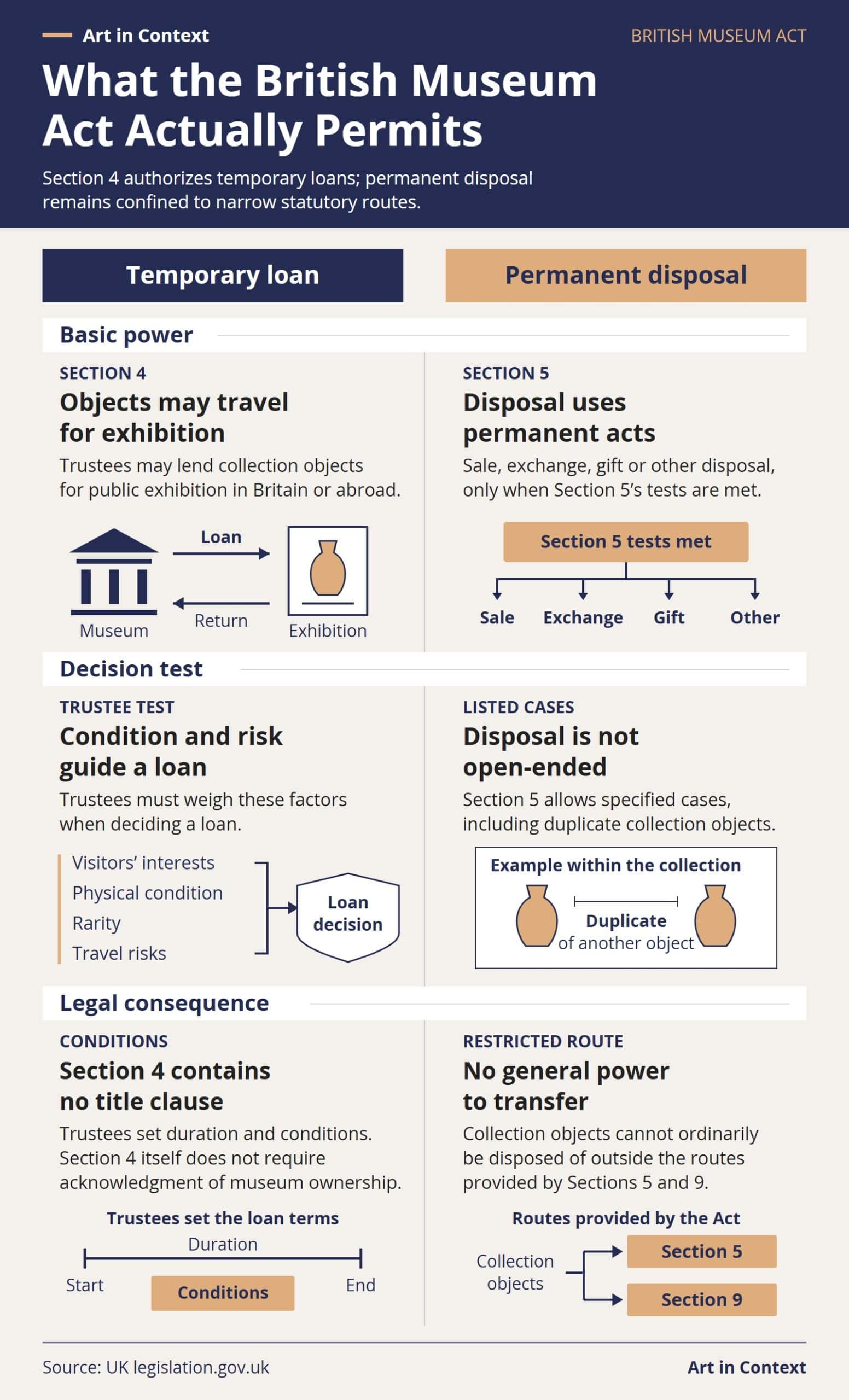
The British Museum Act Separates Loans From Disposal
The British Museum Act 1963 gives the trustees a broad power to lend collection objects for public exhibition. Section 4 directs them to consider visitors, an object’s physical condition and rarity, and the risks of travel when setting a loan’s duration and conditions.
Section 5 is much narrower. It allows disposal in limited circumstances involving duplicates, certain post-1850 printed material, objects unfit for retention, or material made useless through damage or deterioration. Those ordinary categories do not describe fifth-century BCE marble sculptures in active museum displays.
The statute therefore explains why temporary-loan formulas keep returning to the negotiations: a loan can move an object without permanently removing it from the collection. A permanent transfer would require another valid legal route, and no such route has been announced.
The ownership acknowledgment rejected by Mitsotakis is not written into Section 4. The Act instead gives trustees discretion to impose loan conditions. The statutory text consequently supports a narrower conclusion than claims that British law simply makes an agreement impossible: British law expressly permits loans, but its usual disposal power offers no evident route to permanent transfer of these sculptures.
Why the Bayeux Comparison Fails at the Level of the Art
The Bayeux Tapestry arrangement is a finite, reciprocal museum loan. The UK government’s July 8, 2025 announcement described a 70-meter tapestry loan to London from September 2026 to July 2027, with Sutton Hoo treasures, the Lewis chessmen and other British Museum objects lent to France.
The Parthenon case concerns surviving elements of an architectural sculpture dispersed among institutions. Although the works belong in any survey of famous sculptures, they were not conceived as independent statues gathered later into a collection. The frieze formed a continuous relief around the temple’s cella; metopes and pedimental figures occupied other defined positions on the building.
An official digital inventory records 50 meters of surviving frieze in the Acropolis Museum, 80 meters in the British Museum, one block in the Louvre, and additional fragments elsewhere. The distribution makes “reunification” a display proposal for a divided sequence, not the temporary movement of one intact object.
The Acropolis Museum’s third-floor gallery makes that argument spatially. Its rectangular core matches the orientation and dimensions of the Parthenon’s cella; original marbles are combined with plaster copies of pieces abroad, and the glass walls maintain a sightline to the monument.
That installation does not physically reconstruct the ancient building. It instead restores the sequence and orientation needed to read the surviving sculpture as architectural art. This is the strongest substantive difference from Bayeux: the Greek proposal seeks to change how separated parts of one monumental program are seen together.

The Parthenon Gallery at the Acropolis Museum, with the Acropolis visible beyond the glass walls. Photograph by Pinterpandai.com via Wikimedia Commons, licensed under Creative Commons Attribution-Share Alike 3.0 Unported.
How the Reported Deadlock Developed
The dates show why “stalled” is better supported than “collapsed”:
- 2021: The Telegraph, as relayed by To Vima, dates the beginning of the present negotiations to that year.
- July 8, 2025: Britain announced the reciprocal Bayeux Tapestry loan, later cited as a possible partnership model.
- September 23, 2026: To Vima published The Telegraph’s claim that talks had effectively collapsed. Its account also said communication channels remained open.
- September 24, 2026: Mitsotakis rejected the Bayeux analogy, ownership recognition, and a borrowing formula while saying Greece remained ready for an agreement.
- September 24, 2026: The Guardian reported that sources close to the discussions disputed the collapse characterization but acknowledged a substantial gap.
No joint Greek–British Museum announcement has terminated the process. The available reporting establishes incompatible positions and no immediate path to agreement, not a formally declared end to negotiations.

Sculptures from the Parthenon’s east pediment displayed in the British Museum. Photograph by APK via Wikimedia Commons, licensed under CC BY 4.0.
The Gap Is Defined, but the Outcome Is Not
Mitsotakis’s own statement establishes Greece’s present position: permanent reunification cannot be packaged as a loan that recognizes British Museum ownership. The statutory text establishes a separate point missing from much of the shorthand coverage: the 1963 Act permits loans but tightly limits ordinary disposal, and it does not itself prescribe an ownership acknowledgment.
The art-historical record also weakens the Bayeux analogy. The official frieze inventory and Acropolis Museum display document a sculptural sequence divided across collections, whereas the Bayeux agreement moves an undivided work temporarily and returns it to its owner.
The claim that the talks have collapsed remains attributed to The Telegraph and was disputed by other sources close to the discussions.

Isabella studied at the University of Cape Town in South Africa and graduated with a Bachelor of Arts majoring in English Literature & Language and Psychology. Throughout her undergraduate years, she took Art History as an additional subject and absolutely loved it. Building on from her art history knowledge that began in high school, art has always been a particular area of fascination for her. From learning about artworks previously unknown to her, or sharpening her existing understanding of specific works, the ability to continue learning within this interesting sphere excites her greatly.
Her focal points of interest in art history encompass profiling specific artists and art movements, as it is these areas where she is able to really dig deep into the rich narrative of the art world. Additionally, she particularly enjoys exploring the different artistic styles of the 20th century, as well as the important impact that female artists have had on the development of art history.
Learn more about Isabella Meyer and the Art in Context Team.
Choose Art in Context as a preferred source to see more of our reporting in Google Top Stories and other Google Search experiences.
Cite this Article
Isabella, Meyer, “Greece Rejects Parthenon Sculptures Loan Terms as Talks Stall.” Art in Context. September 26, 2026. URL: https://artincontext.org/greece-rejects-parthenon-sculptures-loan-deal/
Meyer, I. (2026, 26 September). Greece Rejects Parthenon Sculptures Loan Terms as Talks Stall. Art in Context. https://artincontext.org/greece-rejects-parthenon-sculptures-loan-deal/
Meyer, Isabella. “Greece Rejects Parthenon Sculptures Loan Terms as Talks Stall.” Art in Context, September 26, 2026. https://artincontext.org/greece-rejects-parthenon-sculptures-loan-deal/.


