

Why Chicago Is Returning Metzinger’s Woman With a Fan

The Art Institute of Chicago announced on September 22, 2026, that it will return Jean Metzinger’s 1913 Woman With a Fan to the heirs of Dutch Jewish collector Emanuel Lewenstein. The decision matters because the ownership link was recovered not from a complete transaction file, but from a nearly illegible mark on the canvas and records that still leave the 1940 consignor unknown.
Why the Art Institute Is Returning Woman With a Fan
Metzinger painted the oil-on-canvas portrait in Paris in 1913. Measuring roughly 36.5 by 25.9 inches, it breaks the sitter, her plumed hat, and the surrounding interior into overlapping planes without abandoning the figure—a useful example of the tension between observation and fragmentation in Cubism. The museum’s accession number is 1959.10, and its longstanding credit line identifies the work as a gift of Mr. and Mrs. Sigmund Kunstadter.
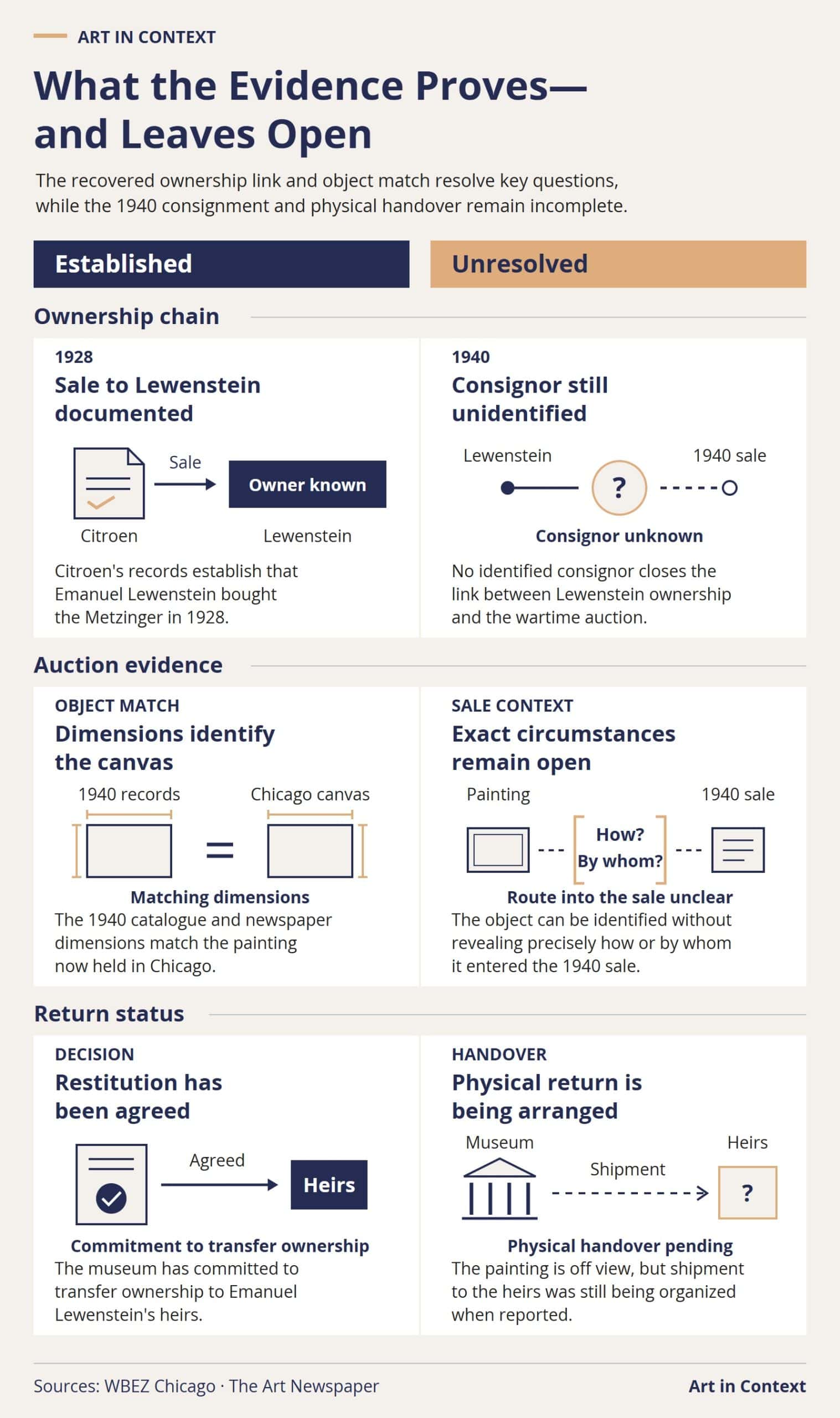
The return is a decision to transfer ownership, not merely to add a cautionary label. Jacques Schuhmacher, the museum’s executive director of provenance research, told The Art Newspaper that the Art Institute regards the October 1940 Amsterdam auction as a forced sale resulting from Nazi persecution. He also acknowledged that the identity of the consignor and the precise circumstances of the sale remain unknown.
The museum has agreed to restitute the painting, but the physical handover was still being arranged when the decision became public. WBEZ reported that the painting was already off view and that art handlers were preparing its return to the heirs.
A Provenance Timeline With a 13-Year Blind Spot
| Year | What the evidence supports |
|---|---|
| 1919 | Dealer and artist Paul Citroen acquired the painting. |
| 1928 | Citroen sold it to Emanuel Lewenstein. |
| After 1930 | After Emanuel’s death, his widow Hedwig is thought to have placed it with the Stedelijk Museum for safekeeping. |
| October 1940 | The work was auctioned in occupied Amsterdam; the consignor is not identified. |
| 1953–54 | It passed through K. A. Legat in The Hague, Galerie Ariel in Paris, and Sidney Janis Gallery in New York. |
| 1959 | It entered the Art Institute’s collection as the Kunstadters’ gift. |
The central gap runs from the 1940 auction to the work’s reappearance with Legat by 1953. It is not the only problem. An earlier AIC-derived public provenance listed Galerie Der Sturm, Léonce Rosenberg, Legat, Ariel, Janis, and the 1959 accession, but omitted Lewenstein and the 1940 sale entirely. New research adds Citroen’s 1919 acquisition and 1928 sale to Lewenstein, but the published catalogue raisonné also places the painting in Léonce Rosenberg’s collection by 1924, leaving the intervening chain unresolved.
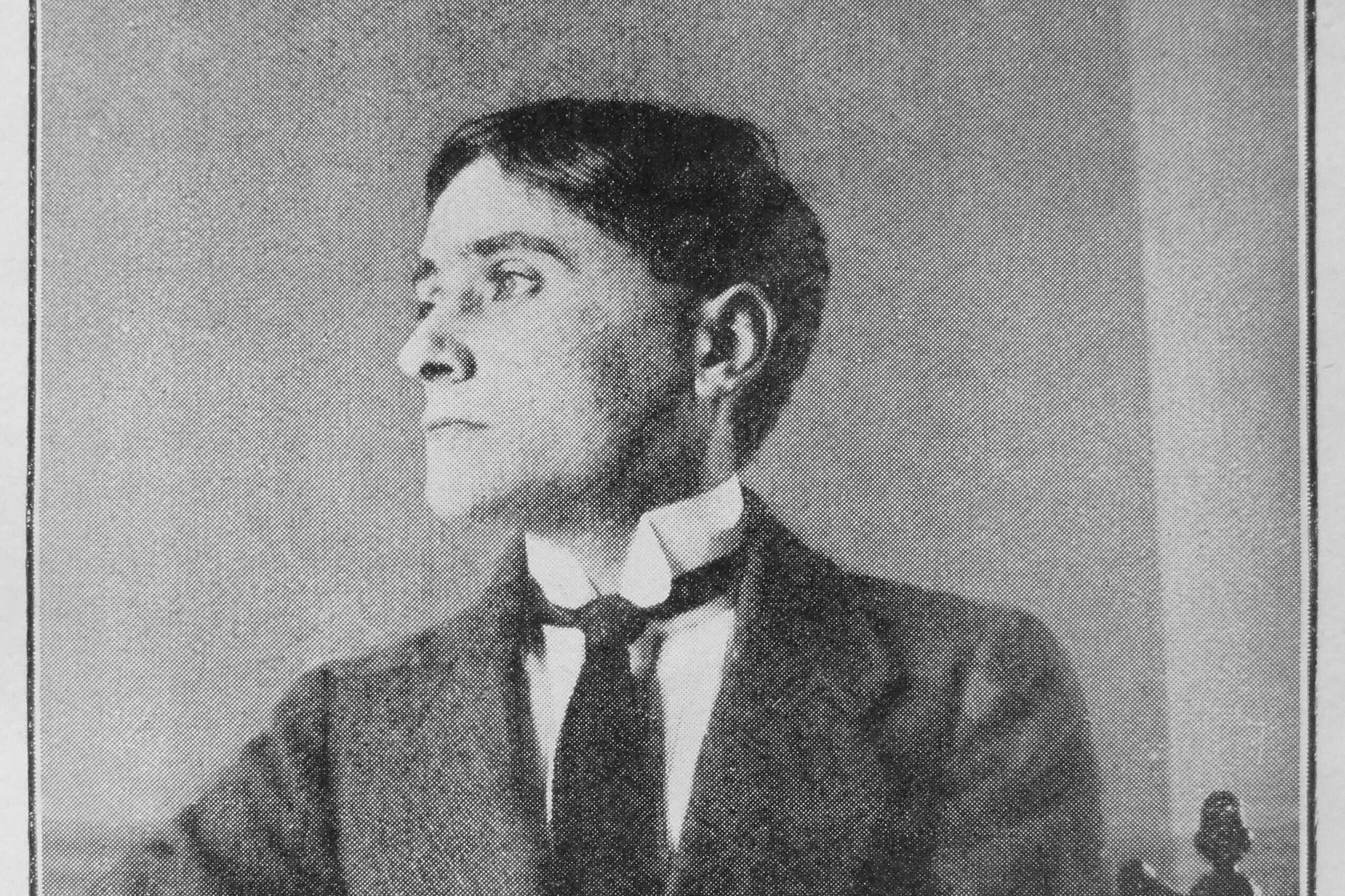
Jean Metzinger in a portrait photograph published in Guillaume Apollinaire’s Les Peintres Cubistes in 1913. Source: Wikimedia Commons; author listed as Guillaume Apollinaire. Public Domain Mark 1.0; cropped.
What the Infrared Inscription Actually Proved
The decisive physical clue was on the back of the painting. Faint pencil marks, unreadable to the naked eye, became legible under infrared photography as the name Paul Citroen. Because Citroen was a relative of Lewenstein and a principal source for his collection, the inscription gave researchers a person to pursue in Dutch archives.
The mark did not, by itself, prove that Lewenstein owned the canvas or that the 1940 sale was forced. Documents from Citroen established the 1928 sale to Lewenstein. A 1940 auction catalogue and a contemporary Dutch newspaper notice supplied dimensions that matched the Chicago painting. Together, the object, the dealer records, and the sale records identify the same canvas across three separate kinds of evidence.
WBEZ reported that the Art Institute conducted the archival work with Mondex Corporation, which represents the heirs.

The Art Institute of Chicago on Michigan Avenue, photographed by Nicholas Hartmann. Wikimedia Commons, Creative Commons Attribution-Share Alike 4.0 International.
Why an Unknown Consignor Does Not End the Case
No document cited by the museum identifies who placed Woman With a Fan in the October 1940 auction, whether the family authorized that person, or who received the proceeds. The museum’s conclusion is narrower: in the absence of evidence pointing to a voluntary, uncoerced transaction, it considers the sale inseparable from the persecution of the Lewenstein family in the occupied Netherlands.
That approach is consistent with, though not compelled by, the nonbinding Washington Principles. The 2024 international best practices for those principles say that a persecuted person’s sale can amount to an involuntary transfer depending on its circumstances and identify restitution as the primary just and fair solution in principle. Restitution remains a case-specific ethical determination, not an automatic legal formula.
The distinction between object identification and the circumstances of loss matters in other returns as well. A recent Goudstikker portrait restitution in Argentina likewise depended on reconstructing a wartime ownership path rather than assuming that a later market appearance cured an earlier loss.
The 1940 Auction Was Part of a Larger Lewenstein Loss
The Metzinger did not surface in isolation. A 2023 German Advisory Commission recommendation concerning Wassily Kandinsky’s Das bunte Leben documented 82 lot numbers from the Lewenstein estate at the Frederik Muller auction of October 9, 1940. The commission could not establish who ordered that painting’s sale or where its proceeds went, yet recommended restitution after considering the persecution context and the absence of evidence for a voluntary transfer.
That finding does not prove who consigned the Metzinger; it concerns a different painting. It does show that the missing consignor is a recurring feature of the same family collection and auction context, not a gap unique to the Chicago canvas. The Art Institute’s decision is therefore supported by direct evidence for this painting’s ownership and by a broader, separately documented pattern of unresolved Lewenstein disposals in the same sale.

Nieuwe Doelenstraat 16 in Amsterdam, formerly occupied by Frederik Muller & Co. Photograph by A. Bakker, via Wikimedia Commons, CC BY 3.0.
Ownership Is Established; the Consignor Is Not
- Infrared imaging identified Paul Citroen on the canvas, and Citroen’s records establish his 1928 sale of the painting to Emanuel Lewenstein.
- The 1940 catalogue and newspaper dimensions connect the Art Institute canvas to an auction in Nazi-occupied Amsterdam.
- The museum’s earlier public provenance omitted both Lewenstein and the wartime sale; the new finding materially revises that history.
- The consignor, the authority behind the consignment, and the destination of the sale proceeds remain unknown.
- The Art Institute has removed the painting from view and agreed to return it, but the institution had not announced completion of the physical transfer when the decision was reported.

Isabella studied at the University of Cape Town in South Africa and graduated with a Bachelor of Arts majoring in English Literature & Language and Psychology. Throughout her undergraduate years, she took Art History as an additional subject and absolutely loved it. Building on from her art history knowledge that began in high school, art has always been a particular area of fascination for her. From learning about artworks previously unknown to her, or sharpening her existing understanding of specific works, the ability to continue learning within this interesting sphere excites her greatly.
Her focal points of interest in art history encompass profiling specific artists and art movements, as it is these areas where she is able to really dig deep into the rich narrative of the art world. Additionally, she particularly enjoys exploring the different artistic styles of the 20th century, as well as the important impact that female artists have had on the development of art history.
Learn more about Isabella Meyer and the Art in Context Team.
Choose Art in Context as a preferred source to see more of our reporting in Google Top Stories and other Google Search experiences.
Cite this Article
Isabella, Meyer, “Why Chicago Is Returning Metzinger’s Woman With a Fan.” Art in Context. September 23, 2026. URL: https://artincontext.org/art-institute-chicago-metzinger-woman-with-a-fan-restitution/
Meyer, I. (2026, 23 September). Why Chicago Is Returning Metzinger’s Woman With a Fan. Art in Context. https://artincontext.org/art-institute-chicago-metzinger-woman-with-a-fan-restitution/
Meyer, Isabella. “Why Chicago Is Returning Metzinger’s Woman With a Fan.” Art in Context, September 23, 2026. https://artincontext.org/art-institute-chicago-metzinger-woman-with-a-fan-restitution/.


