

Bavaria Returns Albert Lang Painting to Sofie Heilbronner’s Heirs

Bavaria has returned Albert Lang’s 1892 oil painting Music (Arcadian Scene) to the heirs of Sofie Heilbronner, whose shipment of household goods was seized after she fled Nazi Germany. The September 22 ceremony in Washington closes the ownership claim, but the published provenance still leaves a crucial gap between a 1943 Berlin auction and the painting’s postwar appearance in Munich.
Why Music (Arcadian Scene) Is More Than a Museum Transfer
Albert Lang painted Music (Arcadian Scene) in 1892. The oil on canvas measures 118 by 154.5 centimeters, or roughly 46 by 61 inches, and entered the Bavarian holdings under inventory number 12253. Its return was marked on September 22, 2026, at the German Embassy in Washington, D.C., with Heilbronner’s descendants present, according to the Bavarian State Painting Collections’ restitution notice.
The painting’s importance to the heirs is domestic as well as legal. Great-grandson Paul Laporte said it had hung in the Heilbronner home in Munich and was one of the few surviving witnesses to the family’s life in Germany before persecution and displacement. At more than five feet wide, it would have been a substantial presence in that home rather than a small object stored in a portfolio.
The institution says records from Galerie Heinemann and Galerie Hugo Helbing confirmed Sofie Heilbronner as the rightful former owner. Those records converted an object carried for decades under an administrative inventory number into a painting with a named prewar owner and a documented claim.
One detail in the early coverage requires correction. A Jewish News Syndicate report said the Bavarian National Museum posted the painting to the Lost Art Database in 2015. The collection’s own notice identifies the Bayerische Staatsgemäldesammlungen, or Bavarian State Painting Collections, as the institution that made the listing. These are separate Bavarian institutions.
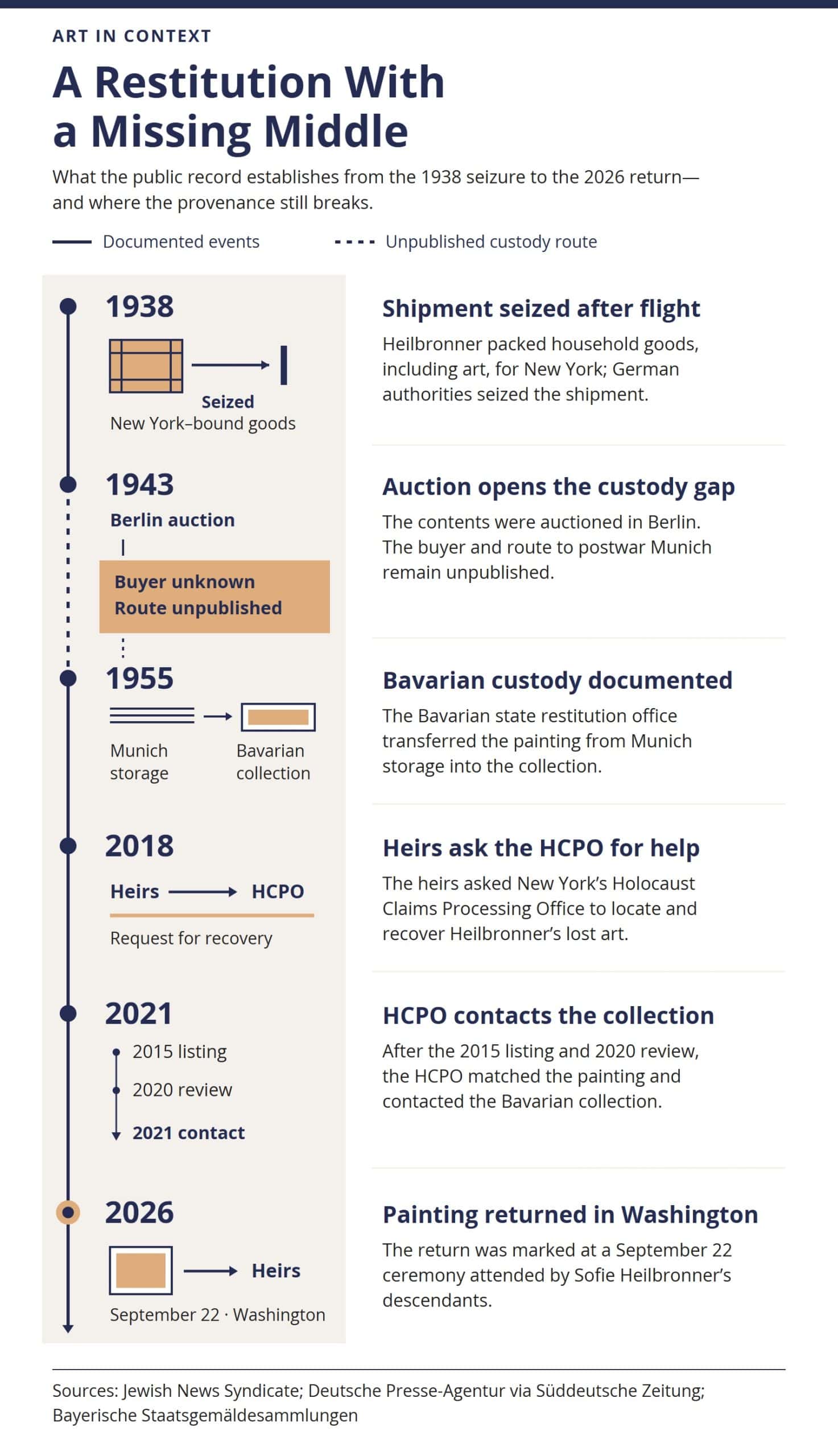
The Provenance Timeline From 1938 to 2026
The available records establish the endpoints of the painting’s displacement and return more firmly than the middle of its journey.
| Year | What is documented |
|---|---|
| 1938 | Heilbronner fled Germany for the United States after packing household goods, including several artworks, for shipment to New York. German authorities seized the property. |
| 1943 | The contents of the seized shipment were auctioned in Berlin, according to dpa; New York authorities say the Nazi regime confiscated the proceeds. |
| 1955 | New York’s official announcement says the Bavarian State Office for Asset Management and Restitution transferred the painting from Munich storage to the museum. |
| 2015 | The Bavarian State Painting Collections listed it in the Lost Art Database as possibly seized through Nazi persecution. |
| 2018 | Heilbronner’s heirs asked New York’s Holocaust Claims Processing Office, or HCPO, for help locating and recovering her lost art. |
| 2020 | A deeper provenance investigation connected the work to a warehouse on Munich’s Lazarettstrasse and a transfer recorded as state-owned property. |
| 2021 | The HCPO, representing the heirs, contacted the Bavarian State Painting Collections after matching the museum object to the lost Lang painting. |
| 2024 | The Bavarian Ministry of Science and the Arts decided that the painting should be restituted. |
| 2026 | The completed return was publicly marked at the September 22 ceremony in Washington. |
The 2018 and 2021 dates describe different actions, not conflicting versions. The heirs approached the HCPO in 2018; the HCPO contacted the Bavarian collection in 2021. Between those moments, the museum began its expanded provenance review in 2020. Describing the work as simply “discovered” after the 2015 Lost Art listing compresses a six-year process involving a public database, family research, museum research, and a formal claim.
What the Gallery Records Proved—and What They Did Not
The Bavarian announcement identifies Galerie Heinemann and Galerie Hugo Helbing records as the decisive evidence for Heilbronner’s prior ownership. It does not publish the individual documents, their dates, a transaction price, or a complete reconstruction of every transfer. The supportable conclusion is therefore narrow but strong: the records established that this particular Lang painting belonged to Heilbronner.
A significant custody gap remains. The published accounts do not identify the buyer at the 1943 Berlin auction or explain how the painting traveled from that sale to the Lazarettstrasse warehouse in Munich. They establish Nazi seizure before the sale and Bavarian custody after the war, but not every intervening holder.

The German Embassy in Washington, D.C., where the restitution ceremony was held. Photograph by Simon Mannweiler, CC BY-SA 4.0, via Wikimedia Commons.
How an Arcadian Painting Became an Anonymous State Object
The painting’s official title presents music through an Arcadian setting, invoking an idealized pastoral world. That subject acquired an unintended historical counterpoint after the work was removed from a real family home, sold by the persecuting state, and later processed as property whose original owner was unidentified.
The postwar phrase used for its entry into Bavarian custody—“transfer of state-owned property”—described an administrative act, not the painting’s lawful history. Inventory number 12253 preserved the object inside a public collection, but the gallery records were needed to reconnect it to Heilbronner. That distinction is central to provenance research: knowing where a painting is stored is not the same as knowing how it came to be there.
The Washington Post reported an estimated value of $2,000 to $10,000, but Laporte emphasized the painting’s significance as part of his family’s heritage. Laporte described the work as part of the family’s heritage and as evidence of a life interrupted by persecution. Restitution restores ownership and that family connection, even though it cannot restore the Munich household in which the painting once hung.

A sign for the Bayerische Staatsgemäldesammlungen, the institution that listed and restituted the painting. Photograph by Mattes, CC BY-SA 3.0, via Wikimedia Commons.
A 2024 Decision Completed in 2026
Bavaria publicly announced the restitution decision in December 2024, alongside decisions involving four other ownership histories. The Washington ceremony came nearly two years later. The reason for that interval has not been made public.
The collection’s general provenance-research page still listed the Lang painting as awaiting restitution on September 23, 2026, and said preparations were underway. The separately dated September 22 restitution notice supersedes that older status: the painting has been returned, while the overview page has not yet caught up.
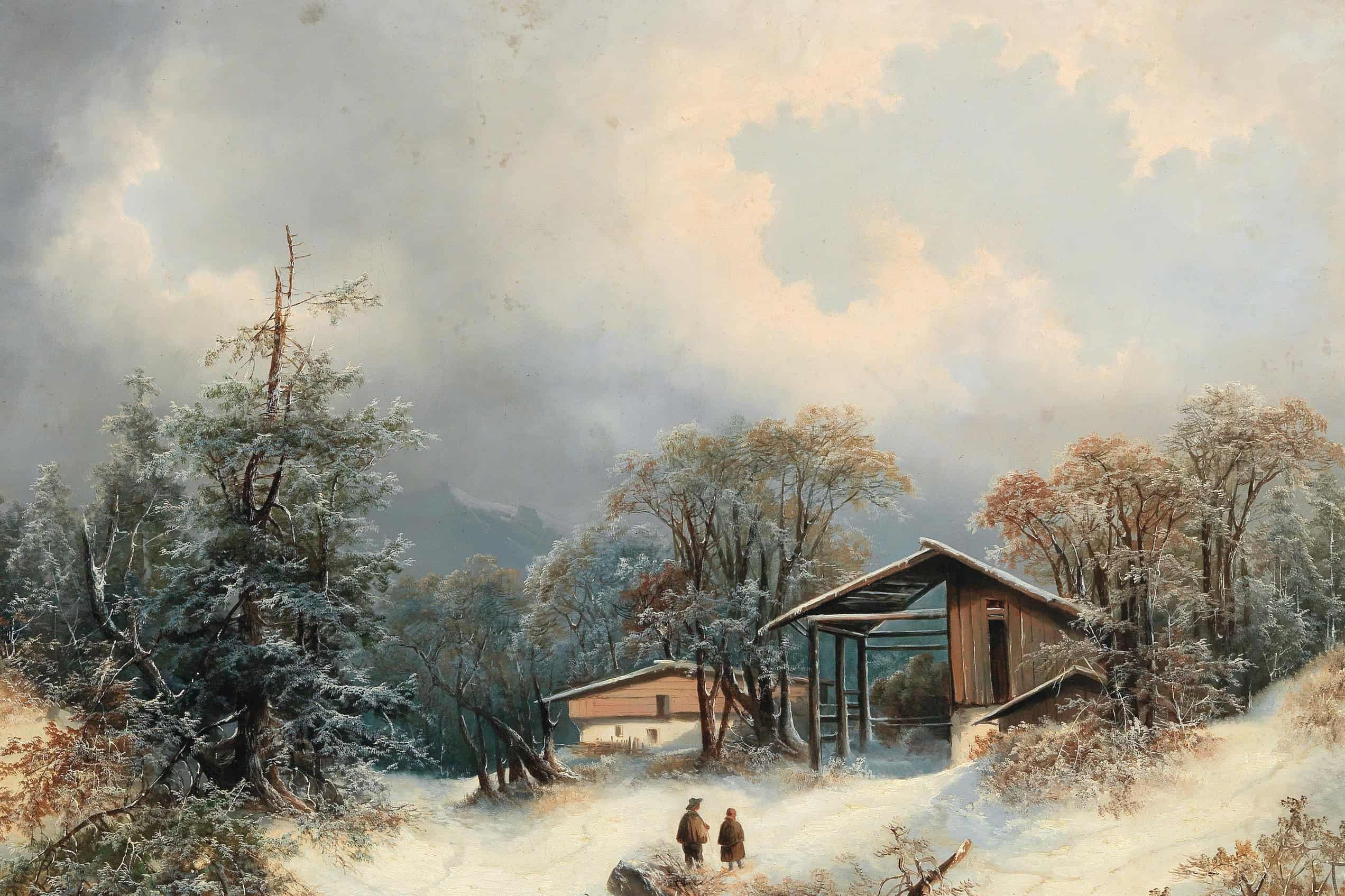
Albert Lang, Winter Landscape with Decorative Figures (1869), via Wikimedia Commons. This is another work by Lang, not the restituted painting. Public Domain Mark 1.0. Cropped.
The Ownership Is Settled; Part of the Route Is Not
Four findings now define the case:
- Galerie Heinemann and Galerie Hugo Helbing records establish Sofie Heilbronner’s ownership, according to the Bavarian State Painting Collections.
- The documented recovery sequence runs from the 2015 Lost Art listing through the heirs’ 2018 HCPO request, the museum’s 2020 research, the 2021 institutional contact, the 2024 restitution decision, and the 2026 return.
- The Bavarian State Painting Collections—not the Bavarian National Museum—made the 2015 Lost Art listing identified in the institution’s own notice.
- The 1943 auction buyer, the route back to Munich, and the present whereabouts of Heilbronner’s other seized artworks remain unidentified in the published records.

Isabella studied at the University of Cape Town in South Africa and graduated with a Bachelor of Arts majoring in English Literature & Language and Psychology. Throughout her undergraduate years, she took Art History as an additional subject and absolutely loved it. Building on from her art history knowledge that began in high school, art has always been a particular area of fascination for her. From learning about artworks previously unknown to her, or sharpening her existing understanding of specific works, the ability to continue learning within this interesting sphere excites her greatly.
Her focal points of interest in art history encompass profiling specific artists and art movements, as it is these areas where she is able to really dig deep into the rich narrative of the art world. Additionally, she particularly enjoys exploring the different artistic styles of the 20th century, as well as the important impact that female artists have had on the development of art history.
Learn more about Isabella Meyer and the Art in Context Team.
Choose Art in Context as a preferred source to see more of our reporting in Google Top Stories and other Google Search experiences.
Cite this Article
Isabella, Meyer, “Bavaria Returns Albert Lang Painting to Sofie Heilbronner’s Heirs.” Art in Context. September 23, 2026. URL: https://artincontext.org/albert-lang-music-painting-restitution-heilbronner/
Meyer, I. (2026, 23 September). Bavaria Returns Albert Lang Painting to Sofie Heilbronner’s Heirs. Art in Context. https://artincontext.org/albert-lang-music-painting-restitution-heilbronner/
Meyer, Isabella. “Bavaria Returns Albert Lang Painting to Sofie Heilbronner’s Heirs.” Art in Context, September 23, 2026. https://artincontext.org/albert-lang-music-painting-restitution-heilbronner/.


