

MNAC Closes Sijena Murals Display Before November 17 Transfer

On Sunday, November 15, the Museu Nacional d’Art de Catalunya ended public display of eight secular mural panels from Sijena. If the announced calendar holds, specialist crews will begin deinstalling them on November 17 for a planned arrival at the monastery on December 2. The move is the first physical transfer under the mural restitution judgment, but it concerns eight comparatively stable panels—not the 35 fire-damaged chapter-house fragments at the center of the harder conservation dispute.
What Is Leaving MNAC Room 17
“Secular” describes the paintings’ subject matter, not their legal or cultural status. The anonymous Romanesque works show courtly life, knights, fortified places, animals, and combat, including a naval encounter between Christian and Saracen galleys. Together they preserve a non-devotional image cycle from a medieval monastic complex.
The MNAC’s permanent collection record dates the group to circa 1200. It describes eight fresco panels transferred to canvas that once formed a continuous frieze along the upper walls of a rectangular room between the monastery church and cloister. One courtly-and-battle panel is about 43 inches high and 106 inches wide, a long horizontal format that reflects that architectural origin.
The record classifies the works as a deposit from the community of Hospitaller nuns in 1960. Aragón’s current announcement is more precise about the event, saying the panels were detached in the summer of 1960 and moved to the museum. They therefore did not make the same 1936 emergency journey as the chapter-house paintings.
A November 15 El País report from Room 17 records Sunday as the last day visitors could see the group before technical work. The paintings had occupied a high, easily missed position near the beginning of the museum’s Gothic galleries, even though the MNAC catalogs them as Romanesque.

Unknown author, Profane Paintings from Sijena: Courtly and Battle Scenes, c. 1200. Public-domain image hosted by Wikimedia Commons, marked Public domain; cropped.
November 17 to December 2: The Transfer Schedule
The new dates replace the provisional October window discussed when Aragón granted its transfer authorization for the eight Sijena panels. In a November 14 announcement, the Government of Aragón said SIT, MNAC technicians, and Aragón’s technical team would begin dismantling, packing, and transport work on Tuesday, November 17. It gave December 2 as the planned arrival date, conditional on the museum’s calendar being met.
One date in the latest coverage needs qualification. The opening and headline of the El País report point to Tuesday, but a later paragraph says the panels will be unhooked on Thursday. The primary Aragón announcement names Tuesday, November 17, and identifies the participating teams. That official schedule is the stronger record for the start date.
| Date | Established step |
|---|---|
| Summer 1960 | Panels detached and transferred to Barcelona |
| July 4, 2016 | Huesca court orders restitution |
| October 2, 2020 | Provincial Court of Huesca upholds the order |
| May 27, 2025 | Supreme Court rejects the final appeals |
| November 15, 2026 | Last day of public display at the MNAC |
| November 17, 2026 | Deinstallation work scheduled to begin |
| December 2, 2026 | Planned arrival at Sijena |
| Early 2028 | Aragón’s target for renewed display |
El País says technicians expect to inspect the panels for five days while custom cases are completed, followed by two days of packing. Those are scheduled operations, not completed conservation findings. The condition of each panel after deinstallation and unpacking remains to be recorded.
At Sijena, Aragón plans temporary storage in the former dormitory wing, followed by historical research, materials analysis, condition assessment, cleaning, and restoration. The government says it wants the paintings on view in the first months of 2028. That is a stated target rather than a fixed public opening date.
Eight Secular Panels Are Not 35 Chapter-House Fragments
The clearest institutional comparison appears in the MNAC’s 2026 transport tender. It says the secular paintings did not suffer the monastery’s 1936 fire, entered the museum in 1960, are smaller and more regular in shape, and are in better condition. The chapter-house group suffered the fire and entered the museum in 1940. Those are the museum’s documented conservation distinctions.
The judgment covers 43 fragments in all: these eight secular panels and 35 fragments from the chapter house. The legal destination is settled, but the physical operations have diverged. A separate 56-week schedule governs the chapter-house murals, whose removal and reinstallation remain contested because of their fire damage, altered materials, scale, and reconstructed architectural mounting.
Aragón’s position is broader. Its November 14 statement says the monastery is equipped to receive and conserve the works and insists that the chapter-house paintings must also return. Yet the October heritage authorization approved a handling plan for the eight Room 17 panels. It did not determine that the 35 Room 16 fragments can travel by the same method.
That boundary matters beyond the legal dispute. A successful transfer of the eight panels would establish that the approved method worked for those eight objects under the conditions recorded during this move. It would not, by itself, resolve the scientific disagreement over the separate fire-damaged ensemble.

Kippelboy, Paintings of the Chapterhouse of Santa Maria in Sigena at MNAC, 2012. Via Wikimedia Commons, licensed CC BY-SA 3.0; cropped.
The Return Changes How the Medieval Frieze Will Be Seen
The secular group was conceived as elevated architectural decoration, not as eight isolated easel paintings. Its long scenes move between courtly ceremony, armed departure, siege, animal attack, and naval combat. Reading the panels as a sequence helps explain why losses and cuts through the painted surface can make individual episodes difficult to follow.
Aragón says the restored works will eventually hang at eye level near the entrance to the former dormitory wing. That plan should make their surviving details easier to examine than the high installation in MNAC Room 17. It also introduces an important distinction: returning the panels to the Sijena monastic complex is not the same as reinstalling them in their original architectural position.
The MNAC record places the former frieze in a room between the church and cloister, while Aragón’s announced display site is the entrance to the dormitory wing. The government’s language about recovering the works’ “original context” is therefore accurate at the level of monastery and place, but the announced museography is a new presentation rather than a literal reconstruction of the circa-1200 room.
That new presentation will depend on what the examinations find. Aragón has announced the sequence—study, analysis, conservation, cleaning, restoration, then display—but has not published a final treatment report or a firm opening day. The December arrival begins that work; it does not complete it.
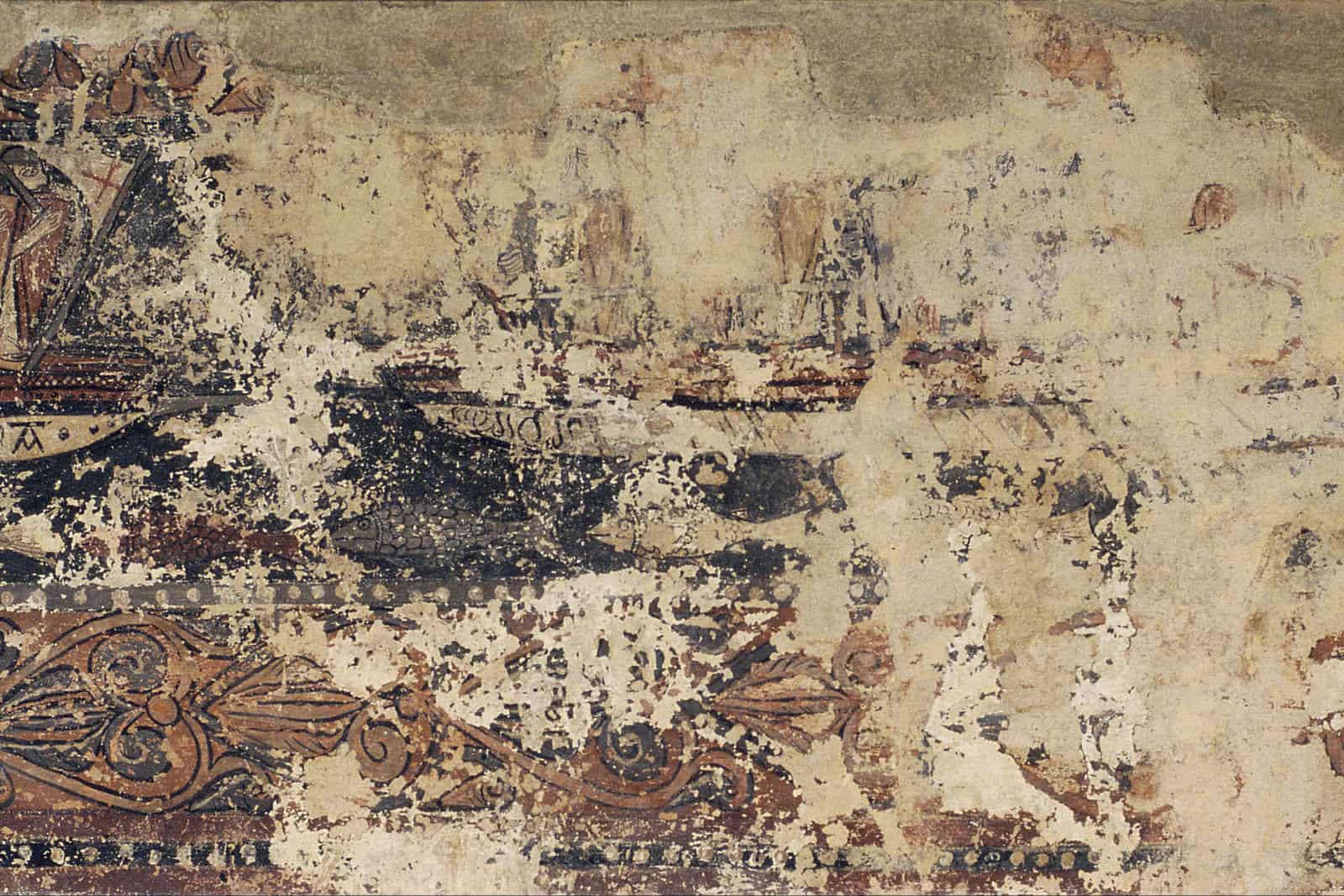
Unknown author, Naval Battle Between a Christian Galley and a Saracen Galley, c. 1200, from the Sijena secular paintings. Public-domain image hosted by Wikimedia Commons, marked Public domain; cropped.
November 17 Is Scheduled; the 2028 Opening Remains a Goal
The November 14 government record says the overall transfer work will begin November 17, while El País reports that the panels themselves will be unhooked on Thursday. The same record makes early 2028 an exhibition goal contingent on study and restoration, not a guaranteed reopening date.
The MNAC’s collection and tender records establish that these eight circa-1200 panels formed a secular frieze, were detached in 1960, escaped the 1936 fire, and present a different transport problem from the 35 chapter-house fragments. Aragón’s announced eye-level installation will return them to Sijena, but not to the unidentified room or upper-wall setting for which they were made. The post-arrival condition findings, the eventual treatment, and the exact 2028 display date remain unknown.

Isabella studied at the University of Cape Town in South Africa and graduated with a Bachelor of Arts majoring in English Literature & Language and Psychology. Throughout her undergraduate years, she took Art History as an additional subject and absolutely loved it. Building on from her art history knowledge that began in high school, art has always been a particular area of fascination for her. From learning about artworks previously unknown to her, or sharpening her existing understanding of specific works, the ability to continue learning within this interesting sphere excites her greatly.
Her focal points of interest in art history encompass profiling specific artists and art movements, as it is these areas where she is able to really dig deep into the rich narrative of the art world. Additionally, she particularly enjoys exploring the different artistic styles of the 20th century, as well as the important impact that female artists have had on the development of art history.
Learn more about Isabella Meyer and the Art in Context Team.
Choose Art in Context as a preferred source to see more of our reporting in Google Top Stories and other Google Search experiences.
Cite this Article
Isabella, Meyer, “MNAC Closes Sijena Murals Display Before November 17 Transfer.” Art in Context. November 15, 2026. URL: https://artincontext.org/sijena-secular-murals-mnac-transfer-november-2026/
Meyer, I. (2026, 15 November). MNAC Closes Sijena Murals Display Before November 17 Transfer. Art in Context. https://artincontext.org/sijena-secular-murals-mnac-transfer-november-2026/
Meyer, Isabella. “MNAC Closes Sijena Murals Display Before November 17 Transfer.” Art in Context, November 15, 2026. https://artincontext.org/sijena-secular-murals-mnac-transfer-november-2026/.


