

Gerda Wegener: Art Deco Portraits and a Paris Career

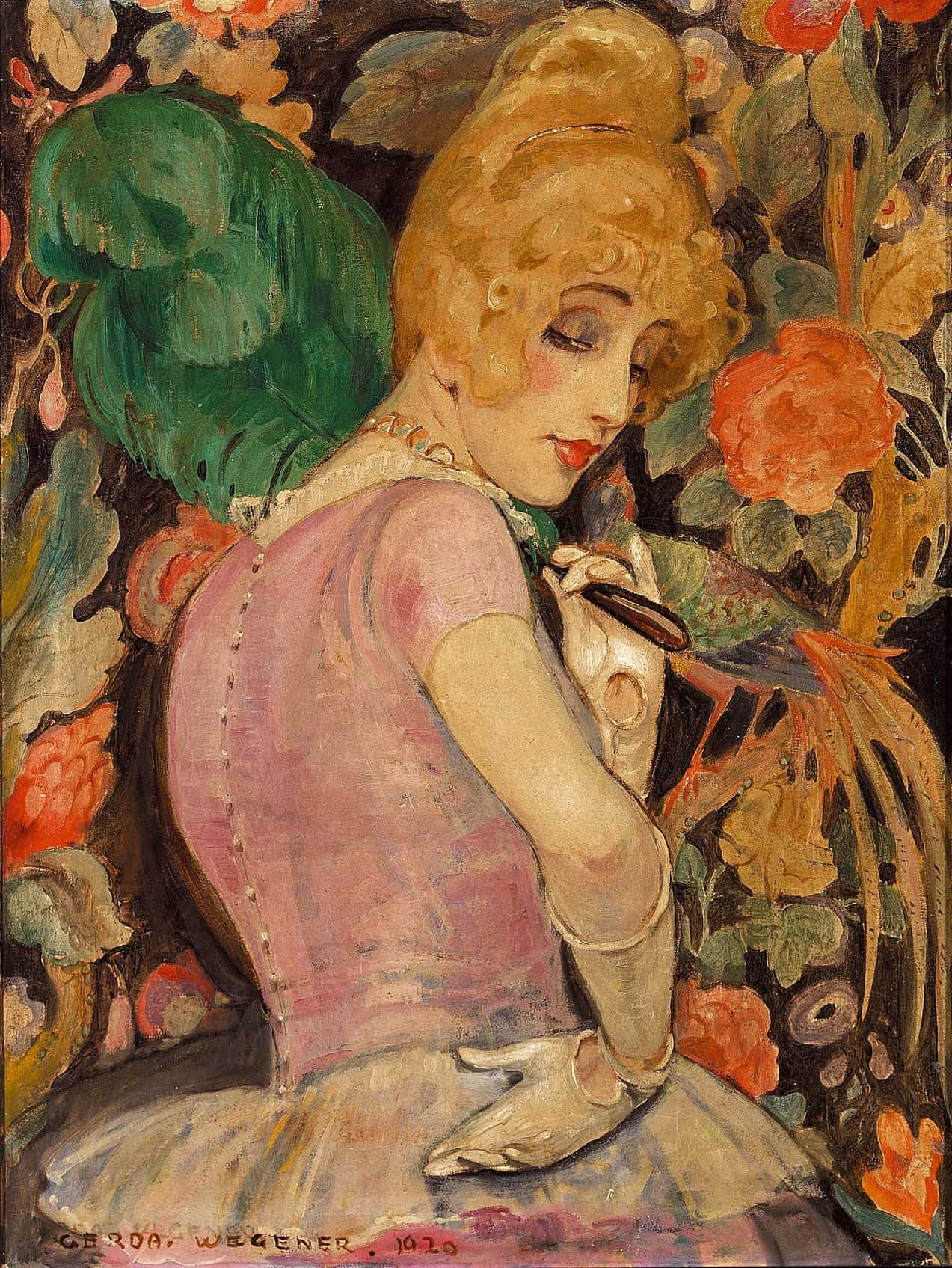
A green feather fan, an unwavering gaze, and a precisely drawn silhouette can make a Gerda Wegener portrait feel like a private performance. Her career moved just as fluently between Copenhagen newspapers, Paris salons, fashion pages, and oil paintings. Looking closely at those connections reveals an artist whose commercial and museum work belonged to the same ambitious practice.
Who Was Gerda Wegener?
Gerda Maria Frederikke Wegener, born Gottlieb, was a Danish painter, illustrator, and designer who worked across fine art and commercial publishing. Born in Hammelev, Denmark, on March 15, 1885, she trained in Copenhagen before building an international career in Paris. She became known for portraits, fashion drawings, magazine illustrations, advertisements, books, and decorative compositions shaped by controlled lines and a strong awareness of modern style.

Wegener’s significance does not rest on a single painting or relationship. Her career shows how portraiture, print culture, fashion, and exhibition art could reinforce one another during the early 20th century. The French state bought three of her works during her lifetime. Decades later, ARKEN brought 178 works together, allowing audiences to see the range of her practice.
A Compact Gerda Wegener Biography
Wegener attended the Royal Danish Academy of Fine Arts’ School for Women from 1902 until the spring of 1905, following preparatory art instruction. She married fellow artist Lili Elbe in 1904, when Elbe was still publicly known as Einar Wegener. Copenhagen provided Wegener’s training, first exhibition controversies, and entry into newspaper illustration. Paris, where the couple settled in 1912, became the center of her mature career.
Her media ranged from oil and watercolor to graphite, print illustration, advertising, and decorative design. She worked for publications that included Politiken, La Vie Parisienne, and Vogue, while also exhibiting paintings in Paris. After her marriage to Elbe was dissolved in 1930, Wegener married Fernando Porta in 1931 and lived for a period in Morocco. That marriage ended in 1936. She returned to Denmark in 1938 and died in Frederiksberg on July 20, 1940, at age 55.
Why Her Dates Are Often Reported Incorrectly
Readers commonly encounter conflicting dates for Wegener. Some English-language biographies give 1886 as her birth year or July 28 as the date of her death. Danish national biographical references give March 15, 1885, and July 20, 1940. They also identify Hammelev as her birthplace and Frederiksberg as her place of death.
From Hammelev to a Copenhagen Breakthrough
Formal training, a disputed portrait, and newspaper illustration shaped Wegener’s early career in Copenhagen. Together, these experiences placed her within both the exhibition world and the fast-moving culture of popular print before she left Denmark.
Training at the School for Women
Wegener arrived at the academy’s School for Women in 1902 after receiving preparatory instruction. The separate school reflects the gendered organization of Danish art education at the time, but it nevertheless gave her sustained formal training until 1905. Drawing would remain central to her practice, whether she was defining a sitter’s face in paint or reducing a fashion figure to a few decisive contours for print.
Her education also placed her within Copenhagen’s professional art world rather than treating art as a private accomplishment. Within a few years, exhibition committees were judging her portraits, and her drawings were competing for space in a major newspaper.
The 1907 Peasant Painter Dispute
One of Wegener’s earliest encounters with public controversy began with a rejected portrait. In 1907, her painting of Ellen Levinsen was refused by both the Charlottenborg and Den Frie exhibitions. The rejection helped ignite the Peasant Painter Dispute, a newspaper argument about artistic standards, institutional authority, and the direction of Danish painting.
Wegener’s role is easy to exaggerate. Her portrait served as a catalyst, but she did not enter the press debate herself. The episode is therefore not a story about an artist deliberately staging a rebellion. It shows how an artwork could become central to a larger cultural conflict without its maker controlling the argument.
The dispute also shows that Wegener’s public career did not begin only after she reached Paris. Her work had already become visible enough in Copenhagen to expose tensions around taste and exhibition access. The controversy placed her name within a national discussion about modern art.
Politiken and a Public Career
A more practical breakthrough followed in 1908, when Wegener succeeded in a drawing competition organized by the newspaper Politiken. Regular work for the paper began in 1909. Unlike a rejected exhibition painting, newspaper illustration placed her images directly before a broad public and required her to communicate quickly through gesture, silhouette, and sharply selected details.
This work was not a detour from painting. It trained the same capacities that later defined her Paris portraits and fashion images: an economical contour, readable poses, and an ability to construct a character through clothes and accessories. Copenhagen therefore supplied two different turning points. The 1907 rejection made her work part of an art-world dispute, while the newspaper competition gave her steady professional work.
Paris and the Making of an Art Deco Career
Moving to Paris in 1912 widened the audience for Wegener’s work and allowed her to pursue publishing, portraiture, decorative design, and salon exhibitions at the same time. Her flexible line connected these formats as Parisian styles moved from Art Nouveau curves toward Art Deco polish.
A 1912 Move
Wegener and Elbe moved to Paris in 1912. The relocation allowed Wegener to connect portrait commissions, editorial work, book illustration, and salon exhibitions within a single international career. Instead of choosing between commercial drawing and exhibition art, she developed both at once.
Paris also brought her work into contact with changing approaches to fashion and modern femininity. Museum interpretations connect her poised, carefully dressed women with the early 20th-century New Woman, a term used for women whose independence and public presence challenged older social expectations. Wegener’s figures often appear aware of being seen, but they seldom look passive. Their posture, clothing, and returned gaze turn fashion into an element of characterization.
Illustration, Advertising, and the Salons
Wegener contributed to periodicals including La Vie Parisienne and Vogue, and she exhibited in Paris salons, including the Salon d’Automne. Her practice also encompassed advertisements, satirical drawings, books, and decorative designs. Each format imposed different practical demands, yet the finished images share a concern with clear outlines, staged bodies, patterned surfaces, and socially legible dress.

Sur la Route d’Anacapri from 1922 shows how these qualities could enter a painted scene. Two women, fashionable clothing, fruit, and a travel setting are arranged with the deliberateness of a magazine spread. The composition does not simply record a stop on a road. It turns travel into theater, balancing the paired figures against a landscape while costume and pose give each woman a distinct presence.
Such works help explain why separating Wegener’s paintings from her publishing career can be misleading. Magazine work sharpened her ability to make a pose instantly readable, while portraiture allowed the same visual intelligence to unfold through color, surface, and sustained attention to a sitter.
Beardsley, Rococo, and a Sharpening Line
Wegener identified Aubrey Beardsley and French rococo as important inspirations. Beardsley’s graphic work offered an example of how a forceful contour and areas of decorative pattern could carry an image. Rococo art offered another kind of precedent through elegant social staging, costume, and cultivated artifice.
Her work does not fit into only one movement. Art Nouveau favored organic curves, flowing lines, and decorative unity, while Art Deco increasingly emphasized streamlined shapes, crisp geometry, and polished modern surfaces. Wegener’s career crossed that shift. Readers comparing Art Deco and Art Nouveau can see why her early sinuous line and later geometric finish support both labels.
The most useful approach is to look for development rather than force every work into a fixed category. Wegener retained supple contours even as her mature figures became more streamlined and her compositions acquired the finish associated with Art Deco. Her place among Art Nouveau artists and later decorative modernists reflects a career lived through a stylistic transition.
Recognition at the 1925 Paris Exposition
Wegener received several medals, including a gold medal, at the 1925 Paris decorative-arts exposition.
These awards came after more than a decade of work in Paris. By 1925, the French state had also purchased Lady with Anemone. The medals marked another stage in an already established career rather than the sudden discovery of an unknown artist.
Lili Elbe as Spouse, Model, and Collaborator
Lili Elbe occupied several documented roles in Wegener’s life and career: spouse, recurring model, and practical studio collaborator. Keeping those roles distinct reveals a sustained working relationship without asking the paintings to prove private beliefs or identities.
A Working Partnership
Gerda Gottlieb married fellow artist Lili Elbe on June 8, 1904. At this point in the chronology, Elbe was publicly known as Einar Wegener. Elbe later became a recurring presence in Gerda Wegener’s art, posing for paintings and illustrations.
Their professional relationship extended beyond posing. Biographical accounts describe Elbe assisting with business and practical studio work, including help with painted backgrounds. Her part in the studio was therefore more active than that of a passive model.
Elbe’s recurring presence also gave Wegener opportunities to vary costume, posture, setting, and degrees of direct address. A model could appear as a specific portrait sitter in one work and participate in a more theatrical figure scene in another. This repetition created visual continuity without making every depicted woman an autobiographical statement.
Transition and the 1930 Dissolution
Wegener supported Elbe during her transition. Their marriage was legally dissolved in 1930 following that transition. The dissolution should not be treated as evidence of hostility or used to erase the practical and artistic partnership that preceded it.
The name Einar Wegener appears in accounts of the 1904 marriage and Elbe’s early public career. Her later life and modeling belong under the name Lili Elbe.
The Art and the Later Fiction
Elbe modeled frequently for Wegener, helped with business and studio tasks, and received Wegener’s support during transition. They married in 1904, and their marriage was legally dissolved in 1930. Paintings can show how Wegener staged a figure, but they cannot by themselves establish either woman’s private beliefs or sexual identity.
Many readers first encounter the pair through The Danish Girl, a later fictionalized treatment. It should not be read as a documentary account of their lives.
Major Works and How to Look at Them
Wegener’s portraits and figure scenes reward attention to contour, color, pose, costume, and the direction of a sitter’s gaze. These features show how she carried ideas between oil painting, works on paper, fashion imagery, and performance portraiture.
Portrait of Lili with a Green Feather Fan: A Close Reading
Portrait of Lili Elbe with a Green Feather Fan is a 1920 oil painting measuring 82 by 61 centimeters. Its vertical format gives the sitter room to command the composition. Lili faces outward rather than dissolving into the setting, and the direct gaze makes the viewer feel observed in return.
The fan is not a minor accessory. Its green feathers form a spreading wedge across the lower part of the portrait, interrupting the body’s vertical axis and drawing attention toward the sitter’s hands. The accessory turns texture into structure: soft feathers contrast with the firmer contours of face, hair, and clothing. Color performs a similar task, using the fan as a concentrated accent within the otherwise controlled arrangement.
Wegener avoids the loose optical effects associated with Impressionism. She builds the figure from decisive edges and carefully presented surfaces. The sitter’s pose feels composed, yet not inert. Small shifts in the head, shoulders, hands, and fan create a chain of angles that keeps the eye moving.
The portrait demonstrates a recurring Wegener device: personal presence emerges through deliberate artifice. Fashion, cosmetics, gesture, and props do not conceal the sitter. They become the means by which she meets the viewer. That relationship between contour and self-presentation is more revealing than trying to read the image as a coded confession about private life.
Three French National Collection Purchases
Three French state purchases provide a precise measure of Wegener’s recognition. The works entered French national collections in different years rather than arriving as a single later group.
Lady with Anemone, dated 1922, is an oil painting measuring 81.8 by 81.5 centimeters. The French state purchased it in 1923. Its near-square format distinguishes it from the more vertically oriented portrait format of Lily, an oil painting of Lili Elbe from around 1922 measuring 73.2 by 60 centimeters. The state acquired Lily in 1927.
La Sieste, also dated to around 1922, broadens the group beyond oil painting. It is a graphite-and-watercolor work on paper measuring 50 by 60 centimeters, purchased by the French state in 1932. A work on paper therefore entered the national collection alongside the painted portraits.
Together, the purchases span nine years, from 1923 to 1932. They show that French institutional interest encompassed different formats and did not end with the 1925 exposition medals.
Ulla Poulsen: Movement Built from Line
Wegener’s 1927 portrait of Danish ballerina Ulla Poulsen in Chopiniana, a work associated with the Danish Theatre Museum, turns a stage performer into a study of controlled movement. The ballet costume expands the figure’s silhouette, while the lines of the limbs and torso guide the eye across that larger shape.

The portrait does not need to depict a complete dance step to suggest motion. Wegener uses directional contours, the balance of the pose, and the contrast between the body and costume to preserve a sense of readiness. The result sits between performance portrait and fashion image: the dancer remains identifiable, but clothing and outline help carry the psychological force of the presentation.
A Summer Day: Staging Modern Leisure
A Summer Day, painted in 1927, replaces the concentrated encounter of a single portrait with an outdoor group. Wegener distributes women across the setting through a mixture of reclining and upright poses. Bodies, clothing, and surrounding space form a coordinated arrangement rather than a casual snapshot.

The picture can be read as a constructed scene of modern leisure. The women occupy the setting with ease, and their relationships are conveyed through proximity, alternating poses, and the rhythm of the group. What the painting does not provide is proof about the private relationships of its models. Its strongest evidence is visual: Wegener could organize several figures while keeping each silhouette legible.
What Makes a Wegener Figure Recognizable?
Several visual cues recur across Wegener’s portraits, illustrations, and staged figure scenes. Begin with the contour. She often lengthens the body, clarifies the curve of a shoulder or hip, and allows a garment to extend the figure’s shape. The line may flow with Art Nouveau flexibility or tighten into Art Deco precision, but it rarely feels accidental.
Next, look at the role of fashion. Hats, fans, jewelry, ballet costumes, and carefully cut clothing do more than establish period detail. They direct the composition and announce how a figure wishes to appear. Wegener’s women often hold a pose with self-conscious control, an effect that supports museum readings of them in relation to the New Woman.
Finally, look for theatrical staging. A sitter may face the viewer as if a curtain has just risen, while paired or grouped figures occupy a landscape as carefully as performers occupy a set. Smooth surfaces and decorative patterns keep the setting active without sacrificing the clarity of faces and bodies. These cues connect the green-fan portrait, the Ulla Poulsen painting, A Summer Day, and Sur la Route d’Anacapri even though their subjects and formats differ.
Morocco, Return to Denmark, and Final Years
Wegener’s later chronology moved from a second marriage and life in Morocco to a return to Denmark. The surviving record establishes the dates of those changes without providing firm grounds for assigning personal motives to them.
Second Marriage and Morocco
Wegener married Fernando Porta in 1931 and lived in Morocco during their marriage. This period shifted the setting of her later life beyond the Copenhagen and Paris worlds that had shaped her earlier career. The marriage ended in divorce in 1936.
Copenhagen and 1940
Wegener returned to Denmark in 1938. She died in Frederiksberg on July 20, 1940, two years after her return. Her death at 55 closed a career that had moved from academy training and newspaper drawing to Paris publishing, salon painting, French state acquisitions, and life in Morocco.
Her final years do not erase the reach of her earlier work. The French acquisitions remained part of national collections, preserving works from a career that crossed the institutional boundary between applied and fine art.
Legacy: From Neglect to Museum Rediscovery
Three French state purchases preserve evidence of Wegener’s recognition during her lifetime, while ARKEN’s large retrospective renewed attention to the full range of her work decades after her death. Seen together, these milestones connect her museum presence with a career also built through magazines and decorative art.
ARKEN and the Return to View
A major turning point in Wegener’s posthumous reputation came at ARKEN Museum of Contemporary Art. Its retrospective ran from November 7, 2015, to May 16, 2016, and assembled 178 works. The museum described it as the largest exhibition devoted to Wegener held up to that point.
The scale allowed viewers to see a broad practice rather than a handful of images detached from one another. Portraits of Lili Elbe remained important, but they could be considered alongside fashion drawings, illustrations, decorative work, and other subjects. Wegener once again stood at the center of her own career.
A Career Across Museum and Magazine
Wegener’s work entered French national collections during her lifetime through the separate purchases of Lady with Anemone, Lily, and La Sieste. The ARKEN retrospective later supplied a different view by gathering 178 works in one exhibition.
The purchases and retrospective illuminate different parts of her career. The French acquisitions establish state recognition between 1923 and 1932. ARKEN placed portraits beside fashion drawings, illustrations, decorative work, and other subjects, showing how widely Wegener applied her visual language.
Why Fine Art and Commercial Art Belong Together
A museum-first account of Wegener misses the speed and public reach of her printed images. A publishing-first account misses the physical presence of her oils and watercolors, as well as the recognition represented by the French acquisitions. The career becomes more coherent when both sides remain visible.
Her legacy also offers a way of looking. Follow the line from a newspaper drawing into the edge of a gown, from a fashion pose into a painted portrait, or from a magazine’s staged sophistication into the paired figures on the road to Anacapri. Those connections show an artist adapting one visual language to different audiences without treating any medium as secondary.
Frequently Asked Questions
These brief answers clarify Wegener’s stylistic classification, conflicting life dates, collaboration with Lili Elbe, and documented French state purchases.
Was Gerda Wegener an Art Nouveau or Art Deco artist?
Both terms describe parts of her development. Her flowing contours connect her with Art Nouveau, while the streamlined figures and polished geometry of her mature work are strongly associated with Art Deco.
Why do sources give different birth and death dates for Gerda Wegener?
Some English-language biographies give 1886 or a July 28 death date. Danish national biographical references give March 15, 1885, as her birth date and July 20, 1940, as her death date.
Did Lili Elbe pose for Gerda Wegener?
Yes. Elbe modeled frequently for Wegener and also assisted with practical, business, and studio work. Their collaboration does not establish either woman’s private beliefs or sexual identity.
Which Gerda Wegener works entered French national collections?
Three documented works entered French national collections through separate state purchases: Lady with Anemone, Lily, and La Sieste. They were purchased in 1923, 1927, and 1932, respectively.

Isabella studied at the University of Cape Town in South Africa and graduated with a Bachelor of Arts majoring in English Literature & Language and Psychology. Throughout her undergraduate years, she took Art History as an additional subject and absolutely loved it. Building on from her art history knowledge that began in high school, art has always been a particular area of fascination for her. From learning about artworks previously unknown to her, or sharpening her existing understanding of specific works, the ability to continue learning within this interesting sphere excites her greatly.
Her focal points of interest in art history encompass profiling specific artists and art movements, as it is these areas where she is able to really dig deep into the rich narrative of the art world. Additionally, she particularly enjoys exploring the different artistic styles of the 20th century, as well as the important impact that female artists have had on the development of art history.
Learn more about Isabella Meyer and the Art in Context Team.
Cite this Article
Isabella, Meyer, “Gerda Wegener: Art Deco Portraits and a Paris Career.” Art in Context. September 9, 2026. URL: https://artincontext.org/gerda-wegener/
Meyer, I. (2026, 9 September). Gerda Wegener: Art Deco Portraits and a Paris Career. Art in Context. https://artincontext.org/gerda-wegener/
Meyer, Isabella. “Gerda Wegener: Art Deco Portraits and a Paris Career.” Art in Context, September 9, 2026. https://artincontext.org/gerda-wegener/.


