


Some Artists Decline Documenta 16 Over Germany’s Gaza Stance

Documenta 16 artistic director Naomi Beckwith says some invited artists have declined to participate because of Germany’s position on the Gaza war or because they believe they would not be free to show the work they want. The disclosure matters, but its scale cannot yet be measured: Beckwith did not identify the artists or give a number.
What Naomi Beckwith Actually Disclosed
In a September 17 interview with Die Zeit, as subsequently reported by Hyperallergic and the German art magazine Monopol, Beckwith described two reasons given by artists who rejected invitations. Some objected to Germany’s position on the Gaza war; others believed that they would not be free in Germany to exhibit what they wanted.
Those are the invited artists’ reported explanations. They are not Beckwith’s assessment of German law, and they are not evidence that Documenta blocked a proposed work. Nor did Beckwith announce withdrawals from a confirmed public lineup. A declined invitation means the artist did not enter the roster in the first place; with no names released, it would be misleading to describe the development as a walkout by participating artists.
A separate interview with Kassel’s HNA, posted September 16, supplies an important boundary. Beckwith said the overwhelming majority of artists had been invited and that the list was largely complete, although some flexibility remained. She declined to say when that list would be made public. The two interviews therefore show that selection is advanced and that refusals occurred, but they do not show what share of the invited field said no.
What the Public Still Does Not Know
No published account identifies the artists, their countries, their proposed work, or the exact number of refusals. It is also unknown when they declined, whether their decisions are final, and whether replacements were invited. Without those facts, neither the geographic reach nor the artistic consequence of the refusals can be assessed.
The reasons also should not be merged. An objection to the German government’s Gaza position is a political refusal; a belief that an artist cannot show freely in Germany concerns the conditions of cultural production. Beckwith reported both, but did not say whether any one artist gave both explanations.
Documenta’s Code Promises Freedom and Permits Contextualization
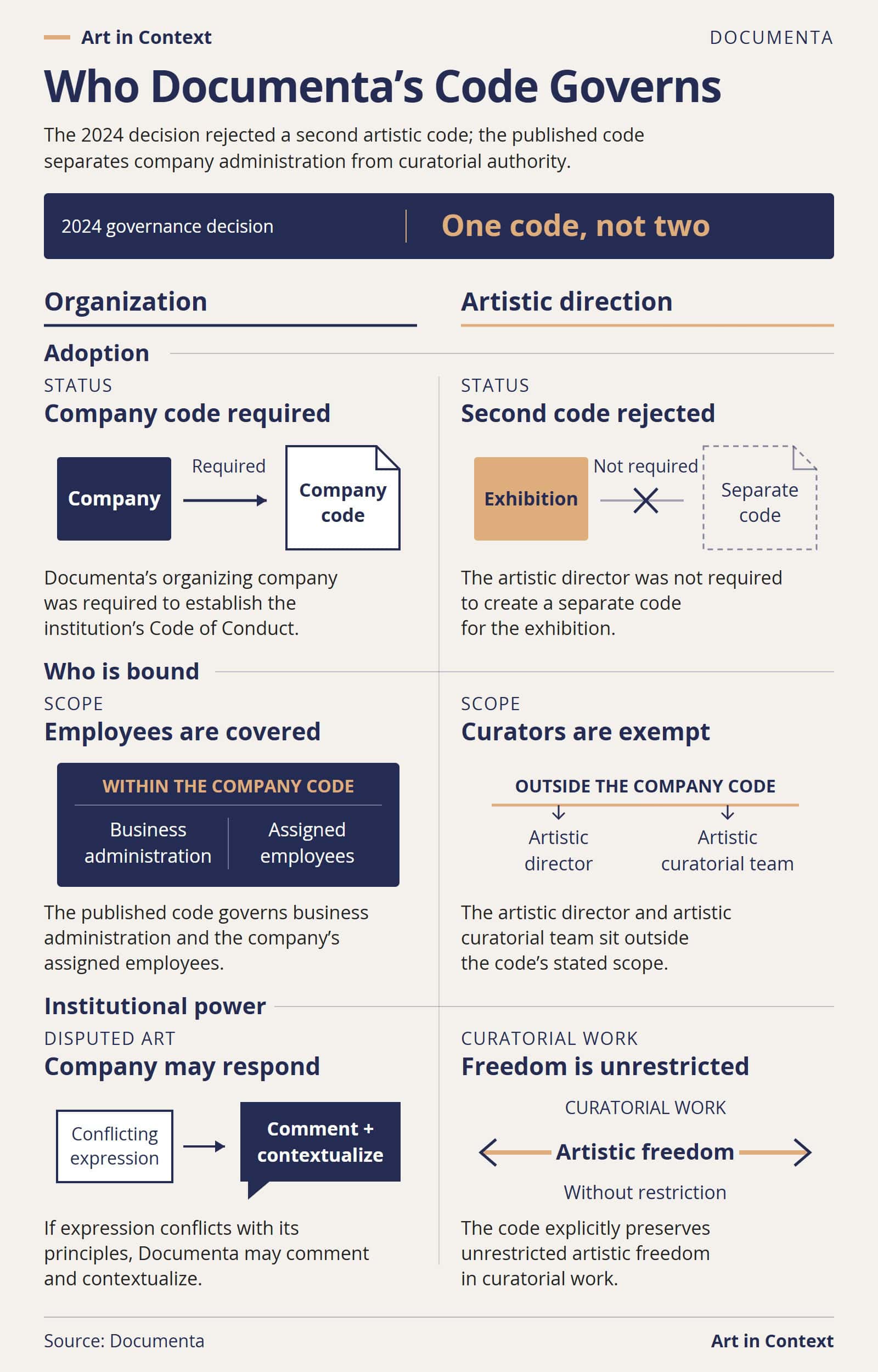
Documenta’s published Code of Conduct draws a sharper institutional line than much of the discussion around it. The code applies to the nonprofit company and its employees. It explicitly says the artistic director and artistic curatorial team are not subject to it, and that artistic freedom applies “without restriction” to curatorial work.
The same document binds the organization to the International Holocaust Remembrance Alliance working definition of antisemitism. It guarantees artistic work within German law, while reserving the institution’s right to comment on an artistic expression it judges to conflict with its principles and, if necessary, to contextualize that position near the work.
Reading those clauses together produces a more precise finding. The code is not a preapproval rule imposed on Beckwith’s curatorial program, but the institution has retained a public-response mechanism for disputed art. That does not invalidate the unnamed artists’ broader perceptions about Germany. It does mean their concerns cannot be reported as proof that Documenta itself censored a submission: no artist has been named, no work has been described, and no veto has been disclosed.
A Second Artistic Code Was Rejected
The current arrangement was a choice, not an omission. In a May 7, 2024 governance resolution, Documenta rejected a recommendation for two codes—one corporate and one written by each exhibition’s artistic director. It required only the organizational code and substituted a public presentation in which the artistic director would explain the curatorial concept, human dignity, and artistic freedom.
That history matters because the phrase “Documenta’s code” can suggest a single set of content rules for everyone making the exhibition. The official record instead separates company conduct from curatorial authority. Beckwith told HNA that she had nevertheless asked her team and every invited artist to work in a spirit of nonviolence, respect, and human dignity. Those are her stated expectations for the exhibition, not evidence that the artists who declined objected to them.

The Fridericianum and Friedrichsplatz during Documenta 14 in 2017. Photo: Heinz K. S. / Wikimedia Commons / CC BY-SA 4.0.
How 2022 and 2023 Still Shape the Next Exhibition
The institutional reforms followed Documenta 15. Documenta’s own retrospective record says that People’s Justice (2000), a banner by the Indonesian collective Taring Padi, was found to contain clearly antisemitic imagery two days after the 2022 exhibition opened. General director Sabine Schormann later left, and an expert committee examined the edition and the organization’s structures.
The first attempt to choose Documenta 16’s artistic director then collapsed in stages. Bracha Lichtenberg Ettinger and Ranjit Hoskoté resigned separately in November 2023 and gave different reasons. On November 16, the remaining four members resigned; Documenta’s official notice said the selection process would be rebuilt. The sequence is important: it was a complete collapse, but not one simultaneous resignation with one universally shared explanation.
A reconstituted committee selected Beckwith, and Documenta’s supervisory board appointed her on December 18, 2024. The company published its code in February 2025. That chronology does not prove why any artist declined an invitation in 2026. It does show that the present dispute arrived after several years in which antisemitism, German historical responsibility, Palestine solidarity, and curatorial independence had already altered Documenta’s leadership process and governance.
What the Refusals Mean for Documenta 16
Documenta 16 remains scheduled for June 12 through September 19, 2027, in Kassel. Beckwith has described a program built around artistic practices, collective learning, performance, music, and improvisation, but the participating artists and specific works remain under wraps.
There is no evidence in the available disclosures of a broad boycott. Beckwith’s statement that most invitations had gone out and the list was largely complete argues against treating the refusals as an institutional collapse. At the same time, an unknown number is not necessarily an unimportant number. A single refusal could remove a work central to a curatorial argument; a larger cluster could affect the exhibition’s geographic or intellectual range. Until the roster or the artists’ own accounts emerge, neither possibility is established.
The defensible conclusion is narrower and consequential: Germany’s Gaza policy and perceptions of constrained artistic freedom are already affecting who is willing to enter Documenta 16. The impact is curatorial even before it can be measured, because the refusals changed the pool from which Beckwith is building the exhibition.

Documenta Halle during Documenta 15, July 2022. Photo: Baummapper / Wikimedia Commons / CC BY-SA 3.0.
The Refusals Are Real; Their Impact Is Still Unknown
Beckwith has established that some unnamed artists declined invitations for two reported reasons: Germany’s position on Gaza and concern about freedom to exhibit. HNA establishes that the roster was largely complete by mid-September, but no public list allows the refusals to be measured against it.
Documenta’s own rules establish that its corporate code does not bind the artistic director or curatorial team, although the company may publicly contextualize disputed art. Its governance record also establishes that the 2023 selection-committee collapse happened in stages and that a proposed second, artistic code was rejected in 2024.
What remains unknown is substantive: who declined, how many did so, what work or viewpoint Documenta 16 consequently lost, and whether any artist will make the decision public before the exhibition opens.

Isabella studied at the University of Cape Town in South Africa and graduated with a Bachelor of Arts majoring in English Literature & Language and Psychology. Throughout her undergraduate years, she took Art History as an additional subject and absolutely loved it. Building on from her art history knowledge that began in high school, art has always been a particular area of fascination for her. From learning about artworks previously unknown to her, or sharpening her existing understanding of specific works, the ability to continue learning within this interesting sphere excites her greatly.
Her focal points of interest in art history encompass profiling specific artists and art movements, as it is these areas where she is able to really dig deep into the rich narrative of the art world. Additionally, she particularly enjoys exploring the different artistic styles of the 20th century, as well as the important impact that female artists have had on the development of art history.
Learn more about Isabella Meyer and the Art in Context Team.
Choose Art in Context as a preferred source to see more of our reporting in Google Top Stories and other Google Search experiences.
Cite this Article
Isabella, Meyer, “Some Artists Decline Documenta 16 Over Germany’s Gaza Stance.” Art in Context. September 22, 2026. URL: https://artincontext.org/documenta-16-artists-decline-germany-gaza-stance/
Meyer, I. (2026, 22 September). Some Artists Decline Documenta 16 Over Germany’s Gaza Stance. Art in Context. https://artincontext.org/documenta-16-artists-decline-germany-gaza-stance/
Meyer, Isabella. “Some Artists Decline Documenta 16 Over Germany’s Gaza Stance.” Art in Context, September 22, 2026. https://artincontext.org/documenta-16-artists-decline-germany-gaza-stance/.


