


How 116 Photographs Imagine the Life Emmett Till Was Denied

Chicago’s Museum of Contemporary Photography has opened If Emmett Till Lived: Freedom on American Ground, an exhibition of 116 works by 116 artists drawn principally from the museum’s collection, with some extended loans, to imagine the childhood, adulthood, and ordinary freedoms Till was denied. Its central achievement is not a reconstruction of an unknowable life, but a collective memorial built from the museum’s own permanent collection.
A Counterfactual Life Built From a Photography Collection
The free exhibition opened September 10 at the Museum of Contemporary Photography at Columbia College Chicago and remains on view through December 19, 2026. The museum’s exhibition record describes it as a collaboration between guest curator Sarah Elizabeth Lewis and the Rev. Wheeler Parker Jr., Till’s cousin, best friend, and the last surviving witness to his kidnapping.
Till was a 14-year-old Black Chicagoan when he was kidnapped, tortured, and murdered during a family visit to Mississippi in August 1955. His mother, Mamie Till-Mobley, insisted on an open-casket funeral at Roberts Temple Church of God in Christ. The National Park Service’s historical account records that thousands came to the church and that publication of photographs of Till’s body in Jet helped turn private grief into a national demand for change.
The photographs in the 2026 exhibition do something categorically different. They do not document the adulthood Till might have had; no photograph can. Instead, works from artists including Gordon Parks, Carrie Mae Weems, Dawoud Bey, Dorothea Lange, LaToya Ruby Frazier, and Lance Omar Thurman become prompts for imagining family, play, work, travel, citizenship, and aging.
That distinction keeps the counterfactual honest. Historical facts establish the life and violence that occurred, while the curatorial arrangement proposes possibilities that did not. The project therefore uses the range of contemporary photography—documentary, portrait, landscape, and conceptual image-making—to make an absence visible without presenting invention as biography.
The Exact Scale Is 116 Works by 116 Artists
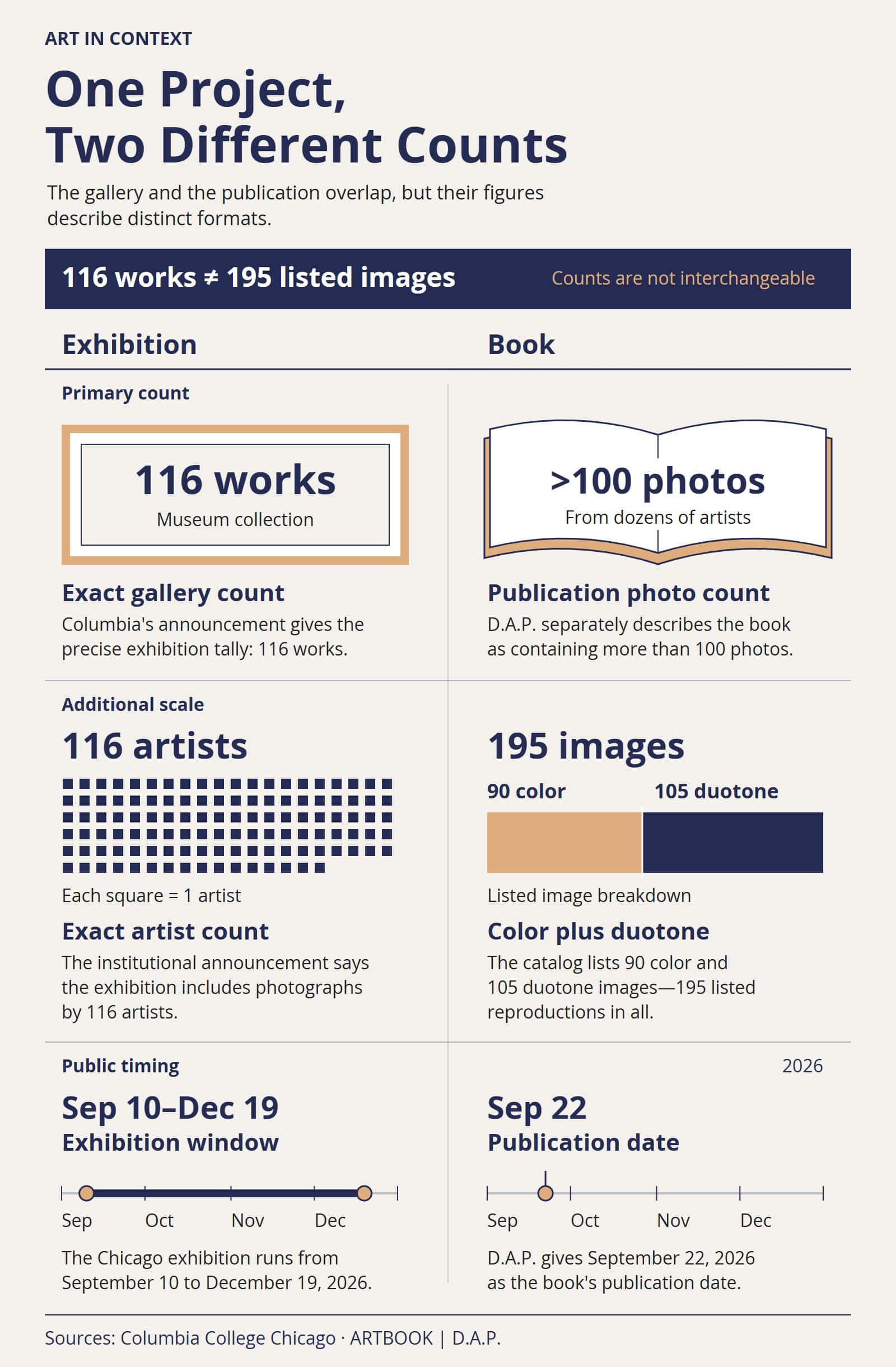
Columbia College Chicago reports 116 works by 116 artists, although individual object credits show that not every exhibited work belongs to the permanent collection.
The number also shows how selectively the exhibition uses the museum’s holdings. MoCP says its collection now exceeds 17,000 objects by more than 1,950 artists. The show activates less than one percent of those objects, but it does so around a single proposition rather than as a survey of collection highlights.
The accompanying publication should not be treated as a 116-item checklist of the gallery walls. The distributor’s catalog record describes a 256-page volume with more than 100 photographs and lists 90 color and 105 duotone images. It gives September 22 as the publication date. The book and exhibition overlap, but their counts describe different formats.
The formal credits are more precise than some press shorthand. The Guardian’s September 13 feature calls Lewis and Parker co-curators, while MoCP names Lewis as guest curator working in collaboration with Parker. It credits Karen Irvine as coordinating curator, Deanna Whitlow as assistant coordinating curator, Jessica Williams Stark as guest curatorial associate, and Caro Campos as research fellow. The museum’s own credit line is the controlling record of who held which role.

Columbia College Chicago, the institution that operates MoCP, photographed by Tony Webster in 2006. Hosted by Wikimedia Commons under the Creative Commons Attribution 2.0 Generic license.
Outside Selectors Turn Collection Objects Into Proposals
Lewis and Parker invited members of the Till family and civic and cultural figures to select images that embodied hopes for the life Till never had. Contributors named by the museum include Lonnie G. Bunch III, Ava DuVernay, Alicia Garza, John Legend, Wynton Marsalis, Rep. Ayanna Pressley, Amy Sherald, Hank Willis Thomas, and Deborah Willis. Their participation distributes interpretive authority beyond the museum’s professional staff without changing the status of the photographs as collection objects.
The Guardian’s interviews and installation account make that method concrete. Parker selected Walter Rosenblum’s Hopscotch from 1952 for its image of childhood innocence. Thomas selected Bey’s 2006 portrait of Barack Obama as an image of Black adulthood and public presence. David Plowden’s Railroad Yards, South Chicago evokes the train journey home that Till never completed.
Stephen Marc’s 1988 photograph of a man tossing a young boy into the air carries another kind of possibility. Lewis chose it for the book cover, and its family scene asks viewers to see hope without pretending the people pictured are Till or his relatives. Lance Omar Thurman’s photograph of the remains of Bryant’s Grocery, by contrast, returns the sequence to a surviving place connected to the 1955 crime.
This is a widened form of curating: selection is partly delegated, while the museum and lead curatorial team shape those choices into a coherent route. The resulting “creative monument” is not one heroic likeness. It is a field of other people’s lives and places, each image carrying a limited proposal about what freedom might have looked like.
Four Dates Place the Exhibition in Its Civic Setting
The project arrived through a sequence of related but distinct events:
- September 9: Roberts Temple held a ceremony lighting a newly fabricated replica of its historic neon sign.
- September 10: MoCP opened the exhibition with a convening and reception.
- September 13: The Guardian published its illustrated feature; this was the report date, three days after the opening.
- September 22: D.A.P. lists the official publication date for If Emmett Till Lived: A Creative Monument.
The September 9 and 10 dates are confirmed in the National Trust for Historic Preservation’s September 10 release. The sign lighting marked completion of exterior restoration work at the church; the exhibition opened the following day at a different site. They are coordinated acts of remembrance, not a single event.
MoCP also says a dedicated website will launch during September with expanded information and public programming, but it gives no exact date. That makes the digital project the one part of the opening sequence still without a fixed public timetable.
For visitors, the physical facts are settled: If Emmett Till Lived is at MoCP, 600 South Michigan Avenue in Chicago, through Saturday, December 19, and admission is free.

Roberts Temple Church of God in Christ, photographed by Legimet in 2025. Hosted by Wikimedia Commons under the Creative Commons Attribution-ShareAlike 4.0 International license.
116 Works, With the Digital Launch Still Undated
The exact gallery scale is 116 works by 116 artists; MoCP’s “more than 110” is a rounded version of Columbia College Chicago’s precise institutional count.
The photographs construct a counterfactual memorial rather than a documentary biography. The selections associated with Parker, Thomas, Lewis, and other contributors are proposals about unrealized experience, while the historical record of Till’s life and murder remains distinct.
The exhibition opened September 10, one day after the Roberts Temple sign lighting and three days before the Guardian feature appeared. The related book has a separate September 22 publication date.
MoCP’s formal credits identify Lewis as guest curator in collaboration with Parker and name the coordinating and research team. The exact launch date of the companion website remains unannounced; the museum has committed only to September 2026.

Isabella studied at the University of Cape Town in South Africa and graduated with a Bachelor of Arts majoring in English Literature & Language and Psychology. Throughout her undergraduate years, she took Art History as an additional subject and absolutely loved it. Building on from her art history knowledge that began in high school, art has always been a particular area of fascination for her. From learning about artworks previously unknown to her, or sharpening her existing understanding of specific works, the ability to continue learning within this interesting sphere excites her greatly.
Her focal points of interest in art history encompass profiling specific artists and art movements, as it is these areas where she is able to really dig deep into the rich narrative of the art world. Additionally, she particularly enjoys exploring the different artistic styles of the 20th century, as well as the important impact that female artists have had on the development of art history.
Learn more about Isabella Meyer and the Art in Context Team.
Choose Art in Context as a preferred source to see more of our reporting in Google Top Stories and other Google Search experiences.
Cite this Article
Isabella, Meyer, “How 116 Photographs Imagine the Life Emmett Till Was Denied.” Art in Context. September 13, 2026. URL: https://artincontext.org/if-emmett-till-lived-chicago-photography-exhibition/
Meyer, I. (2026, 13 September). How 116 Photographs Imagine the Life Emmett Till Was Denied. Art in Context. https://artincontext.org/if-emmett-till-lived-chicago-photography-exhibition/
Meyer, Isabella. “How 116 Photographs Imagine the Life Emmett Till Was Denied.” Art in Context, September 13, 2026. https://artincontext.org/if-emmett-till-lived-chicago-photography-exhibition/.


