

UK Defers Stanley Spencer Resurrection Diptych Export

The UK has deferred a decision on the export licence application for Stanley Spencer’s 1915 diptych The Resurrection of the Good and the Bad, allowing an appropriate purchaser through December 10, 2026, to express interest at the recommended price of £450,000. The decision matters because this severe, divided vision of judgment captures the Resurrection theme before Spencer’s wartime service transformed it.
What the Stanley Spencer Export Deferral Actually Does
The government announcement published September 11 says the decision on the export license has been postponed, initially through December 10 inclusive. It does not transfer the painting to the state, guarantee a museum purchase, or permanently refuse permission to export it. The practical effect is to hold the application while an eligible UK purchaser tries to match the recommended price.
That distinction is easy to lose in the shorthand “export bar.” The same distinction matters in the second UK export bar on Rembrandt’s Catrina Hooghsaet: a deferral creates a purchase route, but does not settle ownership by itself.
The Reviewing Committee on the Export of Works of Art and Objects of Cultural Interest advised the minister that Spencer’s diptych met the third Waverley criterion. Under the government’s published explanation of the system, that criterion asks whether an object is exceptionally important to the study of a branch of art, learning, or history. The September decision identifies that scholarship test; it does not record a separate finding under the history or aesthetic criteria.
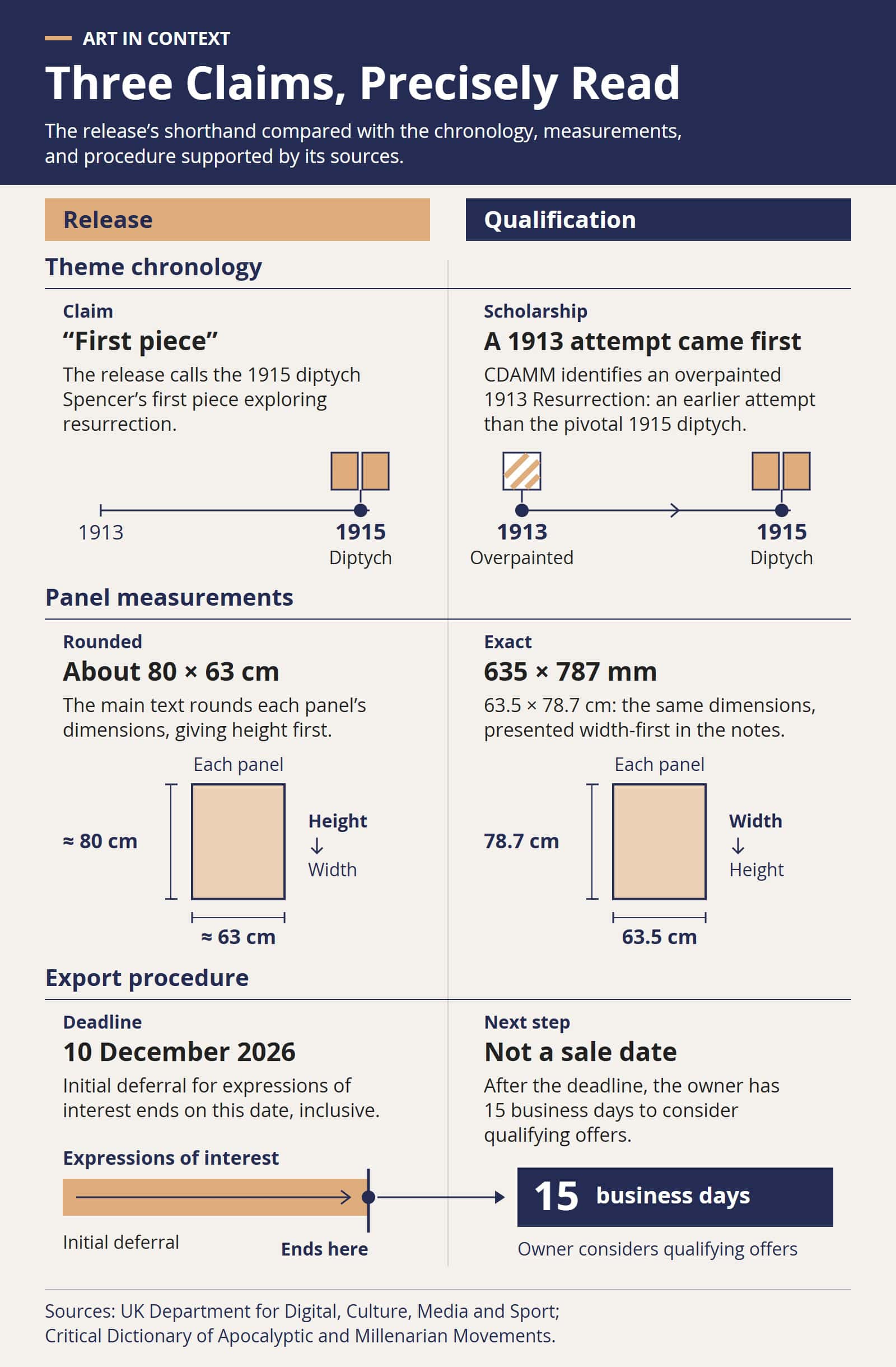
The release appears to give two sizes, but they are not contradictory. Its main text rounds each panel to about 80 by 63 centimeters; the notes specify 635 by 787 millimeters. Converted to centimeters, the precise figures are 63.5 by 78.7—the same rounded pair presented in the reverse order.
The 1915 Diptych Was Not Spencer’s First Known Attempt
The government calls The Resurrection of the Good and the Bad Spencer’s first work on the theme. Mark Hallett, the RCEWA member quoted in the release, uses a narrower and more defensible description: the artist’s “first serious engagement” with a subject that became central to his work.
Independent scholarship supplies the missing qualification. In a signed Critical Dictionary entry on Spencer, Thomas Bromwell identifies a 1913 Resurrection picture that was painted over with The Apple Gatherers. The 1915 diptych can therefore be pivotal without being Spencer’s first known attempt at the subject. The government says that a UK museum acquisition would make it the earliest publicly held example of his Resurrection paintings.
The work makes judgment visible through its two-part structure. Figures designated as the Good rise on the left; the Bad occupy the right. Bromwell describes nearly equal groups of dead people emerging from graves and connects the division to the judgment in Revelation. The moral sorting is not background theology—it is the composition’s organizing device.
That makes the diptych unusually revealing within Spencer’s career. It fixes “good” and “bad” in separate panels at a moment when his treatment of resurrection was still close to a conventional Last Judgment. The severe binary would not remain the dominant idea in the paintings for which he later became best known.

Travoys Arriving with Wounded at a Dressing-Station at Smol, Macedonia, September 1916 (1919) by Stanley Spencer. Imperial War Museums via Wikimedia Commons, public domain. Cropped.
War Changed What Resurrection Meant in Spencer’s Art
The date needs its own distinction: the diptych was made during the First World War, but before Spencer began military service. He entered the Royal Army Medical Corps in 1915, worked at Beaufort Hospital near Bristol, later served in Macedonia, and received an official war-artist commission in 1918. His 1919 painting Travoys Arriving with Wounded at a Dressing-Station at Smol, Macedonia, September 1916 drew directly on that experience.
After the war, resurrection became less a courtroom and more a condition of renewed life. Bromwell notes that Spencer’s later treatments were largely detached from end-time judgment. In The Resurrection, Cookham of 1924–27, the biblical event moves into the churchyard of his Berkshire village. The moral division is softened rather than erased: the Good and Bad share one canvas, with the Bad confined to a single tomb.
The transformation is equally clear in the National Trust’s record for The Resurrection of the Soldiers, painted in 1928–29 for Sandham Memorial Chapel. Soldiers emerge among white crosses, greet comrades, clean buttons, and wind puttees; the museum describes them as awakening to peace. These ordinary gestures are far removed from the punitive division governing the 1915 diptych.
That sequence explains the committee’s scholarship case. The work under export review is not simply an early version of a famous theme. It preserves a position Spencer later revised: explicit division before service, followed by increasingly personal images of reunion, ordinary activity, and joy after his encounter with war.
A Provenance Beginning With a 1915 Studio Sale
The government’s published provenance begins with a direct purchase from Spencer and then records a long passage through private ownership:
- 1915: James Wood bought the diptych from the artist.
- Later: the provenance names Elizabeth Wood, followed by the London dealer Browse & Darby.
- 1980: a private UK collection acquired it from Browse & Darby.
- After 1980: it descended within that ownership line.
- 2026: the current owner purchased it from that source.
The sequence establishes that the painting left Spencer’s hands in 1915 and changed owners again in 2026. The release does not name the current owner, the export-license applicant, the intended country of destination, or the dates and circumstances of every transfer between the early owners. Nor does it announce that any museum has begun a fundraising campaign.

The Stanley Spencer Gallery in Cookham. Photograph by Jim Osley, CC BY-SA 2.0, via Wikimedia Commons.
December 10 Is an Offer Deadline, Not a Sale Date
An appropriate purchaser has through December 10, 2026, inclusive to express serious interest at £450,000. The owner then receives 15 business days to consider qualifying offers. A second deferral does not begin automatically: it starts only after an option agreement is signed, and it would run for four months. Government guidance says an appropriate private buyer may qualify as well as a public institution, provided the work remains in the UK with commitments on public access, conservation, and security.

Isabella studied at the University of Cape Town in South Africa and graduated with a Bachelor of Arts majoring in English Literature & Language and Psychology. Throughout her undergraduate years, she took Art History as an additional subject and absolutely loved it. Building on from her art history knowledge that began in high school, art has always been a particular area of fascination for her. From learning about artworks previously unknown to her, or sharpening her existing understanding of specific works, the ability to continue learning within this interesting sphere excites her greatly.
Her focal points of interest in art history encompass profiling specific artists and art movements, as it is these areas where she is able to really dig deep into the rich narrative of the art world. Additionally, she particularly enjoys exploring the different artistic styles of the 20th century, as well as the important impact that female artists have had on the development of art history.
Learn more about Isabella Meyer and the Art in Context Team.
Choose Art in Context as a preferred source to see more of our reporting in Google Top Stories and other Google Search experiences.
Cite this Article
Isabella, Meyer, “UK Defers Stanley Spencer Resurrection Diptych Export.” Art in Context. September 12, 2026. URL: https://artincontext.org/stanley-spencer-resurrection-diptych-export-bar/
Meyer, I. (2026, 12 September). UK Defers Stanley Spencer Resurrection Diptych Export. Art in Context. https://artincontext.org/stanley-spencer-resurrection-diptych-export-bar/
Meyer, Isabella. “UK Defers Stanley Spencer Resurrection Diptych Export.” Art in Context, September 12, 2026. https://artincontext.org/stanley-spencer-resurrection-diptych-export-bar/.


