

Liang Shaoji, Artist of Living Silkworms, Dies at 81

Chinese artist Liang Shaoji, who spent more than three decades making art with living silkworms, died in Shanghai on September 13 at 81, The Paper reported, citing his representing gallery, ShanghART. His death closes a practice that changed silk from a finished craft material into evidence of biological labor, duration, and negotiated control.
Liang Shaoji Died at 81
The report by The Paper was published on September 14, the morning after Liang died. The report said Liang died in Shanghai after an illness and cited ShanghART for the family’s funeral arrangements. It did not name a diagnosis.
The gallery announcement, as relayed by The Paper, said Liang’s family requested simple funeral arrangements and that information about a farewell gathering would follow.
Liang’s significance rests on more than an unusual material. Over decades, he made the silkworm’s short life cycle part of the artwork’s production and meaning. Silk could register feeding, movement, time and metamorphosis before viewers encountered it as an installation.
From Soft Sculpture to the Nature Series
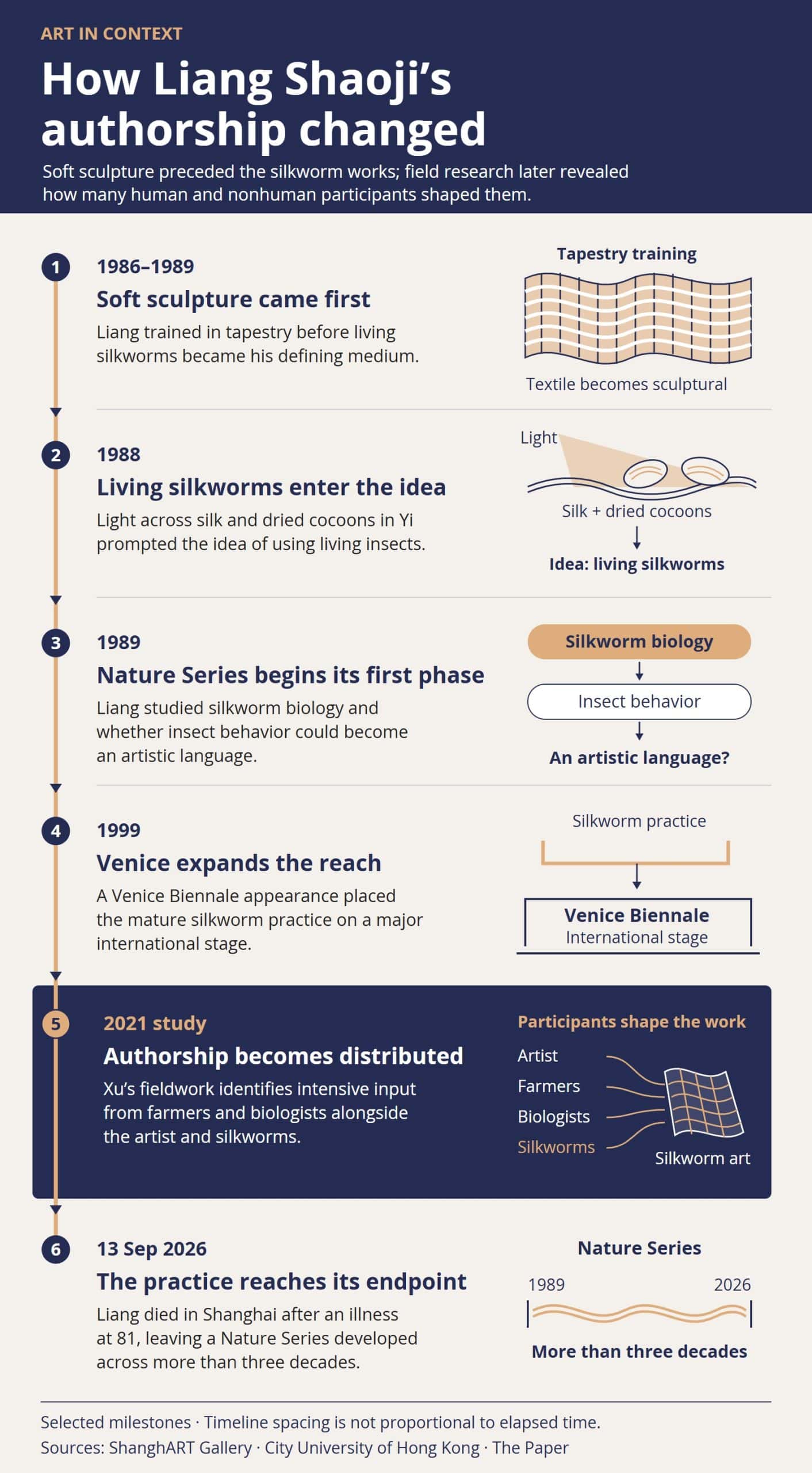
Liang was born in Shanghai in 1945 and graduated in 1965 from the high school affiliated with Zhejiang Academy of Fine Arts. His representing gallery’s biographical chronology records that he studied at the Varbanov Institute of Tapestry at the Zhejiang Academy of Art from 1986 through 1989, learning soft sculpture from the Bulgarian-born artist Maryn Varbanov.
The chronology dates Liang’s participation in the 13th International Biennale of Tapestry in Lausanne to 1987. The Paper identifies the selected work, The Art of War, as a 1986 creation. Liang had already pushed weaving into sculptural space before living insects became his defining medium.
ShanghART says he began experimenting with silkworms in the late 1980s, while its exhibition records date Nature Series No. 1 to 1989. ShanghART dates Nature Series No. 1 to 1989, although a China Academy of Art Museum page gives conflicting 1988 and 1989 start dates. His participation that year in the landmark China/Avant-Garde exhibition also places the shift inside a wider experimental turn in late-20th-century Chinese art.
The international sequence accelerated a decade later. ShanghART’s chronology records appearances at the 48th Venice Biennale and the sixth Istanbul Biennial in 1999, followed by the Lyon and Shanghai biennials in 2000. These were not isolated invitations attached to a late-career discovery; they followed years of training, fiber exhibitions and experiments with the boundary between object and organism.

Silkworms feeding on mulberry leaves, the living medium at the center of Liang Shaoji’s Nature Series. Photograph by Fumikas Sagisavas, hosted by Wikimedia Commons, under the CC0 1.0 Universal Public Domain Dedication; cropped.
What the Silkworms Actually Authored
Calling Liang an artist who “used” silkworms is accurate but incomplete. He raised and fed the insects, selected supports such as metal, wood, stone and mirrors, and arranged the physical conditions in which they spun. The silkworms then produced the silk and introduced variations that could not be drawn by hand in precisely the same way.
A detailed independent account complicates the appealing idea of an equal partnership. In a 2021 City University of Hong Kong doctoral study based on fieldwork with Liang, silkworm farmers and biologists, researcher Feixuan Xu describes a practice shaped by cultivation, scientific advice and artistic intervention. Her evidence adds farmers and scientists to a story often reduced to one artist and his insects.
The crucial change was from using finished silk to staging its production. In ordinary sericulture, Bombyx mori spins a cocoon around itself. Liang instead placed silkworms on chosen surfaces so their secretions accumulated as flat sheets, veils and coverings. The surviving silk is consequently both material and a record of behavior.
Xu reports that flat-cocoon techniques can create greater health risks for silkworms and that Liang sometimes asked them to spin on difficult surfaces. Her conclusion rules out a purely romantic account of nonhuman freedom. A more precise reading is asymmetric collaboration: Liang authored the protocol and the encounter between materials, while the insects determined countless local paths and densities inside those constraints.
That distributed but unequal authorship is Liang’s strongest contribution to contemporary art. The finished installation is only one phase of the work. Husbandry, waiting, biological change and the eventual trace of silk are inseparable from what a viewer sees, placing the Nature Series across fiber art, sculpture, installation, performance and bio-art without fitting comfortably inside any one category.

Bombyx mori cocoons, showing the conventional form Liang redirected into flat sheets and coverings. Photograph by Biswarup Ganguly, hosted by Wikimedia Commons, under the Creative Commons Attribution 3.0 Unported license.
How Liang’s Work Reached International Institutions
ShanghART dates Beds/Nature Series No. 10 to 1993 and records it as the work shown at the 1999 Venice Biennale. ShanghART’s record confirms Liang’s participation in Venice and Istanbul that year. Neither source describes him as a national representative.
Institutional recognition continued beyond the biennial circuit. ShanghART records a Prince Claus Award in 2009. In the United States, the Smart Museum of Art’s record for The Allure of Matter: Material Art from China confirms that Liang was included in the exhibition at the Los Angeles County Museum of Art in 2019 and in Chicago in 2020. The exhibition framed him among artists for whom material choice carried the work’s argument, rather than treating silkworms as spectacle.
The largest survey of his career followed in Shanghai. Liang Shaoji: A Silky Entanglement, curated by Hou Hanru at the Power Station of Art, ran from September 29, 2021, through February 20, 2022. It brought together more than 30 years of the Nature Series with a reconstruction of his studio, a laboratory component and new work, presenting cultivation and research as parts of the practice rather than backstage preliminaries.
The Paper called Silk Radiance at Liangzhu Museum in 2025 the last solo exhibition Liang personally participated in, although ShanghART lists him in a two-artist exhibition categorized as a solo show in 2026. His late work also moved into glass, but his own explanation treated water, fire, light and silk as another form of weaving. The move was an extension of his long method of testing how materials act, not an abandonment of the silkworm practice that established his place in art history.

The Power Station of Art in Shanghai, which hosted Liang Shaoji’s major 2021–2022 retrospective. Photograph by Jingyi Wang, hosted by Wikimedia Commons, under the CC0 1.0 Universal Public Domain Dedication.
Liang Shaoji’s Legacy
Liang’s legacy exceeds the shorthand “silkworm artist.”
- Liang died in Shanghai on September 13, 2026, and The Paper published its report on September 14; the report describes an illness but gives no diagnosis.
- The documented Nature Series begins in 1989, after Liang’s fiber and soft-sculpture training, so living silkworms marked a decisive turn in an existing practice rather than its origin.
- ShanghART’s chronology establishes Venice and Istanbul biennial appearances in 1999, while the Smart Museum establishes the later United States tour of The Allure of Matter.
- Xu’s fieldwork shows that authorship was shared but unequal: Liang, farmers and biologists structured the conditions, and the silkworms materially generated the work.
- Details of a farewell gathering will be announced separately, according to the death report.

Isabella studied at the University of Cape Town in South Africa and graduated with a Bachelor of Arts majoring in English Literature & Language and Psychology. Throughout her undergraduate years, she took Art History as an additional subject and absolutely loved it. Building on from her art history knowledge that began in high school, art has always been a particular area of fascination for her. From learning about artworks previously unknown to her, or sharpening her existing understanding of specific works, the ability to continue learning within this interesting sphere excites her greatly.
Her focal points of interest in art history encompass profiling specific artists and art movements, as it is these areas where she is able to really dig deep into the rich narrative of the art world. Additionally, she particularly enjoys exploring the different artistic styles of the 20th century, as well as the important impact that female artists have had on the development of art history.
Learn more about Isabella Meyer and the Art in Context Team.
Choose Art in Context as a preferred source to see more of our reporting in Google Top Stories and other Google Search experiences.
Cite this Article
Isabella, Meyer, “Liang Shaoji, Artist of Living Silkworms, Dies at 81.” Art in Context. September 15, 2026. URL: https://artincontext.org/liang-shaoji-silkworm-artist-dies-81/
Meyer, I. (2026, 15 September). Liang Shaoji, Artist of Living Silkworms, Dies at 81. Art in Context. https://artincontext.org/liang-shaoji-silkworm-artist-dies-81/
Meyer, Isabella. “Liang Shaoji, Artist of Living Silkworms, Dies at 81.” Art in Context, September 15, 2026. https://artincontext.org/liang-shaoji-silkworm-artist-dies-81/.


