

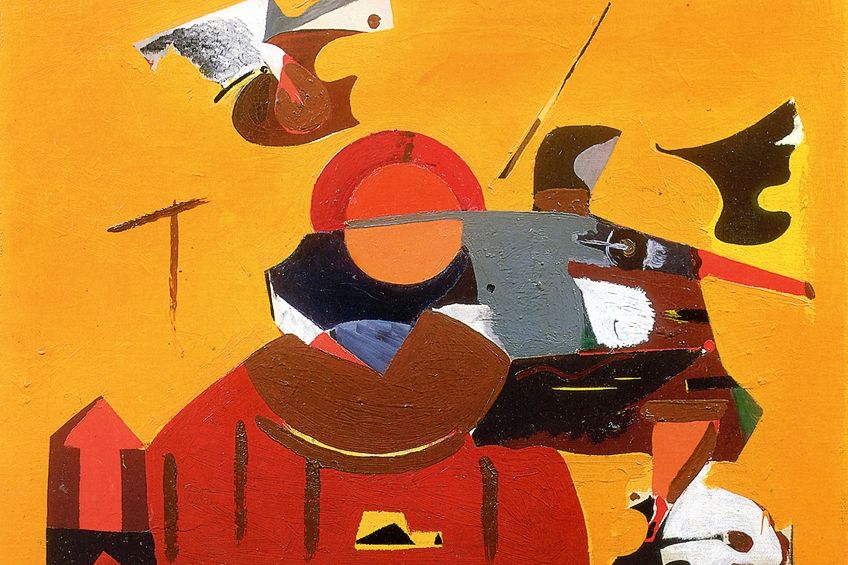
Abstract Expressionism – The Artistry of the Abstract Expressionists

Abstract Expressionism was a diverse field of postwar painting and sculpture that coalesced in New York during the 1940s and gained international prominence in the 1950s. Artists including Jackson Pollock, Lee Krasner, Willem de Kooning, Mark Rothko, Barnett Newman, Clyfford Still, Norman Lewis, and many others treated scale, material, gesture, color, and the act of viewing as urgent artistic problems. The movement was neither purely abstract nor exclusively male, white, American-born, spontaneous, or apolitical.
What Is Abstract Expressionism?
Abstract Expressionism is an art-historical label for artists whose work varied widely but shared a commitment to ambitious, experimental art in and around mid-century New York. It developed through the Great Depression, federal art programs, migration, World War II, Surrealism, European modernism, Indigenous and ancient art as interpreted by these artists, psychoanalysis, existential thought, and intense exchange among studios, schools, galleries, museums, and bars.
It was not the first American movement, nor was it entirely American in origin. Arshile Gorky came from Ottoman Armenia, Willem de Kooning from the Netherlands, Mark Rothko from the Russian Empire, and Hans Hofmann from Germany. New York’s new authority did not simply remove Europe “from the radar”; cultural power shifted through war, migration, money, institutions, criticism, and U.S. geopolitics while Paris and other centers remained active.
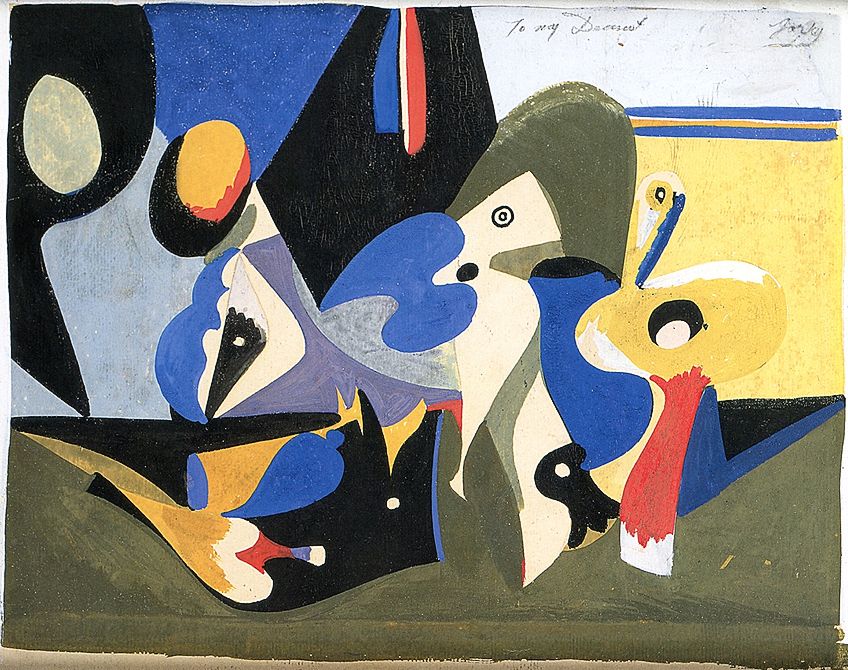
Some works retain bodies, landscapes, symbols, or architectural fragments; others appear nonobjective. Some were brushed rapidly, but many were revised, scraped, redrawn, or built through long sequences. Large scale mattered for numerous artists, not all. “New York School” is another flexible label, and the San Francisco Bay Area developed related but distinct postwar abstraction.
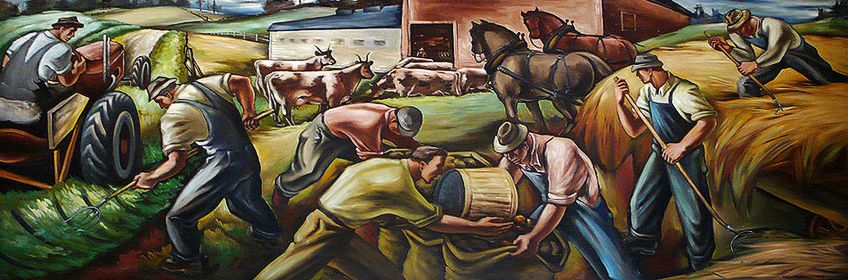
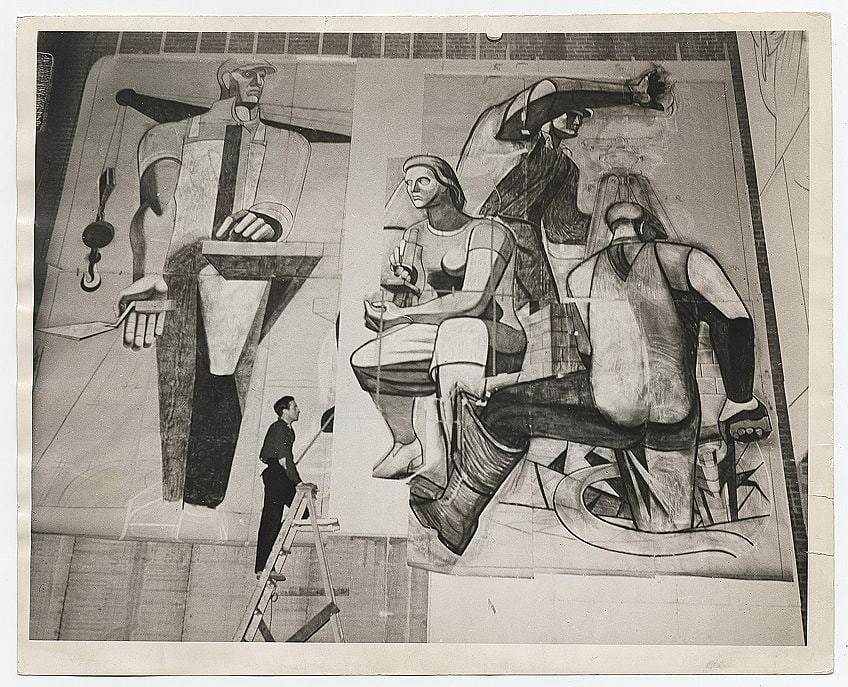
Federal programs during the 1930s and early 1940s gave artists work, experience with murals, and professional networks. This history matters because several future Abstract Expressionists learned to design at public scale before turning to easel paintings.
Famous Artists Who Shaped Abstract Expressionism
No single artist “launched” Abstract Expressionism. Gorky’s biomorphic paintings linked Surrealism and emerging abstraction; Hofmann’s teaching connected European modernism with American students; Pollock transformed poured and dripped line; Krasner developed all-over compositions and later collage; de Kooning sustained a volatile exchange between figure and ground; Rothko, Newman, and Still built large chromatic fields; Lewis joined atmospheric abstraction to Black urban experience; sculptors such as David Smith opened another dimension.
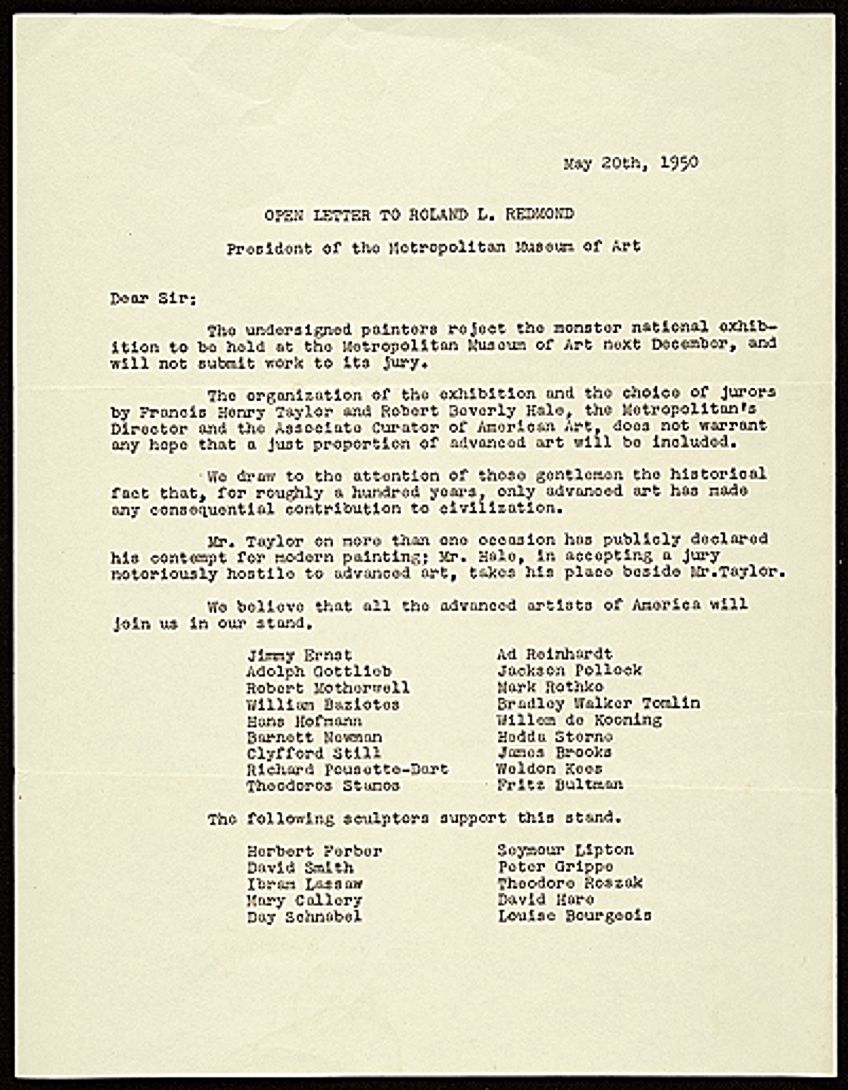
In May 1950, 28 artists signed an open letter protesting the Metropolitan Museum of Art’s conservative selection process for a national competition. A 1951 Life photograph of 15 participants popularized “The Irascibles.” The protest demonstrates organization, but the group was not a formal association and the photograph narrowed public memory. Hedda Sterne was the only woman pictured; signatories Louise Bourgeois, Mary Callery, and Day Schnabel were not included in the photograph.
Commercial galleries, critics, collectors, and museums shaped recognition. Peggy Guggenheim’s Art of This Century, Betty Parsons Gallery, Sidney Janis Gallery, the Museum of Modern Art, and other institutions helped produce the canon. Their decisions also excluded or delayed recognition for women, Black artists, Asian American artists, queer artists, and artists outside favored networks.
A Suitable Abstract Expressionism Definition
The expression predates the New York movement. German-language criticism used related wording for Expressionist art, and American critic Robert Coates applied “Abstract Expressionism” to new American painting in 1946. The term succeeded because it held together a contradiction: images could be abstract in structure yet expressionist in their force, touch, scale, or ambition.
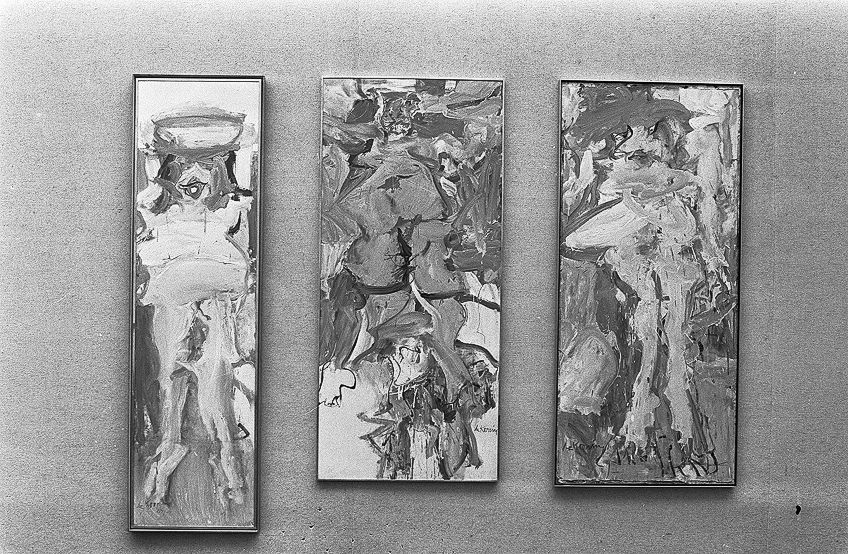
It should not be derived mechanically from German Expressionism plus one list of abstract movements. Nor does it mean “lawless” or “nihilistic.” Pollock’s interlaced lines, Rothko’s hovering rectangles, Newman’s vertical “zips,” de Kooning’s figures, and Lewis’s nocturnal signs demand different descriptions. The category is historical and institutional as much as stylistic.
Characteristics and Influences of Abstract Expressionism
Recurring qualities include attention to the canvas as a field, assertive material presence, nontraditional tools or procedures, large formats, ambiguous imagery, and a belief that painting could create an encounter rather than illustrate a story. These traits are tendencies, not requirements. Figurative art, drawing, small works, planning, and recognizable references all remained active.
The Influence of World War Two on Abstract Expressionism
War and genocide transformed the conditions in which the movement formed, but it is too simple to say that returning soldiers invented abstraction to express trauma. Many central artists did not serve in combat. European refugees and émigrés brought knowledge and institutions to the United States; artists already in New York had worked through Depression-era politics, mural programs, labor organizations, and anti-fascist culture.
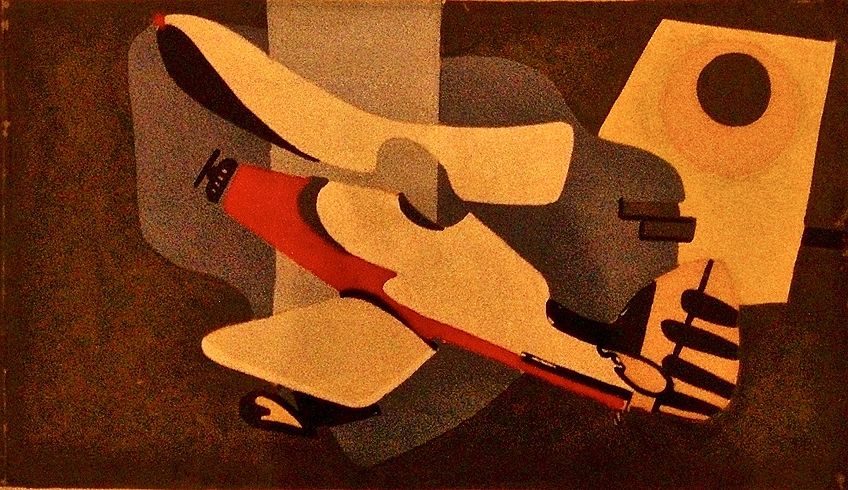
Cold War culture later promoted American art abroad. Some exhibitions received indirect support within U.S. cultural diplomacy, but this does not make every artist a knowing government instrument or every abstract work “nonpolitical.” Artists held varied leftist, anarchist, liberal, anti-Stalinist, spiritual, and skeptical positions. Norman Lewis addressed racial terror through abstraction; Newman wrote on freedom and the sublime; Guston eventually returned to grotesque figuration.
Surrealism and Abstract Expressionism
Surrealist automatism encouraged artists to begin without a fixed image and respond to emerging marks. Exiled artists and exhibitions made Surrealism visible in New York. Gorky, Pollock, Gottlieb, Rothko, Motherwell, and others adapted biomorphism, myth, dream imagery, and the unconscious.
These borrowings require critical context. Mid-century artists and critics often used “primitive” as a sweeping category for Indigenous, African, Oceanic, and ancient cultures, projecting universal myths while ignoring living peoples and distinct histories. Current interpretation names the specific source and the unequal conditions of collecting rather than repeating that framework.
Action Painting in Abstract Expressionism
Critic Harold Rosenberg introduced “action painting” in 1952, describing the canvas as an arena in which to act. The term illuminates bodily process but can turn a finished work into a romantic record of one heroic instant. Pollock, de Kooning, Kline, Krasner, and Guston revised and planned as well as gestured.
Pollock placed canvas on the floor and poured, dripped, flicked, and moved paint using sticks, hardened brushes, containers, and other tools. Gravity, viscosity, speed, reach, and previous layers all shaped the result. “Spontaneous” does not mean haphazard.
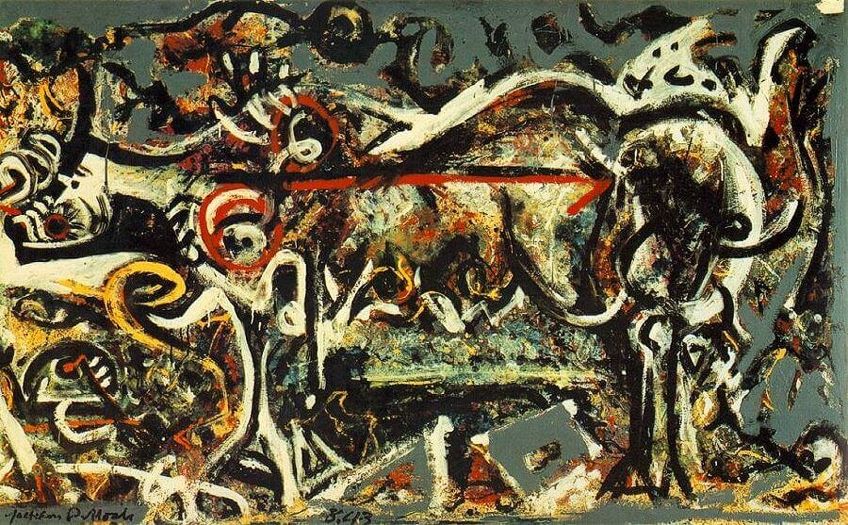
The She-Wolf (1943) by Jackson Pollock; Jackson Pollock, CC BY-SA 4.0, via Wikimedia Commons
The She-Wolf predates Pollock’s mature poured paintings. Its layered creature and signs show his sustained movement between recognizable image and abstraction. The identification with Rome’s foundation myth was suggested after the painting was made, so it should not be treated as a settled program.
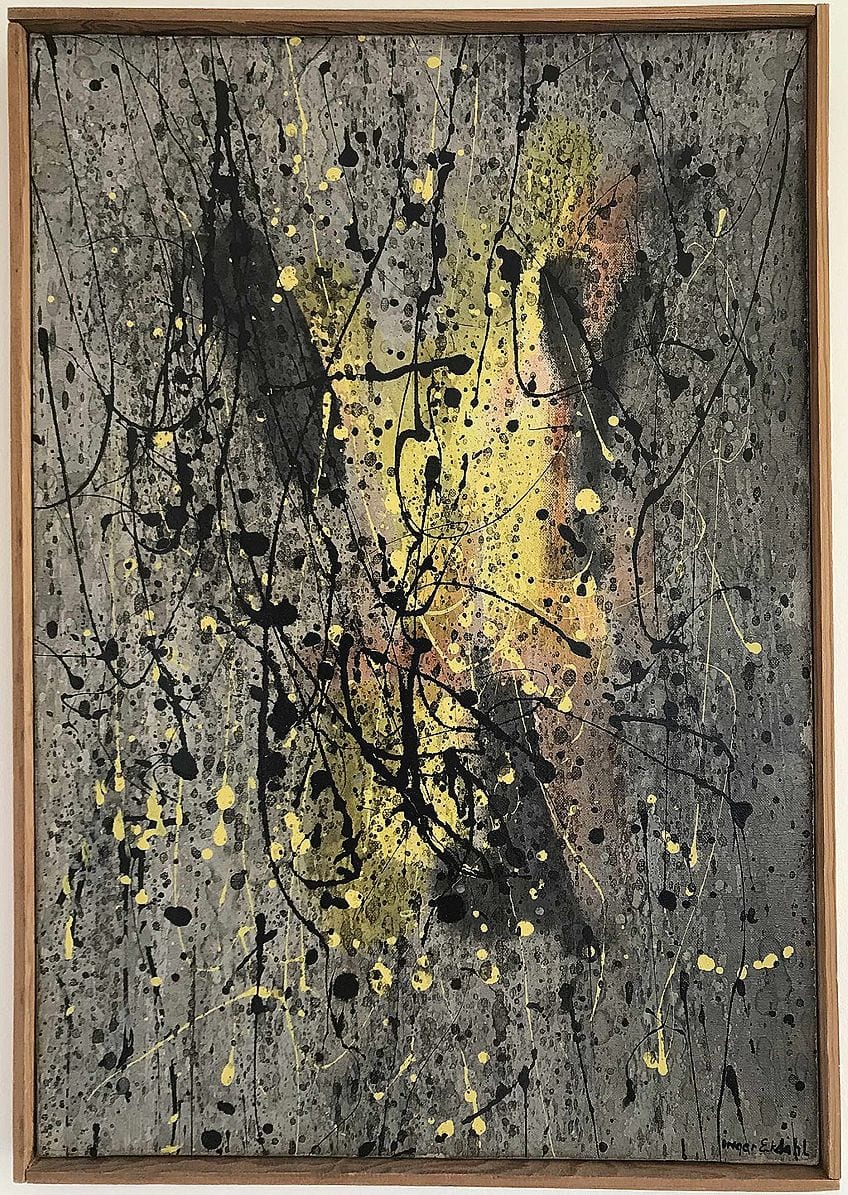
Swedish artist Inger Ekdahl demonstrates that gestural abstraction traveled beyond New York. Her work should not be absorbed into the New York School without evidence; it belongs to an international history of postwar abstraction.
Color Field Painting in Abstract Expressionism
“Color field” usually describes paintings organized through broad chromatic areas, especially those of Rothko, Newman, and Still, and later artists such as Helen Frankenthaler and Morris Louis. Critic Clement Greenberg promoted the category, but its apparent opposition to gesture is porous. Rothko layered and brushed his fields; Newman’s edges and surfaces are physically specific; Still’s fields are jagged and textural.
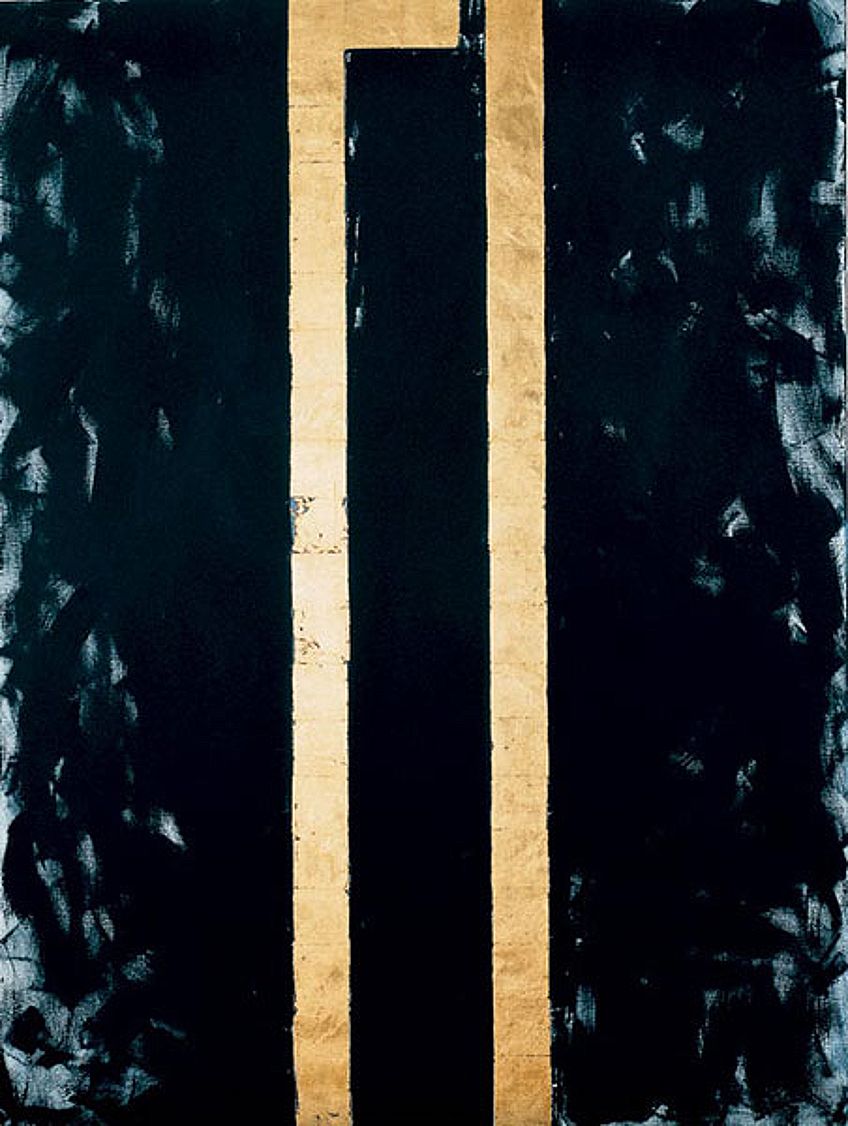
Wasko’s 1988 work is a later response to Newman, not a historical Abstract Expressionist example. Its soot, gold leaf, and vertical organization demonstrate how postwar artists reinterpreted the “zip” through new materials and contexts.
Common Features of Abstract Expressionism
The movement is best understood through a matrix rather than one definition: European modernism and American mural experience; individual studio practice and collective networks; abstraction and residual imagery; chance and control; private interpretation and public institutions.
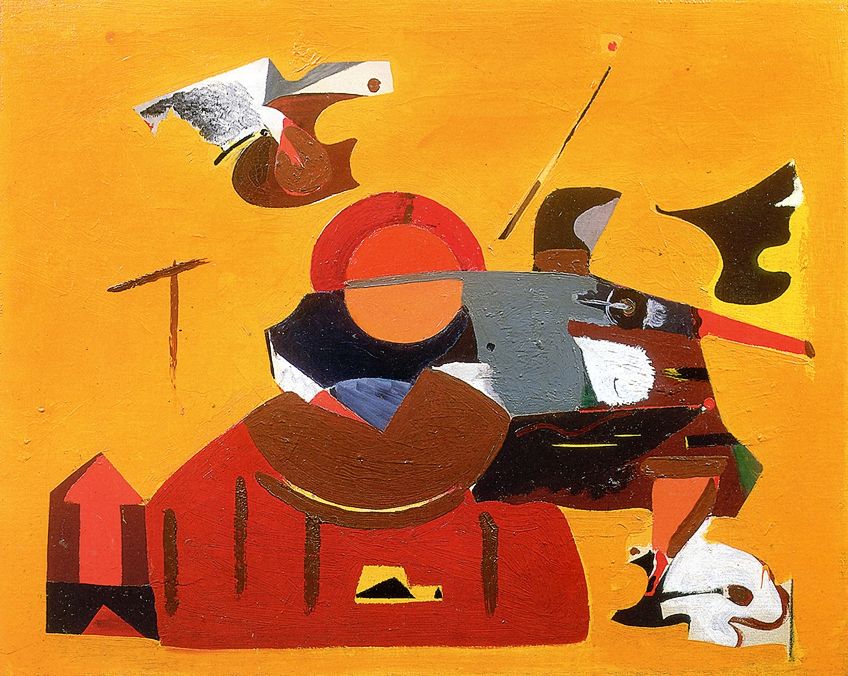
Motivation for the Movement’s Development
Artists sought a convincing form for their own historical moment, but motivations differed. Professional ambition, political disillusionment, spiritual aspiration, trauma, formal experiment, patronage, and competition all mattered. No single national psychology explains the work.
Inspiration from Surrealism
Automatic drawing and the unconscious offered procedures for bypassing academic habits. Artists nonetheless edited what automatism produced. Myth and archetype could widen meaning, but claims of universality often hid culturally specific assumptions.
Exploring a Range of Color
Color ranges from Rothko’s layered luminosity and Newman’s saturated fields to Kline’s black-and-white structures and Lewis’s veiled nocturnes. Black is not an absence of color, and bright color does not automatically mean optimism.
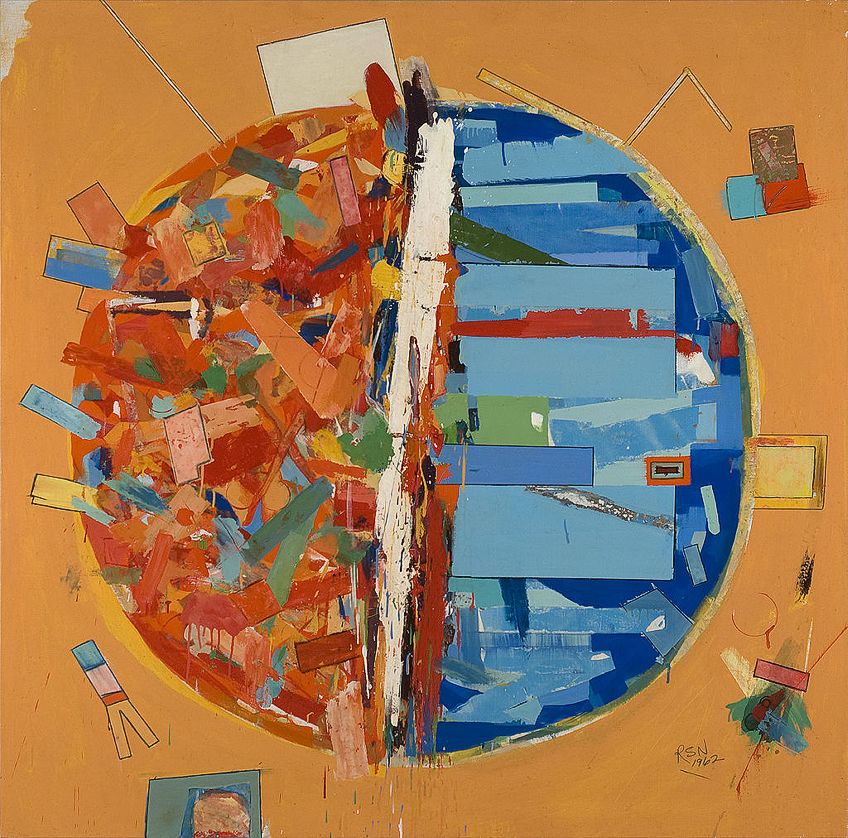
Robert S. Neuman participated in postwar abstraction, but individual works need not fit one New York School formula. The plural title is commonly rendered Pedazos del mundo #6; the inherited caption’s “Mundos” should be checked against the collection record.
Scale of the Artworks
Many paintings are large enough to fill peripheral vision and share the viewer’s bodily space. Newman explicitly asked that his large works be viewed close up. Scale is relational, however, and important drawings, small paintings, prints, and sculptures complicate the cliché that Abstract Expressionism is always monumental.
Prioritizing the Perspective of the Artist
Criticism often linked a canvas to the artist’s psyche, freedom, or authentic self. That idea made process compelling but encouraged biographical myths—especially the isolated, tormented, heterosexual male genius. Meaning also arises from materials, titles, viewers, social position, exhibition, reproduction, and historical context.
Important Criticism in Abstract Expressionism
Rosenberg emphasized action; Greenberg emphasized medium, flatness, and formal development. Their arguments helped build the movement but should not control it. Feminist, Black, queer, social, and revisionist histories have shown how the standard canon marginalized artists including Lee Krasner, Elaine de Kooning, Hedda Sterne, Grace Hartigan, Alma Thomas, Norman Lewis, Beauford Delaney, and many others.
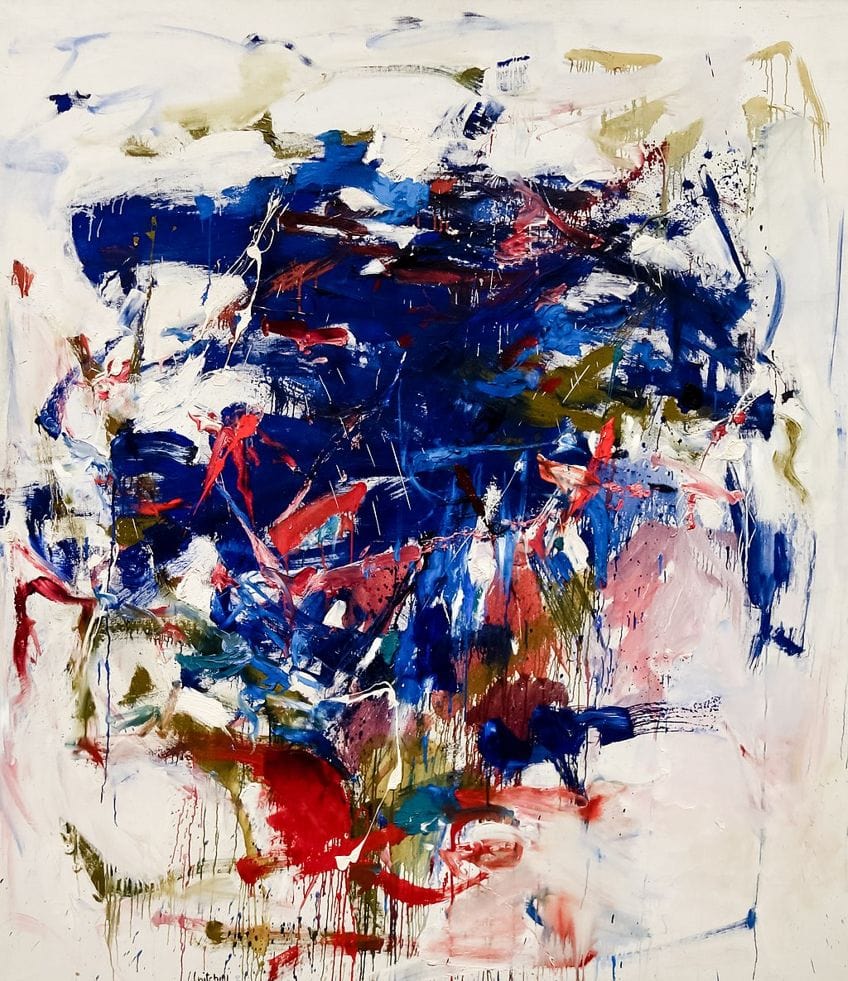
Joan Mitchell’s vigorous paintings were sometimes described through gendered comparisons with male peers. Her sustained engagement with memory, landscape, color, and repeated brushwork deserves its own terms. A CC0 status for an installation photograph does not necessarily remove copyright in Mitchell’s underlying painting.
Abstract Expressionism’s Cold War use is equally complex. U.S. exhibitions could present formal freedom against Soviet Socialist Realism, and covert cultural support occurred in the wider institutional field. The art’s political availability is historically important without reducing individual works to propaganda.
Famous Abstract Expressionist Artists and Their Artworks
The eight inherited profiles are summarized below. Dates and nationalities describe biographies, not artistic identity, and the movement also included many artists beyond this selection.
| Artist | Life | Selected Work | Distinctive Contribution |
|---|---|---|---|
| Mark Rothko | 1903–1970; Latvian-born American | No. 6 (Violet, Green and Red), 1951 | Layered chromatic rectangles and intimate, immersive viewing |
| Clyfford Still | 1904–1980; American | PH-971, 1957 | Jagged fields, fractured figure-ground relationships, control of legacy |
| Willem de Kooning | 1904–1997; Dutch American | Excavation, 1950 | Reworking, scraping, and tension between figure and abstraction |
| Barnett Newman | 1905–1970; American | Vir Heroicus Sublimis, 1950–51 | Expansive fields divided by vertical “zips” |
| Norman Lewis | 1909–1979; American | Evening Rendezvous, 1962 | Atmospheric abstraction engaging Black life and racial violence |
| Franz Kline | 1910–1962; American | Chief, 1950 | Planned black-and-white structures developed through enlargement |
| Jackson Pollock | 1912–1956; American | Autumn Rhythm (Number 30), 1950 | Poured line, all-over structure, canvas worked on the floor |
| Helen Frankenthaler | 1928–2011; American | Mountains and Sea, 1952 | Thinned oil staining that informed later Color Field painting |
Mark Rothko (1903 – 1970)
Rothko moved from figurative scenes through mythic and biomorphic imagery to paintings of luminous rectangular zones. He rejected purely decorative readings and wanted viewers close enough for color relationships and scale to become enveloping. His thin layers, feathered edges, and adjusted grounds required control; these paintings were not simply flat blocks.
https://www.youtube.com/watch?v=bSOw5nXCJHk
Clyfford Still (1904 – 1980)
Still developed irregular, torn-looking color fields that resist easy foreground and background. He guarded his work and distrusted the art market, eventually withholding much of his output. His estate’s conditions led to the Clyfford Still Museum in Denver, which holds the great majority of his surviving art.
Willem de Kooning (1904 – 1997)
De Kooning repeatedly scraped, transferred, drew, and repainted. Excavation (1950) presses bodily and urban fragments into a shifting white field. His Woman paintings did not eliminate composition or the figure; they made the relation between image and brushwork unstable and remain central to debates about gender and representation.
Barnett Newman (1905 – 1970)
Newman’s “zips” are vertical bands or lines that join and divide fields rather than merely split them twice. Vir Heroicus Sublimis contains multiple vertical elements across its red expanse. Close viewing allows the painting to exceed a single glance and makes the viewer’s position part of the work.
Norman Lewis (1909 – 1979)
Lewis moved from Social Realism toward abstraction while remaining attentive to Harlem, jazz, urban crowds, civil rights, and white supremacist violence. Evening Rendezvous (1962) uses small pale forms against a dark red field; interpretations connect them to hooded Ku Klux Klan figures. The Civil Rights Act followed in 1964, not “began” two years later.
Franz Kline (1910 – 1962)
Kline’s black-and-white paintings look rapid but often developed through studies and projection. Chief (1950) may echo the name of a locomotive associated with his Pennsylvania youth, though titles do not decode the image. White areas are actively painted, not empty ground, and later works reintroduced strong color.
Jackson Pollock (1912 – 1956)
Pollock made poured paintings most intensively from 1947 to 1950, not throughout most of his career. In Autumn Rhythm (Number 30) (1950), overlapping skeins vary in density, speed, color, and weight. He worked around unstretched canvas on the floor, but photographs and conservation evidence show sustained decisions rather than uncontrolled discharge. Claims that the work directly expresses a volatile personality confuse biography with formal analysis.
Helen Frankenthaler (1928 – 2011)
Frankenthaler did not spend an entire summer studying under Hans Hofmann; she attended his school briefly in 1950. Mountains and Sea (1952) used thinned oil on unprimed canvas after a trip to Nova Scotia. The stain became integral to the support and influenced Morris Louis and Kenneth Noland. She later used acrylic as well, but not as the medium of this 1952 work.
The Legacy of Abstract Expressionism
Abstract Expressionism did not exhaust itself because Rothko and Newman left “no room for improvement.” Younger artists deliberately challenged its rhetoric, market power, scale, gesture, and seriousness. Color Field painting, Post-Painterly Abstraction, Happenings, performance, Minimalism, Pop, and Neo-Dada selected and rejected different parts of its legacy.
Its canon has also expanded. Scholarship and exhibitions have restored visibility to artists marginalized by gender, race, sexuality, geography, and institutional access. Artists working outside New York adapted gestural and chromatic abstraction to local histories rather than merely following an American export.
The movement’s continuing importance lies in the problems it made unavoidable: how a painting records time, how scale addresses a body, how materials carry meaning, how institutions construct value, and how ideals of individual freedom intersect with collective history and power.
Frequently Asked Questions
What Is Abstract Expressionism?
Abstract Expressionism is a diverse postwar movement that coalesced in New York during the 1940s and became internationally prominent in the 1950s. Its artists experimented with gesture, fields of color, scale, material, and ambiguous imagery rather than following one uniform abstract style.
What Are the Characteristics of Abstract Expressionism?
Common characteristics include assertive surfaces, visible process, ambiguous or nonobjective imagery, experimental paint handling, large scale, all-over composition, and immersive color. Not every work is spontaneous, monumental, or wholly abstract, and planning and revision were often extensive.
What Techniques Are Used in Abstract Expressionism?
Techniques include pouring, dripping, staining, scraping, scumbling, wet-on-wet brushing, drawing into paint, collage, and broad chromatic layering. “Action painting” emphasizes bodily process, while “color field” describes large color areas; the categories overlap rather than forming two rigid camps.

Isabella studied at the University of Cape Town in South Africa and graduated with a Bachelor of Arts majoring in English Literature & Language and Psychology. Throughout her undergraduate years, she took Art History as an additional subject and absolutely loved it. Building on from her art history knowledge that began in high school, art has always been a particular area of fascination for her. From learning about artworks previously unknown to her, or sharpening her existing understanding of specific works, the ability to continue learning within this interesting sphere excites her greatly.
Her focal points of interest in art history encompass profiling specific artists and art movements, as it is these areas where she is able to really dig deep into the rich narrative of the art world. Additionally, she particularly enjoys exploring the different artistic styles of the 20th century, as well as the important impact that female artists have had on the development of art history.
Learn more about Isabella Meyer and the Art in Context Team.
Cite this Article
Isabella, Meyer, “Abstract Expressionism – The Artistry of the Abstract Expressionists.” Art in Context. May 10, 2021. URL: https://artincontext.org/abstract-expressionism/
Meyer, I. (2021, 10 May). Abstract Expressionism – The Artistry of the Abstract Expressionists. Art in Context. https://artincontext.org/abstract-expressionism/
Meyer, Isabella. “Abstract Expressionism – The Artistry of the Abstract Expressionists.” Art in Context, May 10, 2021. https://artincontext.org/abstract-expressionism/.


I’m afraid my favourite expression of “Abstract Sculpture” is *Marie’s Sculpture* on the television series, “Everybody loves Raymond.” Not because of what it ends up resembling; but simply because it kind of shows what “Abstract” is supposed to be.
Raymond’s mother is sure she has made an “Abstract Sculpture.” but, it actually appears to be a woman’s ⬇️. Raymond being her favourite child, is offered the sculpture, then when he & wife admit they don’t *want it,* Marie offers it to a convent’s garage sale. 2 nun’s come to Raymond’s to collect it, & one of the nun’s explains to Marie what it resembles. Marie is *Horrified!* Then, it’s a part of the Art Class’s final display. Throughout the episode, Marie’s husband has been fascinated with it. a janitor at the art display explains what *he* thinks the sculpture resembles. The last words are Frank saying, “Holy cr#p!”
Thank you for explaining *what* “Abstract” is defined as.
Abby
You are welcome Abby 🙂