
High Renaissance Art – The Pinnacle of the Renaissance

High Renaissance art is a retrospective label for an influential phase of Italian painting, sculpture, and architecture around the late 1490s and early sixteenth century. It is associated especially with Leonardo da Vinci, Michelangelo, Raphael, and Donato Bramante and with major commissions in Florence, Milan, and papal Rome. Because its dates, geography, and value-laden name remain debated, this guide treats the High Renaissance as a useful art-historical category rather than a universal “pinnacle” of artistic achievement.
Renaissance Art Periods Timeline
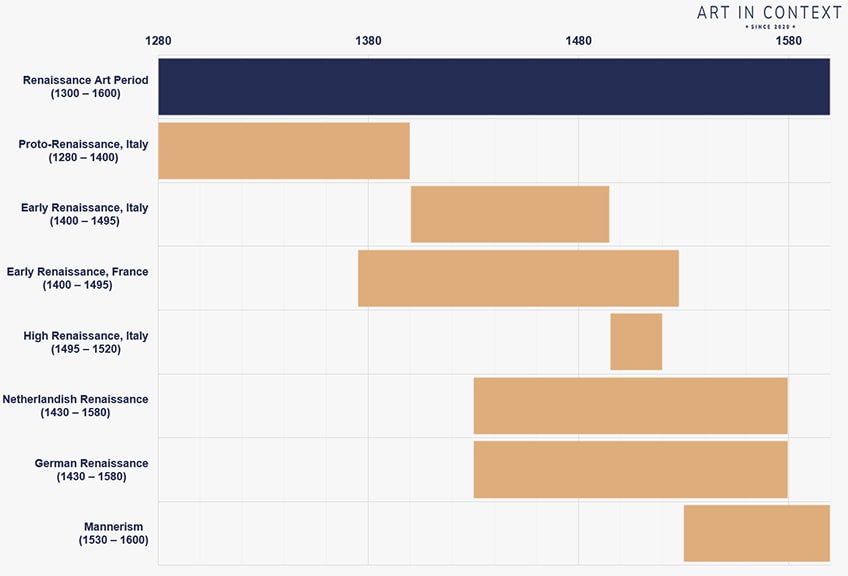
Timelines often place the High Renaissance between the 1490s and 1520 or 1527, but those dates are conventions rather than fixed boundaries. Leonardo’s Last Supper (1495-1498) is sometimes used as an opening marker; Raphael’s death in 1520 and the Sack of Rome in 1527 are common end points. Early Mannerist experiments already appeared before 1520, while classicizing Renaissance approaches continued afterward and developed differently in Venice and other regional centers.
The Historical Background of the High Renaissance
The broader Renaissance period unfolded across several centuries and regions rather than beginning directly because Rome fell in 476. The High Renaissance belongs to a much narrower Italian context near 1500. It grew from fifteenth-century study of antiquity, nature, anatomy, perspective, and proportion, but did not simply replace “medieval” art or progress toward one perfect style.
Art historians commonly connect its emergence with Leonardo’s Milanese Last Supper, Michelangelo’s Florentine sculpture, and the concentration of ambitious papal commissions in Rome after 1503. These artists organized complex figures and spaces into forceful, legible wholes, yet their methods and aims differed markedly.
“High Renaissance” describes a canon assembled by later historians. It helps identify shared ambitions in scale, bodily presence, classical reference, and compositional unity, but it should not turn diverse artists or regions into a single ladder of progress.
The words Renaissance and High Renaissance are retrospective historical labels. Giorgio Vasari had already described a rebirth of the arts in sixteenth-century Italy; nineteenth-century historians later shaped the modern period categories. Museums and scholars still disagree about the High Renaissance’s exact definition, which is why dates and artist lists vary.
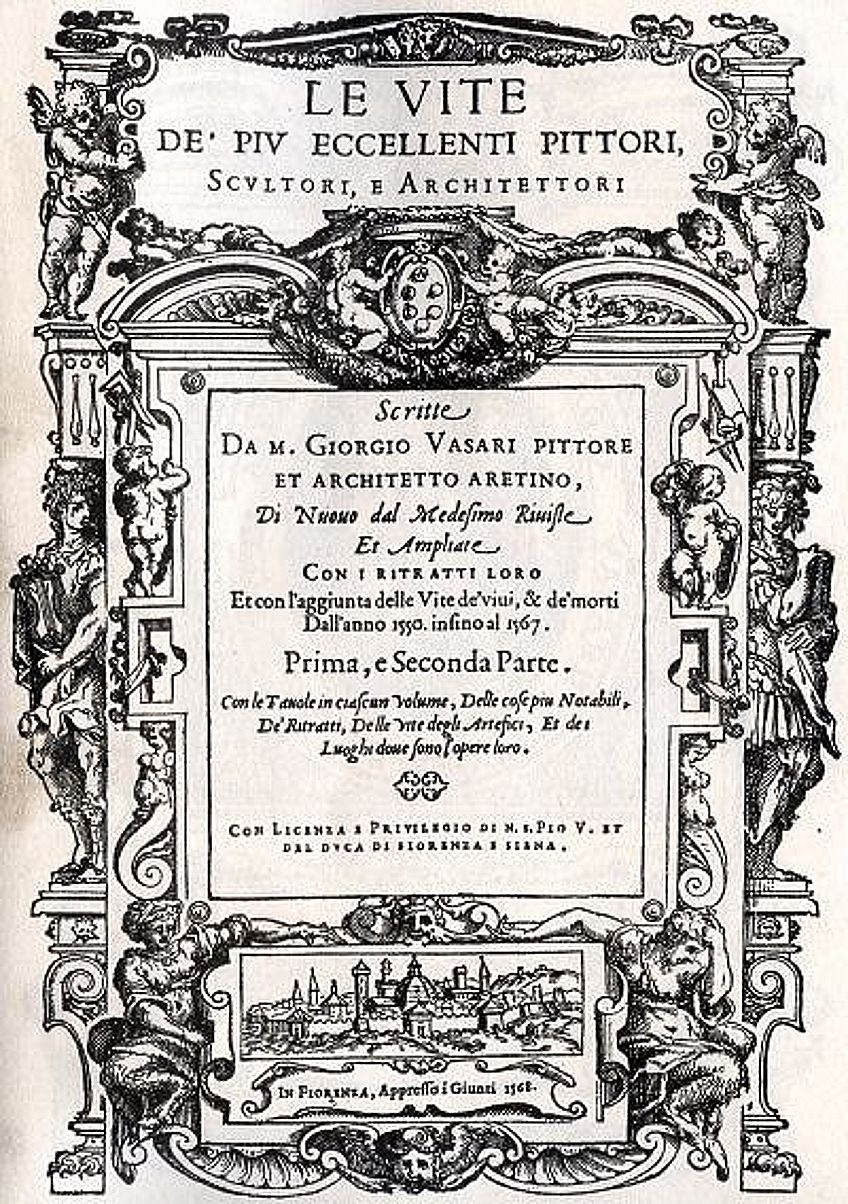
The Italian painter, architect, and writer Giorgio Vasari published the first edition of his Lives of the Most Excellent Painters, Sculptors, and Architects in 1550 and a greatly expanded edition in 1568. His biographies helped establish a powerful story of artistic rebirth culminating in Michelangelo. Later writers, including Johann Joachim Winckelmann and Jacob Burckhardt, reshaped the history of Classical Art and the Renaissance. Modern scholarship still uses their period vocabulary while questioning its emphasis on a few celebrated men and a linear rise toward perfection.
A Brief Glance at the Early Renaissance
To understand the High Renaissance, it is useful to look briefly at the Early Renaissance. During the fifteenth century, Italian artists and patrons developed new solutions for measured pictorial space, freestanding sculpture, classical architectural language, portraiture, and the observation of bodies and light. Late Gothic forms continued alongside these experiments, and developments differed across Florence, Venice, Padua, Urbino, Milan, and other centers.
Renaissance humanism was an educational and scholarly program grounded in grammar, rhetoric, history, poetry, and moral philosophy, often through Greek and Roman texts. It did not simply make humanity the center of the universe or displace Christianity. Humanist learning and Christian devotion frequently coexisted in the same patron, building, or artwork.

Architects used geometry and proportion to adapt ancient columns, orders, arches, domes, and centralized plans for contemporary Christian and civic buildings. Painters combined linear perspective, foreshortening, overlap, scale, light, and atmospheric recession; sculptors studied weight shift, anatomy, and ancient statuary. These were not a single invention or an automatic march toward realism, but tools that artists deployed selectively for narrative, devotion, status, and visual authority.
Rome and the Pope
Rome became a decisive center under Pope Julius II (r. 1503-1513), whose commissions linked papal authority, Christian history, and the material legacy of ancient Rome. Julius engaged Bramante for the rebuilding of St. Peter’s, Michelangelo for his tomb and the Sistine Chapel ceiling, and Raphael for rooms in the Vatican Palace. This concentration of patronage did not make Rome the only center: Leonardo’s major paintings were made across Milan and Florence, Michelangelo’s David was a Florentine civic commission, and Venetian painters pursued different relationships between color, light, and form.
Leo X (r. 1513-1521), a son of Lorenzo de’ Medici, continued major papal commissions after Julius. Popes were not the only patrons. Cardinals, confraternities, religious orders, rulers, civic governments, merchants, and private families all shaped Renaissance production, and large works depended on workshops and specialist collaborators as well as named masters.

High Renaissance Art
High Renaissance art combined inherited techniques with new ambitions in scale, integration, and expressive control. Oil painting was already well established in northern Europe and increasingly used in Italy before this period; linear perspective was likewise a fifteenth-century development. What changed was not the sudden invention of every tool, but the way artists coordinated bodies, architecture, light, gesture, and narrative across demanding commissions.
Leonardo da Vinci, Michelangelo, and Raphael are often grouped as the period’s canonical painters, while Bramante is central to its architecture. The familiar “Big Three” formula is useful but incomplete: Fra Bartolomeo, Andrea del Sarto, Sebastiano del Piombo, Giorgione, Titian, and many workshop participants also shaped early-sixteenth-century art. Correggio worked in Parma and is often discussed at the boundary between High Renaissance classicism, Mannerism, and later illusionistic ceiling painting.
High Renaissance unity does not mean uniformity: Leonardo’s atmospheric transitions, Michelangelo’s bodily force, Raphael’s lucid orchestration, and Bramante’s architectural massing solve different visual problems.
High Renaissance Art Characteristics
No checklist describes every High Renaissance work, but recurring qualities include monumental figures, controlled movement, balanced yet dynamic compositions, convincing bodily weight, and a close integration of figures with architectural or landscape space. Artists studied ancient sculpture and buildings without merely copying them. Idealization and observation work together: anatomy may be carefully understood but adjusted for clarity, expressive force, or the viewer’s position.
Humanist learning informed classical subjects, inscriptions, architecture, and theories of proportion, but most major commissions discussed here remained Christian. The period did not exchange God for humanity. Instead, artists and patrons often used idealized human bodies, ancient visual language, and learned programs to articulate religious, political, and philosophical claims.

The idea of the widely accomplished “universal person” is often associated with Leonardo because his notebooks range across painting, mechanics, anatomy, optics, water, and flight. It is better understood as a later shorthand for broad intellectual ambition than as a rule followed by every High Renaissance artist.

Leonardo developed sfumato through extremely subtle transitions of tone that soften contours and make forms appear to emerge through atmosphere. Chiaroscuro uses patterns and gradations of light and dark to model volume. These terms are related but not interchangeable. Elsewhere, artists used foreshortening and di sotto in sù (“seen from below”) to make ceiling figures appear to occupy space above the viewer. Fully architectural quadratura became especially prominent later and should not be treated as a defining invention of the High Renaissance.
How to Recognize High Renaissance Art
Start with relationships rather than isolated devices. A High Renaissance composition typically makes many bodies, gestures, sightlines, and spatial zones read as a coherent whole. Central groups may form pyramids or stable axes, but balance need not mean stillness: Michelangelo creates physical tension, Leonardo binds emotion through gesture and glance, and Raphael distributes complex groups across lucid architecture.
The boundary with Mannerism is gradual. Mannerist artists often foreground elongation, compressed or ambiguous space, conspicuous virtuosity, unexpected color, and unstable poses, yet those tendencies appear before 1520 and grow from High Renaissance experiments. Date and artist alone do not settle the classification; medium, region, patronage, function, and visual structure all matter.
High Renaissance Artists
The following profiles explain why several artists became central to the High Renaissance canon while also identifying works that fall before or after its conventional boundaries. Their fame should not obscure the assistants, stoneworkers, foundry workers, plasterers, pigment suppliers, and workshop collaborators required to realize large projects.
Donato Bramante (1444 – 1514)
Donato Bramante was a leading architect of the High Renaissance, not the sole founder of a style. After working in Milan, he moved to Rome around 1499 and adapted ancient Roman massing, orders, and centralized forms to contemporary Christian commissions. Under Julius II, his planning helped set the scale of papal Rome that Raphael and Michelangelo later inherited.
Bramante’s Milanese projects include the eastern tribune of Santa Maria delle Grazie and cloisters for Sant’Ambrogio. In Rome, the Spanish monarchs Ferdinand and Isabella commissioned the Tempietto at San Pietro in Montorio, begun around 1502 at a site traditionally associated with Saint Peter’s martyrdom. Its circular form, Doric order, measured proportions, and surrounding plan translate ancient commemorative architecture into a Christian shrine.
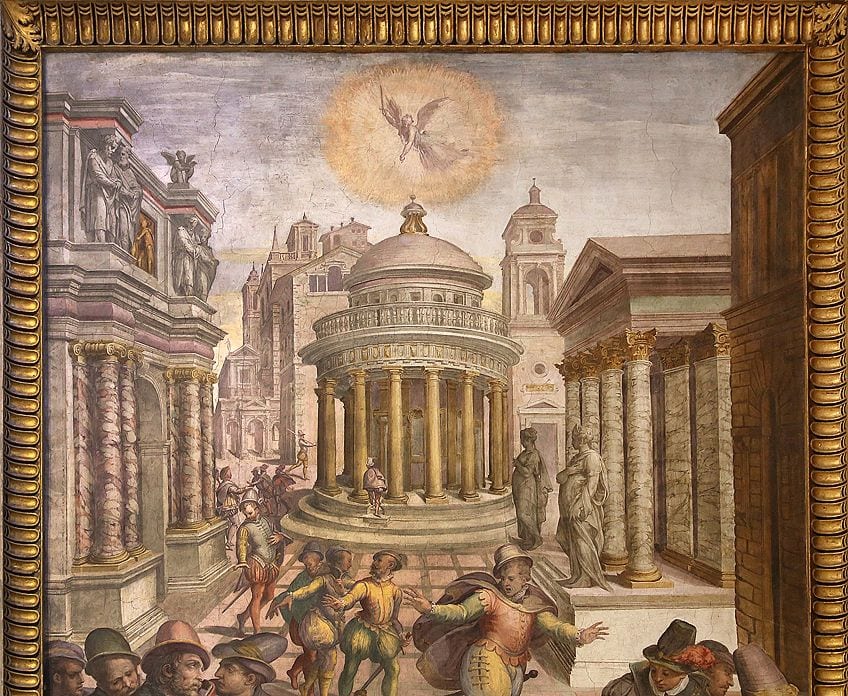
The Tempietto is a canonical example of High Renaissance architecture: its Doric order, circular cella, dome, and intended concentric courtyard make proportion and centralized planning visible at a small scale.
In 1506, Julius II laid the foundation stone for the new St. Peter’s Basilica. Bramante proposed a centralized Greek-cross church around a vast domed crossing and began the massive piers, but he died in 1514. Raphael, Antonio da Sangallo the Younger, Michelangelo, Carlo Maderno, and others repeatedly revised the project; the longitudinal basilica completed in the seventeenth century is therefore not simply Bramante’s building.
Leonardo da Vinci (1452 – 1519)
Leonardo da Vinci worked across painting, drawing, mechanics, anatomy, optics, hydraulics, and other fields. His surviving notebooks include speculative machines as well as close studies of natural processes; they do not make him the inventor of a modern helicopter or parachute. His art is foundational to the High Renaissance even though much of it was produced in Milan and Florence rather than papal Rome.
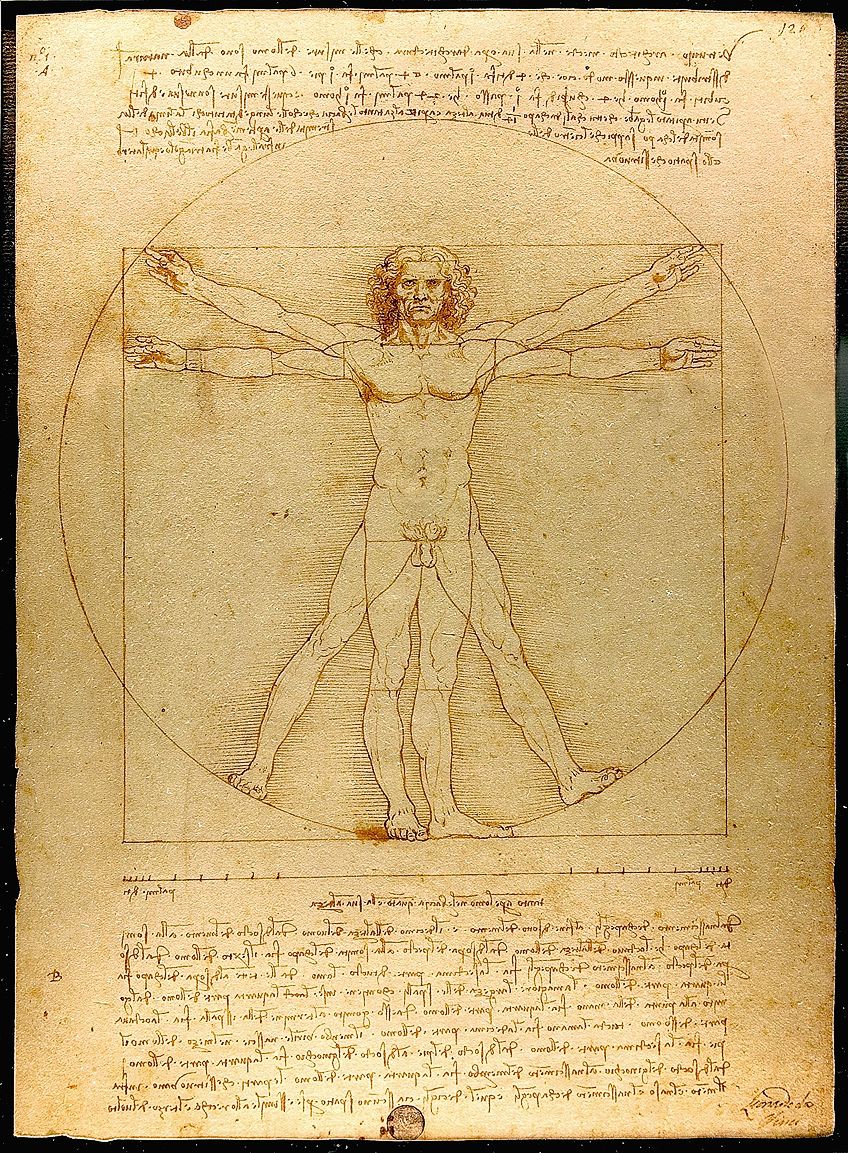
Leonardo dissected and drew human bodies and investigated proportion, movement, light, and vision. The Vitruvian Man (c. 1490) connects the Roman architect Vitruvius’s account of bodily proportion with Leonardo’s own measurement and geometric inquiry. It is a pen-and-ink study, not a generic diagram of Renaissance ideals.
Leonardo’s sfumato, tonal modeling, and study of gesture allowed bodies and expressions to remain legible without hard outlines. Important works include two versions of Virgin of the Rocks, Lady with an Ermine (c. 1489-1491), The Last Supper (1495-1498), and the Mona Lisa (begun c. 1503 and worked on over subsequent years).
The London Virgin of the Rocks shows Mary, the Christ child, the infant Saint John the Baptist, and an angel in a rocky landscape. Their gestures and glances create a linked devotional group, while the pyramidal arrangement remains stable inside an unusual natural setting.

Mary anchors the composition, but the exchanged gestures prevent the pyramid from becoming static. Leonardo built depth through overlap, atmospheric recession, chiaroscuro, and sfumato. Oil paint was not new at the time; its longer working properties and translucent layers nevertheless supported the gradual tonal transitions central to Leonardo’s practice.
The Last Supper depicts Christ and the twelve apostles at the moment when he announces that one of them will betray him. Leonardo organizes the apostles in four groups of three while gestures and expressions register distinct reactions. Christ forms the calm center and the vanishing point lies at his head.

The painted room extends the refectory’s architecture through one-point perspective, and the central window frames Christ against the distant landscape. Leonardo did not use a durable true-fresco method. He painted tempera and oil on a dry prepared wall, an experimental technique that permitted revision but deteriorated rapidly.
The Mona Lisa, now in the Louvre, is also called La Gioconda and is widely identified as Lisa Gherardini, wife of the Florentine merchant Francesco del Giocondo. She turns behind a parapet before an imagined landscape, meeting the viewer’s gaze while her hands settle the pose.
Thin layers and softened transitions make the mouth and eyes appear to shift with the viewer’s attention. The atmospheric landscape recedes through changes in color and clarity, while the turning pose and direct gaze influenced later portrait paintings. The expression’s ambiguity is a visual effect, not evidence from which the sitter’s feelings can be recovered.

Michelangelo (1475 – 1564)
Michelangelo di Lodovico Buonarroti Simoni, known as Michelangelo, worked as a sculptor, painter, architect, and poet. His figures combine close anatomical knowledge with purposeful exaggeration, especially when a sculpture or fresco had to read from far below. His professional rivalry with Leonardo in Florence is documented most clearly through their competing battle murals for the Palazzo Vecchio, neither of which survives intact.
Key works around the High Renaissance include the Pietà (1498-1499), David (1501-1504), and the Sistine Chapel ceiling (1508-1512). The much later Last Judgment (1536-1541) belongs to a different political and stylistic moment and is not a High Renaissance work.
Julius II commissioned the Sistine Chapel ceiling, whose central scenes narrate episodes from Genesis. Clement VII initiated the later altar-wall project for the Last Judgment, and Paul III oversaw its execution. Keeping those campaigns separate clarifies how Michelangelo’s style changed over several decades.
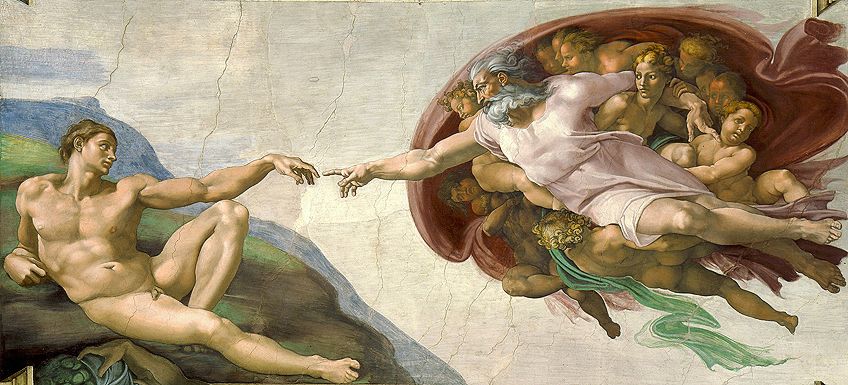
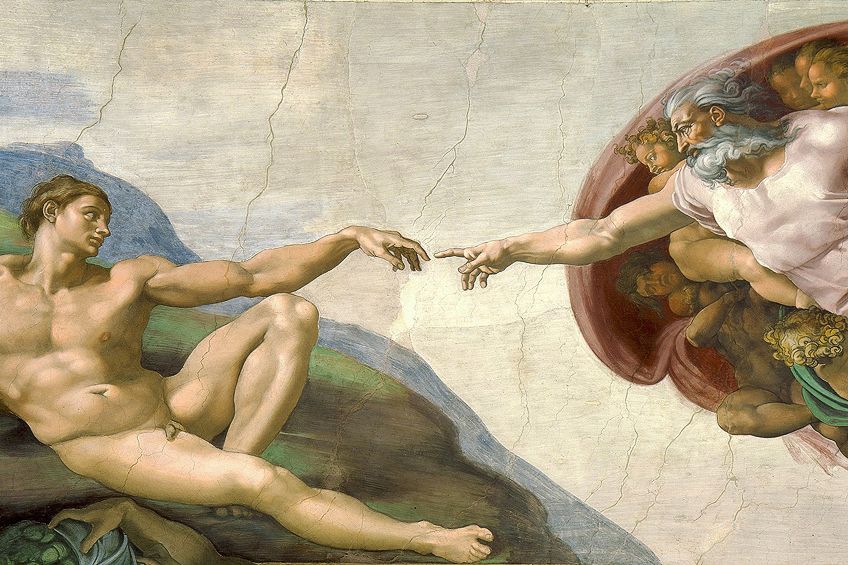
In The Creation of Adam, Adam reclines on the left and extends his left hand toward God, who moves from the right within a group of figures and billowing fabric. The near-touch gives theological action to a remarkably spare field. By contrast, the later Last Judgment fills the altar wall with a rotating multitude around Christ the judge.
Michelangelo carved the marble Pietà for the French cardinal Jean de Bilhères’s funerary chapel; it is now in St. Peter’s Basilica. Mary supports Christ’s dead body across an unusually broad field of drapery. The polished surface, controlled pyramidal composition, and contrast between youthful Mary and lifeless Christ turn bodily observation into a devotional image rather than a literal record of age or scale.
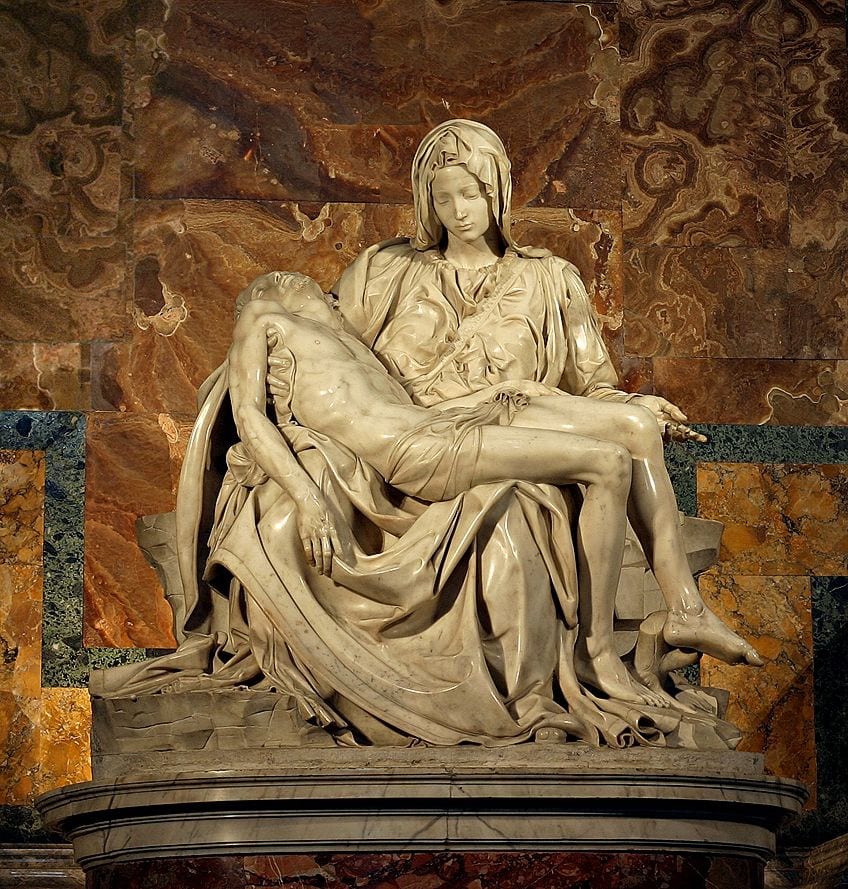
The composition widens from Mary’s head through her robes to form a stable pyramid capable of visually supporting Christ’s body. In Michelangelo’s David, the approximately 5.17-meter (17-foot) figure is monumental rather than life-size. David holds the sling before combat; the absence of Goliath shifts attention from victory to concentration and potential action.
The statue’s contrapposto distributes weight mainly through one leg, setting hips, shoulders, and head into counter-movements. Its anatomy is idealized rather than perfectly literal: the enlarged head and hands strengthen visibility and expressive emphasis, particularly in relation to the sculpture’s originally intended elevated setting.

Raphael (1483 – 1520)
Raphael, or Raffaello Sanzio da Urbino, was a painter, draftsman, and architect whose work became a model for clarity, balance, and adaptable invention. Trained in central Italy and transformed by Leonardo and Michelangelo’s work in Florence, he moved to Rome in 1508 and developed a large workshop capable of handling papal rooms, altarpieces, portraits, architecture, tapestries, and designs for prints.
The Raphael Rooms formed part of Julius II’s Vatican apartment. Raphael and his workshop decorated the four rooms between 1508 and 1524, so not every surface is by Raphael alone. The ensemble comprises the Stanza della Segnatura, Stanza di Eliodoro, Stanza dell’Incendio del Borgo, and Sala di Costantino.
Raphael’s School of Athens (1509-1511) occupies the Stanza della Segnatura. It stages ancient philosophers in an imaginary monumental interior inspired by Bramante’s plans for the new St. Peter’s. Plato and Aristotle walk at the center, while groups devoted to mathematics, natural philosophy, and debate animate the surrounding space.
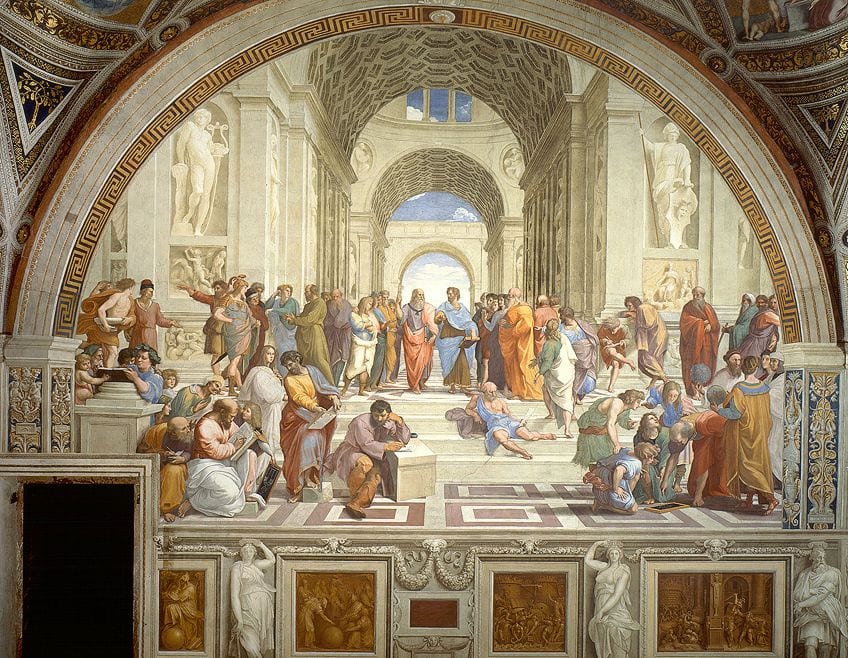
The architecture establishes a deep central axis, but Raphael prevents the scene from becoming rigid by varying poses, clusters, colors, and directions of attention. The main arch frames Plato and Aristotle, while foreground steps bring solitary and grouped figures toward the viewer. The fresco’s coherence depends on the coordination of differences rather than uniformly subdued color or perfect symmetry.
Raphael’s last painting, The Transfiguration (1516-1520), combines two successive episodes from the Gospel of Matthew. Christ appears in glory between Moses and Elijah above, while below the apostles confront a suffering boy whom Christ will cure after descending from the mountain.
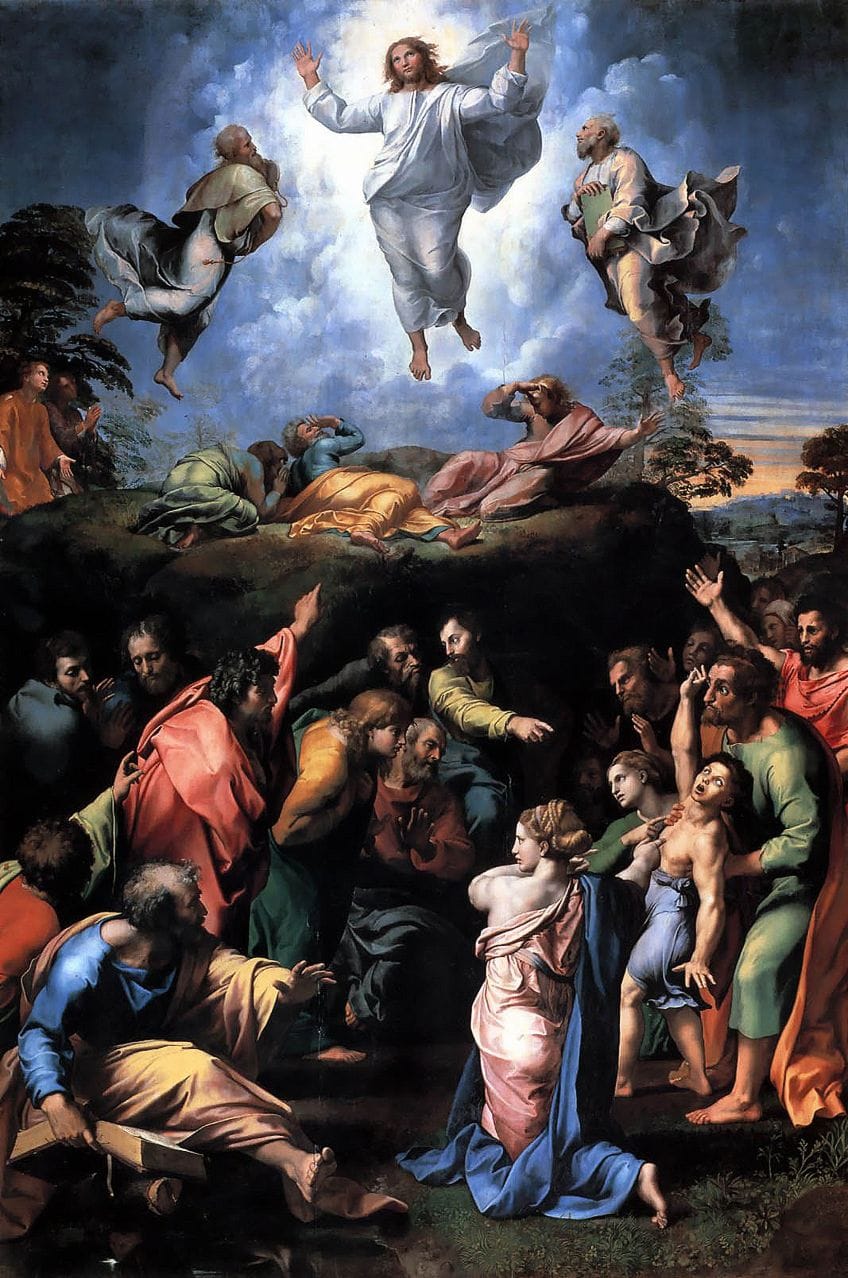
Light, darkness, gesture, and diagonal movement distinguish the radiant upper revelation from the crowded lower crisis while linking both registers. Raphael died in 1520 before the work left his studio; the degree of workshop participation in its execution has been debated. Its compressed drama and lighting became important for later painters, but that afterlife does not make the work itself Baroque.
Correggio (c. 1489 – 1534)
Antonio Allegri, called Correggio after his birthplace, worked principally in Parma and elsewhere in Emilia. His soft modeling reflects knowledge of Leonardo, while his daring domes and sensuous mythologies follow a regional path not reducible to the Roman High Renaissance. He is often treated as a transitional artist whose spatial inventions anticipated later ceiling painting.
Correggio used foreshortening, overlap, light, and soft-edged modeling to dissolve the boundary between real and painted space. In the Assumption of the Virgin (1526-1530) in Parma Cathedral, rings of apostles, clouds, saints, and angels rise toward a brilliant opening as Mary ascends. The figures are calculated for viewing from the floor rather than for a frontal photograph.

Radical foreshortening and the di sotto in sù viewpoint make the dome appear to open into an immeasurable heaven. Because the composition does not primarily extend the church with painted architectural frameworks, it is more precise to call it illusionistic dome painting than strict quadratura. Its upward vortex became an important precedent for Baroque and Rococo decorators, including Pietro da Cortona and Andrea Pozzo.
From the High Renaissance to Mannerism
The High Renaissance has no uncontested final year. Raphael’s death in 1520 is one common marker; the Sack of Rome in 1527, when mutinous imperial troops captured and devastated the city, is another because it disrupted Roman patronage and scattered artists. Leonardo had died in France in 1519, but Michelangelo, Titian, Andrea del Sarto, and others continued to work, so the history cannot be reduced to a sudden extinction of talent.
Mannerism was already developing before the Sack and overlapped with classicizing work. Artists such as Jacopo Pontormo, Rosso Fiorentino, Parmigianino, and Giulio Romano extended Renaissance devices through elongated bodies, unstable poses, compressed or ambiguous spaces, and displays of learned artifice. “High Renaissance” and “Mannerism” are therefore interpretive classifications, not sealed boxes on a timeline.
High Renaissance art is most useful as a way to study how artists coordinated bodies, space, classical reference, patronage, and meaning at exceptional scale—not as proof that one era perfected art for everyone who came after.
Take a look at our High Renaissance art webstory here!
Frequently Asked Questions
When Did the High Renaissance Happen?
The High Renaissance is commonly dated from the 1490s to 1520 or 1527. Leonardo’s Last Supper is often used as an opening marker, while Raphael’s death in 1520 and the Sack of Rome in 1527 are common end points. These boundaries vary by artist, region, medium, and historian.
What Were the Main Techniques During the High Renaissance?
High Renaissance artists used linear and atmospheric perspective, foreshortening, tonal modeling, chiaroscuro, sfumato, fresco, oil painting, and illusionistic viewpoints such as di sotto in sù. These methods were not all invented in the period, and no single artist used every one. Foreshortening concerns forms receding in space, not simply vanishing points.
Who Were the Famous Artists During the High Renaissance?
Leonardo da Vinci, Michelangelo, and Raphael are the best-known High Renaissance painters, and Donato Bramante is central to its architecture. Fra Bartolomeo, Andrea del Sarto, Sebastiano del Piombo, Giorgione, Titian, and workshop collaborators broaden the picture beyond the canonical three.
What Was the High Renaissance Known For?
High Renaissance art is known for monumental figures, idealization joined to anatomical observation, balanced but dynamic compositions, coherent space, classical reference, and the integration of many gestures and forms into a legible whole. The label reflects later art-historical judgment rather than an objectively perfect stage of art.
Where Did the High Renaissance Happen?
Rome was a central High Renaissance site under Julius II and Leo X, especially for Bramante, Michelangelo, and Raphael. Florence and Milan were also crucial to Leonardo and Michelangelo, while Venice and other northern Italian centers developed distinct Renaissance approaches. The period was not confined to one city.
What Were the Main Ideas of the High Renaissance?
High Renaissance artists and patrons drew on classical form, proportion, humanist learning, Christian theology, observation of nature, and the political ambitions of courts and the papacy. Their works often seek compositional unity and bodily presence, but anatomy may be idealized or altered for expression and viewing conditions rather than rendered with literal precision.

Isabella studied at the University of Cape Town in South Africa and graduated with a Bachelor of Arts majoring in English Literature & Language and Psychology. Throughout her undergraduate years, she took Art History as an additional subject and absolutely loved it. Building on from her art history knowledge that began in high school, art has always been a particular area of fascination for her. From learning about artworks previously unknown to her, or sharpening her existing understanding of specific works, the ability to continue learning within this interesting sphere excites her greatly.
Her focal points of interest in art history encompass profiling specific artists and art movements, as it is these areas where she is able to really dig deep into the rich narrative of the art world. Additionally, she particularly enjoys exploring the different artistic styles of the 20th century, as well as the important impact that female artists have had on the development of art history.
Learn more about Isabella Meyer and the Art in Context Team.
Cite this Article
Isabella, Meyer, “High Renaissance Art – The Pinnacle of the Renaissance.” Art in Context. June 11, 2021. URL: https://artincontext.org/high-renaissance/
Meyer, I. (2021, 11 June). High Renaissance Art – The Pinnacle of the Renaissance. Art in Context. https://artincontext.org/high-renaissance/
Meyer, Isabella. “High Renaissance Art – The Pinnacle of the Renaissance.” Art in Context, June 11, 2021. https://artincontext.org/high-renaissance/.