


Wolf Coloring Pages – 49 Brand-New Coloring Sheets

Step into the wild and let your artistic instincts roam free with our brand-new collection of 49 wolf coloring pages! These majestic creatures have long captured our imagination with their strength, beauty, and untamed spirit. Whether you’re a fan of nature’s apex predators or simply seeking a creative and relaxing activity, these intricate illustrations are your canvas. Join us on a journey to explore the enchanting world of wolves, where you can choose your palette and give life to these creatures in the colors of your imagination. Grab your coloring tools and prepare to unleash your inner artist as we celebrate the mystique of wolves in 49 captivating pages.
How to Use Our Wolf Coloring Sheets
Browse through the available options and select the wolf coloring page that you like. Once you’ve chosen the wolf coloring pages you want to use, click on the desired image and a new tab will open with the printable PDF. In the PDF viewer, go to the “File” menu and select “Print.” You can also use the shortcut Ctrl+P (Windows) or Command+P (Mac).
Adjust the print settings, such as paper size and quality, to your preferences. You can typically select “Fit to Page” to ensure the coloring page fits on the paper.
Click “Print,” and the coloring page will be printed on your home printer. Once your coloring pages are printed, you can start coloring using your preferred coloring materials, such as colored pencils, crayons, markers, or watercolors.

A gray wolf stands in side view on a rocky ledge, head raised, with flowing fur lines. Behind it are a crescent moon, a large sun, jagged peaks and dark pine trees. The fine fur detail is demanding.

A wolf’s head in right-facing profile, its fur drawn as dense patterns of leaves, feathers and swirls. Black ink speckles scatter behind the neck, and the mane fades into scratchy strokes at the lower left.

A front-facing wolf head sits inside a round mandala frame of petals, scrollwork and dotted lines. Pointed ears have solid black tips, the nose is filled black, and the cheek fur is built from layered leaf shapes.

A wolf stands in side view with its head turned left and its tail hanging down. Layered mountain peaks rise behind it, and dense pine trees and grass tufts frame the scene. The wolf’s open outline suits larger areas of color.

A cartoon wolf pup sits facing forward with big swirled eyes, a small black nose and a tuft of fur on its forehead. Its bushy tail curls out to the left. Large, open shapes make this an easy sheet.

Four wolves stand side by side, their heads turned in different directions. Angular facet lines cut across faces and bodies like cut glass, with fluffy chest ruffs and shaded ears. The many small facets suit patient coloring with fine pencils.

Inside a round frame, a wolf stands on a snowy ledge with its muzzle raised toward a large moon. Streaky fur lines, curling clouds, a rainbow arc and solid black pines surround it. The dense fur hatching calls for sharp pencils.

Three wolf heads overlap in side profile, one facing left and two facing right. Pointed ears, narrowed eyes, whisker lines on the muzzles and long flowing neck fur with solid black streaks. Fine strands suit sharp pencils.

A wolf stands in left profile on a mountain summit, its body split into angular facets. Solid black rock faces, small bird silhouettes, two fir trees and a faint moon circle fill the background. The large facets are easy to color.

A wolf stands at a three-quarter angle, head turned toward the viewer with narrowed eyes and pointed ears. Its coat is layered with long fur strands, a bushy tail and solid black shadows under the belly. Large open areas on the flanks suit blending.

A cartoon wolf pup sits facing forward with a wide smile, large round glossy eyes and tall pointed ears with dark tips. Its bushy tail curls out to the left, and the front paws are tucked neatly together.

Three-quarter wolf head turned right, with dotted markings above the eye, a zigzag band on the muzzle and tiny curling swirls near the left ear. Dense fine hair strands call for a sharp pencil.

Sitting pup with its head tilted, big glossy eyes and a small smile. Tiny hearts sit on the forehead, haunch and chest, and a fluffy ruff frames the face. Thick outlines keep the shapes easy to follow.

Realistic wolf head in right-facing profile inside a round frame, with a crescent moon, small sparkle stars and jagged mountain peaks behind. Dotted whisker spots mark the muzzle, and fine fur lines cover the neck. The dense strokes suit a sharp pencil.

A small wolf pup stands hunched with its head lowered and a wary, sideways glance. Crescent and round spots mark its body, a bushy tail curls behind, and tufts of fur ring the face.

A heavyset wolf stands in side view with its head turned toward us and a stern stare. Swirling fur strokes cover the round body, and hatched shading marks the legs. The dense linework needs a fine pencil.

Right-facing wolf head in profile with a long mane of layered feather-shaped tufts. A spiral ornament with a sunburst edge sits on the cheek, and tiny swirls and dots drift behind the neck.

A wolf cub lies on the ground with its paws stretched forward and its head tilted, eyes half closed in a gentle smile. Leafy plants frame both sides, and round bubbles float above. The bushy tail has a black patch.

A wolf head turned in three-quarter view, with two tall pointed ears, narrowed eyes and a black nose. Loose sketchy fur strands fall around the cheeks and neck, with hatching inside the ears.

Straight-on wolf face with two tall ears, sharp eyes and a solid black nose. Scale-textured and striped geometric patches cover the cheeks, while dense flowing fur surrounds them. Fine detail makes it a demanding sheet.
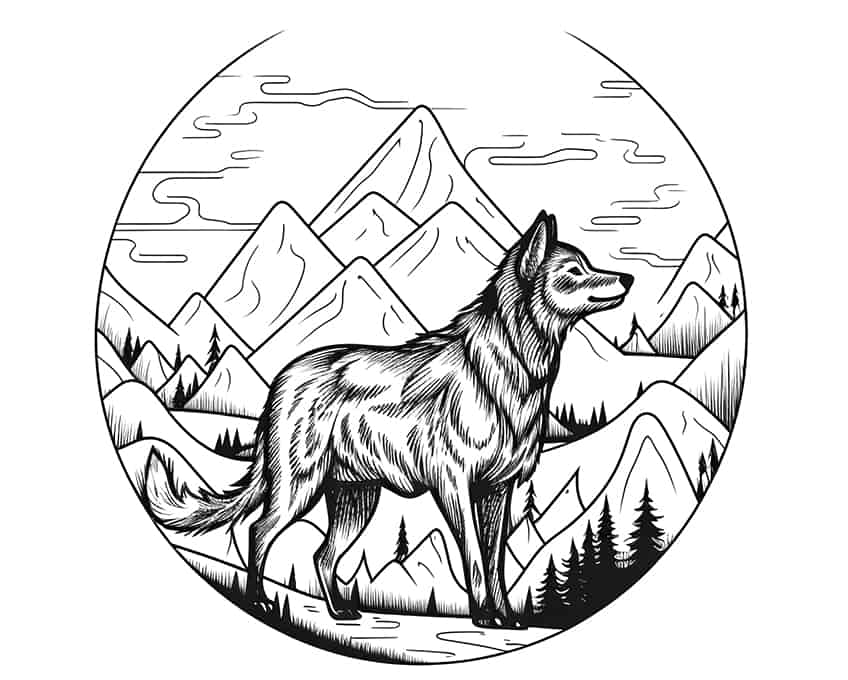
A wolf stands in side view with its head raised and its bushy tail curving low, inside a round frame. Behind it are six pointed peaks, wavy clouds and small pine groups. Hatched fur adds texture.

Symmetrical front view of a wolf’s face with a spiral pattern inside each ear, dotted and beaded arcs above the eyes, and long wavy fur ending in curled tips below the chin. The very fine linework suits experienced colorers.

Four wolf heads face the viewer in a diamond-shaped cluster, their ears overlapping. Each has pale eyes, a black nose and a different fur look, from dark masks to long wispy ruffs.
New Wolf Coloring Pages with Snow and Forest Scenes
These 25 sheets are new additions to the collection above, and each one is a full outline scene rather than a single portrait: a wolf tracking paw prints through snow, a pack resting on a rocky ridge, a lone wolf crossing forest railway tracks, one shaking off water at the riverbank, and a close portrait framed by snowy branches. Every sheet prints as a PDF in A4, so you can pick the ones you like and start coloring right away.


🖍️ Color it online

🖍️ Color it online

🖍️ Color it online

🖍️ Color it online

🖍️ Color it online

🖍️ Color it online

🖍️ Color it online

🖍️ Color it online

🖍️ Color it online

🖍️ Color it online

🖍️ Color it online

🖍️ Color it online

🖍️ Color it online

🖍️ Color it online

🖍️ Color it online

🖍️ Color it online

🖍️ Color it online

🖍️ Color it online

🖍️ Color it online

🖍️ Color it online
What’s the Fascination of Wolves?
- Majestic Beauty: Wolves are known for their striking appearance. Their sleek fur, intense eyes, and powerful build exude a sense of wild beauty that draws people in.
- Pack Dynamics: Wolves live in complex social structures known as packs. These family groups exhibit a strong sense of cooperation, hierarchy, and loyalty, which is fascinating to observe and learn from.
- Apex Predators: As apex predators, wolves play a crucial role in maintaining the balance of ecosystems. Their hunting strategies and role as keystone species contribute to the health of various environments.
- Cultural Significance: Wolves have been integral to the mythology, folklore, and cultural beliefs of many societies throughout history. They often symbolize traits such as strength, cunning, and freedom.
- Survival Skills: Wolves are highly adaptive and resilient creatures. Their ability to thrive in diverse habitats, endure harsh conditions, and hunt effectively showcases their survival skills.
- Conservation Concern: The conservation status of wolves has garnered significant attention. Efforts to protect and reintroduce wolf populations in various regions have raised awareness about the importance of preserving these animals and their habitats.
- Hunting and Howling: Wolves’ hunting behaviors and their distinctive howling add to their mystique. Their vocalizations are not only a form of communication but also a means of expressing their presence in the wild. Their vocalizations are a form of communication and a means of expressing their presence in the wild.

Wolf Facts for Parents and Teachers
Size and Body
The gray wolf (Canis lupus) is the largest wild member of the dog family. An adult stands roughly 26 to 32 inches tall at the shoulder and measures about 4.5 to 6.5 feet from nose to tail tip. Most adults weigh somewhere between 50 and 120 pounds, with males heavier than females and wolves in the far north usually bigger than those farther south.
Wolves have long legs, narrow chests, and broad paws that work a little like snowshoes on deep snow. A single track is about four to five inches long. An adult has 42 teeth, including four long canines for gripping prey. The coat has two layers: a dense, soft undercoat that holds in warmth and longer guard hairs that shed water and snow.
Pack Life, Food, and Family
- Packs: A typical pack is a family made up of a breeding pair and their offspring, often around six to ten wolves in all.
- Territory: Depending on how much prey is available, a pack’s territory can range from roughly 50 to more than 1,000 square miles.
- Diet: Working together, wolves hunt deer, elk, moose, and bison. A lone wolf more often catches beavers, hares, and other small animals.
- Pups: After a pregnancy of about 63 days, a litter of usually four to six pups is born in spring. The pups are born deaf and blind, and their blue eyes turn yellow or amber within a couple of months.
- Howling: A howl can carry for several miles across open country, which helps pack members find each other.
- Lifespan: Wolves typically live six to eight years in the wild and can live longer in captivity.
Wolf Species and Where They Live
Gray wolves live across North America, Europe, and Asia, in forests, tundra, mountains, grasslands, and even deserts. The Arctic wolf, a subspecies with a thick white coat, lives in the Canadian Arctic and Greenland. The red wolf is a separate, smaller species with a cinnamon and gray coat that once ranged across the southeastern United States. The Ethiopian wolf lives only in the highlands of Ethiopia and has a red-brown coat with white markings on its throat, chest, and legs.
Best Colors for Wolf Coloring Pages
Despite the name, gray wolves come in many shades, so you have plenty of room to experiment. For a realistic wolf, start with light gray, charcoal, and silver along the back and shoulders. Add tan, buff, and sandy brown on the legs and sides, and keep the muzzle, chest, and belly cream or white. A little dark brown or black along the spine gives the fur depth.
The eyes of an adult wolf are usually amber or golden yellow, and a dark gray nose and pads make the face stand out. For a red wolf, try cinnamon and russet. For an Arctic wolf, leave the paper white and shade it with pale blue and light gray.
The snow and forest scenes also benefit from cool backgrounds: dark green for the fir trees, slate gray for the rocks, and deep blue for water or a night sky. Layering two or three grays and browns with colored pencils gives the fur a more natural look than a single flat color.
Frequently Asked Questions
What do wolves eat?
Wolves are carnivores that mainly hunt large hoofed animals such as deer, elk, moose, and bison, often by working together to single out a young, old, or weak animal. When large prey is scarce, they also eat beavers, hares, birds, and carrion. A wolf can go several days between meals and then eat a great deal at once.
Why do wolves howl?
Howling lets pack members locate one another, gather before a hunt, and warn neighboring packs to keep out of their territory. Each wolf has a slightly different voice, and a group howling together can sound larger than it really is. Howling at the moon is a myth, since wolves howl at any hour, though dusk and night are common.
Are wolves related to dogs?
Yes. Domestic dogs descend from ancient wolves, and many scientists classify them as a subspecies of the gray wolf, Canis lupus familiaris. People began domesticating those wolves thousands of years ago. Modern wolves are still wild animals and are not suited to life as pets.
Are wolves endangered?
It depends on the species and the place. The gray wolf is listed as Least Concern worldwide by the IUCN, although it disappeared from large parts of Europe and the United States and is now returning to some of them, as in Yellowstone, where wolves were reintroduced in 1995. The red wolf is critically endangered, and the Ethiopian wolf is also endangered.
What is a baby wolf called?
A baby wolf is called a pup. Pups are born in a den in spring, weigh only about a pound at birth, and depend on their mother and the rest of the pack for food and protection. Their eyes are blue at first and change to yellow or amber as they grow.

Matthew Matthysen is an educated multidisciplinary artist and illustrator. He successfully completed his art degree at the University of Witwatersrand in South Africa, majoring in art history and contemporary drawing. The focus of his thesis was to explore the philosophical implications of the macro and micro-universe on the human experience. Matthew uses diverse media, such as written and hands-on components, to explore various approaches that are on the border between philosophy and science.
Matthew organized various exhibitions before and during his years as a student and is still passionate about doing so today. He currently works as a freelance artist and writer in various fields. He also has a permanent position at a renowned online gallery (ArtGazette) where he produces various works on commission. As a freelance artist, he creates several series and successfully sells them to galleries and collectors. He loves to use his work and skills in various fields of interest.
Matthew has been creating drawing and painting tutorials since the relaunch in 2020. Through his involvement with artincontext.org, he has been able to deepen his knowledge of various painting mediums. For example, watercolor techniques, calligraphy and lately digital drawing, which is becoming more and more popular.
Learn more about Matthew Matthysen and the Art in Context Team.
Cite this Article
Matthew, Matthysen, “Wolf Coloring Pages – 49 Brand-New Coloring Sheets.” Art in Context. October 15, 2023. URL: https://artincontext.org/wolf-coloring-pages/
Matthysen, M. (2023, 15 October). Wolf Coloring Pages – 49 Brand-New Coloring Sheets. Art in Context. https://artincontext.org/wolf-coloring-pages/
Matthysen, Matthew. “Wolf Coloring Pages – 49 Brand-New Coloring Sheets.” Art in Context, October 15, 2023. https://artincontext.org/wolf-coloring-pages/.


