
Mannerism Art – A Look at the Ins and Outs of the Mannerism Period

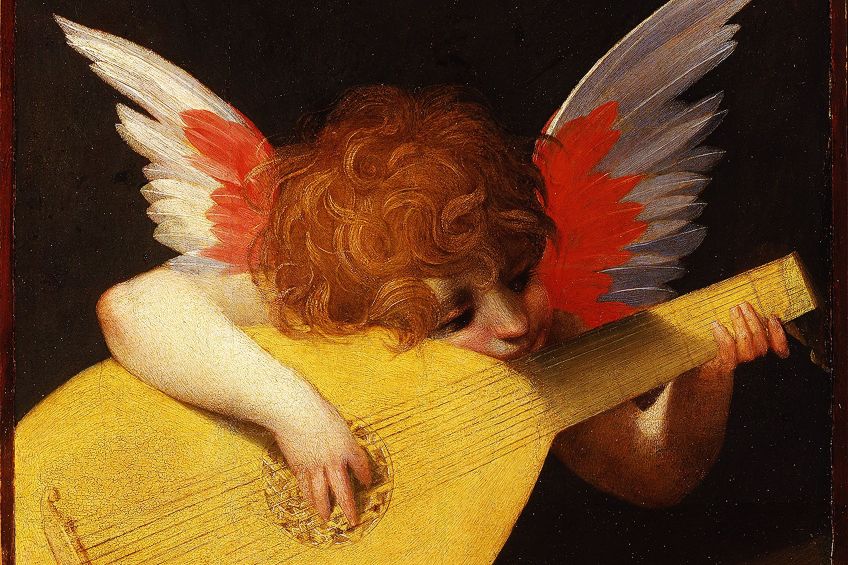
Mannerism was a sixteenth-century approach to art that deliberately stretched the balance, proportion, and spatial clarity associated with the High Renaissance. Its elongated bodies, compressed settings, acidic colors, and cultivated difficulty can look strange at first. Those choices were not simply mistakes or a rejection of skill: they were often demonstrations of invention, elegance, and artistic self-consciousness.
What Is Mannerism?
Mannerism emerged around the 1520s in Florence and Rome and developed across Italian and northern European courts during the later sixteenth century. It was not an organized movement with a manifesto. Rather, the label describes several related styles that privileged artifice, virtuosity, and expressive distortion over the stable harmony associated with Leonardo, Raphael, and the mature Michelangelo.
The name comes from the Italian maniera, meaning “manner” or “style.” Sixteenth-century writers could use the word positively for a refined personal manner. The modern category “Mannerism” was defined much later and remains debated because it gathers together artists whose aims were not identical. It is therefore most useful as a flexible historical label, not a rigid checklist.
Historical Context
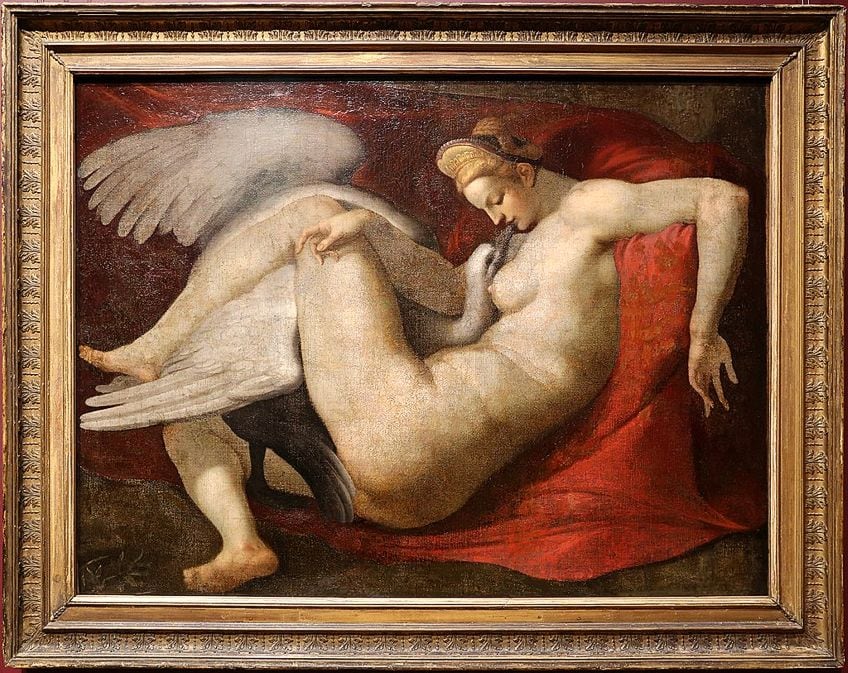
Younger artists inherited an unusually prestigious classical and Renaissance tradition. They studied the idealized bodies and complex poses of Michelangelo and Raphael, but pushed those models toward unexpected proportions, unstable spaces, and sophisticated visual puzzles. The rediscovery of the ancient Laocoön group in Rome in 1506 also supplied a famous example of twisting anatomy and intense emotion.

Political and religious upheaval affected the conditions in which artists worked. The Sack of Rome in 1527 dispersed many artists, while Reformation and Counter-Reformation debates changed expectations for sacred art. Court patronage was equally important: refined portraits, mythological subjects, decorative programs, and collectible objects could signal a patron’s learning and status.
Phases and Geographic Reach
Early Florentine Mannerism is often associated with Pontormo and Rosso Fiorentino in the 1520s. A more polished court style developed by the 1540s in artists such as Bronzino, who became court painter to Cosimo I de’ Medici. In Rome, Parma, Venice, and other centers, artists adapted the idiom differently. There was no valid phase called “Maniera Greca”: that term normally refers to an earlier Italo-Byzantine manner and should not be confused with High or late Mannerism.
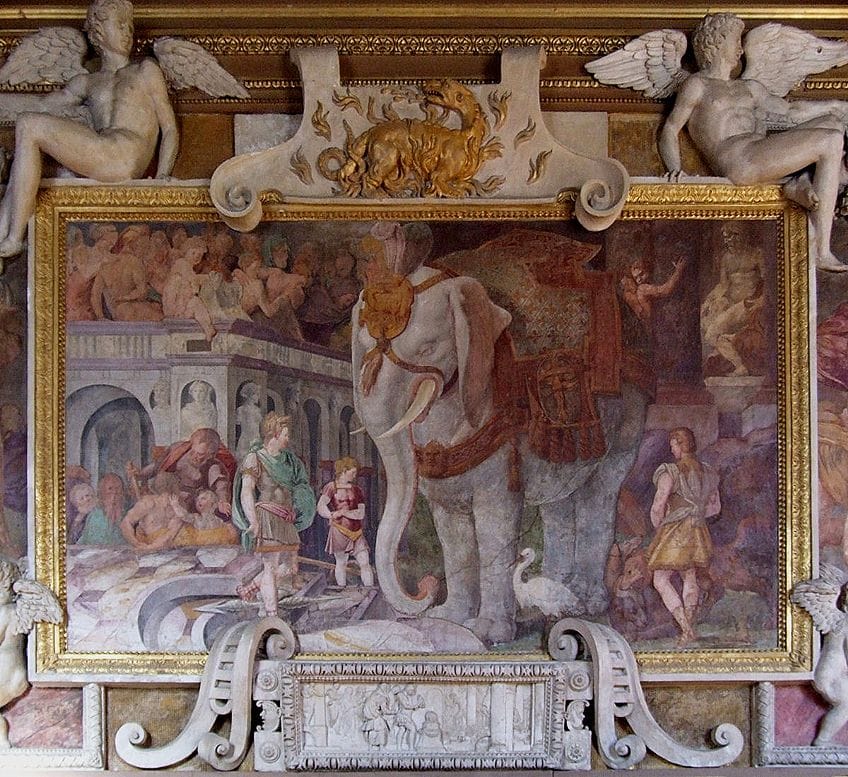
The style also traveled. Rosso Fiorentino and Francesco Primaticcio helped shape the First School of Fontainebleau in France, where stucco, fresco, and ornamental design created elaborate palace interiors. Prague under Rudolf II became another major court center, associated with artists including Giuseppe Arcimboldo and Bartholomeus Spranger. In the Netherlands, artists such as Joachim Wtewael developed a highly finished “international” Mannerism marked by complex poses and elegant distortion.
Hendrick Goltzius carried this international language into printmaking. His swelling engraved line could thicken and taper to model muscle, drapery, and light with extraordinary control, while works after designs by Spranger helped spread Prague Mannerism through reproducible prints. This matters because Mannerism was not transmitted only by traveling painters: drawings, prints, court commissions, and decorative programs allowed styles to move between centers.
Mannerism Across Europe at a Glance
| Center | Artists or Works | Distinctive Emphasis |
|---|---|---|
| Florence | Pontormo, Rosso Fiorentino, Bronzino | Elongated bodies, unusual color, court portraiture, compressed or ambiguous space. |
| Parma | Parmigianino | Graceful distortion, polished finish, elegant elongation, and refined draftsmanship. |
| Mantua | Giulio Romano, Palazzo Te | Classical architecture deliberately destabilized through broken expectations, illusion, and theatrical room decoration. |
| Fontainebleau | Rosso Fiorentino, Francesco Primaticcio | Fresco, stucco, ornament, and courtly interiors integrated into elaborate decorative ensembles. |
| Prague | Arcimboldo, Bartholomeus Spranger | Learned allegory, erotic mythology, composite imagery, and virtuoso court invention. |
| Netherlands | Hendrick Goltzius, Joachim Wtewael | Complex anatomy and courtly elegance circulated through highly finished painting and printmaking. |
| Venice | Tintoretto, Veronese, late Titian | Accelerated diagonals, unusual viewpoints, elongated figures, and theatrical scale overlap with Mannerist tendencies, although Venetian classifications remain fluid. |
| Spain | El Greco | Italian Mannerist devices transformed into an intensely personal language of elongated figures, spiritual light, and unstable space. |
Characteristics of Mannerist Art
No single feature proves that a work is Mannerist. Identification depends on a pattern of choices and on the work’s date, place, function, and artistic circle.
Elongated Form and Complex Poses
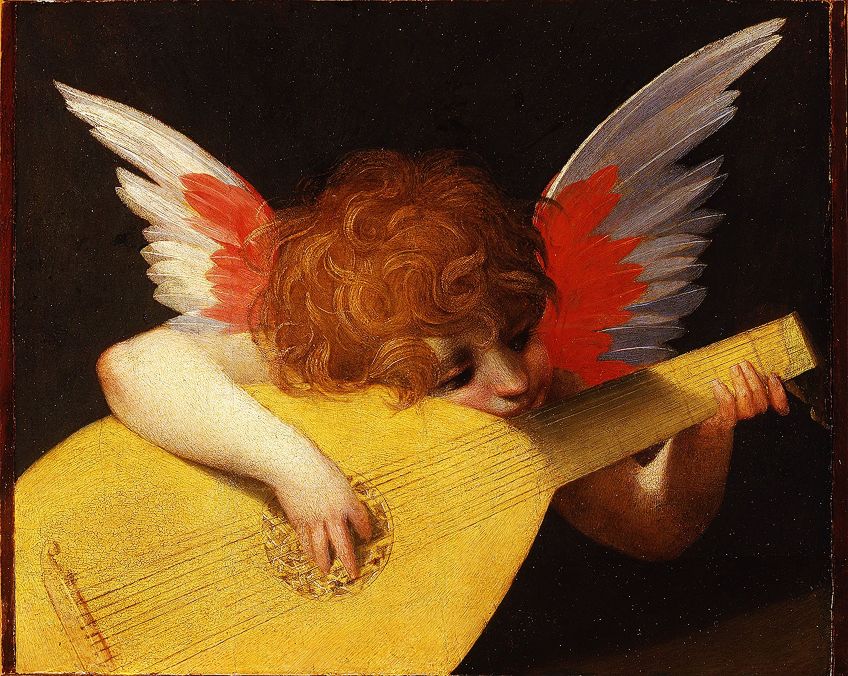
Figures may have unusually long necks, limbs, or torsos. Artists often used the twisting figura serpentinata, a body that seems to spiral upward and invites viewing from several angles. Parmigianino’s unfinished Madonna with the Long Neck, commissioned in 1534, turns disproportion into an effect of otherworldly elegance rather than natural anatomy.
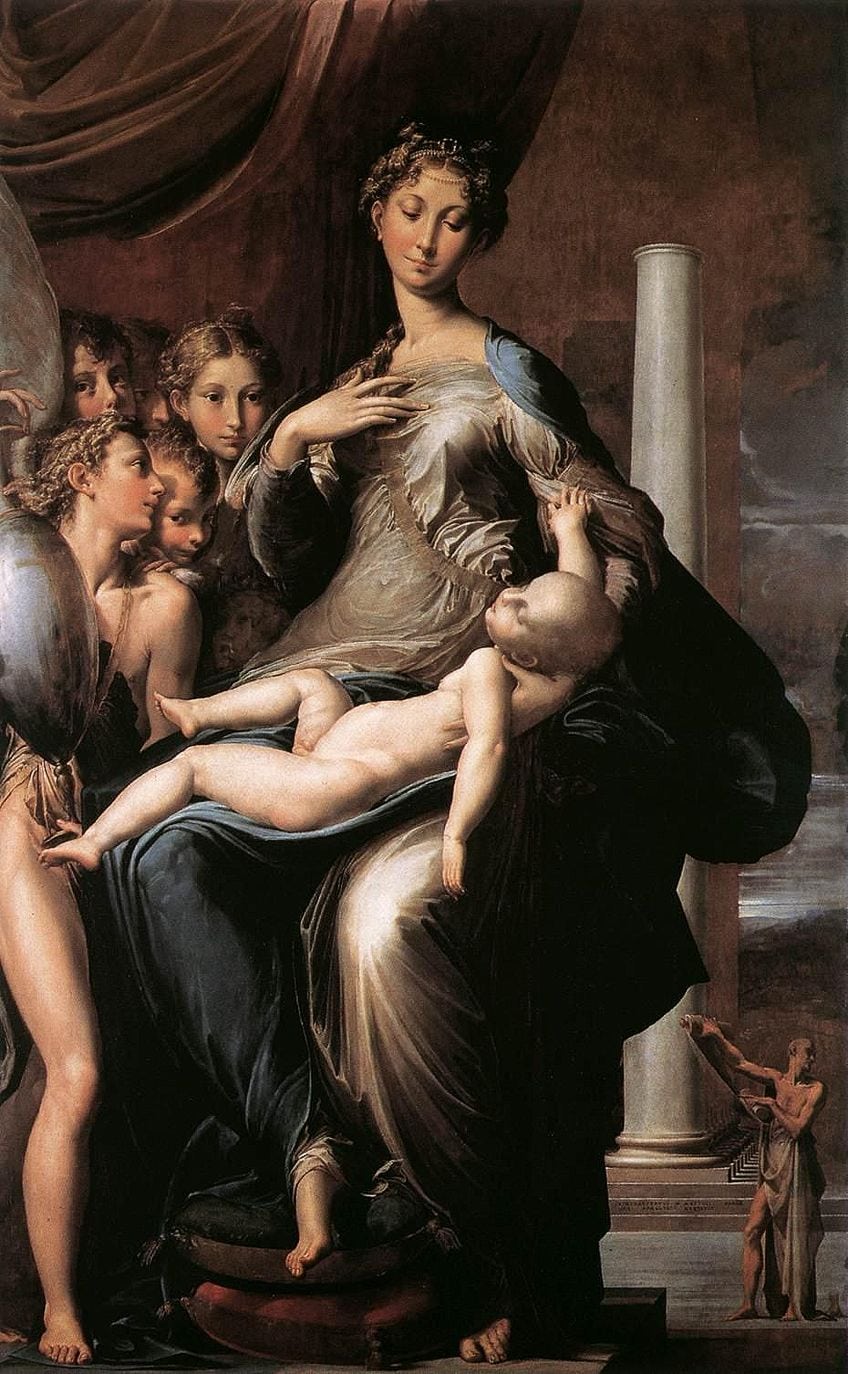
The painting is especially useful because several apparent “errors” work together: the Virgin’s neck and fingers are elongated, the crowded figures at left contrast with the abrupt opening at right, and the tiny distant Saint Jerome resists a stable scale. Its unfinished state prevents every oddity from being treated as a final intention, but the overall preference for cultivated distortion is unmistakable.
Ambiguous Space and Intellectual Play
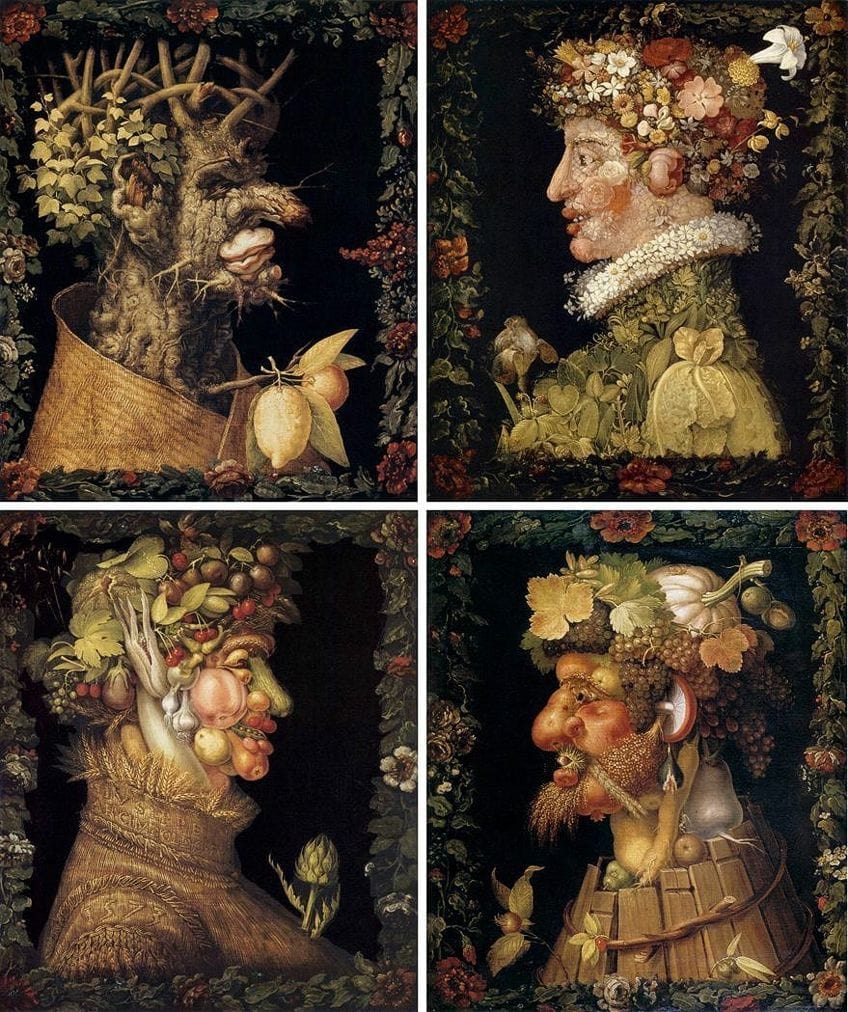
Mannerist compositions may crowd figures at the front, leave puzzling gaps, or make scale and depth difficult to reconcile. Some works reward educated viewers with mythological allusions, visual jokes, or double images. Arcimboldo’s composite heads, assembled from fruit, flowers, animals, or objects, show how courtly ingenuity and ambiguity could become a subject in themselves.
Color and Emotional Tension
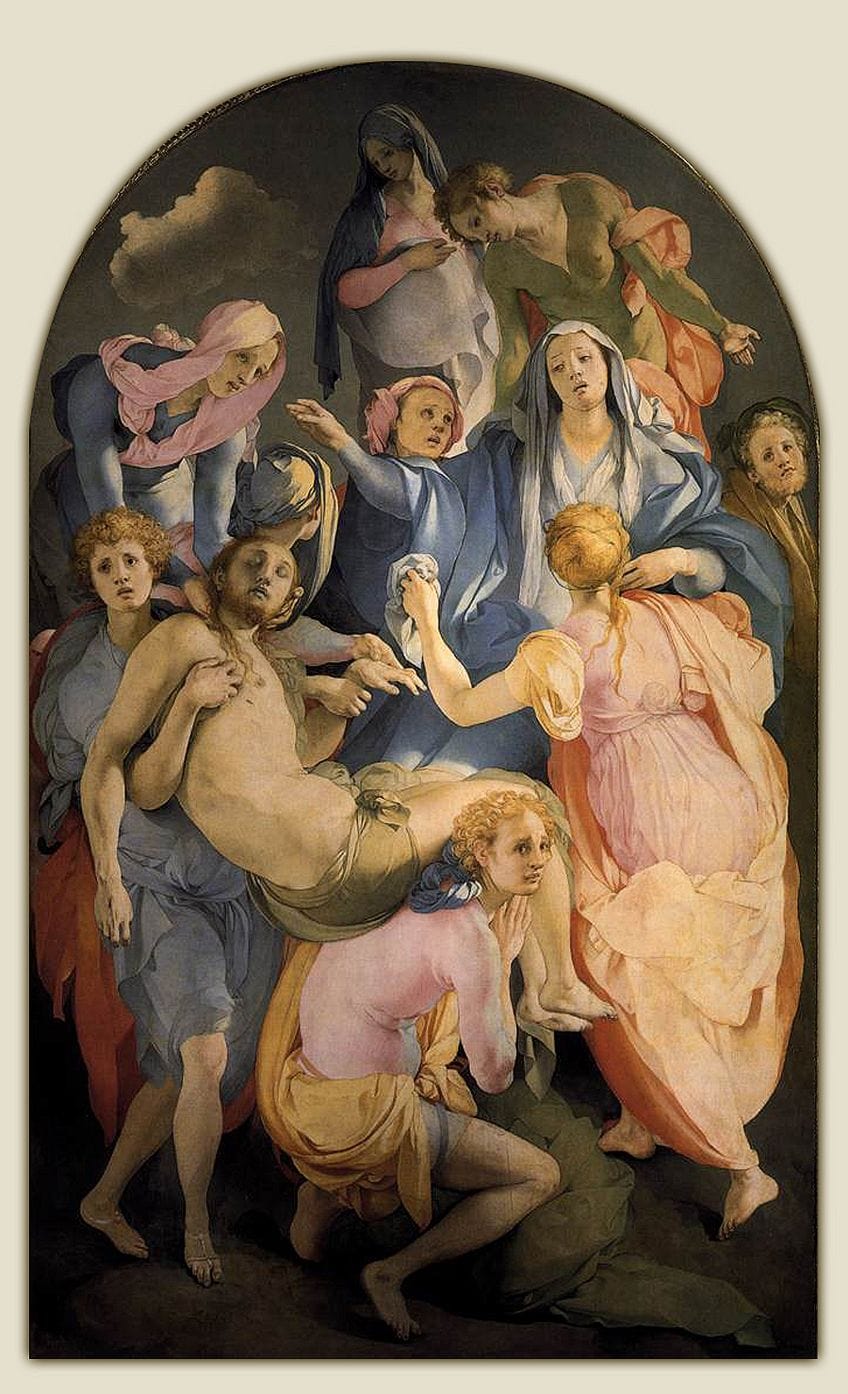
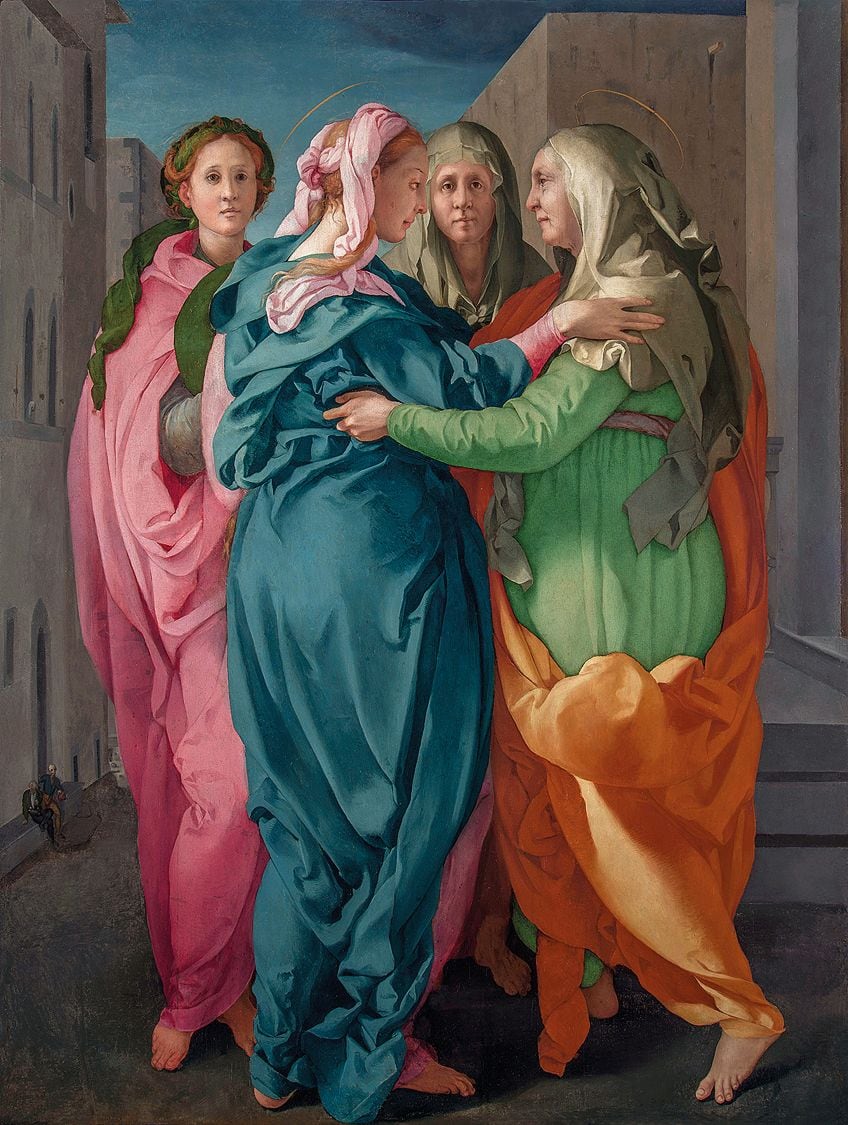
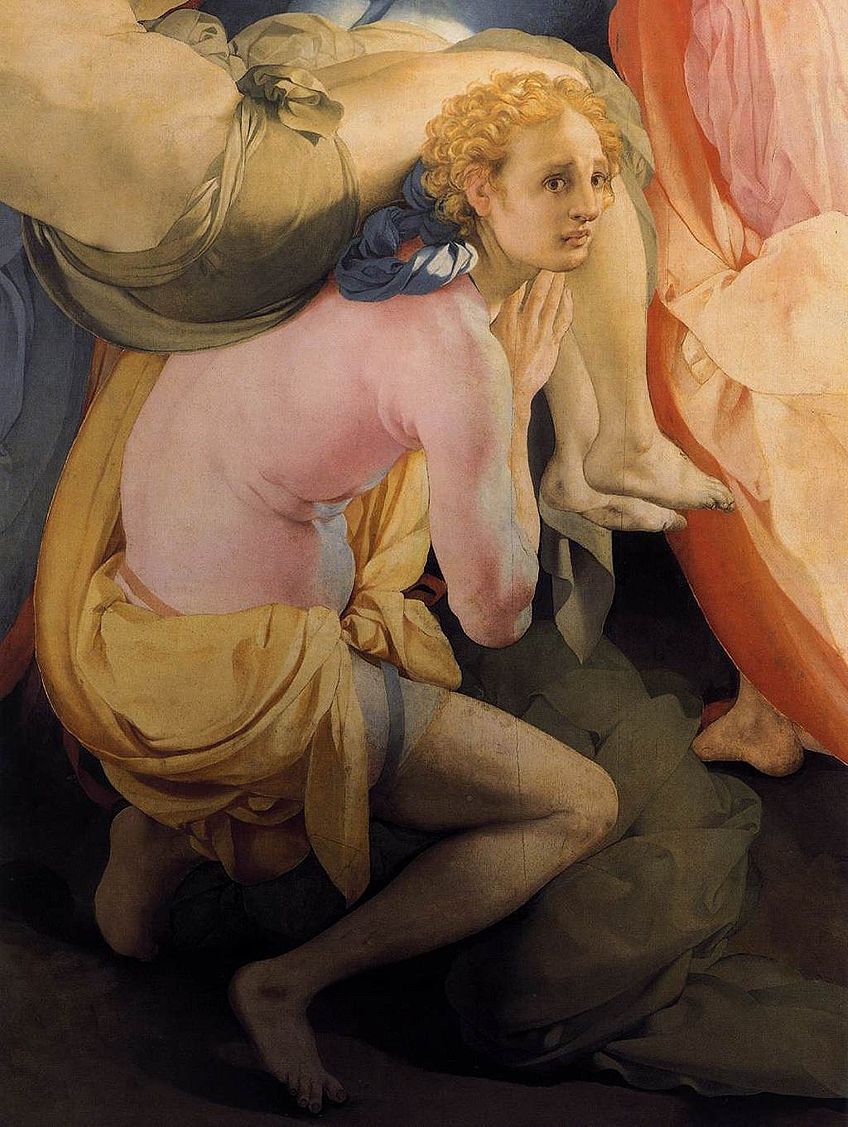
Artists sometimes replaced natural local color with cool pinks, greens, blues, violets, and abrupt contrasts. Pontormo’s Deposition sets weightless, grief-stricken figures in a shallow, uncertain space. Its luminous colors and interlocking bodies intensify emotion without relying on ordinary physical realism.
How to Distinguish Mannerism
| Feature | High Renaissance | Mannerism | Baroque |
|---|---|---|---|
| Body | Idealized but balanced | Elongated, twisting, deliberately artificial | Energetic, weighty, dramatically active |
| Space | Stable and legible | Compressed, crowded, or ambiguous | Deep, theatrical, extending toward the viewer |
| Composition | Harmonious and centered | Complex, asymmetrical, sometimes puzzling | Diagonal, directional, event-driven |
| Typical effect | Clarity and ideal order | Refinement, tension, virtuosity | Drama, immediacy, persuasion |
These contrasts are diagnostic aids, not absolute rules. Transitional works can combine traits, and “Mannerist” should not become a synonym for every elongated figure or unusual color scheme.
How to Analyze a Mannerist Work
- Establish date, place, and function. A court portrait, altarpiece, palace fresco, print, and freestanding sculpture answer different expectations.
- Test the body against natural proportion. Look for stretched necks, small heads, enlarged hands, serpentine twists, or poses that advertise difficulty rather than comfortable movement.
- Map the space. Ask whether perspective remains coherent, whether figures appear too large for the setting, and whether gaps or crowding make the scene deliberately hard to stabilize.
- Follow color and surface. Notice cool or acidic contrasts, polished textures, metallic detail, and places where color separates itself from ordinary local appearance.
- Ask what the artifice accomplishes. Distortion may create elegance, erotic tension, spiritual intensity, courtly wit, or a demonstration of virtuosity. Naming the effect is more useful than merely labeling the work “unnatural.”
This method also guards against the opposite error: treating every unusual sixteenth-century painting as Mannerist. The strongest attribution combines several formal clues with the work’s historical network.
Important Mannerist Artists and Works
Jacopo Pontormo
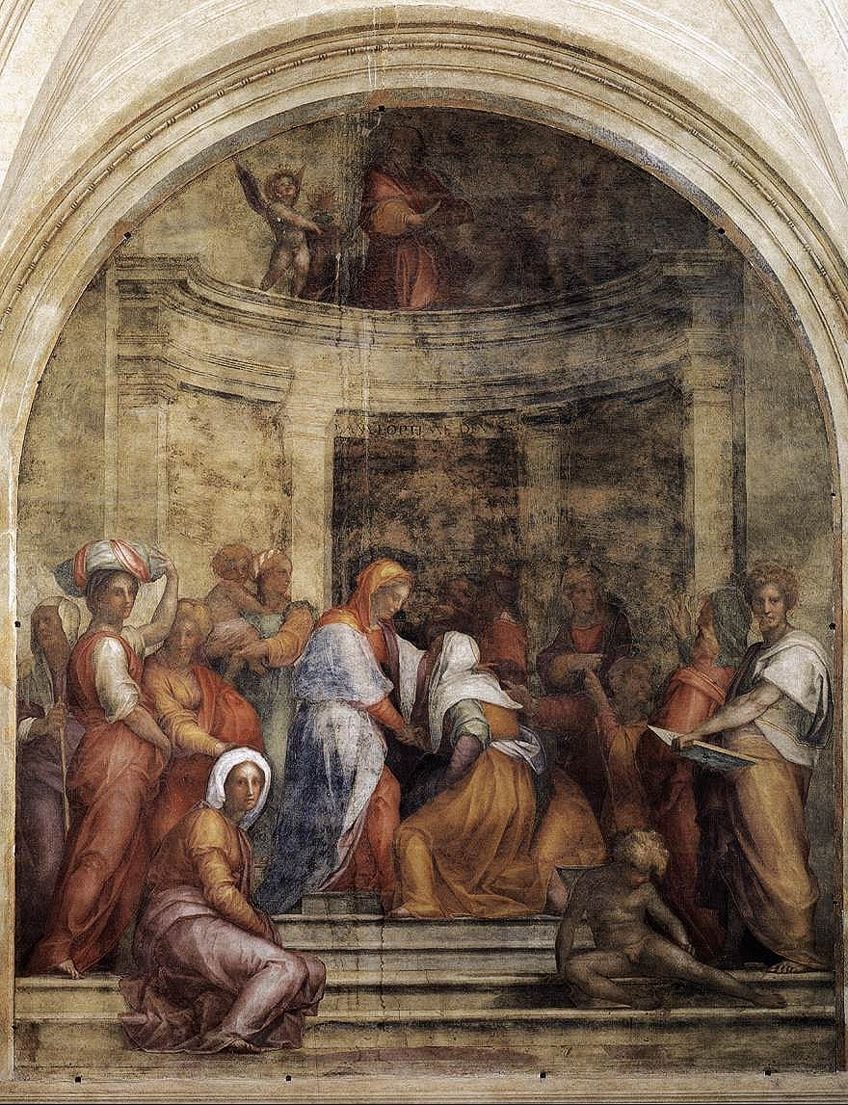
Pontormo was a leading Florentine painter of the early sixteenth century. His figures often seem suspended, emotionally charged, and disconnected from ordinary gravity. Comparing two versions of the Visitation—the meeting of the pregnant Virgin Mary and Saint Elizabeth—shows his development from a relatively measured early composition toward the monumental, closely packed encounter at Carmignano.
Parmigianino, Bronzino, and Arcimboldo
Parmigianino combined extraordinary technical finish with supple distortion. The long proportions and uncertain scale of his Madonna with the Long Neck make it a defining example, but the painting’s unfinished state also requires caution: not every visible irregularity necessarily represents his intended final solution. His prints and drawings helped circulate his elegant figure style beyond Parma.
His Self-Portrait in a Convex Mirror offers a different kind of virtuosity. Parmigianino translated the curved reflection of a convex mirror onto a round support, allowing the enlarged foreground hand and receding face to demonstrate both optical observation and deliberate display of skill. It is a useful reminder that Mannerist distortion could emerge from sophisticated experiments with perception rather than from a simple rejection of naturalism.
Bronzino developed a different kind of artifice at the Medici court. His portraits are often cool, controlled, and exquisitely detailed. Sitters occupy a socially precise world of textiles, jewelry, heraldry, and restrained gesture. In works such as the Metropolitan Museum of Art’s Portrait of a Young Man, an aloof expression, intricate costume, architectural details, and deliberately posed hands turn social identity into a display of cultivated self-command. That stillness differs from Pontormo’s emotional instability, demonstrating why Mannerism is better understood as a family of approaches than as one formula. Bronzino’s position as court painter to Cosimo I also shows that patronage, diplomacy, and dynasty mattered as much as abstract questions of style.
Arcimboldo worked at the Habsburg courts and became famous for composite heads built from meticulously observed objects. A face might consist of seasonal produce, flowers, sea creatures, or books. The illusion changes as viewers move between recognizing the individual objects and the whole portrait. These works combine natural knowledge, courtly entertainment, allegory, and virtuoso wit. They may seem Surrealist to modern eyes, but their original setting was sixteenth-century court culture rather than a modern exploration of the unconscious.
El Greco
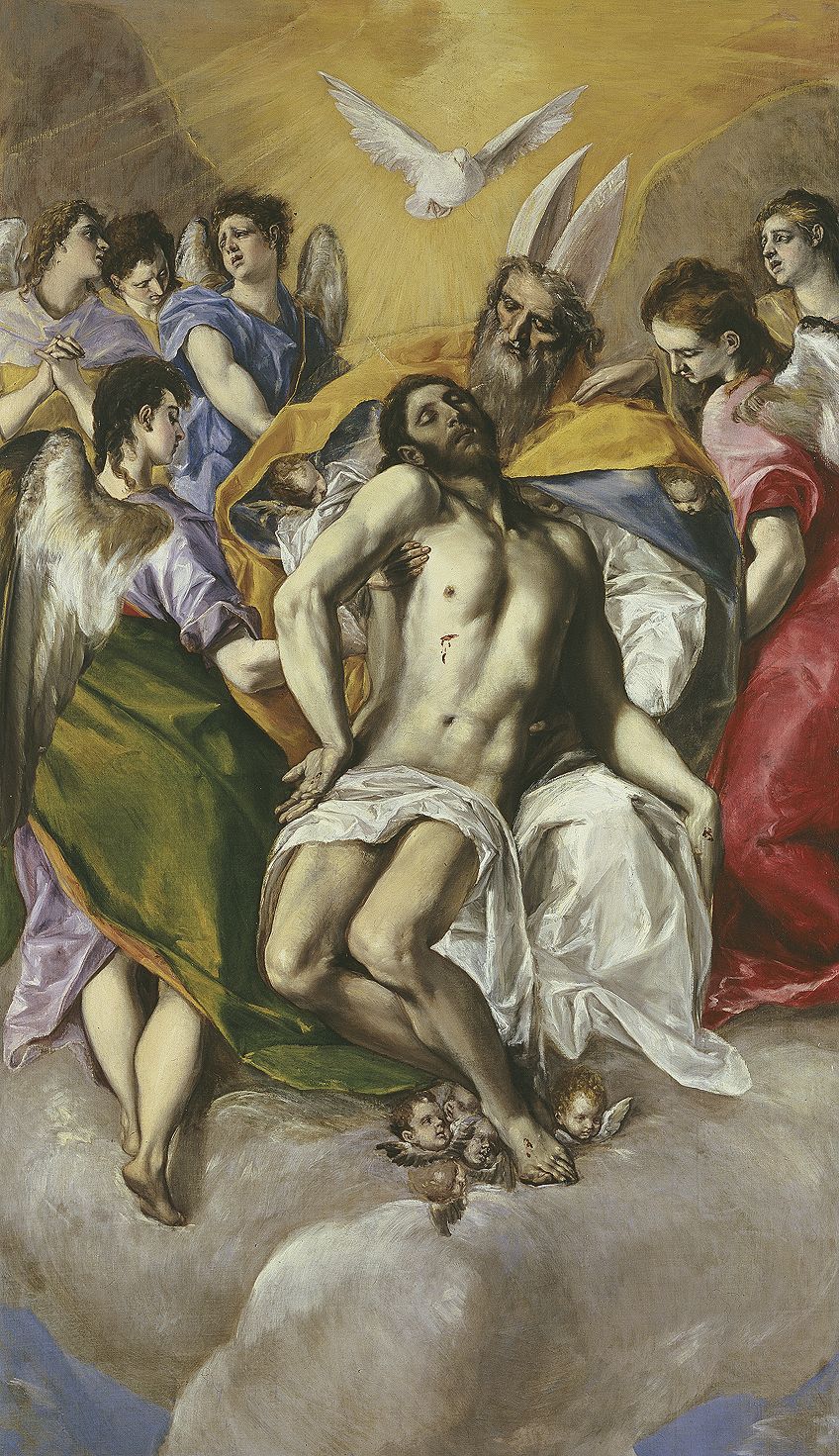
Born on Crete as Doménikos Theotokópoulos, El Greco worked in Venice and Rome before establishing his career in Toledo. His elongated figures and unconventional space reflect an engagement with Italian Mannerism, but his mature Spanish work is highly individual. In The Holy Trinity (1577–1579), elongated bodies, compressed celestial space, intense color, and a sculptural arrangement of Christ, God the Father, angels, and the dove of the Holy Spirit combine Italian sources with El Greco’s own religious language.
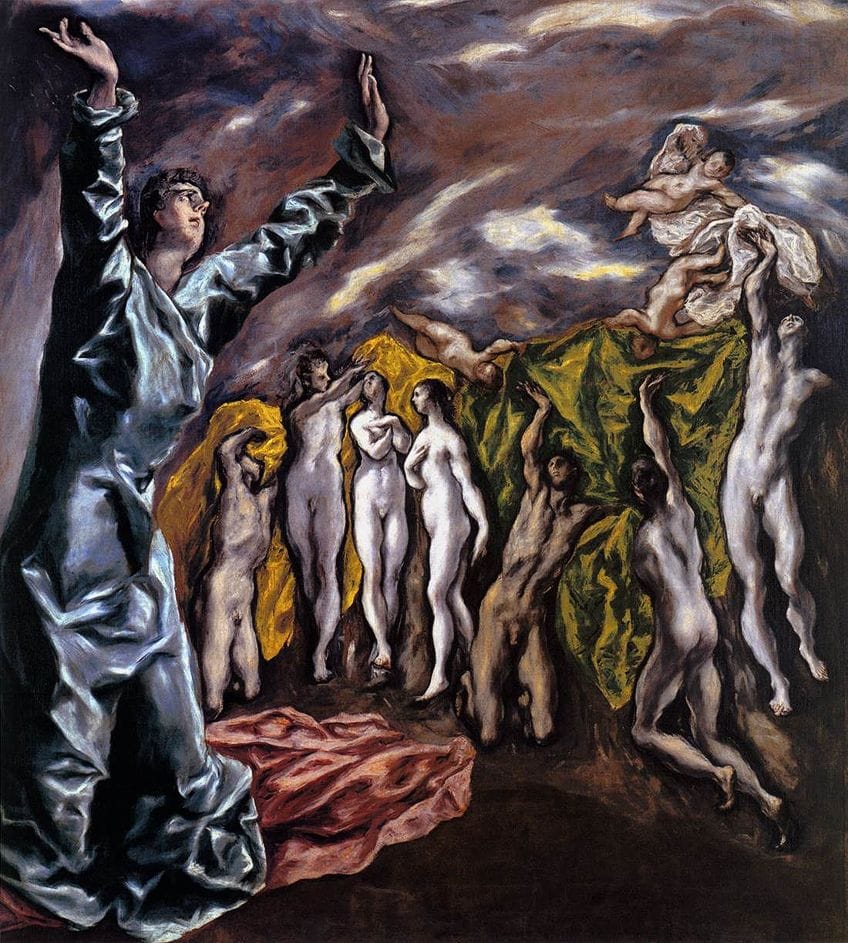
In The Vision of Saint John, also known as The Opening of the Fifth Seal, painted around 1608–1614 as part of a larger altarpiece, upward-reaching bodies turn the Book of Revelation into an intense visionary scene. The later painting shows why El Greco cannot be reduced to a checklist of Mannerist traits: the vocabulary of elongation and unstable space becomes part of a personal spiritual drama.
Mannerist Architecture
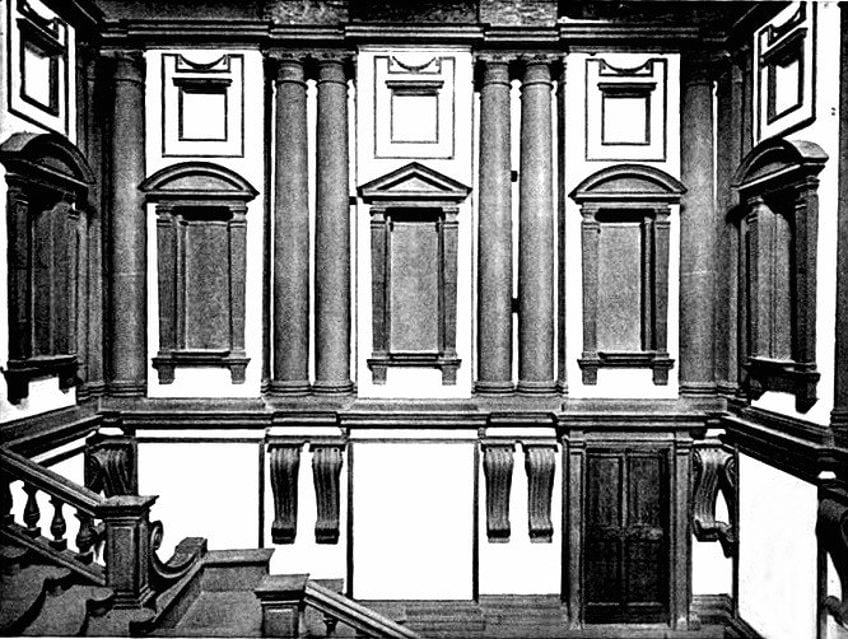
Mannerist architecture keeps the vocabulary of classical columns, pediments, and niches while disrupting expectations about how those elements should behave. Michelangelo designed the Laurentian Library complex in Florence for the Medici pope Clement VII. Its vestibule compresses the room with paired columns recessed into the walls, apparently weighty brackets, blind architectural forms, and a staircase that seems to flow into the space. The result is learned, classical, and intentionally unsettling at once.
Giulio Romano pushed this architectural play in a different direction at the Palazzo Te outside Mantua, built for Federico II Gonzaga. Classical details are shifted, interrupted, exaggerated, or made to appear structurally unstable. Inside, the Sala dei Giganti surrounds the viewer with collapsing architecture and falling mythological giants, dissolving the normal boundary between wall and ceiling. The palace is therefore a key Mannerist example because architecture, painting, illusion, and court entertainment work as one environment.
Mannerist Sculpture
Sculptors explored spiraling motion, multiple viewpoints, technical daring, and courtly symbolism. Giambologna’s three-figure marble Abduction of a Sabine Woman, made in 1579–1583, rises through an interlocking spiral and has no single privileged viewpoint. The marble remains in the Loggia dei Lanzi; the Accademia Gallery displays Giambologna’s full-scale preparatory model.
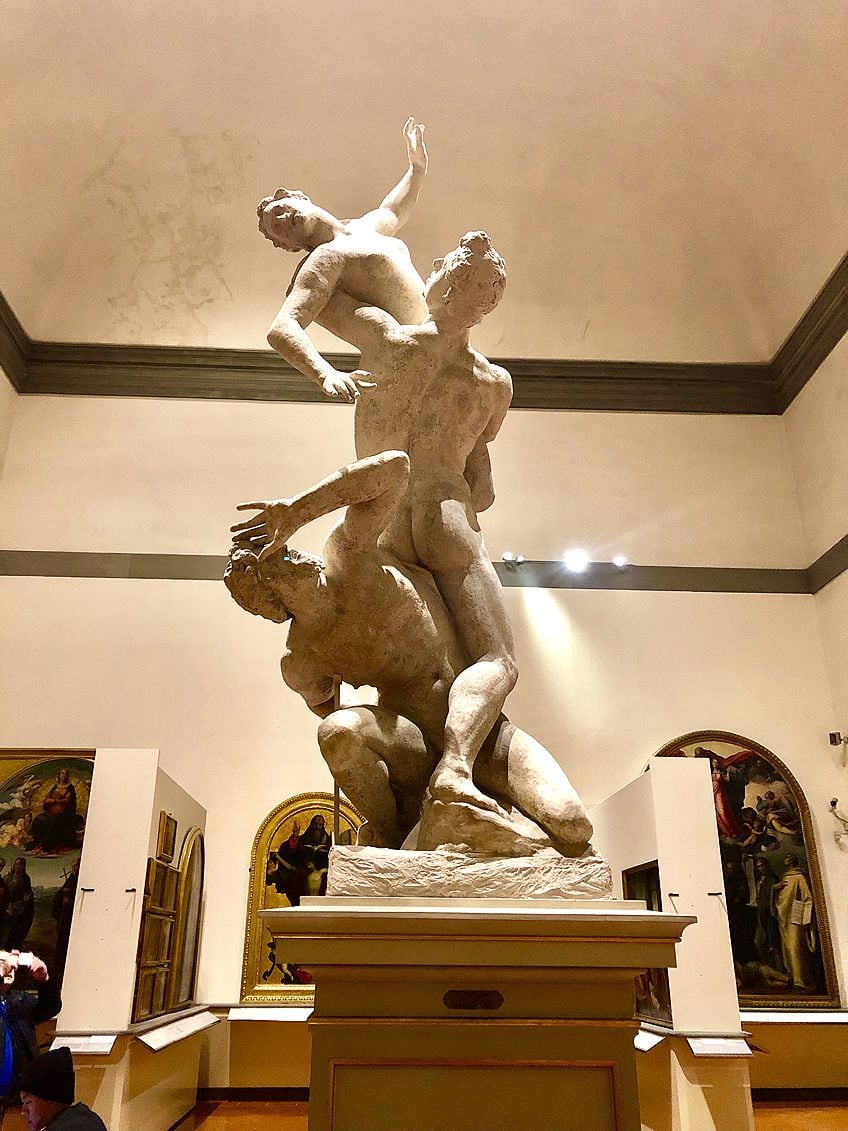
Giambologna returned repeatedly to intertwined bodies and multiple viewpoints. Works such as Samson Slaying a Philistine and Hercules and the Centaur Nessus show why the figura serpentinata was especially effective in sculpture: the composition changes as the viewer walks around it rather than resolving into a single frontal image.
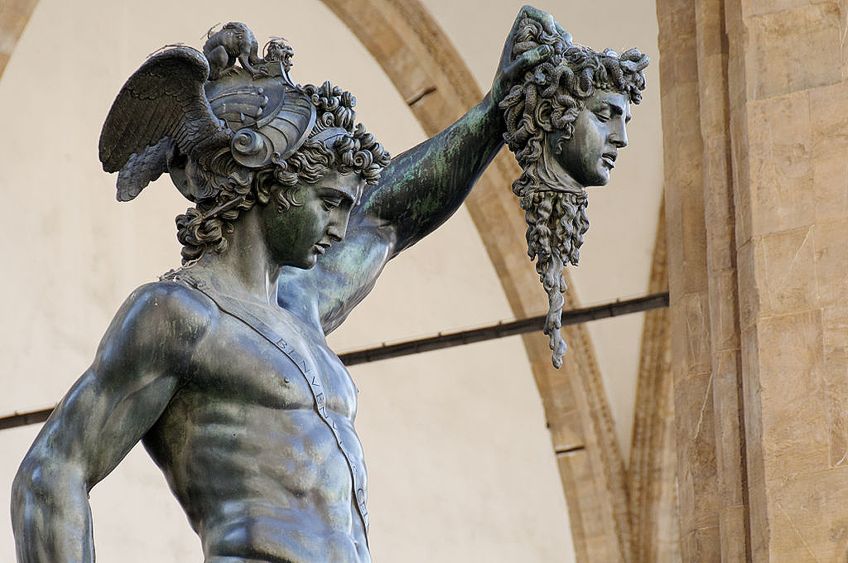
Benvenuto Cellini’s bronze Perseus with the Head of Medusa, made in 1545–1554 for Cosimo I de’ Medici, combines exceptional casting with a forceful political setting. Installed in the Piazza della Signoria, it participated in a carefully charged field of Medici and republican imagery; its technical virtuosity and public placement are as important as its twisting figure. It still stands prominently in the Loggia dei Lanzi in Florence.
From Mannerism to the Seventeenth Century
Mannerism did not simply turn into Baroque art in a straight line. Around 1600, naturalistic approaches associated with Caravaggio, renewed classicism associated with the Carracci, and emerging Baroque strategies coexisted with late Mannerist practices. Different regions changed at different speeds. The categories overlap because they were created by later historians to describe a complicated transition.
Religious reform also changed the stakes. The Council of Trent and later Catholic writers emphasized clarity, decorum, and doctrinal legibility in sacred imagery. Those pressures did not end Mannerism overnight, but they made certain forms of ambiguity and self-conscious display more difficult to justify in church settings. Court art, mythological painting, portraiture, sculpture, and decorative programs could continue to cultivate complexity even as other sacred commissions moved toward clearer narratives.
El Greco, Pontormo, Parmigianino, and Arcimboldo attracted renewed attention from modern artists and critics, who recognized affinities with abstraction, expressive distortion, and visual ambiguity. El Greco in particular became important to artists such as Pablo Picasso and later Expressionists, while Arcimboldo’s composite heads appealed to twentieth-century viewers familiar with Surrealist transformation. That later reception is important, but it does not make the sixteenth-century artists proto-Expressionists or Surrealists; their works belonged to distinct religious, courtly, and intellectual contexts.
Frequently Asked Questions
What Is the Mannerism Art Definition?
Mannerism is a flexible art-historical label for styles that emerged in Italy around the 1520s and spread through European court culture. Mannerist works often favor refined artifice, elongated bodies, complex poses, ambiguous space, and unusual color over the stable harmony associated with the High Renaissance.
When Was the Mannerism Period?
Italian Mannerism is commonly dated from about 1520 to the end of the sixteenth century, although late forms continued into the early seventeenth century in parts of northern Europe. Dates vary by place and by artist, so the period has no single universal endpoint.
Who Were the Main Mannerist Artists?
Frequently discussed painters include Pontormo, Rosso Fiorentino, Parmigianino, Bronzino, Tintoretto, Arcimboldo, El Greco, and northern European artists such as Spranger and Wtewael. Michelangelo strongly influenced the style, while Giambologna and Cellini are central to Mannerist sculpture.
How Can You Recognize Mannerist Art?
Look for several clues together: elongated or twisting bodies, complicated poses, compressed or uncertain space, unexpected color, highly polished surfaces, and a display of artistic virtuosity. Confirm those visual clues with the work’s date, location, function, and relation to sixteenth-century court or religious culture.
How Is Mannerism Different From High Renaissance and Baroque Art?
High Renaissance art often seeks balanced bodies, stable space, and compositional clarity. Mannerism frequently makes those conventions conspicuously artificial through elongation, compression, difficult poses, and cultivated ambiguity. Baroque art can be equally dramatic, but it more often directs movement, light, and emotion toward an immediate event and the viewer. Transitional works can combine all three tendencies.

Isabella studied at the University of Cape Town in South Africa and graduated with a Bachelor of Arts majoring in English Literature & Language and Psychology. Throughout her undergraduate years, she took Art History as an additional subject and absolutely loved it. Building on from her art history knowledge that began in high school, art has always been a particular area of fascination for her. From learning about artworks previously unknown to her, or sharpening her existing understanding of specific works, the ability to continue learning within this interesting sphere excites her greatly.
Her focal points of interest in art history encompass profiling specific artists and art movements, as it is these areas where she is able to really dig deep into the rich narrative of the art world. Additionally, she particularly enjoys exploring the different artistic styles of the 20th century, as well as the important impact that female artists have had on the development of art history.
Learn more about Isabella Meyer and the Art in Context Team.
Cite this Article
Isabella, Meyer, “Mannerism Art – A Look at the Ins and Outs of the Mannerism Period.” Art in Context. May 5, 2021. URL: https://artincontext.org/mannerism-art/
Meyer, I. (2021, 5 May). Mannerism Art – A Look at the Ins and Outs of the Mannerism Period. Art in Context. https://artincontext.org/mannerism-art/
Meyer, Isabella. “Mannerism Art – A Look at the Ins and Outs of the Mannerism Period.” Art in Context, May 5, 2021. https://artincontext.org/mannerism-art/.