

Land Art – Famous Earth Artists and the Ephemerality of Land Art

Land Art emerged in the late 1960s, especially in the United States and the United Kingdom, as artists made the landscape a site, material, subject, and measure of art. Closely connected to Conceptual Art and Minimalism, the movement challenged the assumption that sculpture had to be a portable object displayed in a gallery. Land Art includes monumental excavations and permanent structures as well as walks, plantings, temporary gestures, photographs, maps, films, and indoor “Nonsites,” so it is better understood as a broad field of practices than as one uniform style.
Land Art: An Introduction
Land Art is also discussed under the overlapping labels Earth art and Earthworks, but it is not simply another name for all environmental art. Environmental art is a broader category, while ecological art usually makes ecological systems, repair, or environmental responsibility central to its purpose. Historical Land Art could be ecologically attentive, but it could also involve quarrying, excavation, concrete, steel, and heavy machinery. The movement developed alongside the Minimalism Art movement and Conceptual Art, whose artists likewise questioned the traditional art object and the institutions that defined it.
Land artists explored the boundaries of art through material, scale, location, duration, and documentation. Many intervened directly in a landscape or used soil, vegetation, rocks, gravel, twigs, snow, or water found on-site. Others introduced industrial materials such as concrete and steel or transferred samples of earth into a gallery. What connects these approaches is not a natural-material rule but a sustained attention to the relationship between a work and a particular place.
Writers have compared Land Art with ancient monuments, earthworks, and geoglyphs, but the modern movement arose from a specific postwar context rather than from one direct prehistoric source. Some projects occupied remote deserts and changed through erosion, weather, or seasonal cycles. Others were constructed for long-term survival and now require active stewardship and conservation.
Land Art made exposure to weather and geological time part of the work, but ephemerality was one option rather than a rule: a grass line could vanish within days, while concrete tunnels and steel poles were built to persist.
Site specificity became central to Land Art because a work’s meaning and form could depend on its terrain, light, weather, access, and history. When a work was temporary or difficult to reach, photographs, maps, films, drawings, and written accounts carried it to a wider public. These records were not always neutral substitutes; they framed how viewers imagined scale, remoteness, and change.
This disruption of location challenged the idea that art had to be a movable commodity. Yet the movement did not escape the art economy: dealers, patrons, foundations, museums, photographs, films, drawings, and land ownership remained crucial to producing and circulating many projects. Land Art also developed amid growing ecological awareness, but it did not create the environmental movement, and not every earthwork was environmentally restorative.
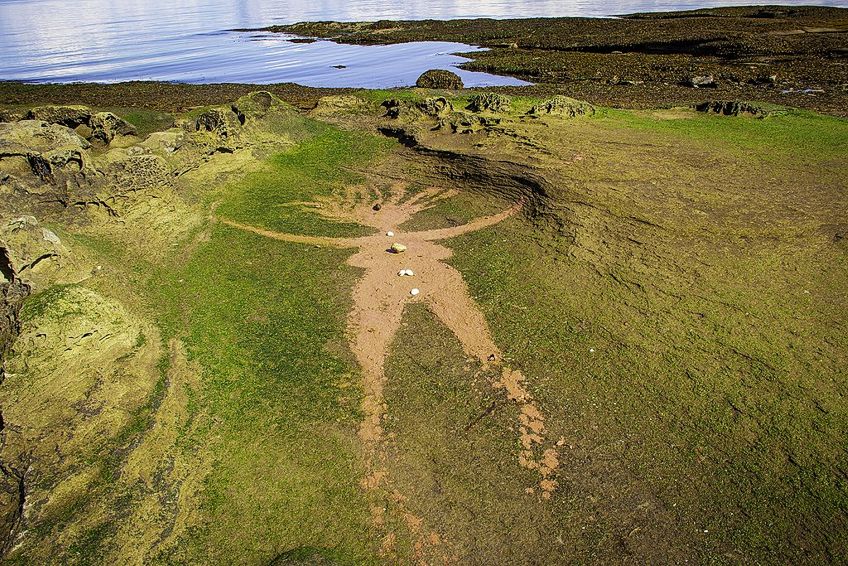
Artists extended activity beyond museums and galleries, gaining room for works that exceeded the scale and mobility of conventional sculpture. Galleries did not disappear from the story: photographic documentation, maps, films, drawings, and material samples often became the means through which distant or temporary projects were exhibited and collected.
Many artists associated with Land Art also worked within Minimal and Conceptual Art. Minimalism contributed serial structures, geometric order, and attention to the viewer’s movement, while Conceptual Art supported the idea that instructions, maps, language, and documentation could form part of a work. The Arte Povera movement offered a related European challenge to conventional artistic materials and institutional value.
Large earthworks often required land access, engineering, machinery, labor, and long-term maintenance. Dealers such as Virginia Dwan and organizations such as Dia Art Foundation were therefore not peripheral to the movement; their financial and institutional support made several canonical projects possible.
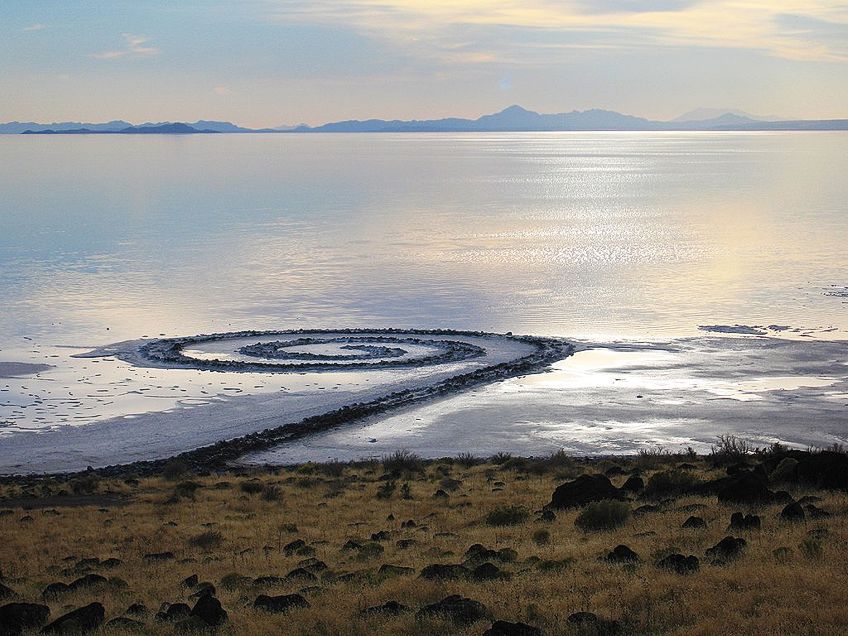
American artist Robert Smithson became one of the movement’s most influential practitioners and theorists. For Spiral Jetty (1970), he used more than 6,000 tons of black basalt rock and earth from the site to form a 1,500-foot-long counterclockwise coil at Rozel Point on the Great Salt Lake. The work was submerged in 1972, re-emerged during drought in 2002, and has remained visible as the lake has receded, demonstrating that its appearance is inseparable from environmental change.
Smithson’s death in 1973 and tighter funding in the mid-1970s affected the first generation of monumental American earthworks, but they did not bring Land Art to a single abrupt end.
Instead, the movement’s strategies continued through walking, performance, public art, ecological and reclamation projects, site-responsive sculpture, and new approaches to landscape. The label is now used broadly, which makes it important to distinguish historical Land Art from any artwork merely installed outdoors.
Two exhibitions helped establish the movement publicly. Earth Works opened at Virginia Dwan’s Dwan Gallery in New York in October 1968. In February 1969, Earth Art, guest-curated by Willoughby Sharp with museum director Thomas Leavitt, brought artists including Jan Dibbets, Hans Haacke, Michael Heizer, Richard Long, Dennis Oppenheim, Robert Morris, Robert Smithson, and Günther Uecker to Cornell University’s Andrew Dickson White Museum of Art.
Land Art challenged established definitions of sculpture by making place, duration, access, and documentation part of the artwork. Artists central to its history include Robert Smithson, Richard Long, Michael Heizer, Nancy Holt, Walter De Maria, Agnes Denes, Dennis Oppenheim, and Andy Goldsworthy, although their methods and relationships to the label differ substantially.
Characteristics and Influences of Land Art
Ephemerality is important to Land Art, but it does not define every work. A temporary line in grass, a field of wheat, a cut in ice, a basalt jetty, a concrete alignment, and a grid of steel poles all place the viewer in different relationships to time. Some works disappear; some weather and transform; some persist because institutions conserve them.
The defining question is not whether Land Art is remote, natural, or temporary, but how a work makes its site—its material conditions, history, scale, access, and change—essential to its meaning.
Many artists resisted the conventional portable object, yet photographs, plans, films, and related gallery works remained marketable. This tension between an unmovable site and a circulable record is one of the movement’s most productive contradictions.
Photography connected Land Art to Conceptual Art rather than distancing the two. A photograph could document an action, function as an autonomous artwork, establish a vantage point, or become one element in a larger installation. For a viewer who never visits the site, that image may become the primary encounter with the work.
Plans, maps, texts, films, and photographs also reveal that Land Art was not only about finished monumental objects. They could record labor and change, connect an indoor viewer to an outdoor place, or deliberately expose the gap between direct experience and mediated knowledge.
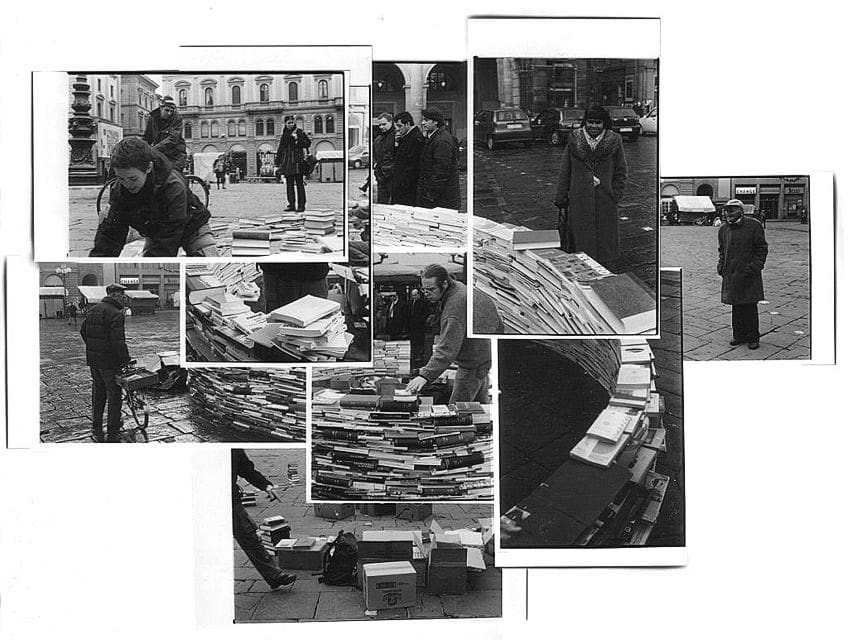
This 2001 installation is a later, related example of site-responsive and participatory practice rather than a work from the historical Land Art movement.
Natural materials found on-site were common, but not essential. Concrete, steel, asphalt, industrial excavation, photographic prints, film, and maps also belong to the movement’s history. Land Art widened the definition of sculpture by treating landscape, movement, weather, and duration as active components rather than as background scenery.
The movement developed during a period of political protest, institutional critique, and growing ecological awareness. Nevertheless, its relationship to ecology remains contested: some artists worked with fragile processes or reclamation, while monumental excavation could repeat the extractive treatment of land that later ecological art challenged.
Land Art projects therefore invite different kinds of attention. A visitor may walk through a work, track the sun, observe a seasonal cycle, compare a site with its map, or encounter only a photograph of an action that has already vanished.
“Site” and “Nonsite” are most useful as terms within Robert Smithson’s own practice, not as universal categories for all Land Art. His Nonsites brought materials gathered from a particular location into geometric containers in a gallery, often with photographs, maps, or text. The indoor work pointed toward an absent outdoor site while also demonstrating that neither place nor representation could fully contain the other.
Smithson’s Site/Nonsite dialectic makes the distance between a place and its representation part of the artwork; it does not simply divide all Land Art into outdoor and indoor types.
Economic change in the mid-1970s altered support for immense earthmoving projects, but artists had always moved between outdoor sites and galleries. That exchange is fundamental to the movement rather than a late compromise.
How to Recognize and Analyze Land Art
Site: Ask why the work is in that particular place. Terrain, ownership, access, climate, local history, and the viewer’s route may all shape its meaning.
Material and action: Identify both what the work uses and what the artist or crew did. Walking, digging, planting, aligning, transporting, filming, and photographing produce different relationships with land.
Duration: Determine whether the work is temporary, changing, periodically visible, conserved, reconstructed, or intended to remain. Ephemerality should be verified rather than assumed.
Documentation: Compare direct experience with photographs, maps, films, and texts. Documentation can preserve evidence, create a separate artwork, control a viewpoint, or reveal that most audiences know the site only through media.
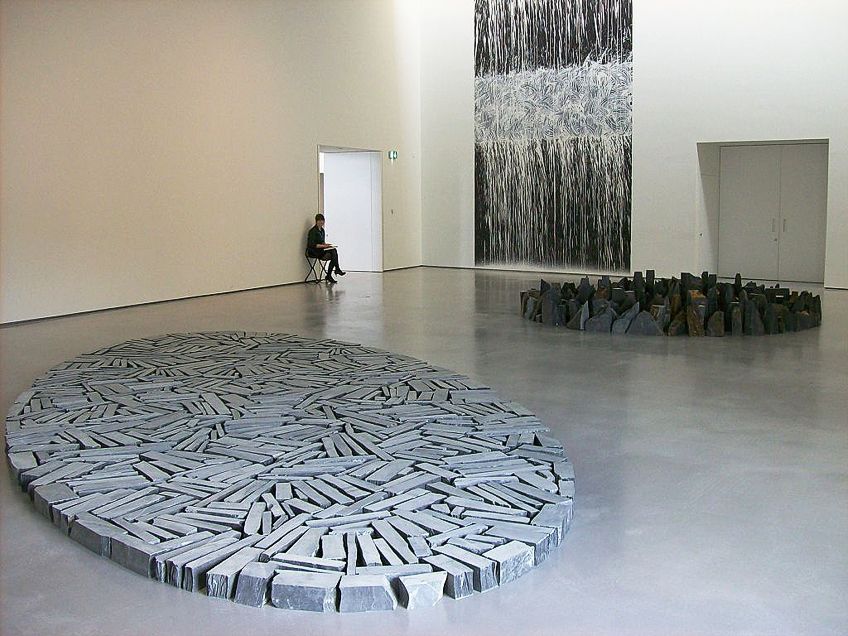
Famous Land Artists and Their Artworks
Throughout the Land Art movement, many famous Land Art works were created by notable artists. Some of these well-known Earth artists have been listed below, along with their iconic works that went on to further define the characteristics that encompassed Earth art.
Walter De Maria (1935 – 2013)
An important figure within Land Art was American artist and composer Walter De Maria. His sculpture joined precise geometric systems with environments that change through light, weather, distance, and time. After working in painting and sculpture, he created projects that connected Minimalist order with the expanded field of Conceptual Art and earthwork.
De Maria used geometric shapes, numerical systems, and manufactured materials such as aluminum and stainless steel. Connections with Dada, Suprematism, and Constructivism within art help locate this formal vocabulary, but the experience of his large works also depends on the viewer moving through a measured space.
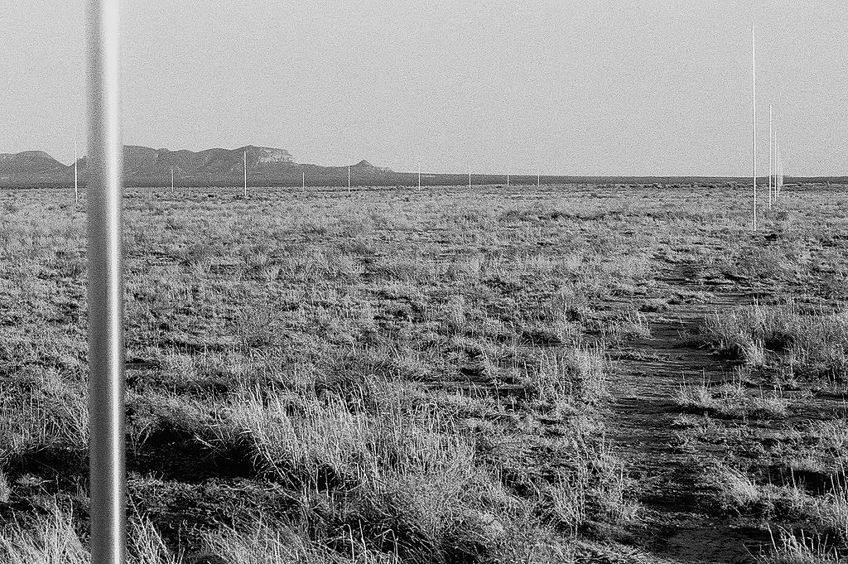
His best-known Land Art piece is The Lightning Field (1977), commissioned and maintained by Dia Art Foundation. It consists of 400 polished stainless-steel poles arranged in a grid measuring one mile by one kilometer in western New Mexico. The poles average 20 feet 7½ inches in height; their differing lengths compensate for uneven ground so their pointed tips define a level plane.
Visitors walk within the grid and observe how the poles appear and disappear as light changes. Lightning may occur, but Dia explicitly notes that a full experience of the work does not depend on a strike. The sustained encounter joins industrial precision with the variable conditions of sunrise, sunset, weather, and the high-desert landscape.
Robert Smithson (1938 – 1973)
Robert Smithson was a leading artist and writer within Land Art. After beginning as a painter, he developed sculpture, photography, film, essays, outdoor projects, and his “Nonsites.” These indoor works placed material gathered from specific locations in geometric containers alongside maps, photographs, or language, establishing a conceptual exchange between gallery and landscape.
Smithson’s best-known work is Spiral Jetty (1970). Assisted by a crew using dump trucks, a tractor, and a front loader, he formed more than 6,000 tons of black basalt rock and earth into a coil 1,500 feet long and about 15 feet wide. Dia documents the work as constructed in April 1970 with dump trucks, a tractor, and a front loader. The work was submerged in 1972 and re-emerged during drought in 2002; its appearance continues to register changing lake conditions.
Although the earthwork could not be moved like a conventional sculpture, it could still be owned, stewarded, photographed, filmed, written about, and represented in collections. Its changing surface and surroundings are central to the work, demonstrating how Land Art can remain materially unstable while institutionally protected.
Smithson’s writing and art repeatedly addressed entropy: processes of dispersal, change, and decay that resist a permanently fixed form. Spiral Jetty became an emblematic work of modern art because it operates at once as a constructed path, a changing site, a film, a photographed image, and a subject of continuing stewardship.
Dia Art Foundation, the work’s owner and steward, documents the site’s changing conditions and explains its construction and conservation in the following institutional film.
Dennis Oppenheim (1938 – 2011)
Another influential Land artist was Dennis Oppenheim, an American artist, sculptor, and photographer. Oppenheim’s early artistic practice displayed a philosophical questioning surrounding the nature, making, and definition of art, as he experimented with Conceptual and Performance art, film installations, and Earthwork art.
The artwork for which he is most known is his 1968 creation entitled Annual Rings, in which he drew large concentric circles into ice that covered a waterway. The purpose behind this was to draw on and emphasize the idea of time in both trees and snow, as Oppenheim worked with ice to draw circles that were representative of the pattern of rings that displays a tree’s age. Oppenheim also experimented with the limitations of space and time, as he drew these rings over a waterway that divided the United States and Canada, as well as their conflicting time zones.
In doing so, Oppenheim created a Land Art piece that placed greater focus and concern on the actual location and materials of the artwork itself, in addition to challenging the values of the ordering system that dictated how individuals were to live.
Nancy Holt (1938 – 2014)
Nancy Holt was a central figure in Land Art, installation art, photography, film, video, sound, and public sculpture. Her practice investigated perception, systems, place, and the movement of celestial bodies. Holt was married to Robert Smithson, but her work has its own distinct methods and history. She died in 2014 and willed the Holt/Smithson Foundation into being; the foundation began operating in 2018.
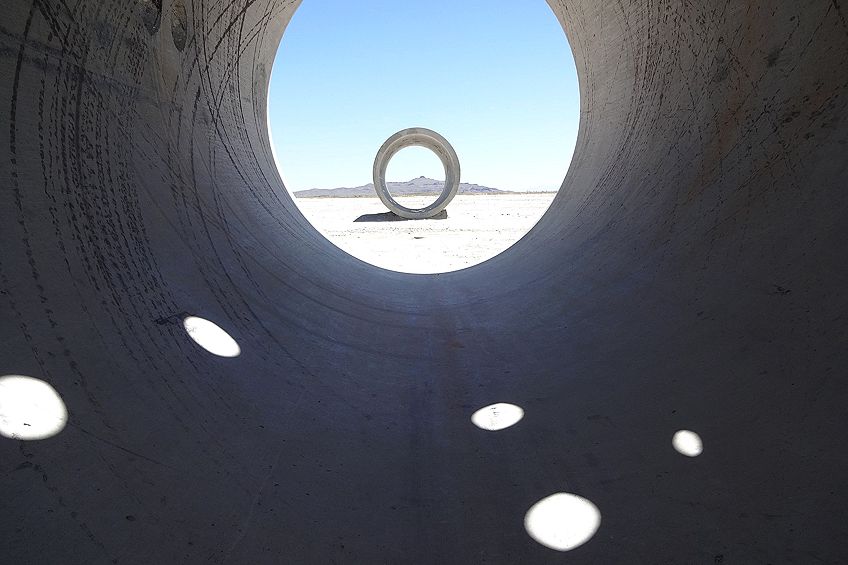
Holt’s early photography and moving-image work informed later sculptures that frame sightlines and register the positions of earth, sun, and stars. Her best-known earthwork is Sun Tunnels (1973–1976), which Dia Art Foundation acquired in 2018 and continues to steward with support from the Holt/Smithson Foundation.
The installation consists of four concrete cylinders, each 18 feet long and 9 feet in diameter, arranged in an open-cross formation in Utah’s Great Basin Desert. Their axes frame the sun on the horizon at the summer and winter solstices. Holes corresponding to stars in Capricorn, Columba, Draco, and Perseus cast changing points of daylight inside the tunnels.
The cylinders provide shade, frame the surrounding mountains, and bring the immense desert and astronomical cycles into relation with the viewer’s body. Their durability also corrects the common assumption that Land Art must be designed to decay: Sun Tunnels is site-specific, permanent, and subject to continuing conservation.
Agnes Denes (Born 1931)
Hungarian-born American artist Agnes Denes works across Conceptual Art, drawing, sculpture, philosophy, mathematics, and environmental projects. Born in Budapest in 1931, she lived in Sweden before arriving in the United States in the early 1950s. Her practice differs from the monumental-desert model of Land Art by connecting land with food systems, economics, social values, and ecological responsibility.
Denes’s seminal work Wheatfield—A Confrontation was commissioned by the Public Art Fund and created on the Battery Park landfill in lower Manhattan in 1982. She and her collaborators planted two acres of wheat near Wall Street and the World Trade Center, facing the Statue of Liberty. Over four months, the field was weeded, fertilized, treated for fungus, and irrigated.
The crop was harvested on August 16, 1982—not in 1986—and yielded more than 1,000 pounds of wheat. The grain later traveled to 28 cities with The International Art Show for the End of World Hunger, where seeds were distributed for planting.
By placing productive farmland on immensely valuable urban real estate, Denes made food, energy, commerce, world trade, and land value collide within a single living work.
Michael Heizer (Born 1944)
Another influential artist within the Land Art Movement was Michael Heizer, who was known for his ability to build extensive works and to investigate the relationship between positive and negative spaces. Since the late 1960s, Heizer was an important figure within Land Art as his immense excavations and constructions were able to simultaneously elicit fear and admiration.
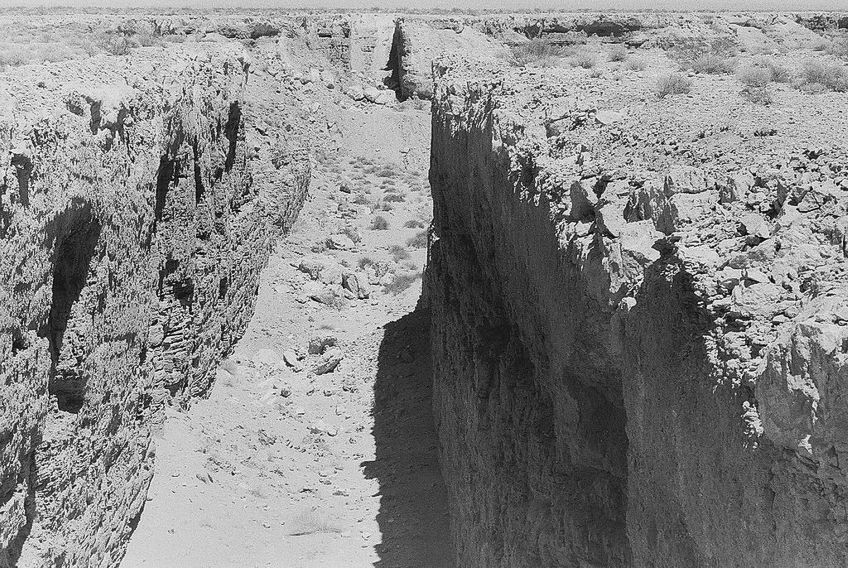
Heizer developed “negative” works in which removal and void become sculptural material. For Double Negative (1969–1970), supported by dealer and patron Virginia Dwan, approximately 240 000 tons of rhyolite and sandstone were displaced to form two aligned trenches cut into the eastern edge of Mormon Mesa in Nevada. Photographs and plans made the remote work legible to gallery audiences.
Despite the work requiring a tremendous amount of labor, the finished product consisted of negative space, as it was essentially a 1500-foot-long canyon that viewers would enter and be surrounded by three walls of earth. Since the majority of viewers could not access it, Double Negative captured the essence of Land Art through its site-specificity and remoteness. Its presence within the desert also meant that the work would eventually disintegrate as a result of being exposed to the elements.
Richard Long (Born 1945)
A prominent British sculptor within the Land Art movement, which generally consisted of American artists, was Richard Long. He made landscapes the primary focus of his works, as he was inspired to manipulate the landscape in different ways during the late 1960s. Long began his direct involvement with nature by using walking as his main medium and created series of works made up of monotonous movements or long unaccompanied walks. In doing so, Long aimed to incorporate a more basic, intimate, and elemental level within his art.
The intention within Long’s work was to represent a dialogue that he personally created between humans and nature. His very first Land Art piece, which represented the beginning of his use of walking as a medium, was created in 1967 and was titled A Line Made by Walking. Within this work, Long created a straight line in a field of grass by walking back and forth across the same path in Wiltshire, England. The trampled grass was then juxtaposed against the unaffected areas of grass on either side of the line Long created.
Long emphasized the temporality of the action and the slight, short-lived change made to the field. The photograph records both the line and the act that produced it, raising a central Land Art question: is the artwork the walk, the mark in the grass, the photograph, or the relationship among all three?
A Line Made by Walking shows that Land Art can be physically modest yet conceptually expansive, with a repeated bodily action turning an ordinary field into a temporary sculptural event.
Andy Goldsworthy (Born 1956)
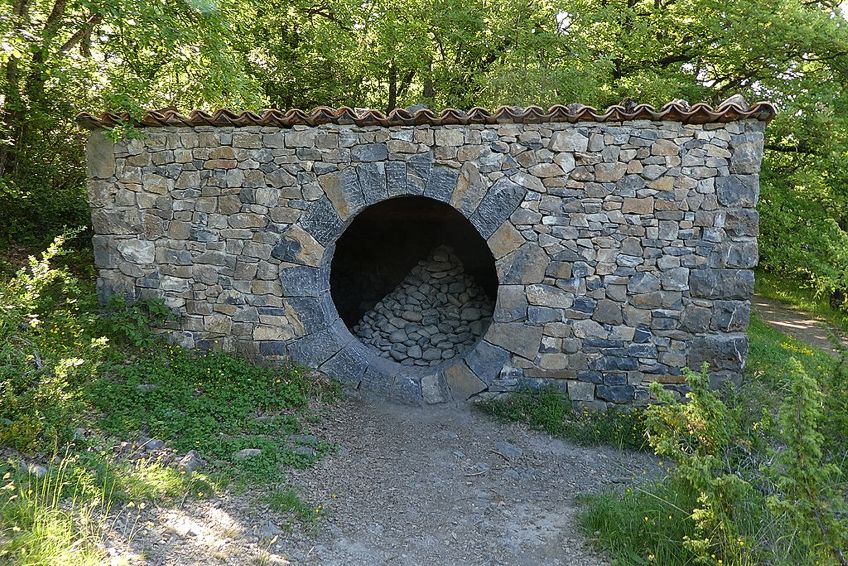
Another British artist who was considered an important figure within the Land Art movement was Andy Goldsworthy. A prominent sculptor and photographer, Goldsworthy focused on creating works that enhanced nature’s beauty, the impact of time, and the relationship between humans and land. Goldsworthy’s works can be categorized as permanent or temporary, with most of his works making up the latter.
Many of Goldsworthy’s outdoor works use found branches, leaves, ice, snow, or stones and may last only until wind, water, thawing, or decay transforms them. He also creates permanent commissions and gallery installations. Photography has a specific role in his practice: it records ephemeral sculpture at a particular moment and becomes the form through which that work reaches most viewers.
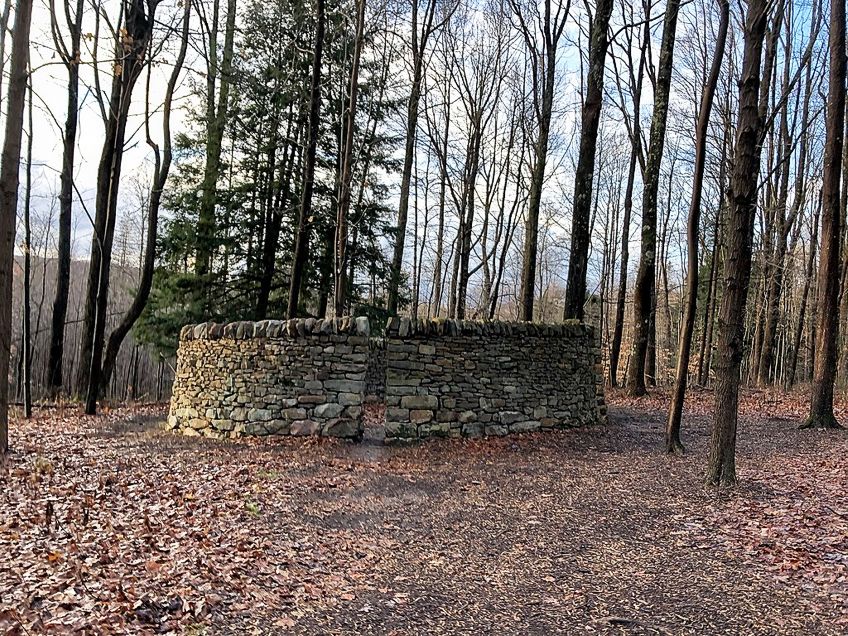
Goldsworthy’s practice likewise makes bodily labor, time, and change visible. In Pebbles, broken and scraped white with another stone (1985), the descriptive title records the material and action rather than imposing a separate symbolic narrative.
His descriptive titles and photographs preserve different kinds of information after an outdoor construction has changed or disappeared. Across ephemeral works and more permanent commissions, Goldsworthy examines how handling, arranging, and waiting expose the forces already active within a landscape.
The Legacy of Land Art
Land Art developed amid the Vietnam War, countercultural protest, institutional critique, and growing environmental concern. Its legacy lies less in a single look than in a set of questions: where can art exist, who controls access to it, how does a site change a work, and what happens when weather, labor, documentation, ownership, and conservation become part of sculpture?
The movement did not place artists wholly outside the art system. Monumental projects depended on patrons, landowners, institutions, engineers, crews, and later stewards, while photographs, films, drawings, and maps circulated through museums and markets. This contradiction remains essential to understanding why an unmovable earthwork can still be owned, exhibited, conserved, and commercially represented.
Contemporary scholarship also challenges the older description of the American West as empty terrain awaiting artistic intervention. Desert earthworks occupy places with ecological, political, and Indigenous histories, and their construction can involve extraction as well as aesthetic transformation. Later environmental, ecofeminist, reclamation, and Indigenous practices have widened the field by addressing damaged land, collective responsibility, food systems, borders, and colonial assumptions.
The historical sites themselves continue to change status. In 2024, Spiral Jetty was added to the National Register of Historic Places, while Dia and partner organizations continue to document the work and advocate for the Great Salt Lake environment. Such stewardship demonstrates that Land Art’s exposure to change does not eliminate conservation; it makes decisions about care especially complex.
Land Art is best understood not as art that merely decorates nature, but as art in which place, material, duration, access, and representation become inseparable parts of the work.
Frequently Asked Questions About Land Art
What Is Land Art?
Land Art is a field of artistic practice that emerged in the late 1960s and makes a landscape or specific place integral to the work. Artists may dig, build, walk, plant, arrange, photograph, film, or transfer earth into a gallery. Some works are temporary, while others use stone, concrete, or steel and are conserved over decades.
How Is Land Art Different From Environmental or Ecological Art?
Land Art is historically associated with site, material, scale, and challenges to the portable gallery object. Environmental art is a broader category for work that creates or engages an environment, while ecological art generally emphasizes ecological relationships, repair, sustainability, or activism. The fields overlap, but a monumental earthwork is not automatically ecologically beneficial simply because it is outdoors.
Why Is Photography Important in Land Art?
Photography allows temporary, remote, or changing projects to reach viewers who cannot visit the site. It may document an action, establish a deliberate viewpoint, circulate as an independent artwork, or accompany maps, films, and material samples. Because most audiences encounter major earthworks through images, the photograph can shape the work’s apparent scale, isolation, and meaning rather than simply record it neutrally.
What Is the Most Famous Land Art Sculpture to Exist?
Spiral Jetty by Robert Smithson is the movement’s most widely recognized sculpture. Built at Rozel Point on Utah’s Great Salt Lake in 1970, the counterclockwise coil is 1,500 feet long and about 15 feet wide. It was submerged in 1972, re-emerged during drought in 2002, and remains visible as changing lake levels reshape its surroundings.

Isabella studied at the University of Cape Town in South Africa and graduated with a Bachelor of Arts majoring in English Literature & Language and Psychology. Throughout her undergraduate years, she took Art History as an additional subject and absolutely loved it. Building on from her art history knowledge that began in high school, art has always been a particular area of fascination for her. From learning about artworks previously unknown to her, or sharpening her existing understanding of specific works, the ability to continue learning within this interesting sphere excites her greatly.
Her focal points of interest in art history encompass profiling specific artists and art movements, as it is these areas where she is able to really dig deep into the rich narrative of the art world. Additionally, she particularly enjoys exploring the different artistic styles of the 20th century, as well as the important impact that female artists have had on the development of art history.
Learn more about Isabella Meyer and the Art in Context Team.
Cite this Article
Isabella, Meyer, “Land Art – Famous Earth Artists and the Ephemerality of Land Art.” Art in Context. April 1, 2021. URL: https://artincontext.org/land-art/
Meyer, I. (2021, 1 April). Land Art – Famous Earth Artists and the Ephemerality of Land Art. Art in Context. https://artincontext.org/land-art/
Meyer, Isabella. “Land Art – Famous Earth Artists and the Ephemerality of Land Art.” Art in Context, April 1, 2021. https://artincontext.org/land-art/.


