


Cecily Brown – Biography, Art Style and Key Paintings

Cecily Brown is a British-born, New York-based painter whose turbulent canvases make seeing feel active and uncertain. Bodies, landscapes, animals, furniture, and flashes of erotic action surface within torrents of color, then slip back into abstraction; from across a room, a scene may cohere, while up close it breaks into strokes, stains, loops, and scrapes. Rather than occupy a midpoint between figuration and abstraction, Brown uses the urge to recognize things to reopen painting’s treatment of pleasure, violence, nature, and the female body from a contemporary woman’s perspective.
Key Takeaways
- Brown combines recognizable bodies, landscapes, and objects with passages of gestural abstraction.
- Old Master paintings, modern art, popular culture, and children’s books all supply material for transformation.
- Oil painting is central to her practice, but drawing, watercolor, lithography, and monotype are independent areas of inquiry.
- Her work reconsiders desire, gender, nature, abundance, and mortality through the act of looking.
Who Is Cecily Brown?
Cecily Brown was born in London in 1969. She studied drawing and printmaking at Morley College and attended the Slade School of Fine Art from 1989 to 1993, earning a BA in Fine Arts. She also took part in an exchange at the New York Studio School. The British painter Maggi Hambling was an important early teacher, while art historian and critic David Sylvester encouraged Brown’s serious engagement with painting. Brown later learned that Sylvester was her biological father.

In 1994, a year after graduating, Brown moved to New York, where she has continued to live and work. The relocation mattered. In Britain, the Young British Artists and conceptually driven practices dominated discussion; New York offered Brown a setting in which she could pursue the supposedly unfashionable medium of painting with conviction.
Her earliest years in the city were experimental. She made Four Letter Heaven, a short animation assembled from approximately 2,000 watercolor drawings, and began exhibiting paintings soon afterward.
Solo presentations at Deitch Projects in 1997 and 1998 introduced her work to New York audiences. Those early paintings included cartoon-like rabbits and overtly sexual imagery. By the turn of the millennium, human figures and fragments of bodies had entered increasingly dense fields of paint, establishing the visual tension for which she became known.
What Defines Cecily Brown’s Art Style?
Brown’s paintings are recognizable for their vigorous brushwork, layered surfaces, saturated color, and resistance to a single, stable reading. Yet “gestural” does not mean unplanned. The marks may feel spontaneous, but they are organized through repeated looking, revision, and attention to the internal rhythm of a composition.
Figuration That Appears and Disappears
A Brown painting often seems abstract at first. Continued looking may reveal a shoulder, an eye, a horse, a tree trunk, a bed, or an intertwined couple. Once noticed, that fragment can disappear again into its surroundings. Positive and negative space exchange roles, while separate figures fuse with one another or with the landscape.

This movement between recognition and uncertainty is central to the experience. Brown does not hide a complete illustration beneath expressive marks. Instead, image and paint come into being together. A stroke can describe flesh and remain visibly a stroke; a patch of green can suggest foliage without settling into a conventional tree. The viewer participates by testing possible images against the material surface.
Brushwork, Color, and Scale
Oil paint gives Brown time to push, drag, blend, remove, and overlay color. Thin veils may sit beside loaded strokes; quick linear marks cut across broader passages; exposed ground can interrupt areas of density. Her palette ranges from high-key pinks, oranges, greens, and blues to bruised purples, earth tones, and near-black fields.
Color can establish atmosphere, separate visual incidents, or make bodies and landscapes harder to distinguish.
Many of her best-known canvases are large enough to surround the viewer’s field of vision, turning looking into a physical encounter. Brown also works at intimate scale, however, and her smaller “bedroom paintings” compress figures, furniture, and enclosing lines into tense interiors. Across formats, she avoids a single focal point. The eye moves restlessly rather than arriving at one decisive subject.
Art-Historical and Popular Sources
Brown is an avid student of images. Her sources span European Old Masters, modern painting, prints, photographs, album covers, films, magazines, and children’s books. She does not simply quote them as recognizable cultural references. Copying, remembering, rotating, cropping, and repainting become methods for understanding how an image works—and for changing the assumptions built into it.
Among her recurring art-historical touchstones are Peter Paul Rubens, Nicolas Poussin, Francisco Goya, Eugène Delacroix, William Hogarth, Édouard Manet, Hieronymus Bosch, and Frans Snyders. From modern art, her work is frequently discussed in relation to Willem de Kooning, Francis Bacon, Joan Mitchell, Philip Guston, and Max Beckmann. Brown may borrow a spatial structure, a cluster of bodies, a color relationship, or a brushstroke’s energy without reproducing the source literally.

The combination challenges a simple account of influence. Brown enters traditions shaped largely by celebrated male painters, but she alters their visual and gender politics. Hunts, shipwrecks, boudoirs, pastoral scenes, and female nudes return without the certainty of the controlling gaze common to their precedents. Viewers are drawn into the pleasure of looking while being denied easy possession of what they see.
Recurring Subjects: Desire, Nature, and Mortality
Erotic imagery brought Brown early attention, but sexuality in her work is rarely straightforward. Bodies overlap, dissolve, and exchange identities. Pleasure can coexist with anxiety, comedy, aggression, or vulnerability. This ambiguity complicates the familiar distinction between an active viewer and a passive figure on display.
Nature is equally important. Gardens, forests, parks, animals, and pastoral leisure scenes provide structures in which forms can multiply and camouflage one another. In recent work, woodland walks and children’s-book imagery have brought a lighter palette without eliminating unease. The apparent idyll often retains the warning embedded in fairy tales and cautionary stories.
Still life and vanitas imagery—symbols of life’s brevity—add another dimension. Tables laden with food, flowers, glassware, game, and domestic objects offer sensual abundance while implying decay and death. Brown’s 2023 Metropolitan Museum of Art survey, Death and the Maid, emphasized this sustained engagement with mortality. Desire and death are not separate themes in her paintings; each intensifies the other.
How Cecily Brown Develops a Painting
Brown’s process combines research with improvisation. Reproductions and other images may accumulate around the studio. A source can provide an initial scaffold, but the painting changes through addition, erasure, turning, and reworking. Forms emerge from marks as often as marks follow a predetermined form. The finished canvas preserves this history of decisions rather than concealing it beneath a polished image.

Her approach is especially clear in Adoration of the Lobster, begun in 2023 during her Met exhibition and completed in 2024. Brown started with a rotated reproduction of her earlier painting No You for Me, printed on linen, and painted until the underlying image was no longer visible. She has described reproduced images as stage-like starting points. References to paintings of abundance and the senses by Rubens, Jan Brueghel the Elder, and Frans Snyders pass through a composition of purple ground, vivid lines, figures, interiors, reflective spaces, and the fleeting form of a lobster.
The method shows why Brown’s paintings feel both historical and immediate. The past is not a fixed catalog to be cited; it is material to be handled. Each transformation makes room for accident while retaining the pressure of the source.
Drawings, Watercolors, Monotypes, and Prints
Painting is central to Brown’s reputation, but her works on paper are not secondary. The Drawing Center’s 2016 exhibition Rehearsal brought together more than 80 drawings, large-scale works on paper, and sketchbooks. Its premise was crucial: Brown’s drawings are not merely preparatory studies for paintings. They are an independent way of investigating images through repetition.

She may redraw a Hogarth scene, isolate an animal from clip art, or translate the cover of Jimi Hendrix’s Electric Ladyland. Repetition does not aim at perfect replication. Each pass exposes a different gesture, relation, or ambiguity. Watercolor, gouache, ink, pastel, oil, and ballpoint pen allow changes of speed and density that sharpen her attention to how perception is constructed.
Brown has also made lithographs and monotypes. She began working with Universal Limited Art Editions in 1999; her first lithograph, Footsie (2000), used 10 colors and 15 plates.
Printmaking’s separations, reversals, and layered impressions suit an artist interested in recurring forms and unstable images. Monotype, which normally yields one primary impression, adds another productive tension between repetition and uniqueness.
Key Cecily Brown Paintings
Tender is the Night, 1999
Tender is the Night belongs to the period when Brown’s erotic imagery and expansive brushwork were reaching a broader public. Its literary title, shared with F. Scott Fitzgerald’s novel, adds emotional atmosphere without explaining the image. The painting demonstrates how Brown turns physical intimacy into an unstable field in which bodies, color, and space continually reorganize one another.

Black Painting I, 2002
In Black Painting I, a dark field gradually yields a solitary woman and flickering erotic fragments. The Broad connects the composition to Goya’s The Sleep of Reason Produces Monsters, yet the painting avoids a simple narrative. Phallic shapes and shadowy incidents hover between apparition and mark, making visibility itself uncertain.
Fair of Face, Full of Woe, 2008
This small oil triptych, or three-panel work, in the Metropolitan Museum of Art compresses Brown’s layered, expressionistic handling. Fragments of bodies seem to surface inside landscape-like passages. The title comes from an English fortune-telling nursery rhyme, linking childhood language to adult unease. Its altarpiece format also gives the elusive scene an unexpectedly ceremonial structure.
No You for Me, 2013
No You for Me demonstrates Brown’s capacity to rework a historical composition without making quotation the endpoint. Critic Roberta Smith suggested a possible echo of Delacroix’s The Death of Sardanapalus, a spectacle of luxury, violence, and collapse.
Brown destabilizes that inherited drama, shifting attention from narrative command toward fragments, reversals, and the title’s emotional force.
The Splendid Table, 2019–2020
A monumental three-panel oil painting, The Splendid Table revisits the Flemish tradition of lavish still life. Hanging deer and goose carcasses and a rabbit on the central table become part of a panoramic painterly environment. The Dallas Museum of Art acquired the triptych in 2024, during its presentation of Brown’s survey Themes and Variations.

Adoration of the Lobster, 2023–2024
Now in the Met’s collection, Adoration of the Lobster brings together Brown’s interests in appropriation, the five senses, still life, and self-revision. The painting’s concealed reproduction of an earlier work turns her own past into a surface to be overwritten.
What remains visible is not a clean succession of sources but a richly compressed field of visual memory.
Major Exhibitions and Recognition
Brown’s institutional history charts her development from a closely watched emerging painter to a major international figure. The Hirshhorn Museum and Sculpture Garden organized her first museum solo exhibition in 2002. Modern Art Oxford followed with a solo show in 2005, and the Museum of Fine Arts, Boston presented a substantial exhibition in 2006–2007.
Later projects expanded the understanding of her practice. Rehearsal at The Drawing Center in 2016 centered her drawings. Louisiana Museum of Modern Art presented Where, When, How Often and with Whom in 2018. Exhibitions at Blenheim Palace in 2020–2021 and the Museo e Real Bosco di Capodimonte in 2022 placed her work in direct conversation with historic architecture and collections.

The Met’s Death and the Maid in 2023 was her first full museum survey in New York and united paintings, drawings, sketchbooks, and monotypes from roughly three decades. Themes and Variations opened at the Dallas Museum of Art in 2024 and traveled to the Barnes Foundation in 2025, concentrating on gendered motifs such as the boudoir, garden, hunt, and shipwreck.
In 2026, Serpentine South in London presented Picture Making, Brown’s first major solo exhibition at a UK institution in more than 20 years. New works inspired by Kensington Gardens appeared alongside paintings dating to 2001 and recent monotypes and drawings. The exhibition highlighted the English landscape, park life, amorous couples, and the darker edge of childhood illustration.
Where Can You See Cecily Brown’s Work?
Brown’s art is held by leading public institutions in the United States and Europe. Collections include the Metropolitan Museum of Art, Solomon R. Guggenheim Museum, Whitney Museum of American Art, Brooklyn Museum, The Broad, and Dallas Museum of Art.
Her work also belongs to the Tate collection, Louisiana Museum of Modern Art, National Museum in Oslo, and Glenstone.
Because not every collection work is continuously displayed, visitors should check current gallery listings before traveling. Museum collection pages remain useful for studying dates, materials, dimensions, and curatorial interpretations even when a painting is off view.
Why Cecily Brown’s Paintings Matter
Brown has helped demonstrate that ambitious oil painting can engage contemporary questions without surrendering sensuality, historical knowledge, or visual difficulty. Her canvases neither reject the Western canon nor accept it intact. They pull its compositions apart, test its pleasures, and reconsider who gets to look, act, and occupy the center of an image.
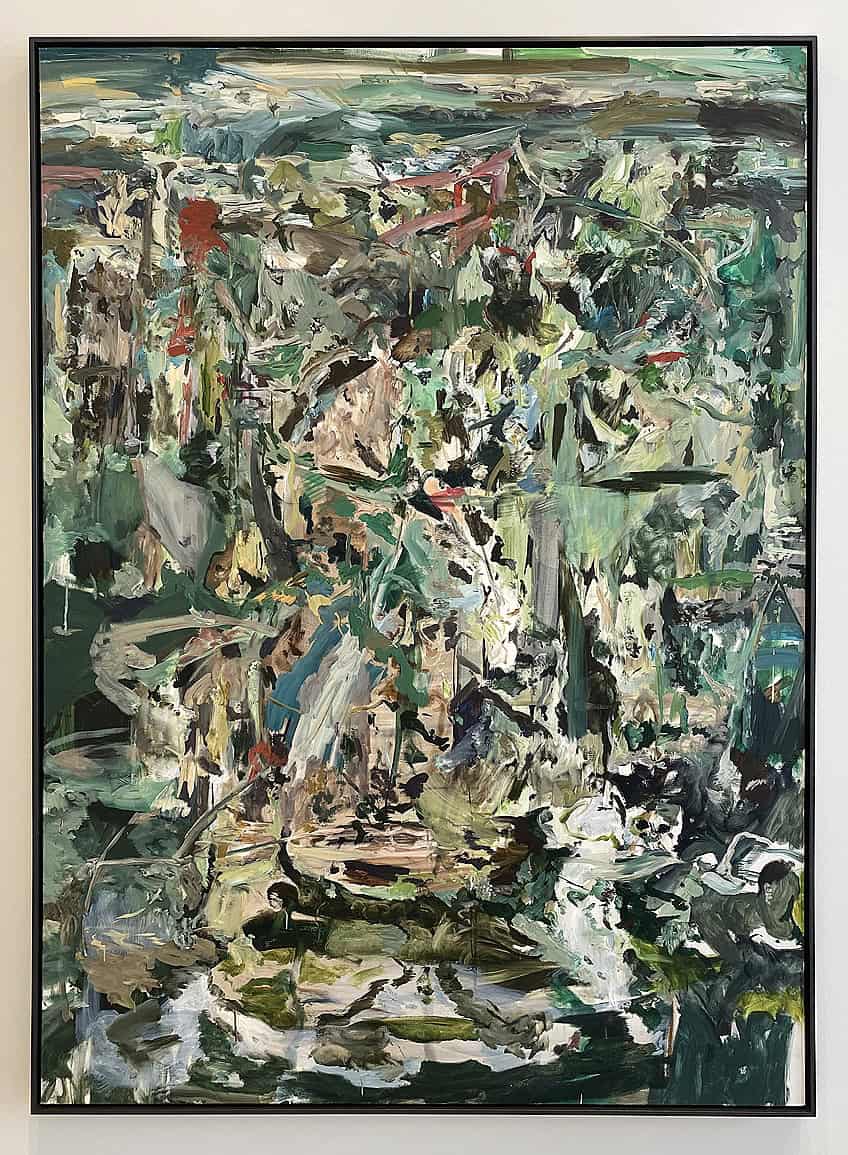
Most importantly, Brown makes uncertainty productive. A viewer cannot grasp one of her paintings in a glance and move on. Recognition remains provisional, and every return can uncover a different body, rhythm, or relationship. In an image-saturated culture that encourages instant comprehension, her art insists that looking is slower, stranger, and more alive.
Frequently Asked Questions
What Is Cecily Brown Best Known For?
She is best known for layered oil paintings in which bodies, landscapes, animals, and interiors emerge from energetic fields of color and brushwork.
Is Cecily Brown an Abstract or Figurative Painter?
Her work uses both modes. Recognizable forms appear and dissolve within abstract marks, making the shift between seeing an image and seeing paint central to the experience.
What Materials Does Cecily Brown Use?
Brown is primarily an oil painter. She also works with watercolor, gouache, ink, pastel, ballpoint pen, lithography, and monotype.
Where Does Cecily Brown Live and Work?
Born in London in 1969, Brown moved to New York in 1994 and continues to live and work there.
Cite this Article
artincontext, , “Cecily Brown – Biography, Art Style and Key Paintings.” Art in Context. September 24, 2026. URL: https://artincontext.org/cecily-brown/
, a. (2026, 24 September). Cecily Brown – Biography, Art Style and Key Paintings. Art in Context. https://artincontext.org/cecily-brown/
, artincontext. “Cecily Brown – Biography, Art Style and Key Paintings.” Art in Context, September 24, 2026. https://artincontext.org/cecily-brown/.


.jpg)
