


UK Blocks Export of Antico’s £4.6M Seated Nymph

The United Kingdom has deferred a decision on whether Antico’s Seated Nymph may leave the country, giving an appropriate domestic buyer until December 17, 2026, to come forward at a recommended £4.6 million; the bronze connects Mantuan court culture, more than 160 years of documented British collecting, and Antico’s repeatable casting practice.
What the Antico Export Bar Actually Does
The September 18 official notice does not permanently prohibit export, transfer ownership, or require a museum to buy the statuette. It pauses the export-license decision while an eligible UK purchaser has an opportunity to match the recommended price. That price is £4.6 million, plus VAT of £166,666.67.
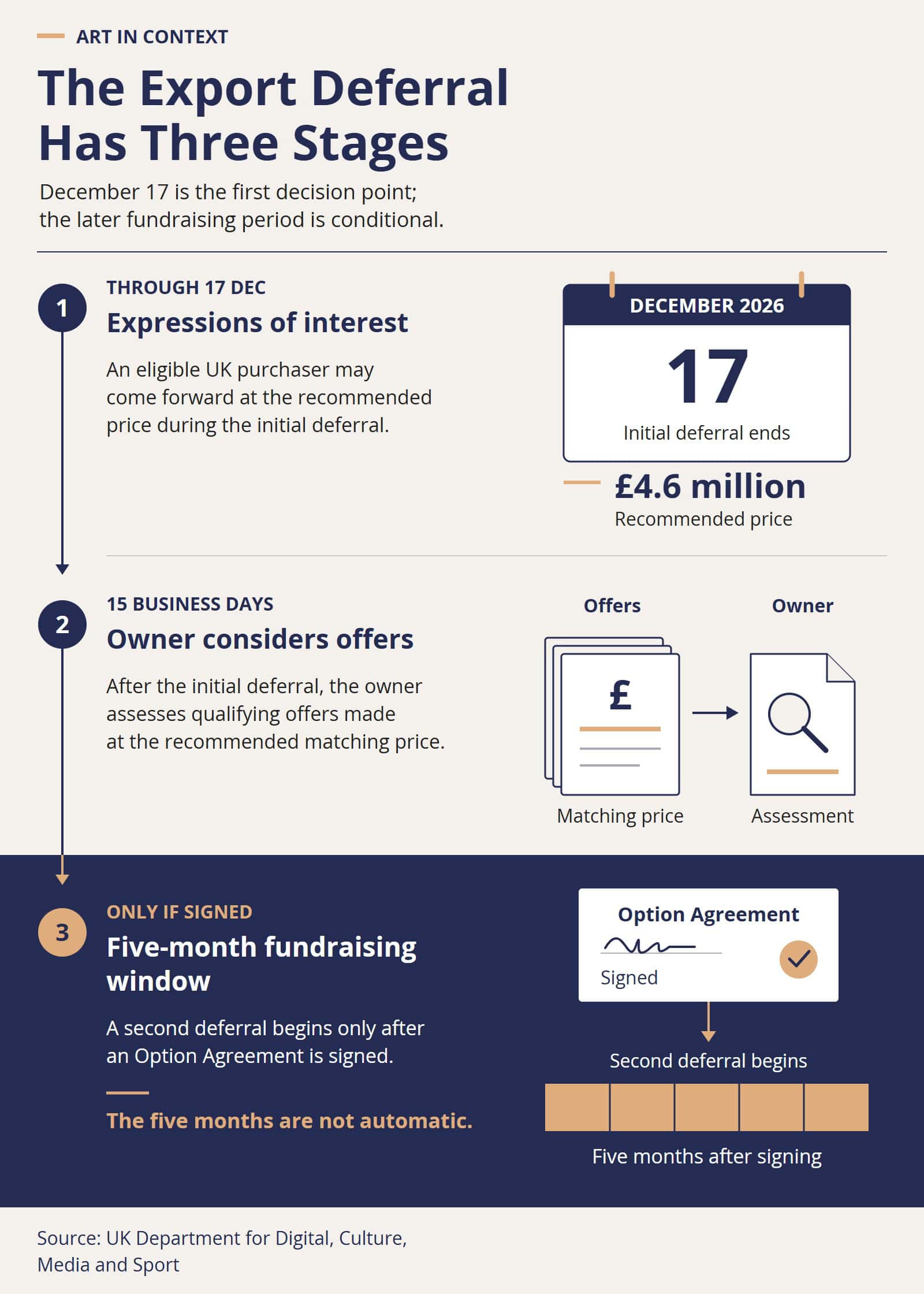
The timetable has three distinct stages. The five-month period sometimes described in coverage is conditional, not automatic.
| Stage | What happens |
|---|---|
| Initial deferral | Expressions of interest may be made through December 17, 2026, inclusive. |
| Owner’s consideration | The owner then has 15 business days to consider qualifying offers at the recommended price. |
| Second deferral | A five-month fundraising period starts only after an Option Agreement is signed. |
Under the UK government’s published explanation of the system, an Option Agreement gives the purchaser a contractual right to buy at the fair-market price if the necessary funds are available by the end of the second period. An appropriate purchaser can be a public institution or a private UK buyer that undertakes to provide reasonable public access, conservation, and security.
Recent cases involving a Rembrandt portrait under a second UK export bar and Stanley Spencer’s Resurrection diptych show why “bar” should be read as a timed licensing deferral, not confiscation.
A Handheld Bronze Whose Surface Records Its Use
Antico—Pier Jacopo Alari Bonacolsi—made the statuette in Mantua around 1503, although the government retains a question mark on that date. The figure is 19.5 centimeters high and 22 centimeters with its bronze base. Mercury gilding picks out the hair and drapery, while silver-inlaid eyes brighten the dark bronze. A tiara distinguishes this cast and supports, without proving, an identification as a goddess such as Venus.
Its scale matters. The government says the work was probably intended to be held and turned, allowing its finish to be examined from several angles. The 2009 Sotheby’s catalogue and condition report add physical evidence: wear is concentrated on exposed gilded surfaces, and the report attributed much of it to handling.
X-rays showed a solid-cast head joined in wax to a hollow torso and rock seat before casting. X-ray fluorescence identified a copper-rich bronze alloy and confirmed mercury in the gilded areas. The missing toes on the left foot may reflect an original casting failure; the condition report proposed that separately cast toes were attached during manufacture and later lost. These are not incidental defects. They make the object evidence for Antico’s workshop decisions, which helps explain why the export committee treated it as significant for scholarship as well as appearance.
A Provenance with a Firm British Half and a Hypothetical Italian Half
The official provenance does not establish a single unbroken line back to 1503. It offers alternatives. The bronze may have belonged to Isabella d’Este and remained with the Este family in 1684. It may instead relate to the crossed-leg metal figure in Gianfrancesco Gonzaga’s 1496 inventory, or have belonged to Bishop Ludovico Gonzaga or another Gonzaga. Only under that latter chain is a passage through Charles I’s collection and the Commonwealth sales proposed.
The British record is firmer but still has a soft edge. The government places the work with the Dukes of Bedford by 1861 and suggests that the 6th Duke or an ancestor probably acquired it. Sotheby’s 2009 catalogue offered the broader proposed window of about 1730 to 1830. The change in phrasing matters: a plausible Grand Tour acquisition is not the same as a documented purchase.
The Bedford Estates sold the bronze at Sotheby’s on December 8, 2009. The Art Newspaper reported that it realized £1.4 million with fees and was bought by dealer Alan Hobart. The government confirms that the current owner acquired it from Patricia Wengraf Ltd. in April 2026; The Art Newspaper reports that transaction at £4.6 million.
Measured against the reported 2009 total, £4.6 million is £3.2 million higher, a nominal increase of about 229 percent. That comparison is a chronology, not an investment return: the 2009 number includes auction fees, the later figure comes from a reported private sale, and it does not account for inflation, taxes, insurance, conservation, or dealer costs.

Woburn Abbey, the Bedford family seat; photograph by Poliphilo via Wikimedia Commons, CC0 1.0.
Why the Washington Cast Strengthens the Scholarship Case
The committee found that Seated Nymph met Waverley criterion two, outstanding aesthetic importance, and criterion three, outstanding significance for study. It did not cite criterion one, close connection with British history and national life. The distinction is revealing: the bronze’s long Bedford history supports research value, but the official national-importance finding rests on aesthetics and scholarship rather than British origin.
A closely related cast in the National Gallery of Art, Washington, makes that scholarship concrete. The Washington figure is 19 centimeters high without its plinth and 22 centimeters with it, and likewise combines mercury-gilded hair and drapery with silvered eyes. Its collection record dates it to 1503.
Sotheby’s catalogue argued in 2009 that the Bedford and then–Robert H. Smith bronzes were the two casts securely attributable to Antico himself. They share size and form but not an identical head: the Bedford figure wears a tiara, whereas the Washington cast has a classical hair knot. That combination of repetition and alteration is evidence for how Antico reused models rather than simply making duplicates.
The catalogue also connected the pose to the ancient “Sandalbinder” marble in the Uffizi. The Uffizi dates its Roman version to the second century A.D. and says it derives from a late Hellenistic prototype; many visible parts, including the head, feet, and right hand, are modern restorations. The comparison is therefore strongest at the level of crossed legs, twisting torso, and drapery—not as a claim that Antico copied every surviving detail.

Roman Seated Nymph, second century A.D., Uffizi; photograph by Armin Kleiner via Wikimedia Commons, Creative Commons Attribution-Share Alike 4.0 International.
December 17 Is the First Decision Point, Not the Last
The official record establishes an initial deadline of December 17, followed by 15 business days for the owner and a five-month second period only if an Option Agreement is signed. It also establishes that the committee relied on aesthetic and scholarly significance, not the British-history criterion.
The bronze is documented with the Dukes of Bedford by 1861 and was sold from the Bedford Estates in 2009; its proposed Gonzaga, Este, Isabella d’Este, and Charles I connections remain alternative possibilities. The reported £1.4 million 2009 result and £4.6 million 2026 private-sale price come from The Art Newspaper, while the government independently confirms the 2026 dealer and date and sets £4.6 million as the recommended matching price.
No UK purchaser or fundraising campaign has been announced. The owner and intended export destination are not identified in the government notice, and whether the work will enter a publicly accessible British collection remains unresolved.

Isabella studied at the University of Cape Town in South Africa and graduated with a Bachelor of Arts majoring in English Literature & Language and Psychology. Throughout her undergraduate years, she took Art History as an additional subject and absolutely loved it. Building on from her art history knowledge that began in high school, art has always been a particular area of fascination for her. From learning about artworks previously unknown to her, or sharpening her existing understanding of specific works, the ability to continue learning within this interesting sphere excites her greatly.
Her focal points of interest in art history encompass profiling specific artists and art movements, as it is these areas where she is able to really dig deep into the rich narrative of the art world. Additionally, she particularly enjoys exploring the different artistic styles of the 20th century, as well as the important impact that female artists have had on the development of art history.
Learn more about Isabella Meyer and the Art in Context Team.
Choose Art in Context as a preferred source to see more of our reporting in Google Top Stories and other Google Search experiences.
Cite this Article
Isabella, Meyer, “UK Blocks Export of Antico’s £4.6M Seated Nymph.” Art in Context. September 21, 2026. URL: https://artincontext.org/antico-seated-nymph-uk-export-bar/
Meyer, I. (2026, 21 September). UK Blocks Export of Antico’s £4.6M Seated Nymph. Art in Context. https://artincontext.org/antico-seated-nymph-uk-export-bar/
Meyer, Isabella. “UK Blocks Export of Antico’s £4.6M Seated Nymph.” Art in Context, September 21, 2026. https://artincontext.org/antico-seated-nymph-uk-export-bar/.


