

Manifesta 16 Ruhr Drew 185,855 Visits—What Will Remain?

Manifesta 16 Ruhr recorded 185,855 visits to its 12 principal church venues before closing on October 4, nearly 86 percent above the advance forecast. The turnout is clear; the legacy is not. Only a small number of projects have named futures, while several exhibition churches are empty again and one is expected to be demolished.
What the 185,855 Figure Actually Counts
The European nomadic biennial ran for 106 days, from June 21 through October 4, across Duisburg, Essen, Gelsenkirchen, and Bochum. Its curators treated former or underused postwar churches as places for contemporary art and neighborhood activity rather than as neutral exhibition halls.
The Regionalverband Ruhr’s closing release, issued after the October 8 final press conference, reports 185,855 visits at the 12 principal venues. It separately records about 9,000 participations in Manifesta 16+, the locally organized program of 16 projects in 10 Ruhr cities. Adding those two disclosed categories produces roughly 194,855 visits or participations, which closely explains the headline claim of “around 200,000.”
| Measure | Reported result |
|---|---|
| Principal venues | 185,855 visits |
| Advance forecast | About 100,000 |
| Above forecast | About 86% |
| Manifesta 16+ | About 9,000 participations |
| Combined disclosed total | About 194,855 |
That distinction matters. Manifesta itself described its mid-August milestone as “visits,” and neither closing release publishes a method for identifying repeat attendance across free venues. The result is therefore best read as footfall, not as proof that 185,855 different people attended. The approximately 200,000 headline is a defensible rounded total, but it combines two categories rather than supplying a second exact count.
The City of Gelsenkirchen supplies the missing comparison with the original estimate: organizers had expected about 100,000 visitors. It also reports 61,560 visits to that city’s four principal sites, almost exactly one-third of the biennial total. St. Bonifatius, home of the Ferdane Satır Tea Garden, led them with 23,157 visits.

Kulturkirche Liebfrauen in Duisburg, one of Manifesta 16 Ruhr’s principal venues. Photograph by Fred Romero, hosted by Wikimedia Commons, licensed under the Creative Commons Attribution 2.0 Generic license; cropped.
Two Named Continuations, but No Acquisition List
Manifesta’s strongest projects used the churches as material, subject, and social setting. The result sat between installation art, commissioned production, and community infrastructure: a tea garden occupied St. Bonifatius, Penique Productions turned the interior of St. Josef blue, and a weaving school and migrant-memory displays reshaped the Thomaskirche.
The most definite continuation is the Ferdane Satır Tea Garden. The RVR says the mobile garden will become part of the IGA 2027 Future Garden at Nordsternpark in Gelsenkirchen. That is a relocation with a named destination, not a permanent conversion of St. Bonifatius.
A second project has money and an existing host. Go(o)d Kitchen, organized by the Oberhausen food bank and kitev in the Heilige Familie church, combined cooking, performance, and a modular structure built in workshops. The Kaleidoskop cultural-diversity prize awarded the initiative €50,000, and WDR reports that the group will continue its work.
The broader claim about art is less specific. The RVR says that some specially commissioned works will remain at their sites or continue, and that some works will be acquired by or donated to museums and local institutions. But the release names no artwork, artist, receiving institution, transfer date, or accession record. That does not show that no transfers are happening; it means the closing announcement cannot yet be treated as a verifiable acquisition list.
This gap is especially important because the event’s social popularity and its artistic judgment are different questions. In WDR’s closing report, former Kunsthalle Recklinghausen director Ferdinand Ullrich praised the intentions but argued that the art itself was weak. The announced afterlives include the Ferdane Satır Tea Garden, Go(o)d Kitchen, and St. Martin’s NEBENAN project, whose organizers have scheduled a January 2027 planning meeting while seeking further funding. They do not yet establish which new artworks will enter Ruhr collections.

The former Heilige Familie church in Oberhausen, photographed by SilvioMartin. CC BY-SA 4.0, via Wikimedia Commons.
The Church-Reuse Test Is Still Unfinished
The institutional promise is longer-term. The RVR says it will work with church organizations over the coming years on a political and strategic framework for disused church buildings. Gelsenkirchen’s release adds a concrete staffing detail absent from the broader announcement: the RVR has created a new half-time position for that work.
That commitment is real, but it is not the same as securing new uses for the 12 venues. WDR found that many of the churches were empty again after the biennial. It also reported that St. Marien in Essen-Karnap is slated for demolition because its leaking roof is considered uneconomical to repair.
St. Marien was not a peripheral rental. Manifesta’s own venue record lists 10 participants there, including Katharina Fritsch, Alicja Kwade, SUPERFLEX, Jason Dodge, and Annika Kahrs. Its threatened loss therefore sharpens the central result: temporary access allowed substantial art to inhabit the building, but the exhibition did not reverse the building’s underlying condition or determine its future.
A biennial can test a use without delivering the capital, ownership agreement, maintenance plan, or operator needed to sustain it. Manifesta demonstrated public use of art and community programs in these neighborhood churches; the attendance total establishes that much. The next measure is not another visit count but whether named works enter public collections and whether named buildings gain funded operators.
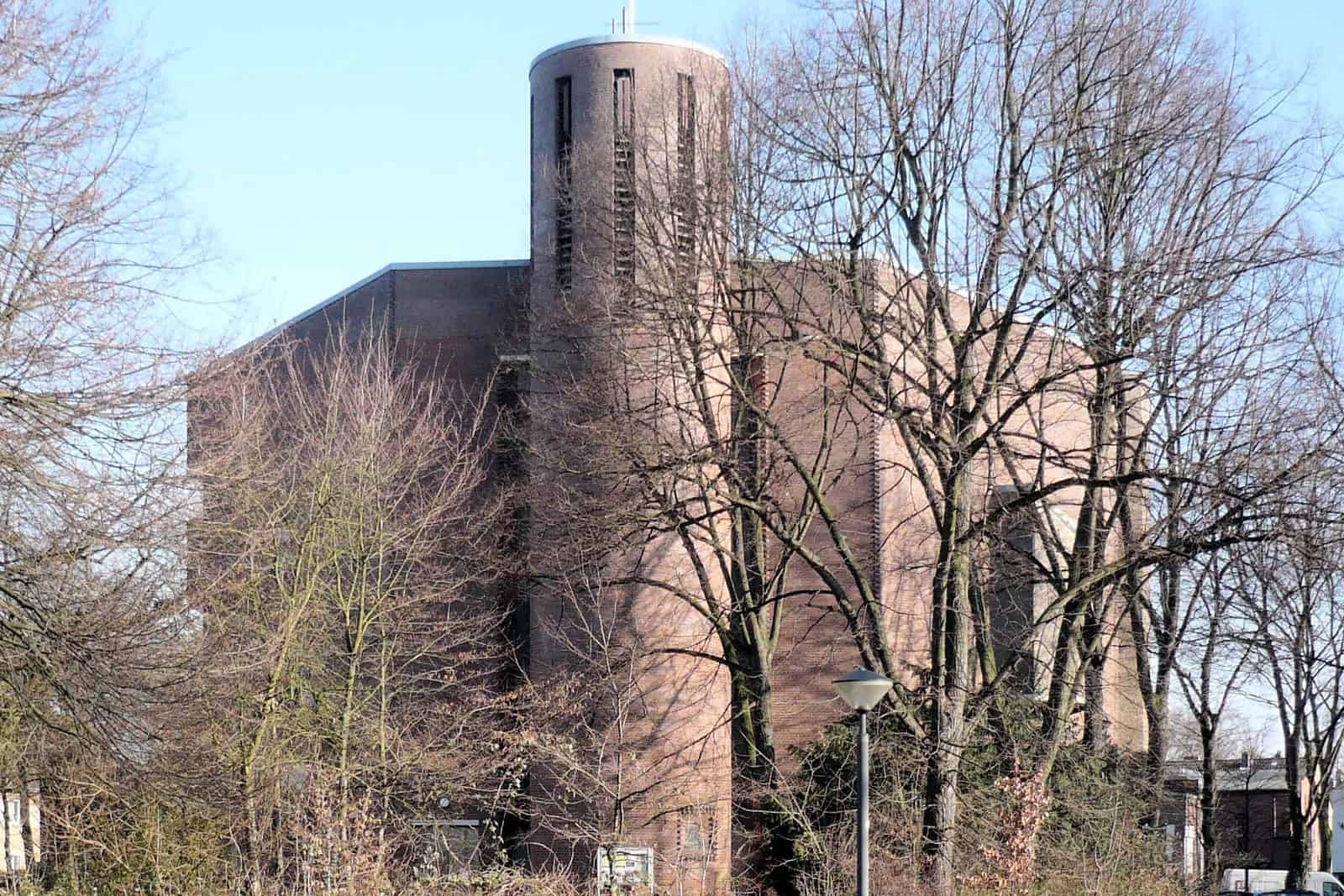
St. Marien in Essen-Karnap, photographed in 2009 by Wiki05. Hosted by Wikimedia Commons and released into the public domain.
What the Closing Record Establishes
The 185,855 principal-site figure is about 86 percent above the advance estimate of 100,000, while the “around 200,000” claim is a rounded combination of principal-site visits and roughly 9,000 Manifesta 16+ participations.
The Ferdane Satır Tea Garden has a named next location at IGA 2027, and Go(o)d Kitchen has a €50,000 award and a reported continuation.
The RVR and Gelsenkirchen closing releases do not identify the works or institutions behind the announced acquisitions and donations, leaving those transfers unspecified in those two records.
The RVR has promised a regional strategy and assigned a half-time post, but WDR’s site reporting shows that several churches are empty again and St. Marien is still expected to be demolished.

Isabella studied at the University of Cape Town in South Africa and graduated with a Bachelor of Arts majoring in English Literature & Language and Psychology. Throughout her undergraduate years, she took Art History as an additional subject and absolutely loved it. Building on from her art history knowledge that began in high school, art has always been a particular area of fascination for her. From learning about artworks previously unknown to her, or sharpening her existing understanding of specific works, the ability to continue learning within this interesting sphere excites her greatly.
Her focal points of interest in art history encompass profiling specific artists and art movements, as it is these areas where she is able to really dig deep into the rich narrative of the art world. Additionally, she particularly enjoys exploring the different artistic styles of the 20th century, as well as the important impact that female artists have had on the development of art history.
Learn more about Isabella Meyer and the Art in Context Team.
Choose Art in Context as a preferred source to see more of our reporting in Google Top Stories and other Google Search experiences.
Cite this Article
Isabella, Meyer, “Manifesta 16 Ruhr Drew 185,855 Visits—What Will Remain?.” Art in Context. October 11, 2026. URL: https://artincontext.org/manifesta-16-ruhr-185855-visits-legacy/
Meyer, I. (2026, 11 October). Manifesta 16 Ruhr Drew 185,855 Visits—What Will Remain?. Art in Context. https://artincontext.org/manifesta-16-ruhr-185855-visits-legacy/
Meyer, Isabella. “Manifesta 16 Ruhr Drew 185,855 Visits—What Will Remain?.” Art in Context, October 11, 2026. https://artincontext.org/manifesta-16-ruhr-185855-visits-legacy/.


