
Collage Art – History, Techniques, and Key Artists

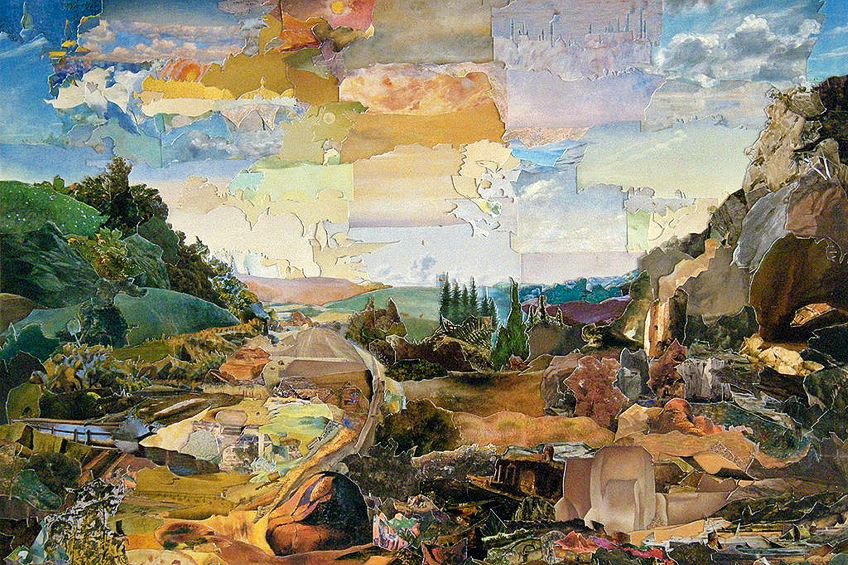
Collage is both a technique and the artwork produced by it: fragments of paper, photographs, fabric, printed matter, or other materials are arranged and attached to a supporting surface. The process is much older than Modernism, but Pablo Picasso and Georges Braque transformed it in 1912 by bringing mass-produced materials into Cubist art. Dada, Surrealism, Pop Art, feminist practice, and digital image-making later expanded its uses.
The History of Collage Art: An Introduction
Collage became a decisive Modernist practice in the early 20th century. It is not synonymous with assemblage, a related term generally used for three-dimensional constructions. Nor is collage one unified movement. It is a transferable method that artists have used within Cubism, Dada, Surrealism, Constructivism, Pop Art, and many later practices.
The word comes from the French verb coller, meaning “to glue.” Cubist artists Pablo Picasso and Georges Braque established collage as a radical modern-art method through an intense exchange in 1912. They were not the first artists to combine materials, but they made the collision between represented objects and real manufactured fragments central to a new pictorial language.
In May 1912, Picasso attached chair-caning-patterned oilcloth and a rope frame to Still Life with Chair Caning, often identified as the first Cubist collage. In September, Braque made Fruit Dish and Glass, the first Cubist papier collé, by pasting imitation wood-grain paper into a charcoal composition. Picasso soon added newsprint and other fragments to drawings and oil paintings. Their different approaches developed through dialogue rather than a simple sequence of one artist following the other.
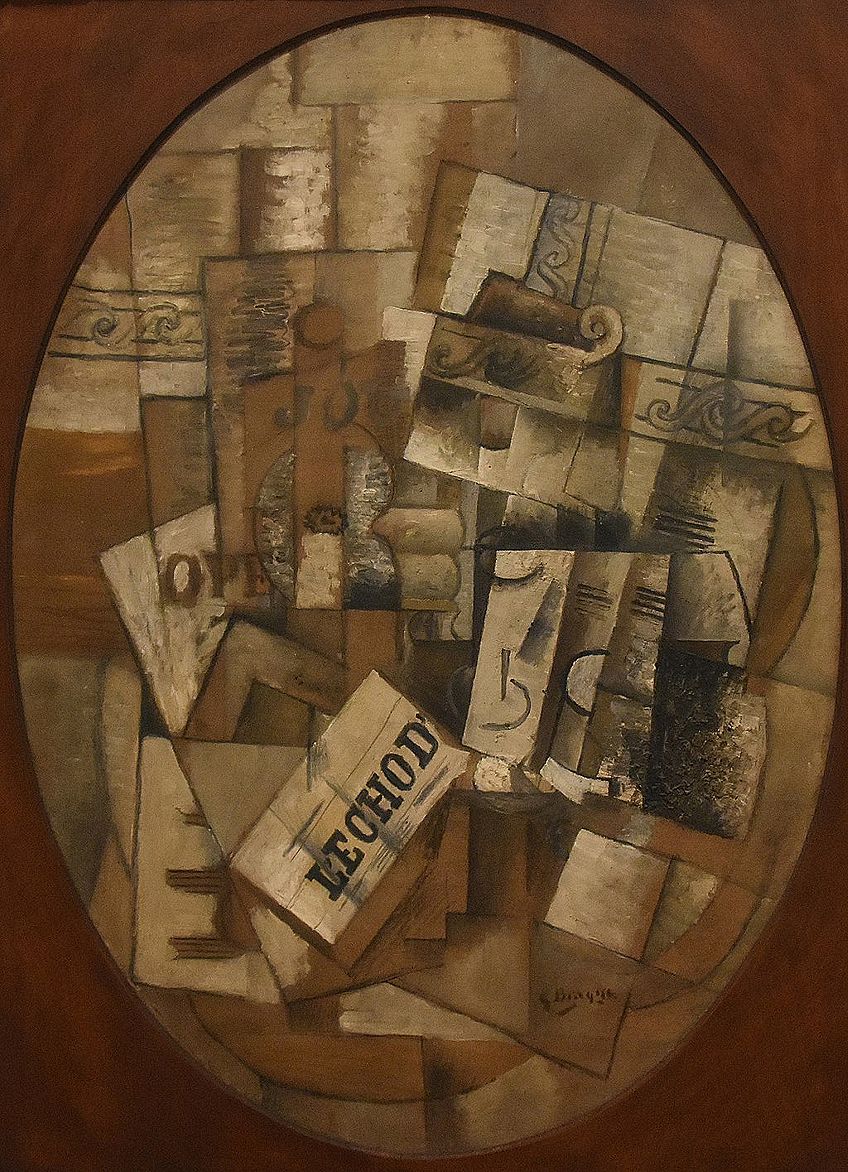
Paper, cloth, paint, labels, tickets, magazine and newspaper clippings, photographs, and found objects can all enter a collage. A fragment carries traces of its former use while gaining new visual and conceptual relations. That double identity—what the material was and what it now does—made collage especially important to modern art.
Collage can be mixed media, but the terms are not interchangeable. A mixed-media work combines more than one medium; a collage specifically organizes attached fragments on a support. By placing commercial print beside drawing or painting, artists could disrupt the hierarchy between fine art and mass culture while exposing how images circulate.
Collage preceded Dada, but Dadaists transformed it during and after the First World War. Newsprint, magazines, tickets, advertisements, propaganda, and photographs supplied both material and social evidence. Cutting and recombining them could interrupt official messages, ridicule authority, or register a culture experienced as fragmented.
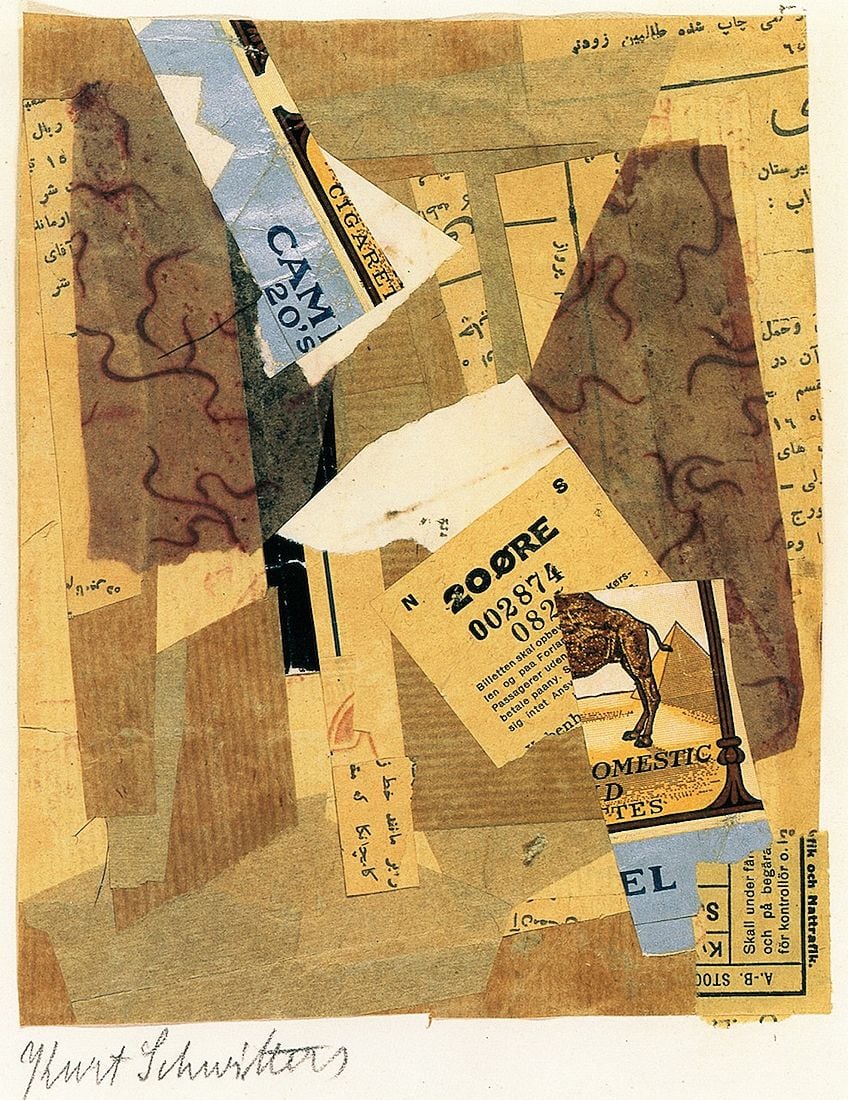
Attaching ordinary matter to art challenged the separation between fine art and daily life. Juxtaposition can be carefully composed, generated through chance, or revised through both processes. Meaning comes from selection, cropping, scale, concealment, overlap, and the new relationships formed between fragments.
Because an image can change meaning when removed from one setting and placed in another, collage supports ambiguity, satire, memory, and layered narrative. The tools can be inexpensive and accessible, yet responsible use still requires attention to source, attribution, copyright, and the cultural implications of recontextualizing other people’s images.
Modern and contemporary artists have used found and mass-produced material to question originality and the artist’s hand. However, collage does not eliminate authorship: choosing, cutting, ordering, attaching, and framing fragments are creative decisions, and their source histories remain part of the work.
Collage creates meaning through the encounter between fragments—their original histories, their physical edges, and their new context.
Collage Art Influences and Style
Collage has several closely related forms. Papier collé means pasted paper and usually describes paper fragments integrated with drawing or painting. Photomontage constructs an image primarily from photographs or photographic reproductions. Decoupage decorates an object or surface with cut paper, often under layers of varnish. Assemblage extends the logic of juxtaposition into three dimensions. These categories overlap, but distinguishing them helps explain how artists use different materials, surfaces, and kinds of illusion.
Precursors of Collage Art
Processes resembling collage existed long before the term acquired its modern artistic meaning. In Heian-period Japan, calligraphers wrote poetry on sheets assembled and decorated from colored or marbled papers. European devotional objects, albums, and decorative arts also combined materials, although applying gold leaf or gemstones in Gothic cathedrals is more accurately described as gilding or inlay than collage.
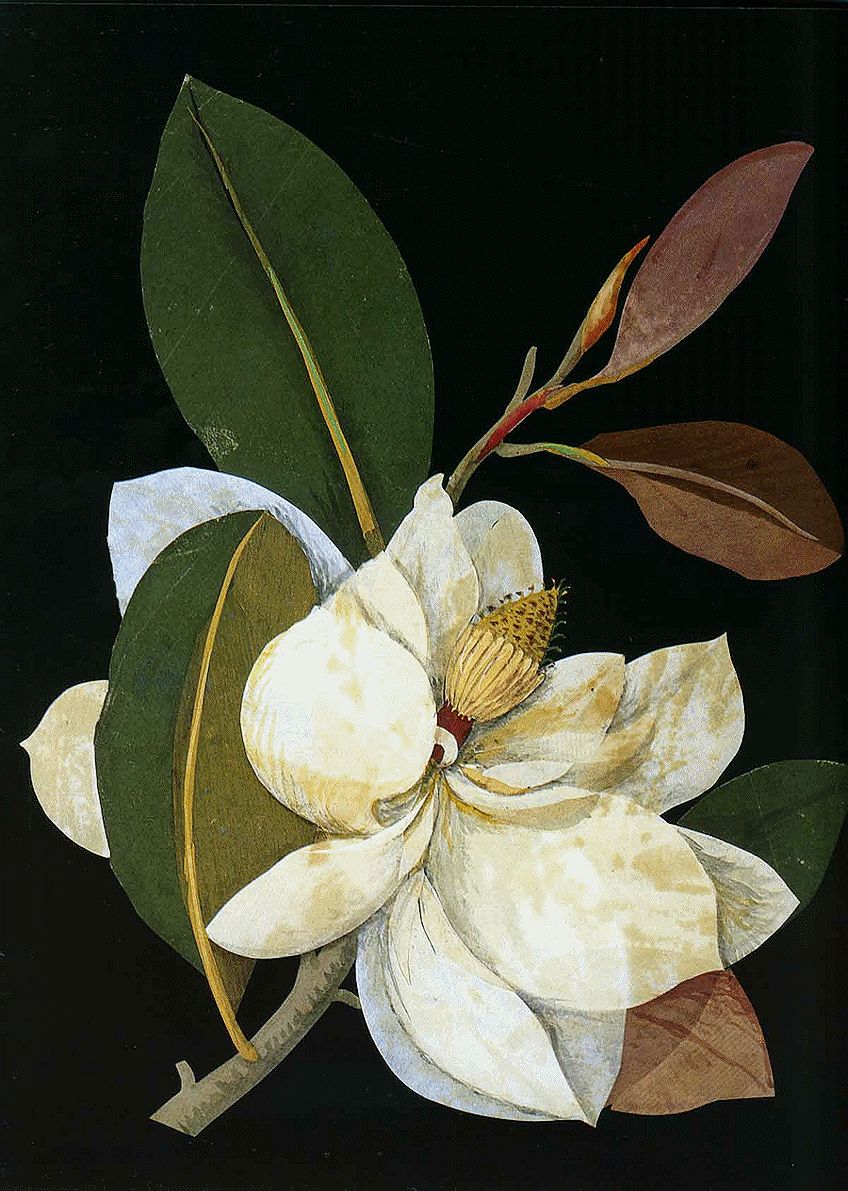
In 1772, Mary Delany began making what she called paper mosaics: exceptionally precise botanical compositions built from cut colored papers. Nineteenth-century scrapbooks and photographic albums later mixed prints, drawings, captions, and ornament in inventive page designs. Such precedents show a long history of cutting and combination. Art histories nevertheless conventionally begin the story of modern collage in 1912, because Picasso and Braque made the pasted fragment a deliberate challenge to pictorial representation and artistic value.
Associated Movements
Collage moved between movements rather than developing as a single style. Cubism used pasted papers to test the relationship between reality and representation. Dada turned mass media into antiwar, political, and satirical material. Surrealism exploited unexpected combinations to disturb ordinary logic. Neo-Dada and the Pop Art movement later revisited consumer packaging, celebrity imagery, comic strips, and advertising. The same basic operations—selection, cutting, displacement, and recombination—served very different purposes.
Cubism
In its modern-art sense, collage emerged through the work of Cubist painters Georges Braque and Pablo Picasso. Their pasted materials were not simply unrelated fragments chosen for disorder. Newspaper, wallpaper, labels, and imitation surfaces operated as signs: a wood-grain paper could stand for a table while remaining visibly flat, manufactured paper. This tension between what a fragment depicts and what it physically is became central to Cubist collage.

Rather than making pictures less flat, Cubist collage often emphasized the literal flatness of the support. A pasted rectangle sits materially on the sheet even as its pattern suggests wood, print, or another object. Drawing may continue across it, turning a physical edge into a contour within the represented scene. The viewer must alternate between seeing a constructed still life and recognizing the ordinary pieces from which it is made.
Common Cubist materials included painted cut-outs, patterned papers, packaging, and newsprint. In Picasso’s 1913 Bottle of Vieux Marc, Glass, Guitar and Newspaper, printed fragments intersect with drawn forms. Braque’s 1913 Violin and Pipe similarly uses pasted paper and charcoal to make still-life objects emerge through partial clues. Text and pattern are not decoration alone: they establish scale, place, texture, and competing levels of reality.
Dadaism
Dada emerged in Zurich in 1916 during the First World War and quickly developed in several cities. Its artists adopted collage but expanded its materials and political force. In Zurich, torn papers and chance procedures tested conventional composition. In Berlin, photomontage cut photographs and typography from the illustrated press into fractured images of politicians, machines, military figures, and modern urban life.
Dada’s international networks were shaped by war, exile, nationalism, and distrust of the values associated with European institutions. Hans Arp was a founding participant at Zurich’s Cabaret Voltaire and explored torn paper, simplified forms, and what he called the laws of chance. Berlin artists such as Hannah Höch and Raoul Hausmann drew on a particularly dense illustrated-media culture. Their approaches differed, so “Dada collage” names a field of experiments rather than one recognizable look.
Dadaists used magazine clippings, advertisements, tickets, wrappers, typography, and discarded matter, sometimes combining collage with relief and assemblage. The commercial origins of these fragments were important: a newspaper photograph carried the authority and bias of mass communication even after it was cut apart. By treating cheap, temporary material as art, Dada challenged permanence, craftsmanship, and institutional definitions of value.
Surrealism
Surrealists used collage to make ordinary images behave strangely. Fragments drawn from catalogs, popular illustrations, scientific diagrams, and photographs could be joined with such visual continuity that an impossible scene initially appeared plausible. The resulting shock came from recontextualization: familiar objects acquired erotic, comic, threatening, or dreamlike associations when their expected scale and setting disappeared.
Illustrations, photographs, colored paper, and paint enabled seemingly coherent but imaginary environments. Joseph Cornell extended collage into intimate box constructions, arranging maps, reproductions, glass, and small found objects into poetic networks of memory and desire. His work demonstrates why assemblage and collage are related, even though one projects into three-dimensional space.
Photocollage, overpainting, assemblage, and combinations of image and text all entered the vocabulary of Surrealist artists. Max Ernst made collages from nineteenth-century engravings and used this method for collage novels, including La Femme 100 têtes (1929). Careful joins make separate source images read as one scene while their mismatched logic remains unsettling.
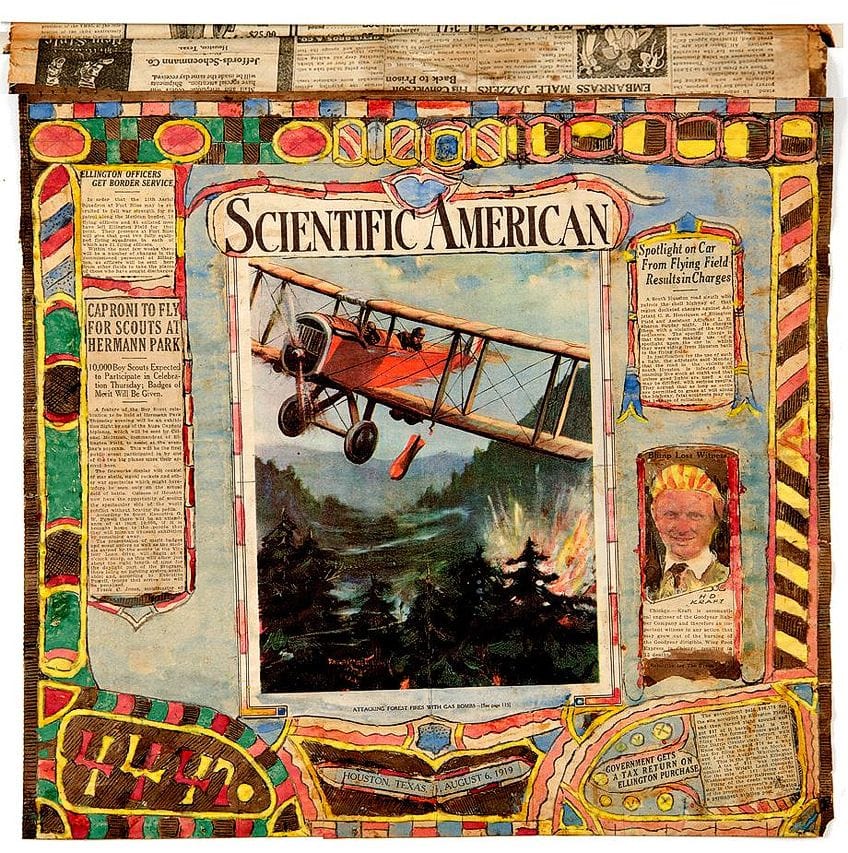
Charles Dellschau’s illustrated notebooks sit outside the formal Surrealist movement but show how drawing, watercolor, clippings, and invented narratives can produce comparable effects. Such boundary cases are useful reminders that collage practices also developed in vernacular, self-taught, and private forms beyond avant-garde groups.
Collage as Commentary
Collage can turn an existing image into commentary because context is never neutral. A glamorous advertisement can become critical when placed beside evidence of labor or war; an official portrait can lose authority when cropped, enlarged, or fused with machinery. The fragment brings prior associations into the artwork, while its new neighbors redirect them.
In contemporary art, artists continue to use print, photographs, textiles, packaging, metal, and digital files. Painting has always been capable of criticism, but collage offers a distinctive rhetorical device: it can quote the visual culture under examination directly. That quotation may be obvious through torn edges or disguised through seamless editing.
This power also creates responsibilities. Source images may contain stereotypes, record trauma, or belong to communities whose context should not be erased. Copyright may restrict copying even when a work is transformed, and rules vary by jurisdiction. Strong critical collage therefore depends not only on visual contrast but also on informed selection, accurate attribution, and a defensible reason for reusing each fragment.
Notable Collage Artists and Their Collage Examples
Because collage crosses movements, no short list can represent its full range. The artists below show several pivotal uses of the method: Cubist experiments with representation, Dada strategies of chance and mass-media critique, and Matisse’s late transformation of painted paper. Their works also show that a collage may be meticulously planned even when it looks spontaneous.
Henri Matisse (1869 – 1954)
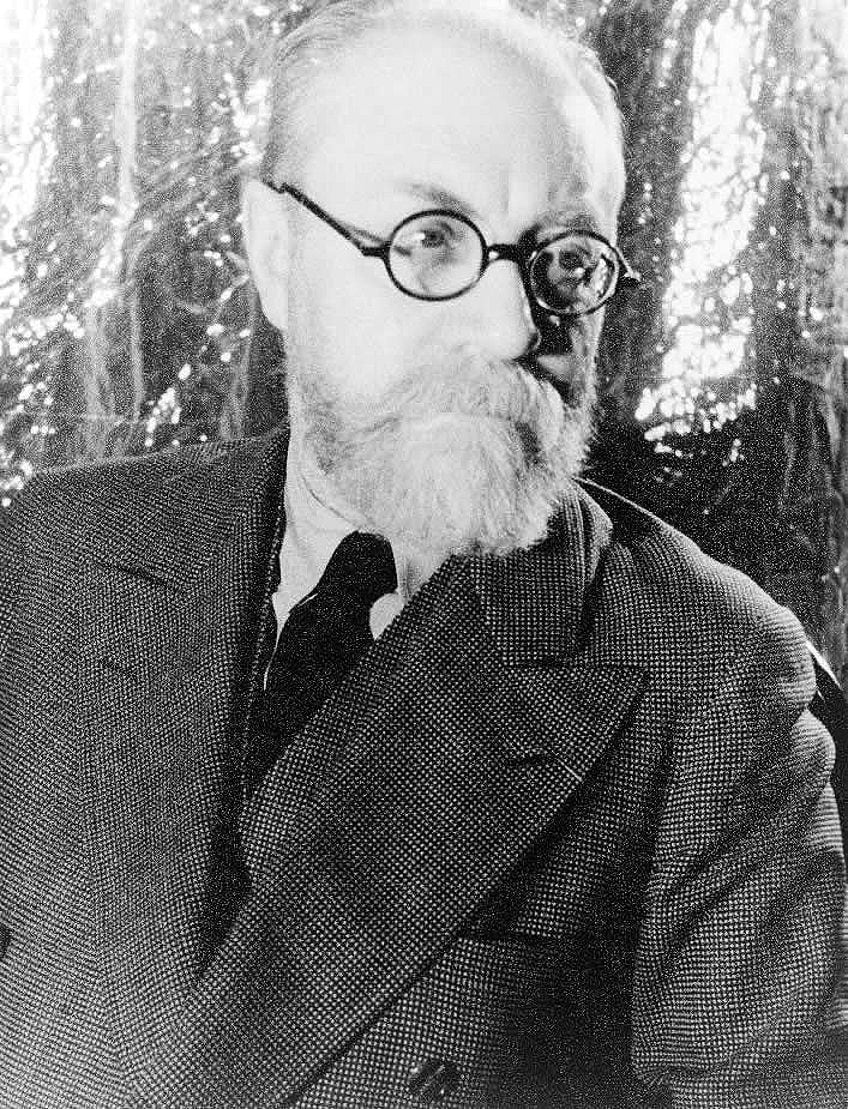
Henri Matisse made cut paper central to the final phase of his career. The method grew from his experiments during the 1930s and became especially important in the 1940s, when illness restricted his mobility. Studio assistants brushed large sheets with opaque gouache paint. Matisse then cut directly into the colored paper with scissors, describing the process as drawing with scissors.
Assistants pinned the shapes to walls under Matisse’s direction, allowing him to reposition them repeatedly before a final arrangement was mounted and glued. Botanical forms, animals, human figures, stars, and abstract signs became rhythmic fields of intense color. Some compositions expanded across whole walls, loosening the boundary between an easel picture, a mural, and an architectural environment.
One late example is The Sheaf, a 1953 cut-paper maquette made from gouache-painted papers arranged on white paper. Its branching colored forms suggest leaves, fronds, or a burst of energy without becoming a literal botanical study. The maquette served as the design for a ceramic-tile panel, demonstrating how the cut-out could function both as an autonomous collage and as a model for another medium.
Matisse’s cut-outs make flatness active rather than trying to hide it. Positive shapes and the empty spaces between them exchange roles; overlaps imply depth while crisp edges keep the surface legible. This economical method gave him a new way to explore the illusion of depth within art, movement, and scale through color alone.
Pablo Picasso (1881 – 1973)
Pablo Picasso and Georges Braque developed Cubist collage through close exchange in 1912. Picasso’s experiments incorporated printed oilcloth, rope, newspaper, wallpaper, labels, and cut papers. These materials did not merely imitate objects: their physical presence complicated the difference between a painted representation and an actual manufactured thing.
Picasso’s Still Life with Chair Caning (1912) is generally described as the first Cubist collage. The oval composition compresses clues to a café still life, including a glass, knife, fruit, and the letters “JOU.” Instead of painting every element, Picasso attached oilcloth printed with a chair-caning pattern and encircled the work with rope.
The printed pattern can be read as the seat of a café chair, as a material beneath objects on a tabletop, or simply as commercial oilcloth. The rope simultaneously acts as a real object, a frame, and a possible reference to a table’s carved edge. Those unstable readings are the work’s point: no single illusion fully resolves the fragments.
“JOU” may begin the French word journal, refer to the newspaper Le Journal, or activate the verb jouer, “to play.” Wordplay, material substitution, and visual ambiguity push the viewer beyond a purely formalist reading. Picasso’s later constructions and collages continued to mix studio media with commonplace materials, shaping later debates about authorship, value, and high and popular culture.
Georges Braque (1882 – 1963)
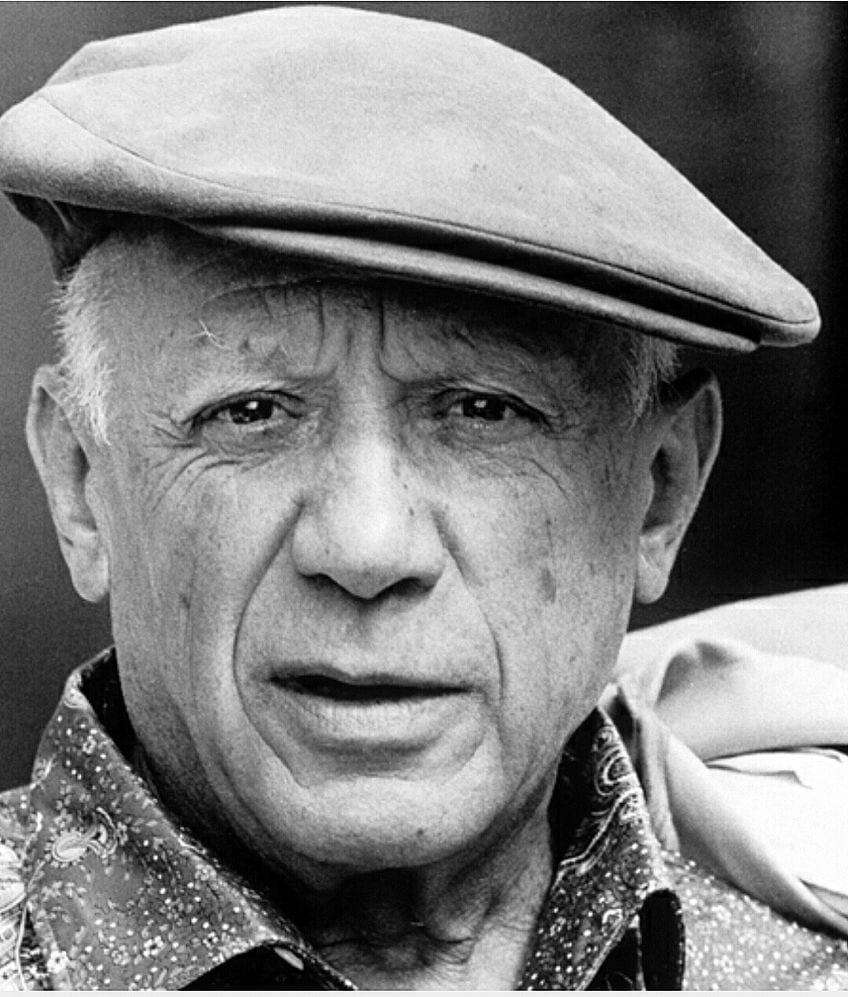
Georges Braque was the other central pioneer of Cubist collage. In September 1912, while staying at Sorgues, he bought imitation wood-grain wallpaper and cut it into shapes for Fruit Dish and Glass. He called works of this type papiers collés. Braque shared the development with Picasso, who responded with further pasted-paper experiments; the exchange was reciprocal rather than a simple story of one inventor and one follower.
In Fruit Dish and Glass, charcoal lines pass over and around three pieces of faux-bois wallpaper. Curving contours and abbreviated marks allow a glass, grapes, a dish, and a table to emerge, while the patterned paper remains obviously cut and pasted. Instead of restoring conventional perspective, the real wallpaper makes pictorial space more paradoxical.
Braque’s cut papers create a shallow, layered space in which no element has only one role. A strip can be background, tabletop, wall paneling, or flat paper, depending on the marks around it. This flexible relationship between material fact and depicted form became one of collage’s most durable contributions to twentieth-century art.
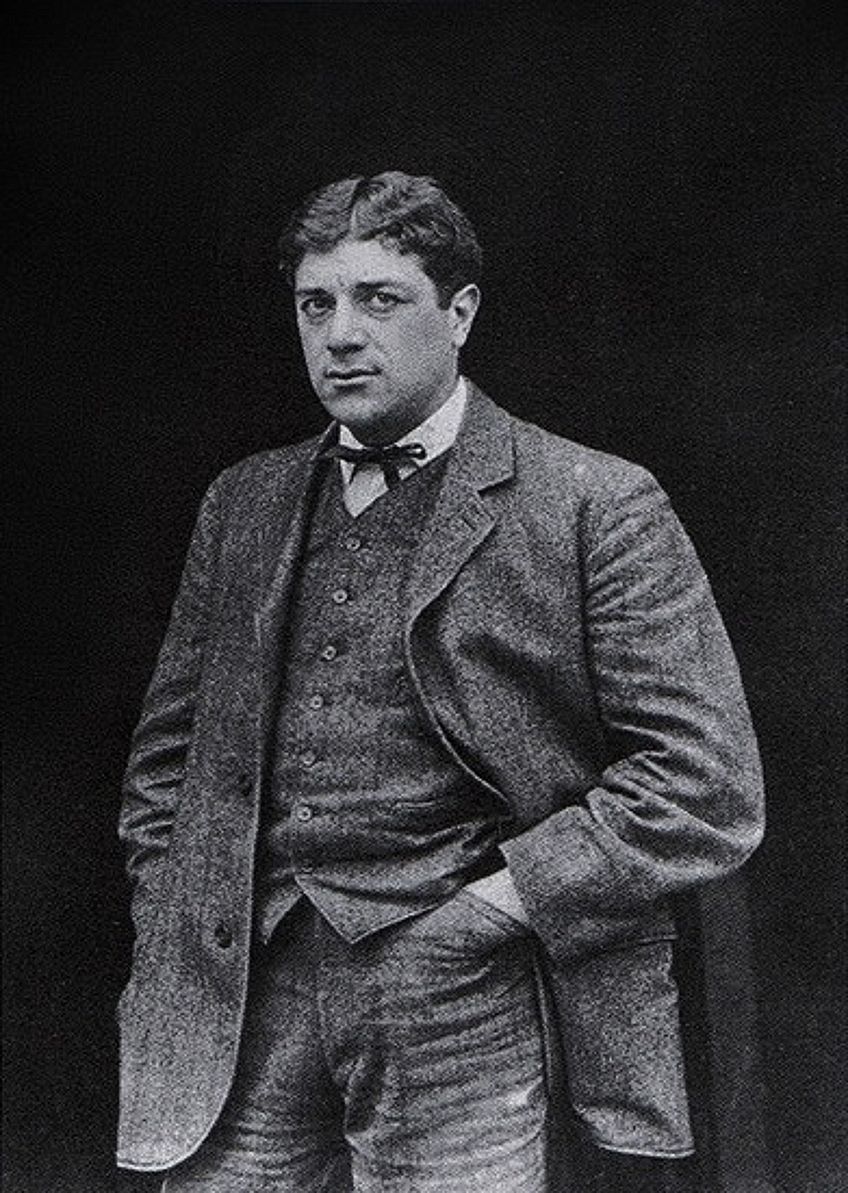
Hans Arp (1886 – 1966)
Hans Arp, also known as Jean Arp, helped found Zurich Dada in 1916. His reliefs, drawings, poems, and collages replaced descriptive detail with elemental forms. Chance offered an alternative to academic composition and individual mastery, but it did not necessarily eliminate revision or judgment.
One celebrated example is Untitled (Collage with Squares Arranged according to the Laws of Chance) (1916–1917). Torn blue-and-white papers appear to have been dropped and then attached where they fell. Accounts of the procedure have encouraged viewers to treat gravity as a co-author and the artist as someone who establishes conditions rather than controlling every position.
Yet the work’s balanced spacing and ordered appearance complicate a literal story of complete randomness. Arp selected the papers, the format, and the moment when the arrangement became finished; he may also have adjusted positions. It is therefore clearer to describe the collage as assisted chance—a negotiation between a rule, accidental placement, and aesthetic decision—than as the total surrender of control.
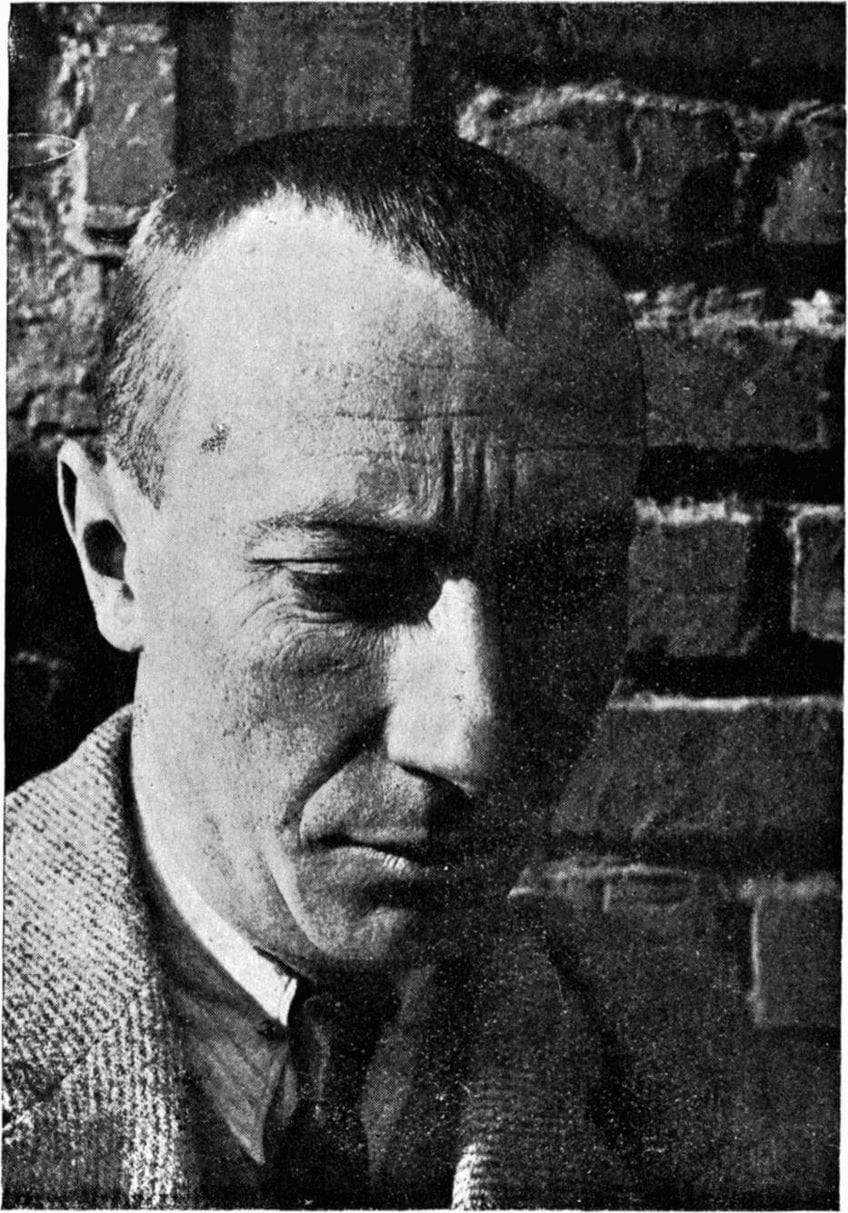
Kurt Schwitters (1887 – 1948)
Kurt Schwitters began making collages from tickets, labels, advertisements, wire, cloth, and street debris around 1918. Although closely associated with Dada, he developed his practice independently in Hannover after Berlin Dadaists rejected his participation. His aim was expansive: found matter could become an artistic element through composition rather than through its conventional value.
Schwitters called this approach “Merz,” a word he extracted from a fragment of the German Commerzbank. Merz encompassed collage, assemblage, poetry, publishing, performance, and eventually the evolving architectural environment known as the Merzbau. One key collage is Merz Picture 32 A. The Cherry Picture (1921), sometimes mistranslated as The Cherry Pie.
The work layers printed papers, fabric, tickets, wrappers, a child’s picture card, and other fragments on a painted support. Schwitters collected many ingredients from Hannover’s streets, but he arranged and attached them with great care. Diagonals, repeated circles, color accents, and areas of light and dark organize what first appears to be urban debris.
The cherry card supplies the title and a visual center, while scraps retain evidence of circulation and use. The collage may evoke a noticeboard or layered city wall, yet it is not completely disorganized. Its tension comes from the meeting of transient, damaged materials with a stable pictorial structure—a defining feature of Schwitters’s Merz practice.
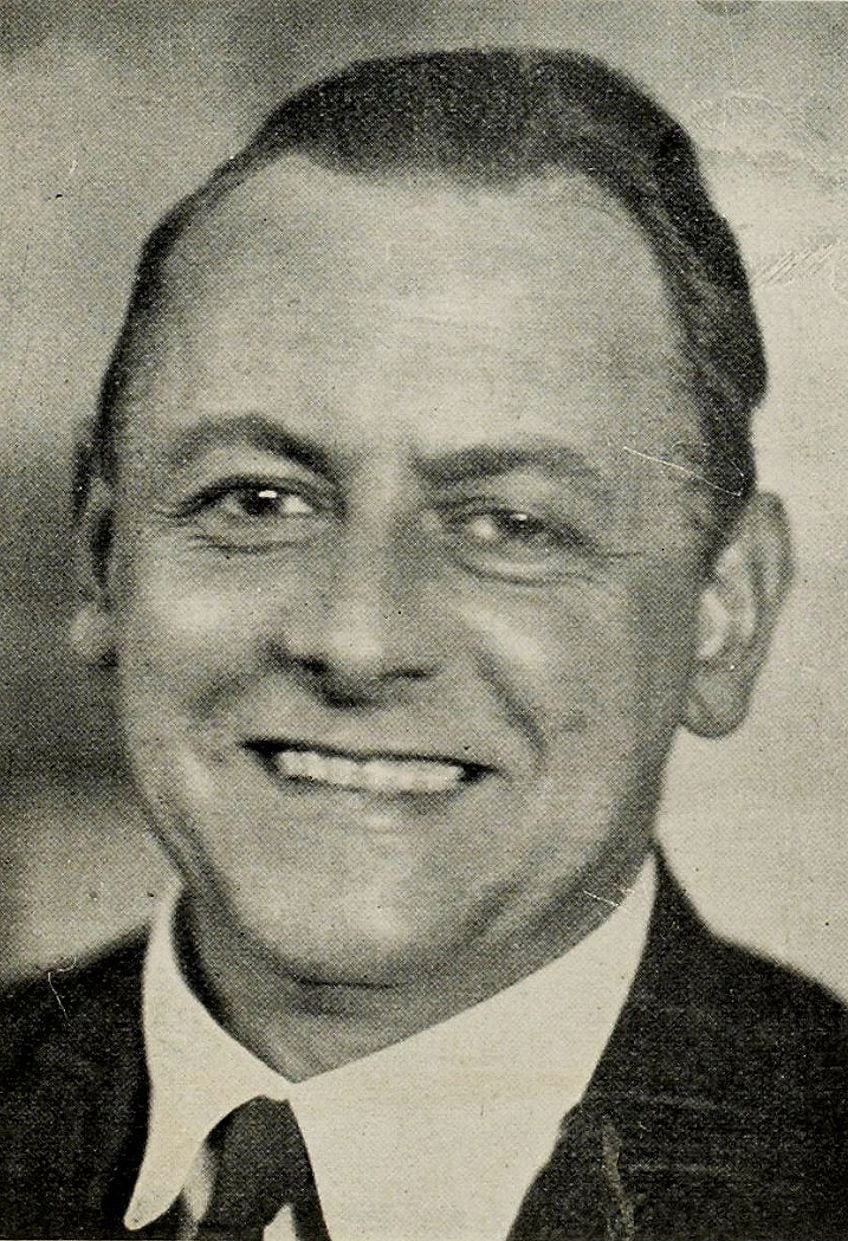
Hannah Höch (1889 – 1978)
Hannah Höch was a leading Berlin Dada artist and an important female artist in the history of photomontage. Her experience designing patterns for publishing gave her intimate knowledge of the illustrated press. She cut that media apart with precision, recombining bodies, machines, politicians, dancers, maps, and typography to test modern identities and the visual construction of gender.
Her best-known work, Cut with the Kitchen Knife Dada through the Last Weimar Beer-Belly Cultural Epoch in Germany (1919–1920), turns the illustrated press into a crowded map of early Weimar culture. Political leaders, Dadaists, performers, athletes, machinery, and words collide across a large sheet. A small map marks European countries where women then had voting rights, tying the work’s political satire to questions of gender and power.
The photomontage distinguishes a “Dada” zone from figures associated with the establishment while refusing an easy, linear message. Cropping can make public authority look unstable or absurd; shifts of scale prevent the many images from settling into a single viewpoint. It was shown at the First International Dada Fair in Berlin in 1920, where photomontage appeared as both a political instrument and a challenge to traditional media.
Höch sustained photomontage across six decades. Fashion magazines and ethnographic imagery allowed her to examine the “New Woman,” sexuality, race, beauty standards, and the way mass culture categorizes bodies. Those sources also demand historically alert viewing because they carry colonial assumptions that the new compositions expose, repeat, or complicate. Höch’s fractured identities remain relevant to contemporary artists working with gender, performance, and media representation.
Collage Art in Other Forms
Collage is also a useful model for thinking beyond works made with paper and glue. Architecture, music, and film can assemble existing units so that meaning arises from their juxtaposition. In these fields “collage” may name a literal production method, a metaphor, or both, so the comparison should be made precisely.
Architecture
Architects routinely use graphic collage to test scale, atmosphere, and relationships between a proposal and its site. A broader theoretical use became influential through Colin Rowe and Fred Koetter’s 1978 book Collage City. They criticized totalizing urban plans and argued for cities that accommodate fragments from different periods and systems. Here collage is less a recipe for disorder than a model for negotiation between inherited fabric, new intervention, public space, and competing ideals.
In architecture, collage can be a design tool and a metaphor for cities built through historical layers rather than one total plan.
Music
Music can be constructed through montage, quotation, tape editing, sampling, and digital looping. Twentieth-century recording technologies allowed composers and producers to cut recorded sound physically and later to rearrange it electronically. As in visual collage, a borrowed fragment can retain its former identity while acquiring new rhythm, scale, and context.
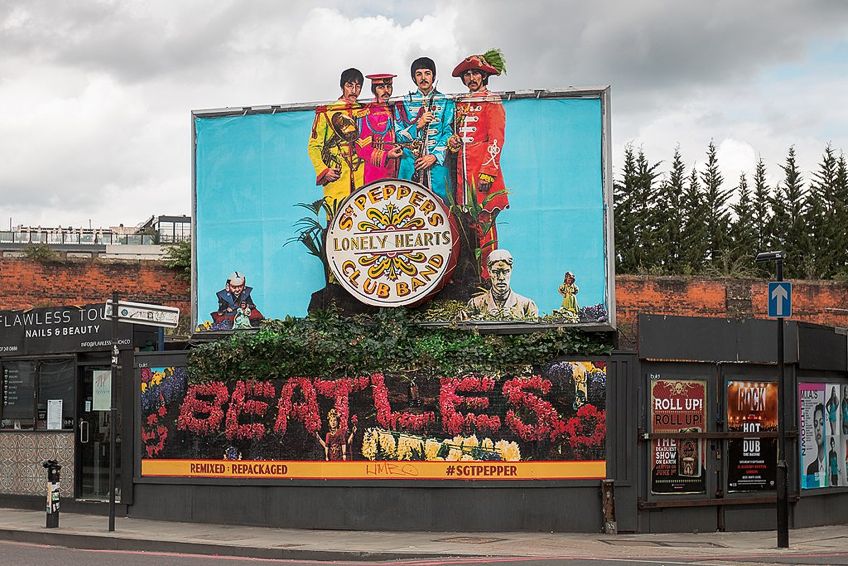
The Beatles and producer George Martin used tape assembly, studio effects, and layered recordings during the 1960s. “Being for the Benefit of Mr. Kite!” incorporates short segments of mechanically played organ recordings that were cut up and reassembled. The 1967 cover of Sgt. Pepper’s Lonely Hearts Club Band also uses a collage-like gathering of photographed figures, objects, text, and painted scenery.
Sampling became foundational to hip-hop and important across electronic and popular music. Digital tools made cutting and layering fast, but ease of production does not remove legal questions. Releasing sampled music may require authorization for both the sound recording and the underlying composition. Musical collage therefore shares visual collage’s creative tension between quotation, transformation, attribution, and rights.
Film
Film collage combines footage from different sources, periods, formats, or genres. Newsreels, home movies, advertisements, fictional scenes, voice recordings, and newly shot material can contradict or reinterpret one another through editing. Found-footage practice makes the archive itself a subject, revealing who produced an image, what it omitted, and how reuse changes its authority. Collage can also be physical: artists may scratch, paint, tape, or attach material directly to film. Canadian filmmaker Arthur Lipsett became particularly known for densely edited films assembled from discarded image and sound fragments.
The Legacy of Collage Art
Collage’s legacy lies in a way of thinking as much as in a set of materials. It treats images as things that can be extracted, repeated, layered, and contested. That logic helped shape photomontage, assemblage, artist books, installation, appropriation, zines, album covers, and moving-image practices. It also offered artists a direct way to work with the visual evidence of politics and consumer culture.
Digital collage extends familiar operations through selections, masks, layers, blending modes, scanning, and compositing. A seamless image may conceal its sources more completely than torn paper does, but it remains constructed from decisions about inclusion and context. Generative and automated tools add further questions about training data, consent, disclosure, and authorship. Across physical and digital practice, source awareness is therefore part of the medium’s contemporary legacy.
Tips for Making Your Own Collage
Collage is accessible because useful material is often already at hand, but a strong result still depends on choices about support, contrast, rhythm, attachment, and meaning. Begin with reversible arrangements, document the sources you use, and test adhesives on scraps before applying them to irreplaceable material.
Collect and Create Your Own Source Material
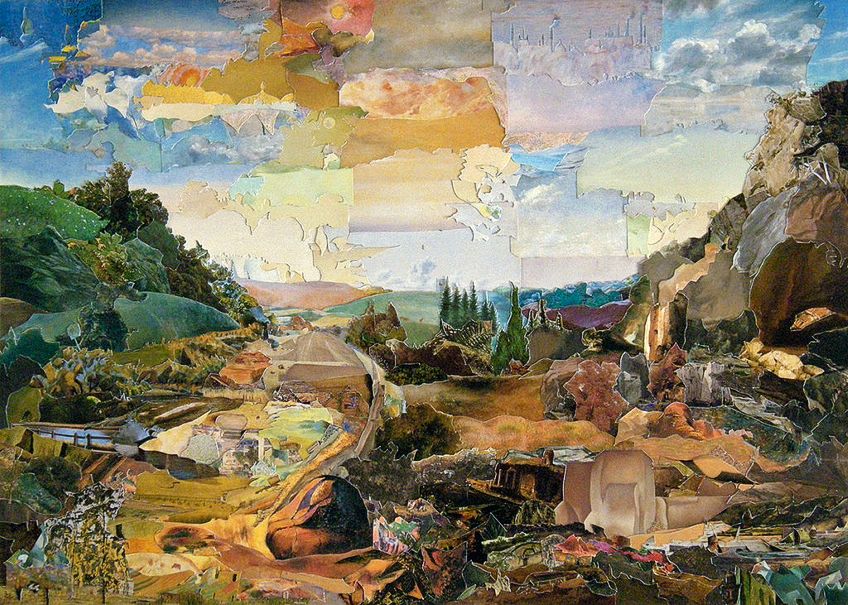
Build a small material library around a question, color family, texture, or visual motif rather than collecting everything indiscriminately. Possible sources include packaging, personal photographs, maps, envelopes, fabric, photocopies, drawings, and painted papers. Sorting fragments into clear sleeves or folders makes relationships easier to see and protects delicate pieces.
Old books, photographs, clothing, and recycled paper can be useful, but avoid cutting unique family records, rare publications, or culturally sensitive material without considering their value. You can create distinctive sources by painting, staining, printing, folding, or photographing paper before cutting it. Making your own material also gives you more control over color, texture, and reproduction rights.
Organize Your Composition Prior to Gluing It Down
Choose a stable support and arrange the largest shapes before committing to adhesive. Move fragments, rotate the support, photograph alternatives, and compare how the eye travels through each version. Overlap can establish depth; repeated colors or edges can create rhythm; a quiet area can prevent dense material from becoming visually uniform.
For a first project, limit the palette or source family and focus on one or two elements such as line, color, shape, scale, or texture. Test whether removing a fragment strengthens the central relationship. When ready, use an adhesive compatible with both the fragment and the support, work from the center outward where appropriate, and allow the piece to dry flat under clean release paper and light, even weight.
Track Sources and Rights
Record where each image or text fragment came from before separating it from its page or file. A simple source sheet can include creator, title, publication, date, URL, license, and any required credit. Mark material you made yourself, material in the public domain, material covered by a suitable license, and material that would need permission before public display or sale.
Owning a magazine or photograph does not automatically grant the right to reproduce its content. Copyright exceptions such as fair use, fair dealing, quotation, or parody differ by country and depend on context; transformation alone is not a universal exemption. For a work intended for publication, advertising, merchandise, or sale, seek qualified legal guidance when permission is uncertain. Ethical questions can remain even when legal reuse is possible, particularly with private photographs, sacred imagery, or records of violence.
Collage makes context visible: every cut separates a fragment from one history, and every placement asks it to participate in another.
Frequently Asked Questions
What Is Collage Art?
Collage is a technique in which fragments such as paper, photographs, fabric, printed matter, or other materials are arranged and attached to a support. The word also describes the resulting artwork. A collage can be abstract or representational, carefully planned or partly chance-based, and physical or digital.
How Is Collage Different From Mixed Media and Assemblage?
A collage specifically depends on combining attached fragments on a support. Mixed media is the broader category for artworks made with more than one medium, so a collage may also be mixed media. Assemblage applies related principles to three-dimensional objects and constructions, although artists often blur the boundary between collage and assemblage.
Who Invented Modern Collage?
No one invented the basic act of combining materials, which has a long history. Pablo Picasso and Georges Braque established collage as a radical modern-art method in 1912. Picasso made Still Life with Chair Caning in May, and Braque created the first Cubist papier collé, Fruit Dish and Glass, in September. Their innovations developed through close exchange.
What Materials Can Be Used and How Should Rights Be Managed?
Artists can use paper, photographs, fabric, labels, maps, packaging, drawings, painted sheets, and many other flat or low-relief materials. The support and adhesive should be compatible with the chosen fragments. For public or commercial use, document every source and confirm whether it is original, licensed, in the public domain, or used with permission. Copyright exceptions vary by jurisdiction, so uncertain cases need individual review.

Isabella studied at the University of Cape Town in South Africa and graduated with a Bachelor of Arts majoring in English Literature & Language and Psychology. Throughout her undergraduate years, she took Art History as an additional subject and absolutely loved it. Building on from her art history knowledge that began in high school, art has always been a particular area of fascination for her. From learning about artworks previously unknown to her, or sharpening her existing understanding of specific works, the ability to continue learning within this interesting sphere excites her greatly.
Her focal points of interest in art history encompass profiling specific artists and art movements, as it is these areas where she is able to really dig deep into the rich narrative of the art world. Additionally, she particularly enjoys exploring the different artistic styles of the 20th century, as well as the important impact that female artists have had on the development of art history.
Learn more about Isabella Meyer and the Art in Context Team.
Cite this Article
Isabella, Meyer, “Collage Art – History, Techniques, and Key Artists.” Art in Context. April 8, 2021. URL: https://artincontext.org/collage-art/
Meyer, I. (2021, 8 April). Collage Art – History, Techniques, and Key Artists. Art in Context. https://artincontext.org/collage-art/
Meyer, Isabella. “Collage Art – History, Techniques, and Key Artists.” Art in Context, April 8, 2021. https://artincontext.org/collage-art/.