

Simon Stålenhag: Landscapes, Machines, and Memory

Simon Stålenhag turns quiet Swedish roads, fields, and housing estates into places where gigantic machines feel less like visitors than forgotten neighbors. His images invite a second look: first at the impossible technology, then at the ordinary human world that makes it convincing. Following that tension reveals how a self-taught painter built a career in books, games, natural-history illustration, and television, while one of his books also reached cinema as a film adaptation.
Who Is Simon Stålenhag?
Simon Stålenhag is a Swedish artist and author born in Stockholm on January 20, 1984. His best-known narrative art books place robots, industrial structures, abandoned vehicles, and other speculative machines in carefully observed Scandinavian and American landscapes. The series began with Tales from the Loop, which developed from images combining childhood memories with imagined technology.

Tales from the Loop was published in 2014. Things from the Flood followed in 2016, before The Electric State shifted the action to the United States in 2017. His bibliography subsequently expanded through natural history, darker dystopian fiction, and a return to the Mälaröarna landscape in his fifth narrative art book, Sunset at Zero Point, in 2025.
Although Stålenhag’s finished images can resemble watercolor or gouache, an opaque form of watercolor painting, he produces his color scenes digitally. That combination of painterly surfaces and designed machinery places him among notable digital painting artists, but medium alone does not account for the work’s effect. The decisive feature is the close fit between invention and place: a machine looks persuasive because the field, road, light, and nearby buildings feel observed rather than generic.
Stålenhag continues to live in the Mälaröarna area, the group of islands in Lake Mälaren that includes Färingsö. This continuity matters because the landscape is not simply a backdrop borrowed for a successful series. It connects his childhood wildlife drawing, his speculative books, and the newest stage of his career.
From Färingsö to the Loop
Stålenhag’s development did not follow a conventional progression from art school to gallery exhibitions. Its major turns came through a specific childhood landscape, self-directed study, professional concept work, online circulation, and the decision to organize individual images into books.
A Childhood Landscape on Lake Mälaren
Stålenhag’s family moved from the Stockholm area to Färingsö in 1987, when he was three. The island sits in Lake Mälaren west of Stockholm and contains the mixture of farmland, woodland, roads, houses, and water that would later ground his fictional settings. He has identified Färingsö as the single most important place in his work, and he still lives in the wider Mälaröarna area.

As a child, he drew birds, wildlife, and landscapes. This early attention to animals and terrain developed before the robots for which he became known. It also helps explain why vegetation, changing weather, earth, and water retain so much visual weight in his speculative scenes. The machinery may seize attention first, but the surrounding land rarely feels incidental.
Stålenhag did not attend art school. He learned through practice and through close study of Swedish artists including Bruno Liljefors, Gunnar Brusewitz, and Lars Jonsson. Their documented importance belongs to the naturalistic side of his formation: careful observation of wildlife, atmosphere, and the character of a particular landscape.
From Wildlife Drawing to Game Concept Art
A professional turning point came when Stålenhag entered game-industry work at about 24 or 25. Designing concept art required him to invent robots repeatedly and develop the digital skills needed to render them. The job did more than add a new subject. It gave him a practical toolkit for making constructed objects look as visually coherent as the landscapes he already knew how to observe.
This change did not erase his earlier interests. Instead, machine design and landscape painting began to reinforce one another. His robots needed weight, surfaces, joints, and believable placement. The countryside supplied scale, atmosphere, and visual resistance: mud could collect around a mechanical foot, weeds could soften an industrial edge, and familiar buildings could make an impossible structure seem physically present.
The 2011 Image That Opened the Loop
In 2011, Stålenhag made the first image in the project that became Tales from the Loop. It placed a dinosaur in an orchard, combining an ordinary remembered environment with a deliberately impossible interruption. From that image grew a fictional setting populated by children, robots, dinosaurs, and a secret particle accelerator.
The process is important because the fictional history followed the images rather than preceding them as a fully written universe. Stålenhag began with visual situations tied to childhood memory, then developed connections among them. This allowed the setting to feel partially remembered and partially invented. A machine might be familiar to the children inside the story even though it remains unexplained to the viewer.
The Loop books are therefore not straightforward forecasts. Stålenhag has described them as altered echoes of the late 1980s and 1990s, the period of his own childhood. Their technology changes the remembered past instead of showing what he expects the future to become.
Online Circulation, Books, and Crowdfunding
Sharing the images online brought Stålenhag’s work to viewers beyond established art audiences. International editorial coverage had appeared by 2013, and he later credited social platforms with expanding his audience and turning the images into paid illustration opportunities. This attention preceded the publication and crowdfunding milestones that followed.
Tales from the Loop appeared as a book in 2014. A 2015 crowdfunding campaign then offered English editions of the first two Loop books. It attracted 3,890 backers and raised $321,680 against a $10,000 goal. Those figures demonstrated substantial interest in English editions and physical publication.
Crowdfunding remained important later in the career. The 2020 campaign for The Labyrinth drew 9,090 backers and SEK 4,230,378 against a SEK 200,000 goal. By then, the route from a personal image experiment to international publishing was firmly established.
How Simon Stålenhag Builds a Painting
Stålenhag’s process helps explain why his scenes balance documentary familiarity with speculative design. He does not begin by placing a finished robot into a convenient background. He starts with the real landscape and allows its structure to shape the invention.
A Digital Process with a Painted Surface
Countryside walks and photographs provide visual references. Stålenhag adjusts color and sketches the scene before building the finished image through high-resolution layers. Textured digital brushes help him evoke the grain, softened edges, and uneven opacity associated with watercolor and gouache.
A Wacom tablet or Cintiq is his principal painting tool. The hand still controls pressure, shape, placement, and revision, but the marks exist in a digital file rather than on a conventional watercolor sheet. Understanding the distinction between digital art and traditional art prevents a common misconception: the surface looks painted because of his decisions and technique, not because the final color image is necessarily a photographed physical painting.
His machine-design method is equally specific. Stålenhag has explained that he designs machinery to fit the visual rhythm of a photographed landscape. A vertical mechanism might answer a line of trees or utility poles, while a low structure might follow the horizon. This reverses the usual assumption that the environment was constructed merely to display a predesigned robot.
The result depends on integration. Reflected light, atmospheric haze, scale, and contact with the ground must apply to the invented object as convincingly as they do to a house or vehicle. Once those relationships work, the image can remain ambiguous without looking arbitrary.
Documented Influences, Not Just Visual Resemblances
Stålenhag’s acknowledged science-fiction influences include concept artists Ralph McQuarrie and Syd Mead. Their work offered models for giving imagined technologies a functional presence. His other documented influences, including Liljefors, Brusewitz, and Jonsson, belong to a different but complementary tradition of attentive landscape and wildlife representation.
Real Swedish postwar environments also feed the work. Buildings and landscapes associated with the 1950s through the 1970s supply recognizable architectural forms for the remembered world of the Loop. Their ordinary materials and practical shapes make the fictional infrastructure feel embedded in a society rather than dropped into an empty science-fiction stage.
These documented connections are more useful than assigning every resemblance to influence. Two artists may use large machines, misty horizons, or abandoned industrial spaces without one having shaped the other. In Stålenhag’s case, the strongest account joins the people and environments he has named with the working process he has described.
Major Books and the Worlds They Build
Stålenhag’s books share a concern with imagined technology and carefully observed settings, but they do not all describe the same world or create the same contrasts. Reading them in order reveals changes in location, period, technology, and social pressure.

Tales from the Loop and Things from the Flood
Tales from the Loop from 2014 and Things from the Flood from 2016 transform remembered Swedish landscapes. The fictional particle accelerator and its associated machines alter an environment of roads, homes, farms, and postwar buildings. Children, robots, dinosaurs, and industrial remnants inhabit this changed version of Stålenhag’s childhood setting.
Because the setting reworks the late 1980s and 1990s, its unfamiliar technology belongs to a changed past. This distinction clarifies the books’ unusual mixture of recognition and impossibility. The clothing, architecture, landscape, and social setting can feel historical, while robots and enormous industrial remnants suggest a technological path that never existed.
The Electric State and a Different Kind of Dystopia
The Electric State, published in 2017, moves away from rural Sweden to a damaged American landscape in late 1997. Its central journey follows a teenager and a yellow robot through a country marked by the remains of battle drones and widespread dependence on virtual-reality headsets.
The change of place brings a change of emphasis. Stålenhag has contrasted the industrial world of the Loop with the consumer-culture dystopia of The Electric State. Machines in the Swedish books often appear as infrastructure or the residue of large technological programs. In the American book, networked entertainment and consumption press more directly on the damaged society.
Treating both settings as a single generic retro-future misses that distinction. One alters a remembered childhood landscape through industrial science fiction. The other uses a road journey through an alternate America to show technological ruin alongside an absorbed consumer population.
The Labyrinth and Images from Deep Time
Images from Deep Time, published in 2019 and created with science writer Anna Davour, makes the natural-history strand of Stålenhag’s practice explicit. It connects the artist who once drew birds and wildlife with the illustrator commissioned to reconstruct prehistoric life.
The Labyrinth followed in 2020 and returned to narrative dystopia. Its premise centers on three travelers crossing an ash-covered world and on the underground bunker society from which they emerge. The open landscape is no longer simply a familiar place altered by machinery. It has become an environment whose basic conditions threaten human movement and survival.
The proximity of these two publications shows the range within Stålenhag’s practice. One addresses deep time and natural history; the other presents an invented catastrophe and a restricted human future. Together, they show that his work cannot be reduced to the setting established by the first Loop book.
Sunset at Zero Point, the Fifth Book
Stålenhag’s fifth narrative art book was published in Sweden in 2025 as Svenska maskiner, ensligt belägna. Its English title is Sunset at Zero Point. The book returns to Mälaröarna but expands its story across decades, addressing masculinity, friendship, and sexuality.
That return does not simply reset the first Loop book. A longer time span changes what the familiar geography can hold: relationships develop, memories accumulate, and the landscape becomes a point of continuity across different stages of life. The new book consequently broadens the personal geography that began on Färingsö while keeping it connected to the artist’s current home.
The official publication sequence now runs from Tales from the Loop in 2014 through Things from the Flood in 2016, The Electric State in 2017, Images from Deep Time in 2019, The Labyrinth in 2020, and Sunset at Zero Point in 2025. The list includes five narrative art books and one natural-history collaboration, rather than six interchangeable installments of one fictional series.
How to Look at Fjärrhandske
Fjärrhandske offers a practical introduction to Stålenhag’s visual language. He identified it as the individual image that made the greatest impact during the work’s early circulation. The scene contains two children, a robot, and a police bus, but it withholds the event that brought them together.
Children, Machine, and Police Bus
Begin with the children. Their ordinary human scale gives the viewer a measure for the robot and turns a science-fiction object into something encountered rather than displayed. They are not posed like technical demonstrators beside a new invention. They occupy a situation whose rules remain unclear.
Next, trace the visual triangle formed by the children, robot, and police bus. Each point suggests a different role: witnesses or participants, an unfamiliar machine, and an institutional response. Yet the image does not settle whether the machine is dangerous, damaged, controlled, or merely present. The police vehicle adds pressure without resolving the action.
Finally, look at the land between and around those subjects. The machine occupies the rural environment instead of replacing it. This relationship is central to Stålenhag’s method. The speculative object gains weight from the road, vegetation, atmosphere, and recognizable vehicles surrounding it.
Scale, Color, and Narrative Withholding
Stålenhag has connected the image’s palette to his preference for blue and purple tones punctuated by yellow artificial light. Those color relationships separate the sources of light while holding the encounter inside one atmosphere. Cool colors spread across the scene; warmer illumination marks human technology and concentrated activity.
Scale produces a second tension. The children are physically small, but their presence provides the image’s emotional and narrative reference point. The robot may occupy more space, yet it cannot explain itself. The police bus carries familiar authority, but it cannot supply the missing sequence of events.
This withholding encourages interpretation without proving a single allegory. A viewer can reasonably describe uncertainty, surveillance, danger, or curiosity as effects of the arrangement. It would be less responsible to turn those impressions into claims about the artist’s beliefs or the children’s exact motives.
The same viewing method can guide a reader through other scenes: find the smallest familiar figure or object, use it to judge scale, follow the placement of artificial light, and identify what remains unexplained. This shifts attention from the novelty of the machine to the visual relationships that make the encounter tense.
Beyond the Books
Stålenhag’s work reaches natural-history institutions, games, and television, while The Electric State also became the basis of a film. His documented role changes with each project, so an adaptation should not be mistaken for a work created by him alone.
Natural History and Museum Illustration
The Swedish Museum of Natural History commissioned Stålenhag to illustrate prehistoric life. The institution’s current dinosaur pages continue to credit several images to him. This work is not an isolated departure from science fiction. It develops the wildlife interest and observational habits present in his childhood drawing.
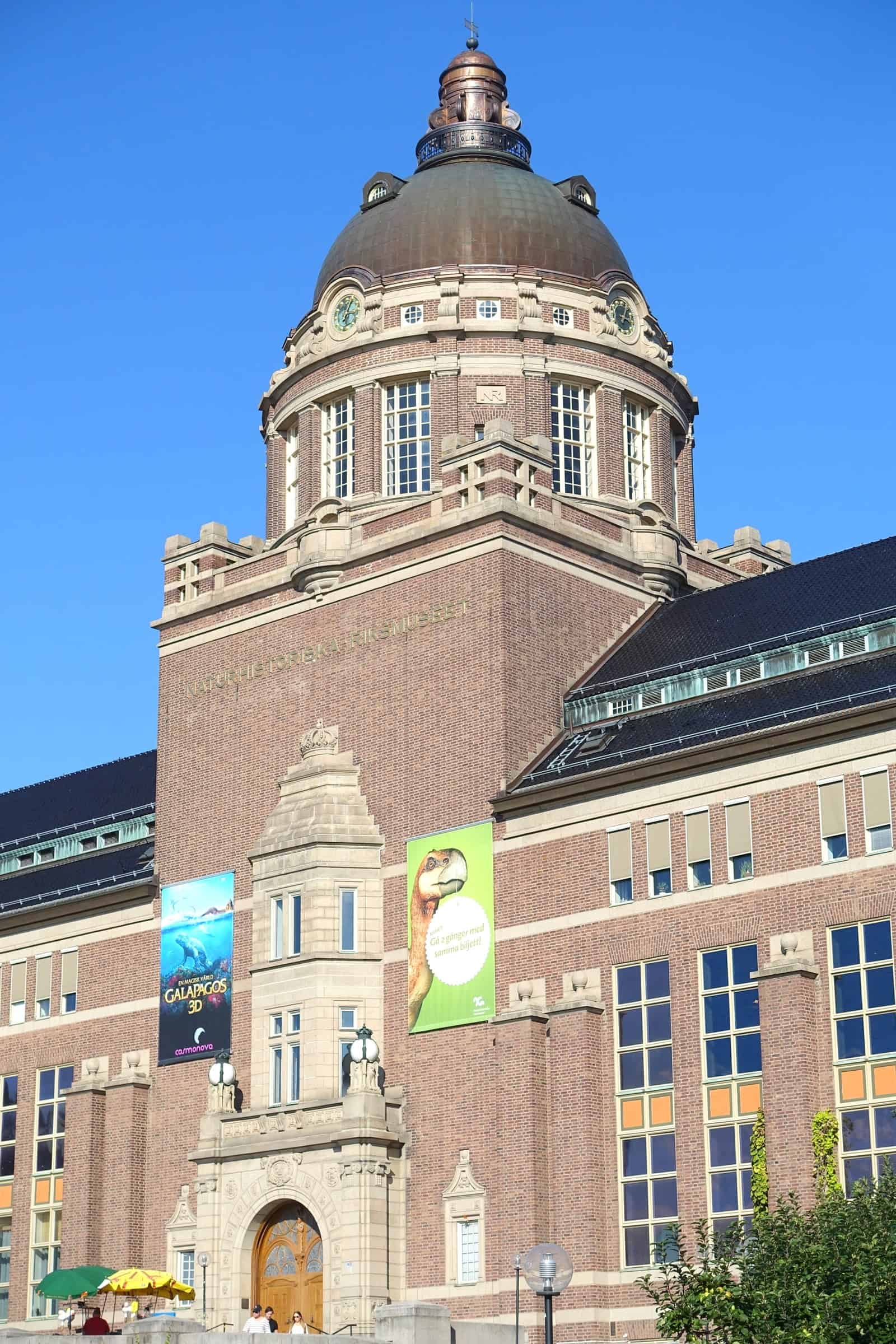
The commission extends a line of work that began with his early drawings and paintings of birds, animals, and landscapes. It also places Images from Deep Time, his 2019 collaboration with science writer Anna Davour, within a continuing natural-history practice rather than treating the book as an unrelated detour.
Games and Participatory Worldbuilding
Stålenhag also collaborated with Tommy Salomonsson on the independent video game Ripple Dot Zero. The project belongs to the game-related strand of his career that helped make digital image-making and robot design central to his toolkit.
Free League Publishing later transformed the Loop setting into a tabletop role-playing game, released in 2017. It received five Gold ENNIE Awards, including Best Game and Product of the Year. The format gives participants rules for creating characters, choices, and events within a setting derived from Stålenhag’s work.
This change is more than a new publication format. The tabletop game makes the setting participatory and distributes creative decisions among its players and game leader. It remains an adaptation of Stålenhag’s imagery rather than another art book authored in precisely the same way.
From Art Book to Television and Film
Amazon’s eight-episode Tales from the Loop television series premiered in 2020. Nathaniel Halpern created and wrote the series. Stålenhag served as a co-executive producer and made custom key art, meaning promotional artwork used to represent the production.
The Electric State became a Netflix film in 2025. Anthony and Joe Russo directed it, and Christopher Markus and Stephen McFeely wrote the screenplay. The film is based on Stålenhag’s book, but the documented record does not give him a production role comparable to his participation in the television series.
The two adaptations therefore have different creative relationships to Stålenhag. He participated in the television production as a co-executive producer and promotional artist. The film record identifies his graphic novel as its source while crediting a separate team of directors and screenwriters.
Simon Stålenhag’s Contribution and Legacy
Stålenhag’s contribution is clearest in the relationship between observed places and designed machinery. His books have also provided source material for a role-playing game, television, and film, although each adaptation has its own creators, methods, and degree of participation from the artist.
Why the Ordinary Landscape Matters
The credibility of these worlds begins with local specificity. Färingsö is not an anonymous rural setting, and the Swedish postwar buildings are not neutral scenery. Their recognizable roads, trees, fields, materials, and proportions establish a world with its own history before a robot enters it.
This approach provides useful recognition guidance. In a Stålenhag scene, look for an ordinary place carrying visible traces of use: worn ground, modest architecture, parked vehicles, distant figures, or changing weather. Then notice how the speculative element obeys the same light and spatial conditions. The contrast works because both halves of the image receive attention.
That sensitivity connects his practice with broader contemporary landscape art, even though his machines and narrative settings give it a distinctive direction. The landscape does not decorate the story. It establishes scale, memory, and material credibility.
A Visual World That Other Media Reinterpret
The move from online images to books, a role-playing game, television, and film demonstrates substantial cross-media reach. It also keeps authorship visible: the game turns the setting into participatory play, the television series has its own creator and writer, and the film credits its own directors and screenwriters.
Fjärrhandske shows what remains central to Stålenhag’s own visual contribution. A specific landscape, two children, an unexplained robot, a police bus, and carefully separated sources of light create tension without establishing one compulsory interpretation. Place, scale, and omission do as much work as the speculative machine.
Sunset at Zero Point shows why the return to Mälaröarna remains significant. The setting can carry a new decades-spanning story about friendship, masculinity, and sexuality rather than merely repeat the Loop formula. The geography endures, but the human questions and historical range can change.
Frequently Asked Questions
These questions turn the distinctions among Stålenhag’s projects into practical choices. They help readers choose a first book, separate two easily conflated settings, and interpret an unresolved scene without treating an impression as proof of the artist’s beliefs.
Which Simon Stålenhag Book Should a New Reader Choose First?
Begin with Tales from the Loop for an altered version of Stålenhag’s childhood Sweden. Choose The Electric State for a late-1997 American journey shaped by consumer culture, The Labyrinth for an ash-covered survival setting, or Sunset at Zero Point for a decades-spanning return to Mälaröarna.
How Can Readers Tell the Loop Books from The Electric State?
Start with place and technology. The Loop books alter rural Sweden of the late 1980s and 1990s with industrial infrastructure, while The Electric State crosses a damaged American 1997 shaped by battle-drone remains, virtual-reality dependence, and consumer culture. Similar painted machinery does not make the settings interchangeable.
How Should Viewers Read an Unexplained Stålenhag Scene?
Use familiar details before assigning a meaning. Compare people and vehicles with the machine to judge scale, follow the natural and artificial light, and note how the invented object meets the ground and weather. Then separate visible evidence from interpretation: uncertainty or danger may describe the scene’s effect, but they do not prove a belief held by the artist.

Isabella studied at the University of Cape Town in South Africa and graduated with a Bachelor of Arts majoring in English Literature & Language and Psychology. Throughout her undergraduate years, she took Art History as an additional subject and absolutely loved it. Building on from her art history knowledge that began in high school, art has always been a particular area of fascination for her. From learning about artworks previously unknown to her, or sharpening her existing understanding of specific works, the ability to continue learning within this interesting sphere excites her greatly.
Her focal points of interest in art history encompass profiling specific artists and art movements, as it is these areas where she is able to really dig deep into the rich narrative of the art world. Additionally, she particularly enjoys exploring the different artistic styles of the 20th century, as well as the important impact that female artists have had on the development of art history.
Learn more about Isabella Meyer and the Art in Context Team.
Cite this Article
Isabella, Meyer, “Simon Stålenhag: Landscapes, Machines, and Memory.” Art in Context. September 23, 2026. URL: https://artincontext.org/simon-stalenhag/
Meyer, I. (2026, 23 September). Simon Stålenhag: Landscapes, Machines, and Memory. Art in Context. https://artincontext.org/simon-stalenhag/
Meyer, Isabella. “Simon Stålenhag: Landscapes, Machines, and Memory.” Art in Context, September 23, 2026. https://artincontext.org/simon-stalenhag/.


