


10 Contemporary Landscape Artists to Know: Beyond the Horizon

Landscape painting continues to evolve in the contemporary art world, with artists pushing boundaries and redefining traditional approaches to depicting natural scenery. Today’s landscape artists blend classical techniques with modern perspectives, creating works that reflect our changing relationship with the environment while still capturing its enduring beauty. From Richard Diebenkorn’s abstract interpretations to David Hockney’s vibrant scenes, contemporary landscape painters offer diverse viewpoints that challenge and inspire our understanding of the natural world.
Key Takeaways
- Contemporary landscape artists combine traditional techniques with innovative approaches to create unique interpretations of natural environments.
- Notable figures like David Hockney, Wayne Thiebaud, and Natalia Baykalova have significantly influenced modern landscape painting through their distinctive styles.
- The evolution of landscape art reflects changing cultural attitudes toward nature and environmental concerns while maintaining the genre’s visual appeal.
Evolution of Landscape Painting
Landscape painting has a rich history dating back to ancient times, though it emerged as a distinct genre during the Renaissance period. Initially serving as mere backgrounds for religious or mythological scenes, landscapes gradually gained recognition as subjects worthy of artistic focus in their own right.
The 17th century saw Dutch painters elevate landscape art to new heights, with artists like Jacob van Ruisdael creating detailed portrayals of the natural world. By the 18th century, landscape painting had become firmly established across Europe, with various styles emerging in different regions.

The Romantic movement of the early 19th century brought emotional intensity to landscapes, as artists like J.M.W. Turner and Caspar David Friedrich used dramatic natural settings to evoke powerful feelings. This period marked a significant shift in how artists approached the natural world.
Impressionism later revolutionized landscape painting through its emphasis on light, color, and atmosphere. Claude Monet and other Impressionists worked outdoors, capturing fleeting moments and changing conditions in nature.
The 20th century saw further experimentation, with movements like Cubism and Abstract Expressionism transforming how artists interpreted landscapes. Artists began deconstructing natural forms and exploring subjective experiences of place.
Contemporary landscape artists continue this evolution, addressing modern concerns like environmental issues, urban development, and digital technology. They blend traditional techniques with innovative approaches, creating works that reflect our complex relationship with the natural world today.
Notable Contemporary Landscape Artists
Contemporary landscape artists have revolutionized traditional approaches to depicting natural environments through innovative techniques and unique perspectives. These artists have successfully blended classical landscape traditions with modern sensibilities, creating works that resonate with today’s audiences while maintaining connections to art history.
Shara Hughes
Shara Hughes creates vibrant, dreamlike landscapes that blur the line between reality and imagination. Her work features bold colors and fantastical elements that transform conventional landscape painting into psychological explorations.
Hughes was born in 1981 in Atlanta, Georgia, and gained significant recognition after her inclusion in the 2017 Whitney Biennial. Her paintings often incorporate surrealist elements while maintaining references to traditional landscape composition.

Critics have praised Hughes for her ability to create what she calls “invented landscapes” – scenes that exist only in her imagination rather than depicting actual locations. These works feature impossible colors and physics-defying perspectives.
| Name | Born | Country |
|---|---|---|
| Shara Hughes | 1981 | United States |
Paul Anthony Smith
Paul Anthony Smith has developed a distinctive approach to landscape art through his “picotage” technique, where he meticulously picks away at photographic surfaces to create textured, patterned landscapes.
Born in Jamaica in 1988 and raised in Miami, Smith’s work explores cultural identity, memory, and place. His altered photographs of Caribbean landscapes incorporate patterns inspired by African masks and textiles.
Smith’s landscape works often examine post-colonial perspectives and the relationship between Caribbean geography and diaspora identities. His pieces can be found in major collections including the Minneapolis Institute of Art and the Studio Museum in Harlem.
| Name | Born | Country |
|---|---|---|
| Paul Anthony Smith | 1988 | Jamaica |
Wayne Thiebaud
Wayne Thiebaud, though perhaps best known for his paintings of cakes and pastries, created remarkable California landscapes characterized by exaggerated perspectives and vibrant colors. His depictions of San Francisco’s steep streets and Sacramento Valley farmlands are instantly recognizable.
Born in 1920 in Mesa, Arizona, Thiebaud developed a distinctive style featuring thick paint application and strong shadows. His landscapes employ vertiginous viewpoints and compressed space to create dramatic visual impact.
Thiebaud’s work demonstrated his mastery of color theory, often employing “halation” – surrounding objects with rainbow-like color bands. Before his death in 2021, his landscapes had become highly sought after by private collections worldwide.
| Name | Born | Country |
|---|---|---|
| Wayne Thiebaud | 1920-2021 | United States |

Peter Doig
Peter Doig creates haunting, dreamlike landscapes that blend memory, imagination, and photographic sources. His work often features solitary figures in mysterious natural settings, creating an atmosphere of isolation and contemplation.
Born in Edinburgh in 1959, Doig spent his childhood in Trinidad and Canada, influences that frequently appear in his work. His paintings command some of the highest prices among living artists, with his landscape “Country-rock (wing mirror)” selling for $28.8 million in 2017.
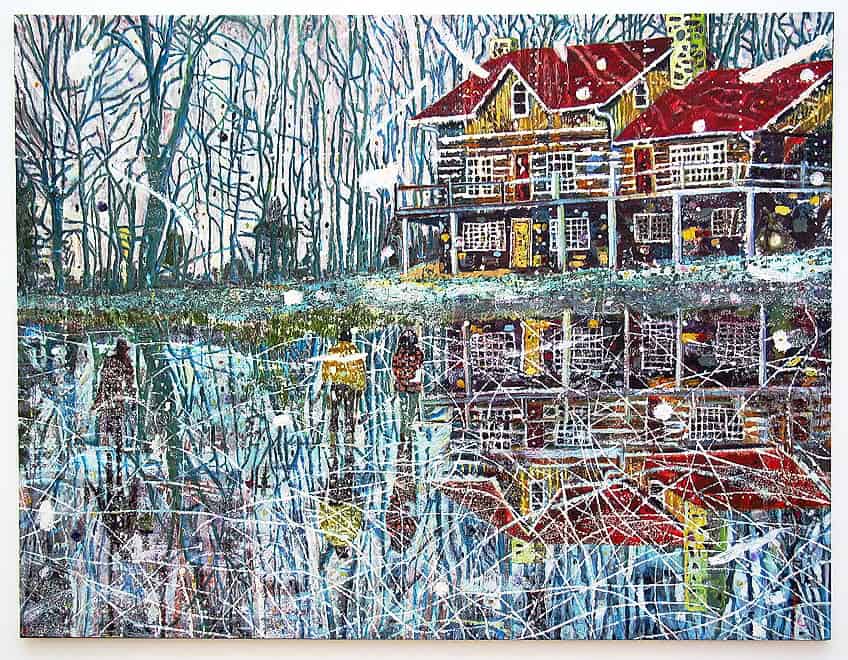
Doig’s landscapes are characterized by their layered paint application and unusual color choices. He frequently incorporates elements from personal memories, film stills, and found photographs to create scenes that feel simultaneously familiar and strange.
| Name | Born | Country |
|---|---|---|
| Peter Doig | 1959 | Scotland |
David Hockney
David Hockney has continuously reinvented landscape painting throughout his lengthy career, from his iconic California swimming pools to his recent iPad drawings of Yorkshire countryside. His work combines traditional observation with technological innovation.
Born in 1937 in Bradford, England, Hockney’s landscape works often feature vibrant colors and simplified forms. His “Yorkshire Landscapes” series, created after returning to his native England, displays his masterful use of color to capture seasonal changes.
Hockney has embraced digital technology in his landscape practice, creating thousands of iPad drawings that capture the changing light and seasons. His massive multi-canvas works like “Bigger Trees Near Warter” demonstrate his ongoing experimentation with scale and perspective.
| Name | Born | Country |
|---|---|---|
| David Hockney | 1937 | United Kingdom |

Julie Mehretu
Julie Mehretu creates complex, layered compositions that transform traditional landscape concepts into abstract explorations of geography, architecture, and social systems. Her large-scale works combine painting and drawing to create dynamic visual experiences.
Born in 1970 in Addis Ababa, Ethiopia, Mehretu’s work often incorporates cartographic elements, architectural drawings, and urban planning schemes. These elements are layered with gestural marks to create landscapes that feel simultaneously structured and chaotic.
Mehretu’s landscapes address political and social concerns, including migration, climate change, and globalization. Her work can be found in major collections worldwide, including MoMA and the Guggenheim Museum.
| Name | Born | Country |
|---|---|---|
| Julie Mehretu | 1970 | Ethiopia |

Etel Adnan
Etel Adnan created vibrant, abstracted landscapes that captured the essence of her emotional connection to place, particularly Mount Tamalpais in California. Her work demonstrates how simplified forms can convey profound feeling and sense of place.
Born in Beirut, Lebanon in 1925, Adnan began painting in her mid-thirties while working as a professor and writer. Her landscape paintings feature bold color blocks and simplified forms that capture the emotional essence rather than literal depiction of landscapes.

Adnan’s landscapes reflect her multicultural background and complex relationship with place and belonging. Before her death in 2021, her work gained significant recognition in major exhibitions at the Serpentine Gallery in London and documenta 13.
| Name | Born | Country |
|---|---|---|
| Etel Adnan | 1925-2021 | Lebanon |
Vija Celmins
Vija Celmins creates meticulously detailed renderings of natural phenomena, including ocean surfaces, night skies, and desert floors. Her work demonstrates extraordinary technical precision while exploring perception and memory.
Born in Latvia in 1938, Celmins fled with her family during World War II before eventually settling in the United States. Her landscape works are typically created in graphite or charcoal, achieving photographic realism through painstaking detail.
Celmins often works from photographs, transforming casual snapshots into contemplative objects through her intensive process. Her ocean surfaces and star fields become meditations on time, space, and observation rather than traditional landscapes.
| Name | Born | Country |
|---|---|---|
| Vija Celmins | 1938 | Latvia |

Gerhard Richter
Gerhard Richter is one of the most influential contemporary artists, whose work spans a remarkable range from photorealism to abstract expression. His landscapes often create a captivating tension between crisp details and blurred forms, inviting viewers to reflect on perception and reality. By employing innovative techniques and color, Richter challenges traditional artistic conventions and opens up new spaces for interpretation.

| Name | Born | Country |
|---|---|---|
| Gerhard Richter | 1932 | Germany |
April Gornik
April Gornik creates atmospheric landscape representations that capture both emotional and visual depths. Her impressionistic compositions skillfully combine light, shadow, and color to evoke the ephemeral beauty of nature. Gornik’s work offers an immersive experience where real scenes and artistic enhancement engage in a dynamic dialogue.
| Name | Born | Country |
|---|---|---|
| April Gornik | 1953 | USA |

Frequently Asked Questions
Contemporary landscape art continues to evolve with new talents, techniques, and perspectives emerging in this dynamic field. The following questions address key aspects of today’s landscape art scene.
Who are some notable contemporary landscape artists emerging today?
Ilse D’Hollander and Hurvin Anderson represent exciting voices in contemporary landscape art with their distinctive approaches to spatial representation. April Gornik has also gained recognition for her luminous, atmospheric landscapes that blend realism with emotional depth.
What distinguishes contemporary landscape art from traditional landscape painting?
Contemporary landscape artists often incorporate environmental concerns, abstract elements, and modern perspectives rather than pursuing pure representation. Many use non-traditional materials, digital techniques, or conceptual approaches to challenge viewers’ relationships with nature and the environment.
Can you name a few female artists who have made significant contributions to contemporary landscape art?
Vija Celmins has created meticulous renderings of natural phenomena like ocean surfaces and night skies that transcend simple landscape depiction. April Gornik and Ilse D’Hollander have also made remarkable contributions with their distinctive styles that reimagine how we perceive and interact with landscapes.

Isabella studied at the University of Cape Town in South Africa and graduated with a Bachelor of Arts majoring in English Literature & Language and Psychology. Throughout her undergraduate years, she took Art History as an additional subject and absolutely loved it. Building on from her art history knowledge that began in high school, art has always been a particular area of fascination for her. From learning about artworks previously unknown to her, or sharpening her existing understanding of specific works, the ability to continue learning within this interesting sphere excites her greatly.
Her focal points of interest in art history encompass profiling specific artists and art movements, as it is these areas where she is able to really dig deep into the rich narrative of the art world. Additionally, she particularly enjoys exploring the different artistic styles of the 20th century, as well as the important impact that female artists have had on the development of art history.
Learn more about Isabella Meyer and the Art in Context Team.
Cite this Article
Isabella, Meyer, “10 Contemporary Landscape Artists to Know: Beyond the Horizon.” Art in Context. September 7, 2025. URL: https://artincontext.org/10-contemporary-landscape-artists-to-know/
Meyer, I. (2025, 7 September). 10 Contemporary Landscape Artists to Know: Beyond the Horizon. Art in Context. https://artincontext.org/10-contemporary-landscape-artists-to-know/
Meyer, Isabella. “10 Contemporary Landscape Artists to Know: Beyond the Horizon.” Art in Context, September 7, 2025. https://artincontext.org/10-contemporary-landscape-artists-to-know/.


