

Byzantine Art – Traversing the Byzantine Empire Art Period

Byzantine art is the visual culture of the medieval Eastern Roman Empire and the communities shaped by it. Created from the foundation of Constantinople in 330 through the Ottoman conquest in 1453—and continued in post-Byzantine traditions—it includes churches, mosaics, frescoes, icons, manuscripts, ivories, metalwork, textiles, and luxury objects. Its artists could be abstract or naturalistic, devotional or secular, innovative or deliberately traditional. Understanding the art therefore requires chronology, function, material, and place rather than a single formula of gold backgrounds and solemn figures.
What Is Byzantine Art?
“Byzantine” is a later scholarly label. The empire’s inhabitants generally called themselves Romans, and their state was the eastern continuation of the Roman Empire. Constantine I refounded Byzantion as Constantinople in 330. Greek eventually became the principal language of government and culture, while Roman law, Christianity, classical learning, and contacts across the Mediterranean and Eurasia shaped artistic production.
The category also reaches beyond changing imperial borders. Venice, southern Italy, Sicily, the Balkans, the Caucasus, and the Slavic world adapted Byzantine forms through trade, diplomacy, migration, conquest, and religious exchange. A work can therefore be Byzantine, Byzantine-influenced, or post-Byzantine; those terms are related but not interchangeable.
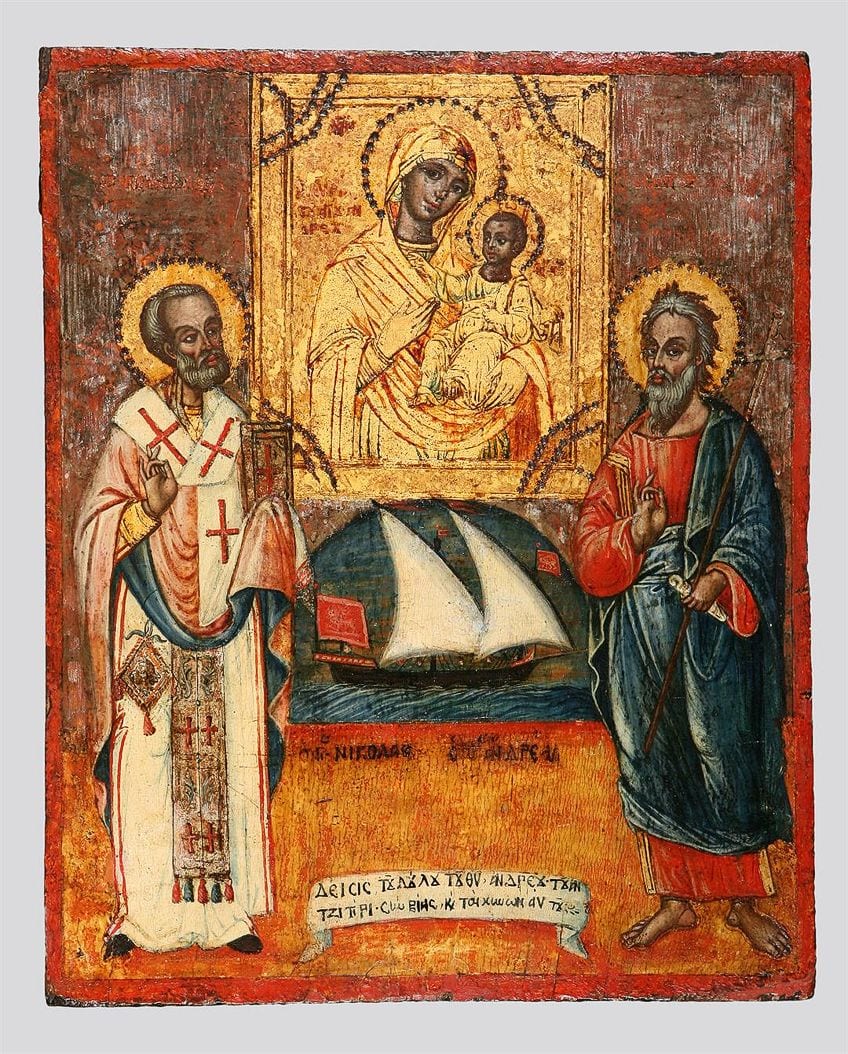
This icon joins saints, the Hodegetria image of the Virgin and Child, a donor inscription, a ship, and Venice’s winged lion. It shows why geography and patronage matter: Byzantine icon types circulated through maritime networks and could acquire local political or devotional signs.
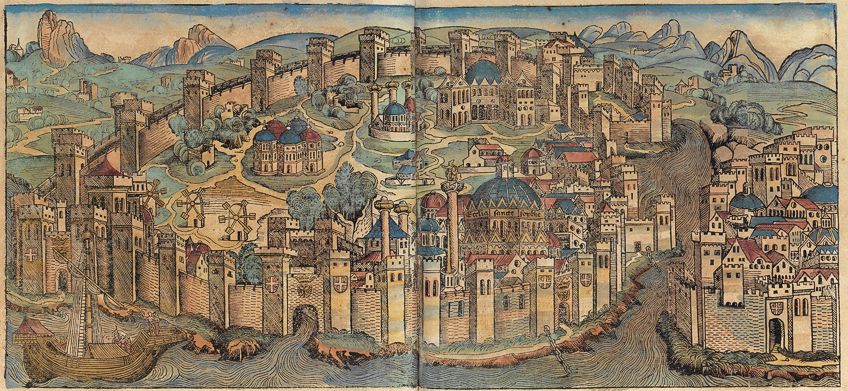
The Nuremberg Chronicle woodcut was printed in 1493, forty years after the Ottoman conquest. It is a Western, post-Byzantine visualization of Constantinople rather than an eyewitness record of the medieval capital. Images about Byzantium must be distinguished from images made within Byzantium.
The Metropolitan Museum of Art’s overview divides the long history into Early Byzantine, Middle Byzantine, and Late Byzantine phases, interrupted by Iconoclasm and the Latin occupation. The dates are analytical tools, not walls: regional styles and workshop practices did not change everywhere at once.
A History of Byzantine Art
Early Byzantine Art, circa 330–726
Early Byzantine art developed from late Roman visual and building traditions as Christianity gained imperial support. Artists retained modeling, portrait conventions, illusionistic space, and classical subjects while creating new church programs, sacred narratives, and images of authority. Surviving monuments are unevenly distributed because Constantinople was repeatedly rebuilt and many portable works were lost.
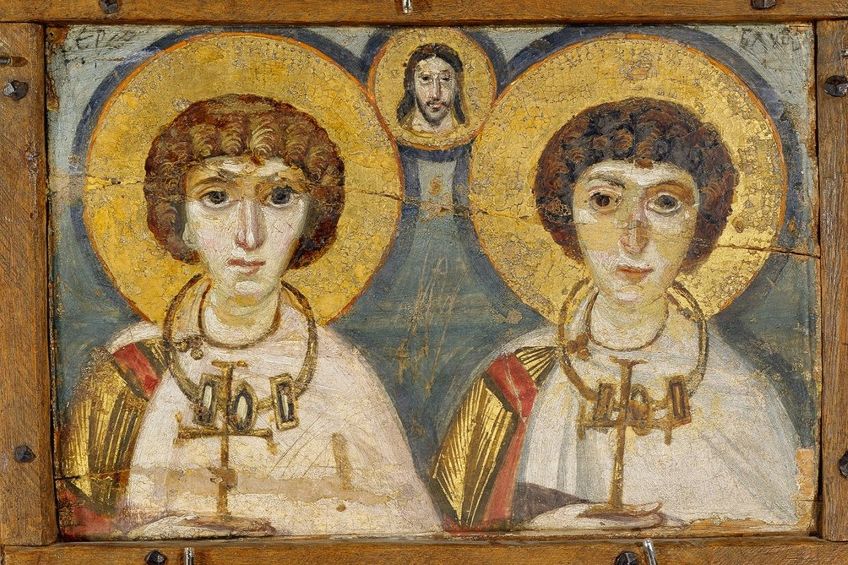
The icon of Saints Sergius and Bacchus demonstrates the frontal presence and individualized faces possible in early panel painting. The supplied filename says “BC,” but the work is Christian and dated to the seventh century AD. It should not be used as evidence that every Byzantine figure was flat or impersonal.
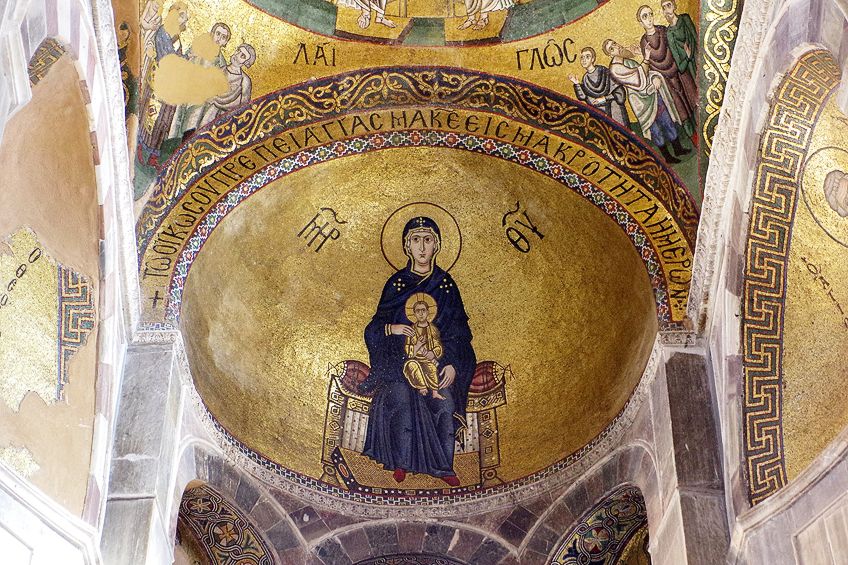
Hosios Loukas is a Middle Byzantine monastery, so its richly patterned interior is a later comparison rather than an Early Byzantine survival. Marble revetment, mosaic, architecture, and controlled light work together; the decoration is not a detachable layer applied to a neutral shell.
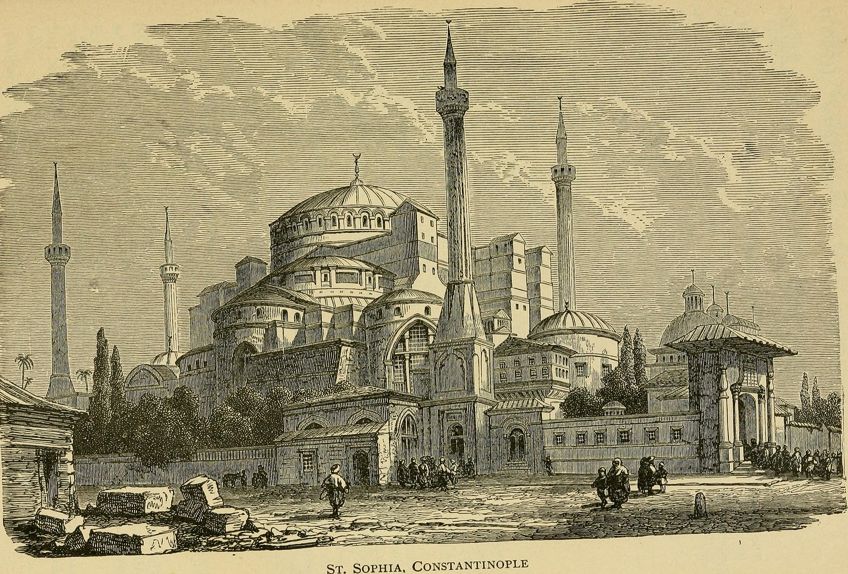
Justinian I commissioned the present Hagia Sophia after the Nika uprising. Anthemius of Tralles and Isidore of Miletus designed the church, completed in 537, around a vast domed interior. The historical book illustration above is evidence of later reception, not a direct document from Justinian’s reign.
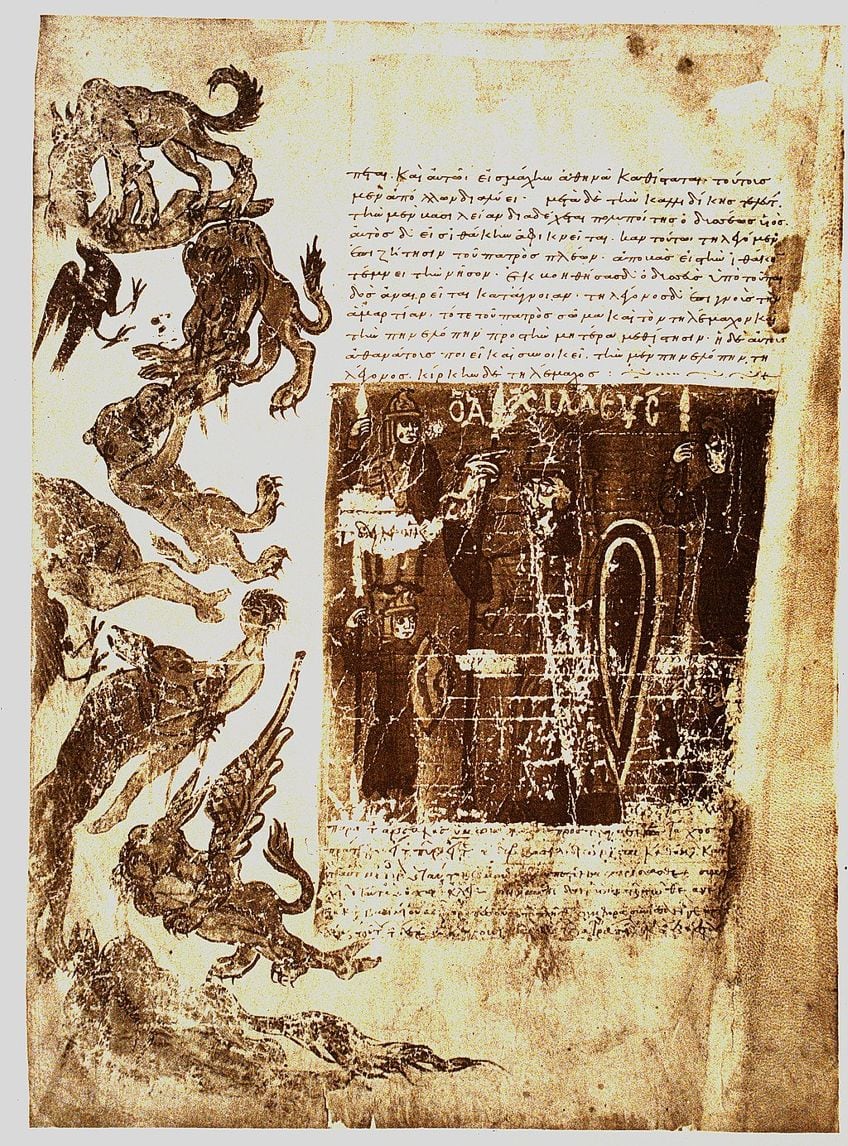
The illustrated Byzantine Iliad is a reminder that classical literature did not disappear. Christian patrons and scribes copied, studied, and pictured ancient texts, although surviving manuscripts may be later than the compositions they transmit. “Byzantine” and “classical” are therefore overlapping histories, not opposites.
Byzantine Iconoclasm, circa 726–843
Iconoclasm was a contested series of imperial policies and theological debates over sacred images, conventionally divided into about 726–787 and 815–843. Icons were defended at the Second Council of Nicaea in 787 and restored permanently in 843. The Smarthistory guide to Iconoclasm emphasizes gaps in the evidence and warns against reducing the period to a simple war between art and religion.
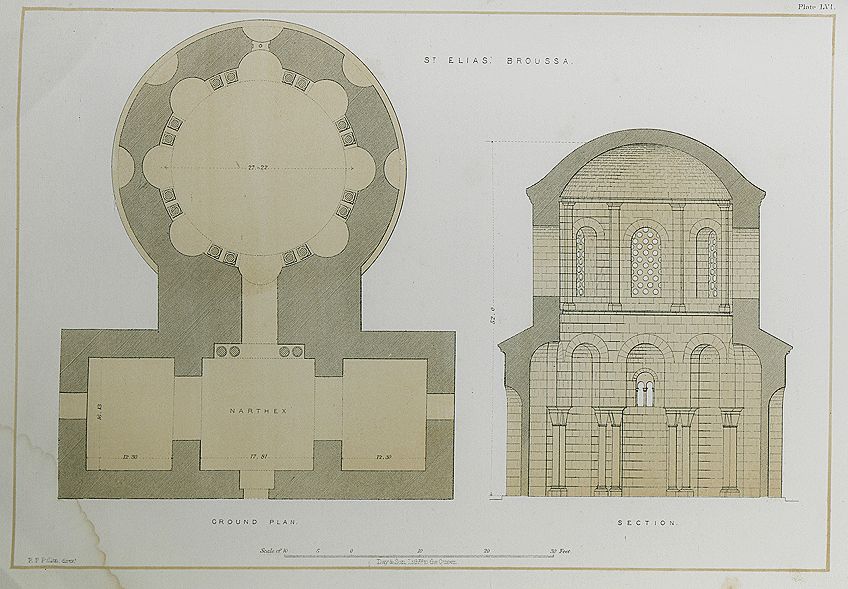
This 19th-century architectural drawing records a church plan and section; it is not itself Byzantine. Such later surveys are useful evidence, but they must be separated from the monuments they document. The centralized, domed, cross-in-square church became especially important after Iconoclasm.
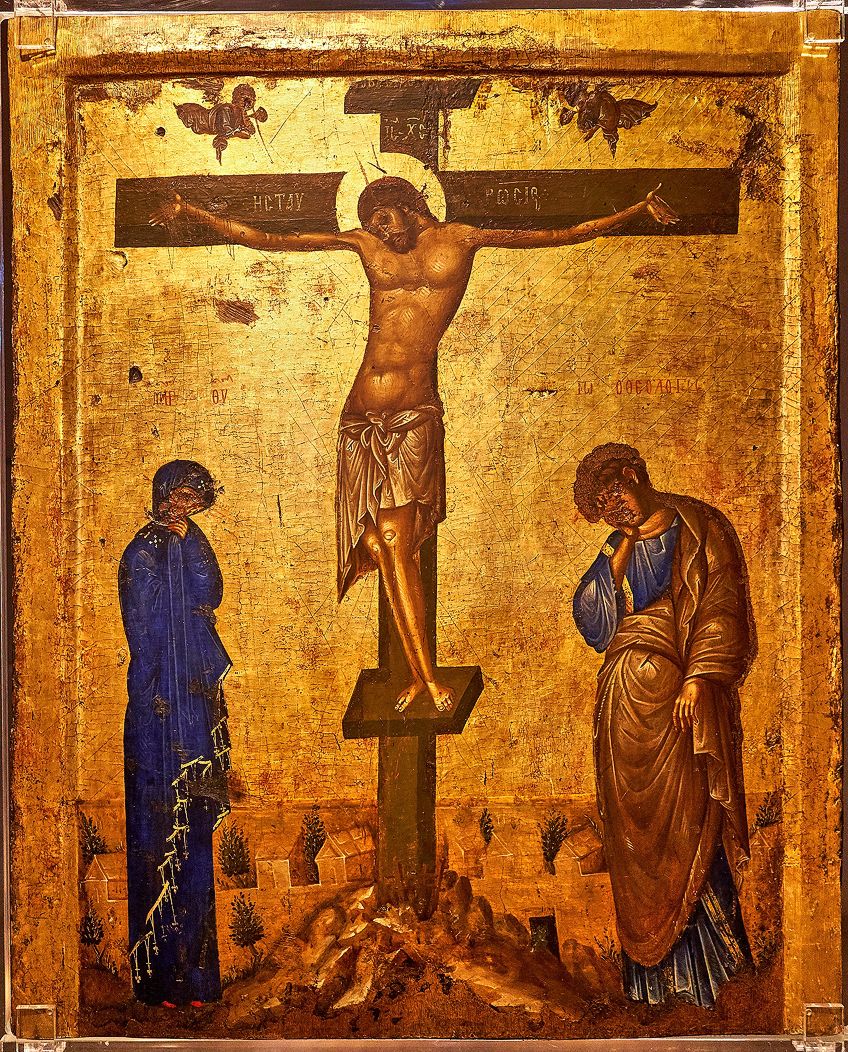
The 14th-century Crucifixion icon is much later than Iconoclasm. Its figures, gestures, inscriptions, and gold ground belong to a living image tradition restored after 843, not to a style frozen in the eighth century.
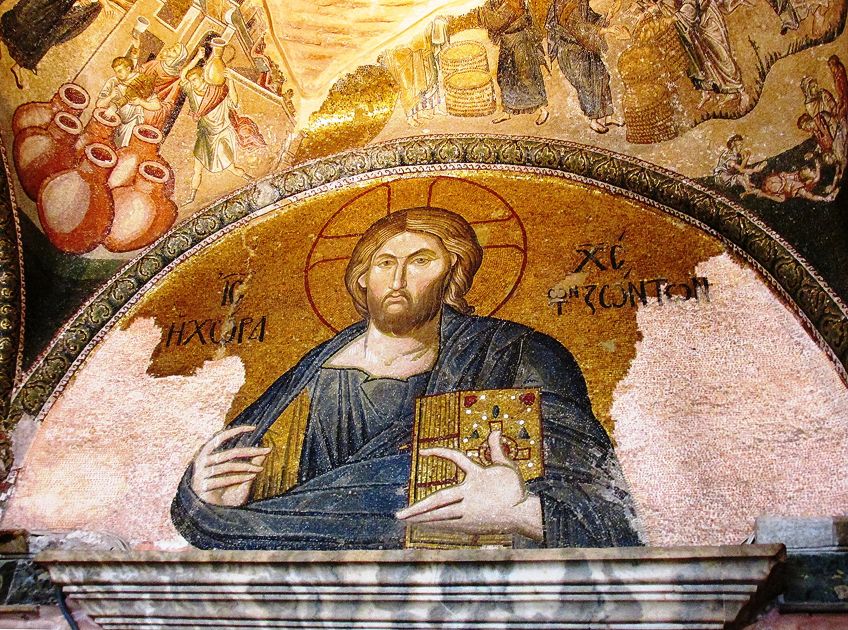
The Pantocrator mosaic in the Chora church likewise belongs to the Late Byzantine renewal of Constantinople. Modeling, highlights, line, and a commanding frontal gaze create presence without imitating ordinary space.

Hagia Eirene’s apse cross is among the most important surviving monuments associated with Iconoclasm. Its non-figural program shows that image restriction did not end decoration, architecture, or symbolic design. The supplied numeric Commons source and public-domain designation require manual confirmation because that source record could not be reopened during this update.
Middle Byzantine Art, 843–1204
After the restoration of icons, emperors, monasteries, bishops, and private patrons supported renewed building and object production. Hierarchical church programs often placed Christ Pantocrator in the dome, the Virgin in the apse, and narrative scenes below. Artists also produced manuscripts, enamels, ivories, reliquaries, ceramics, and silks for devotion, ceremony, diplomacy, and trade.
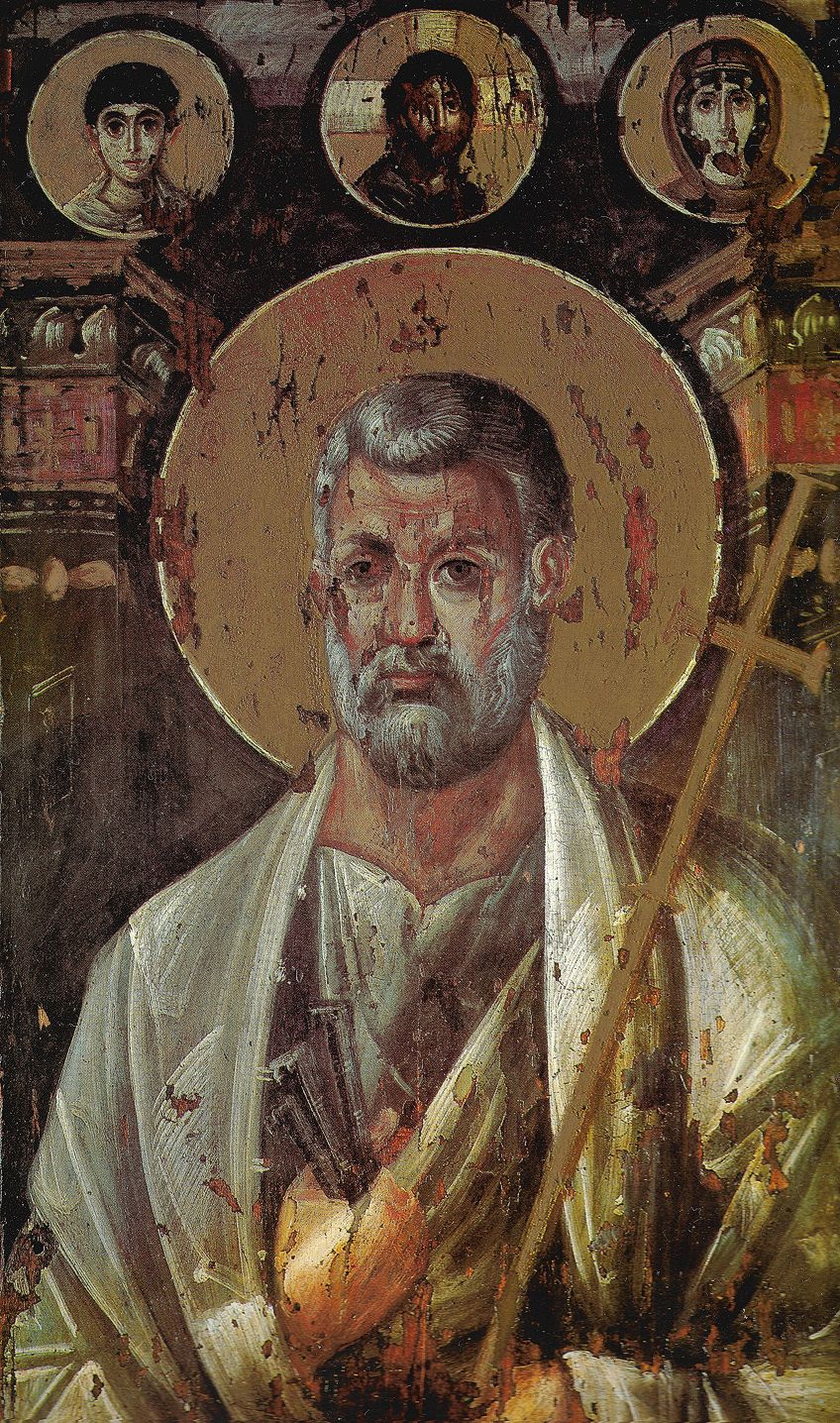
The encaustic Saint Peter icon at Sinai is usually dated to the sixth or seventh century, so it predates the Middle Byzantine period even though its icon type remained influential. Dating varies across records; a precise century should not be asserted more strongly than the evidence allows.
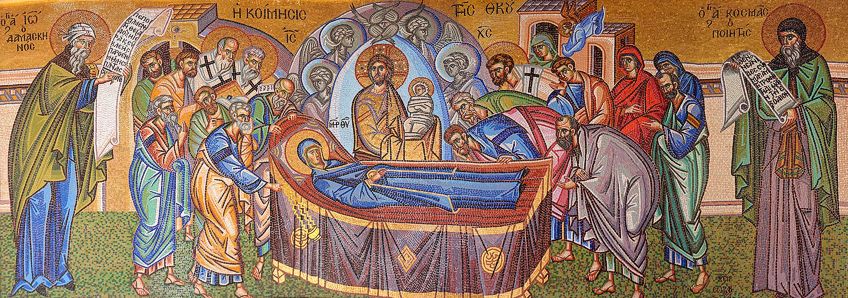
The Kykkos mosaic is a modern work made within a much older devotional tradition. It demonstrates the afterlife of Byzantine composition, but it is not a medieval mosaic. The photograph’s CC BY 3.0 label and the underlying modern artwork’s reuse status require a manual rights check because the linked record could not be reopened.
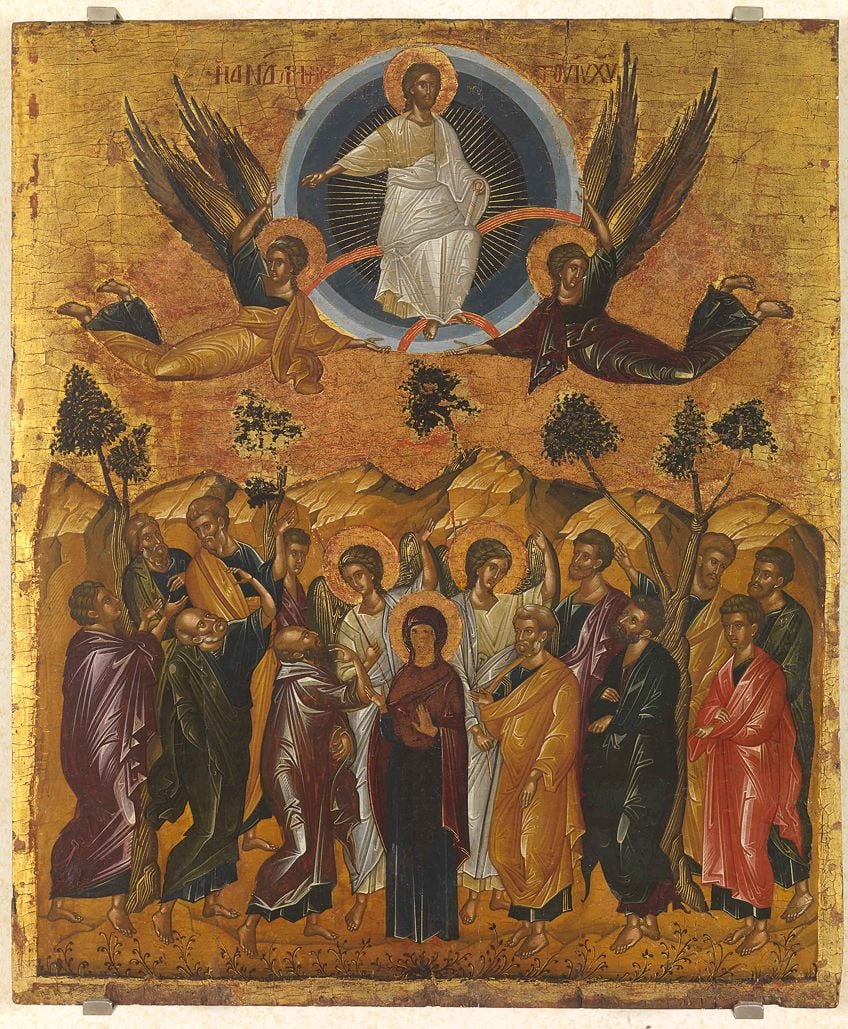
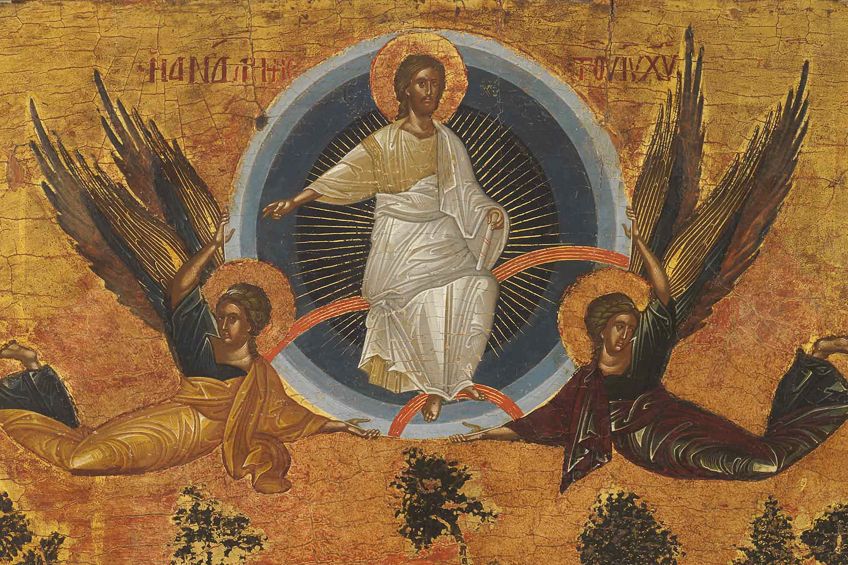
The Ascension image from Candia belongs to the late 15th-century Cretan environment under Venetian rule, after Constantinople’s fall. It illustrates continuity across a political boundary: post-Byzantine painters could sustain Orthodox iconography while working amid Venetian and Renaissance contacts.
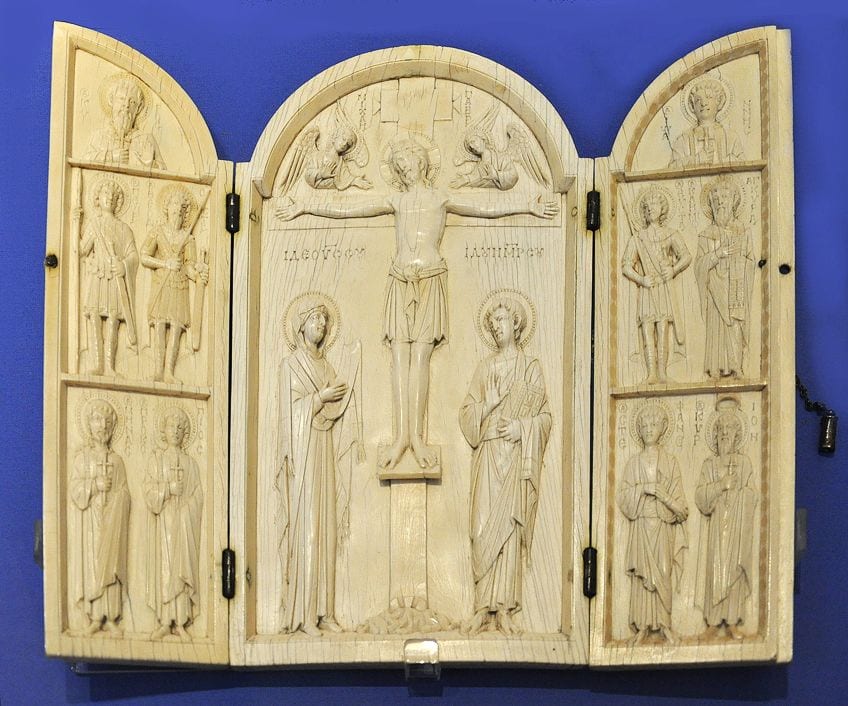
The Borradaile Triptych, made around the 10th or 11th century, shows the intimacy and precision of carved ivory. Portable objects could organize multiple sacred figures in a compact, tactile format and move between courtly, ecclesiastical, and private settings.
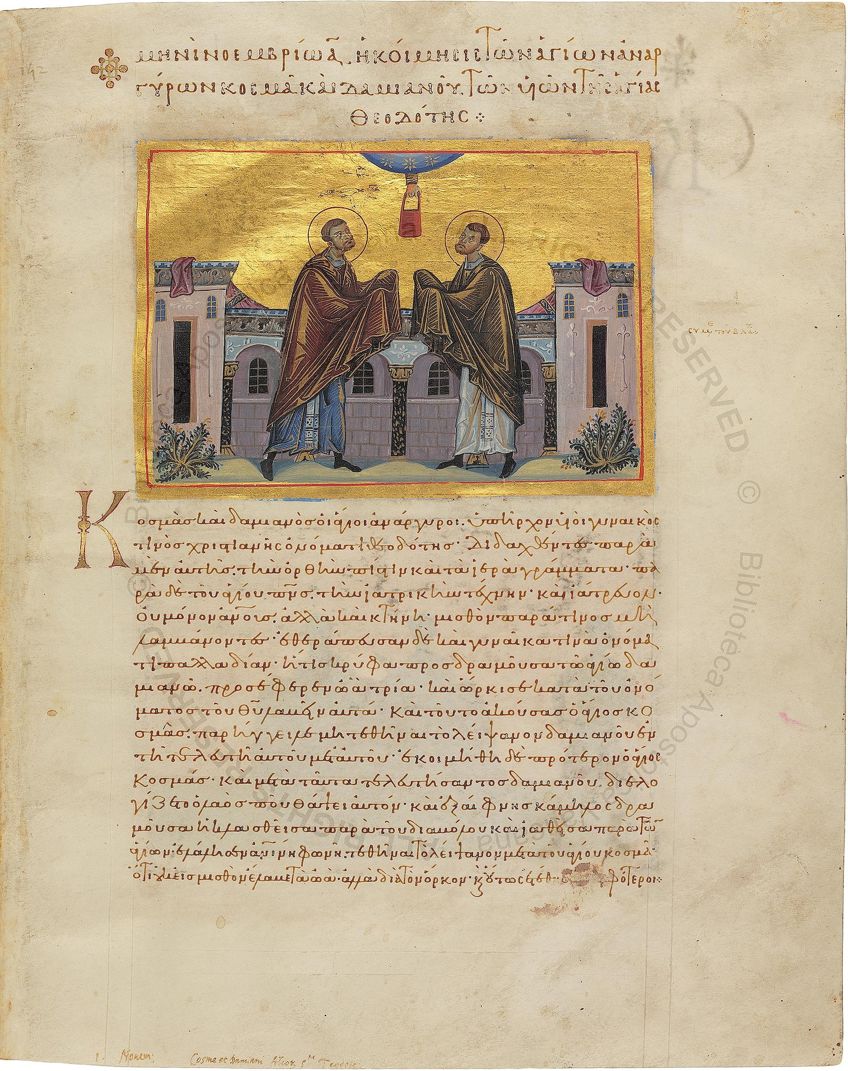
The Menologion of Basil II, made around the turn of the 11th century, is a lavishly illuminated liturgical manuscript. Its miniatures coordinate text, commemoration, imperial patronage, and workshop specialization; they are not merely small versions of wall paintings.
The Fourth Crusade and Late Byzantine Art, 1204–1453
Crusaders captured and looted Constantinople in 1204, establishing Latin rule until 1261. Byzantine successor states maintained political and artistic traditions, and the restored empire of the Palaiologan dynasty sponsored new mosaics, frescoes, icons, and manuscripts. Late Byzantine art often combines energetic movement, complex settings, expressive gesture, and renewed engagement with antique models.
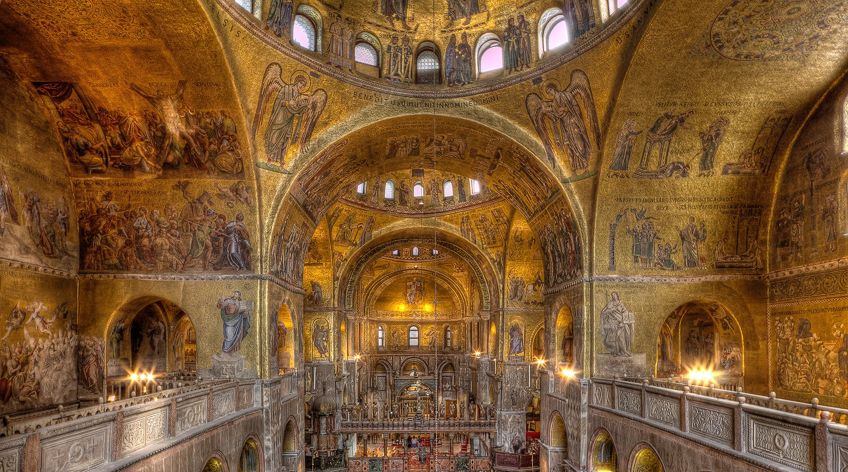
St Mark’s Basilica in Venice is not a monument of Constantinople, and its fabric and decoration developed in multiple campaigns. It is nevertheless central to Byzantine reception: Venetian wealth, trade, spolia, and imported or locally adapted mosaic practices made the church a major site of cross-cultural exchange.
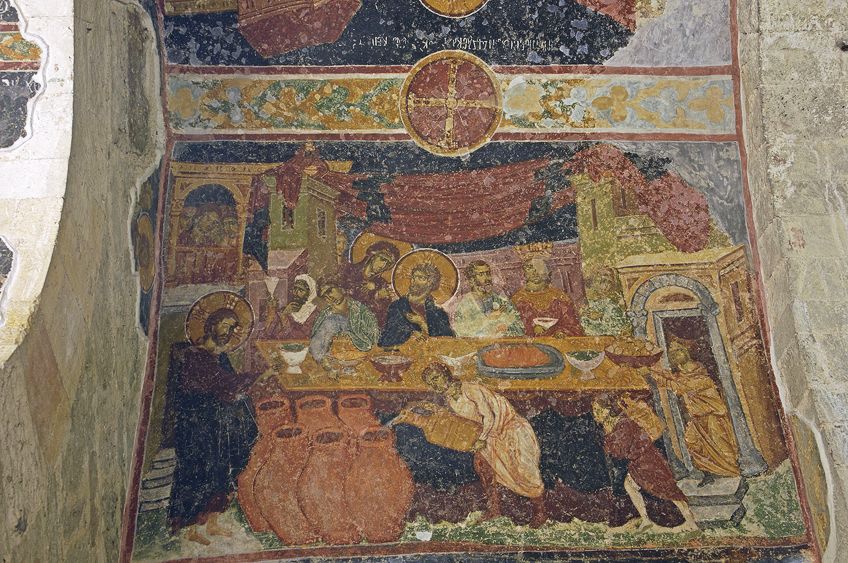
The Marriage at Cana fresco is in Hagia Sophia at Trabzon, not the better-known Hagia Sophia in Constantinople. The distinction corrects the source article’s ambiguity and places the painting in a 13th-century church associated with the Empire of Trebizond. Its Commons source identity and CC BY-SA 4.0 photo license still require manual confirmation because the record could not be reopened.
Post-Byzantine Art and Regional Legacies
The Ottoman conquest of Constantinople in 1453 ended the Byzantine state, not Byzantine visual culture. Orthodox communities, itinerant painters, monasteries, and workshops continued icon and church traditions in Crete, the Balkans, the eastern Mediterranean, and beyond. Russia, Serbia, Bulgaria, Romania, Georgia, and other regions developed their own histories rather than simply copying Constantinople.
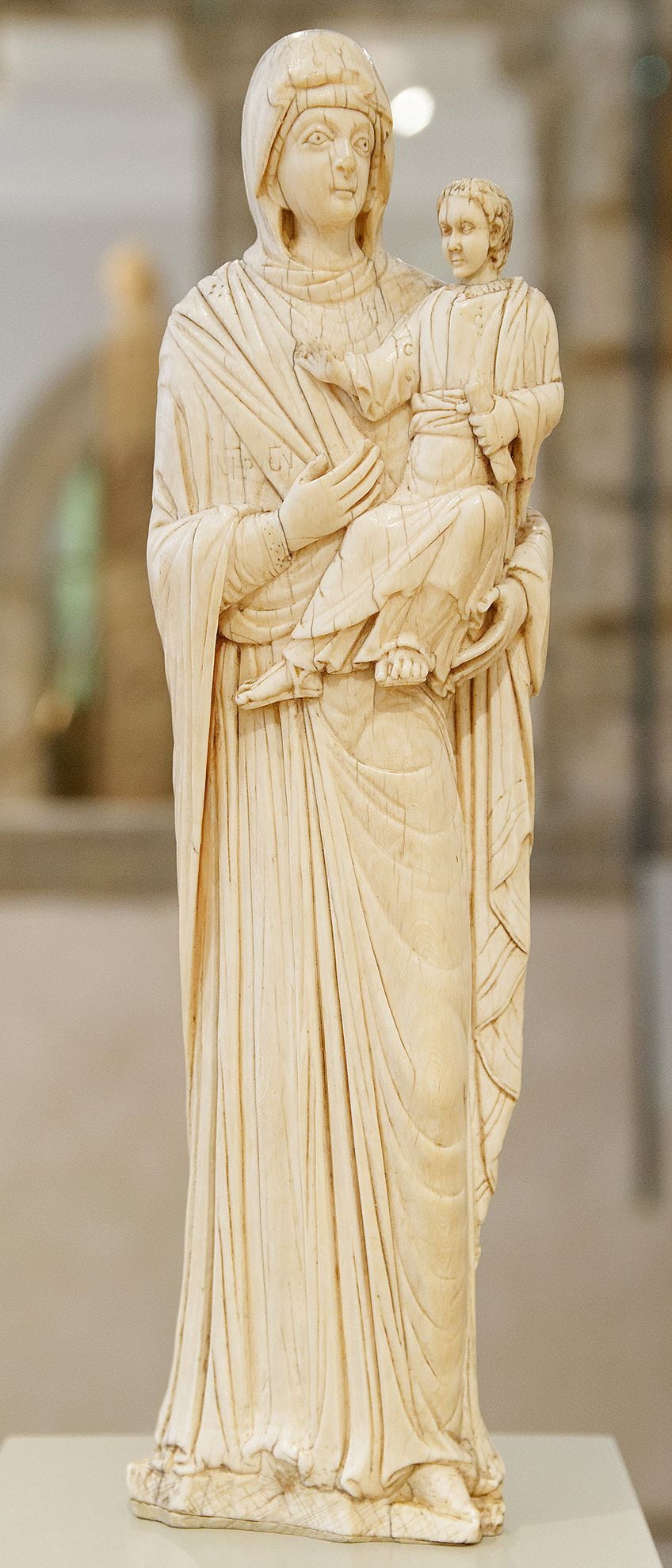
This ivory Hodegetria in the Victoria and Albert Museum dates to the turn of the 10th and 11th centuries, not 1220–1230 as the former article stated. Its current source record describes it as the only known free-standing Byzantine sculpture. The figure demonstrates how a familiar icon type could be translated into three dimensions.
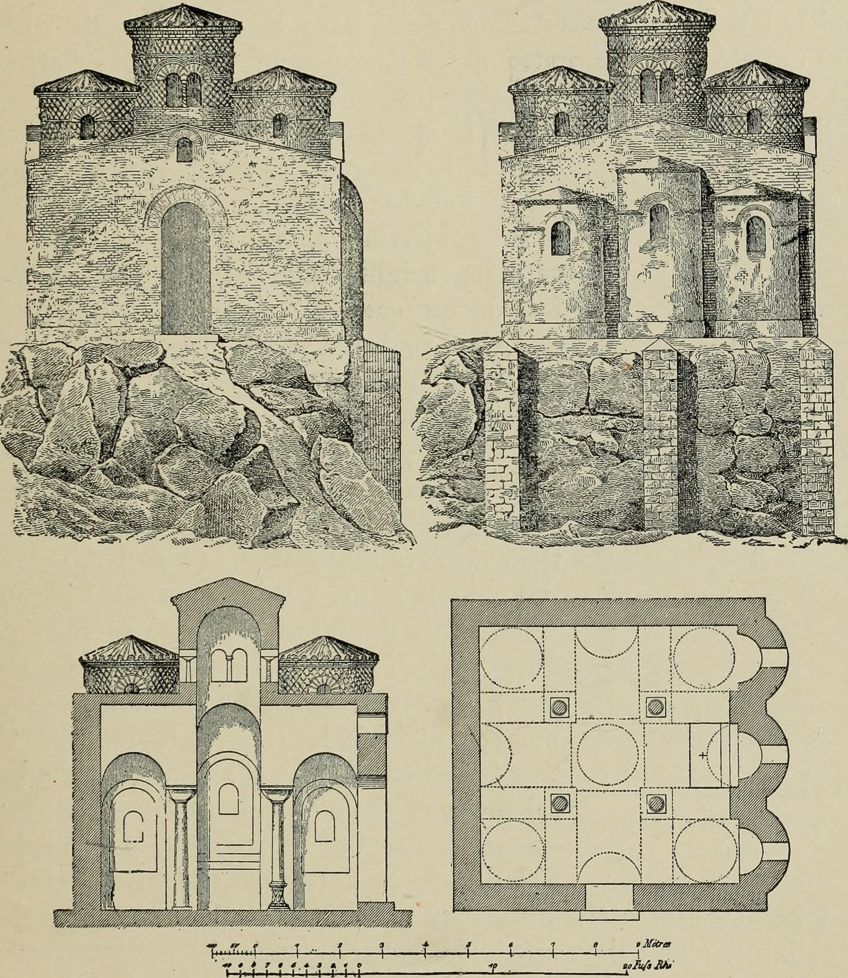
La Cattolica at Stilo in Calabria shows the importance of southern Italy to the Byzantine architectural story. Its compact Greek-cross plan and domed bays belong to a regional setting where political rule, liturgy, construction, and local craft interacted.
Characteristics and Media of Byzantine Art
No checklist describes every Byzantine work. Date, region, medium, patron, and intended use matter. Still, several recurring strategies help explain how Byzantine art creates meaning: frontal address, controlled hierarchy, inscriptions, repeated icon types, precious materials, patterned surfaces, and the integration of images with ritual space.
Icons and Iconography
An icon is a sacred image, commonly but not exclusively painted on a portable panel. Iconography means the visual conventions used to identify figures and events. Repetition was not the absence of creativity; it made an image recognizable while allowing artists to vary expression, color, material, scale, and local emphasis. The Met’s account of icons and Iconoclasm explains how sacred images functioned through prayer, procession, touch, gift, and placement.
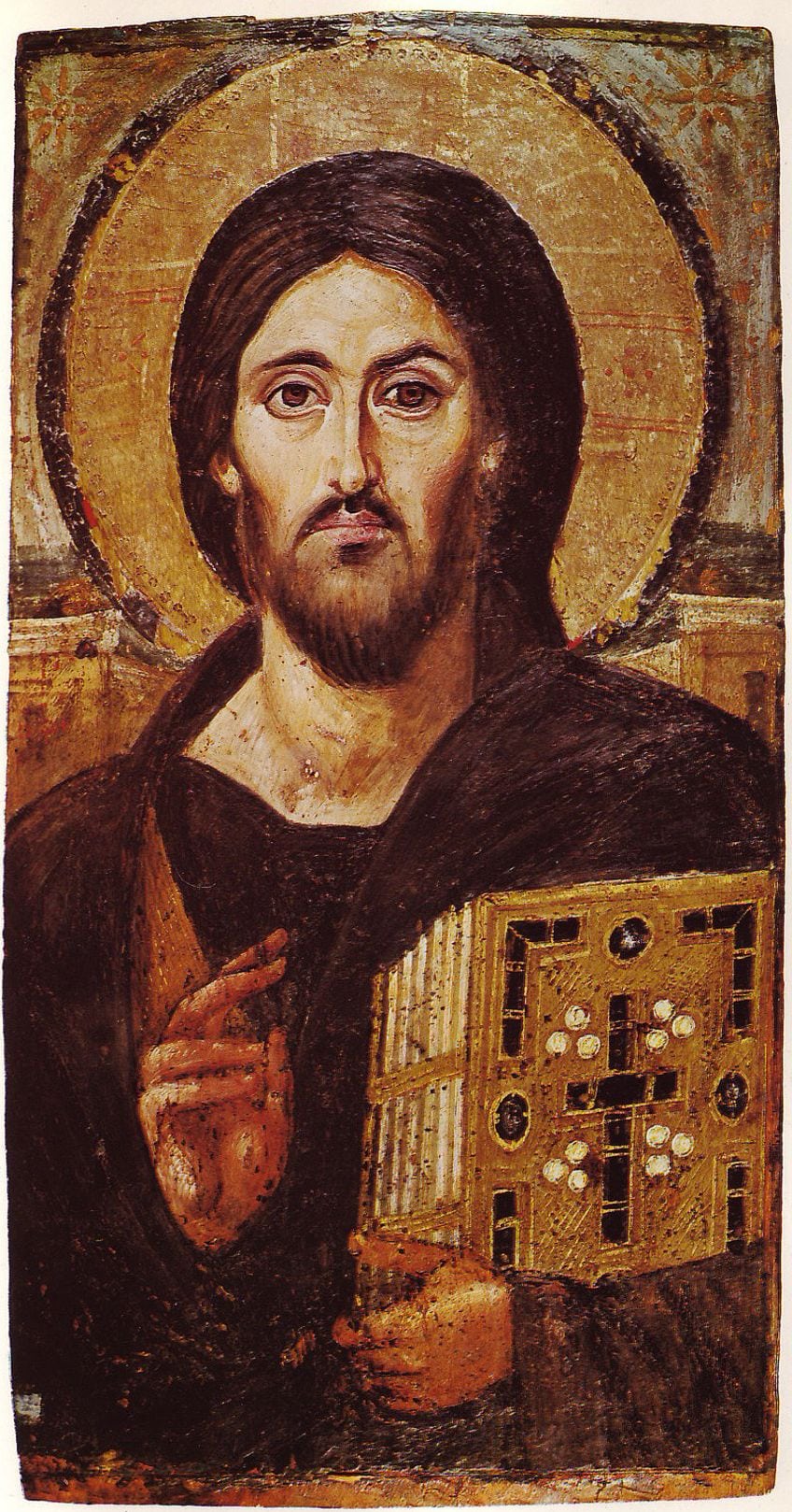
The sixth-century Christ Pantocrator at Saint Catherine’s Monastery, Sinai, is an encaustic panel painted with pigments in hot wax. Subtle asymmetry, modeling, direct gaze, blessing hand, and Gospel book combine authority with human presence. The monastery’s location helped preserve early icons, but survival is never proof that no comparable works existed elsewhere.
Mosaics, Frescoes, and Light
Mosaics assemble glass, stone, gold, and other tesserae into durable surfaces that respond to shifting light. Fresco applies pigment to wet plaster, while related wall-painting methods can involve dry finishing. Both media organize sacred space through scale and position. Gold backgrounds can deny ordinary landscape, evoke divine radiance, or intensify a figure’s presence, but Byzantine artists also depicted buildings, terrain, objects, and bodies with considerable observation.
Byzantine Architecture
Byzantine builders used basilican, centralized, and hybrid plans. Domes could rise over square bays through pendentives or squinches; columns, piers, vaults, galleries, windows, marble, and mosaics shaped movement and perception. The cross-in-square plan became widespread in the Middle Byzantine period but was not the universal design of all Byzantine churches.
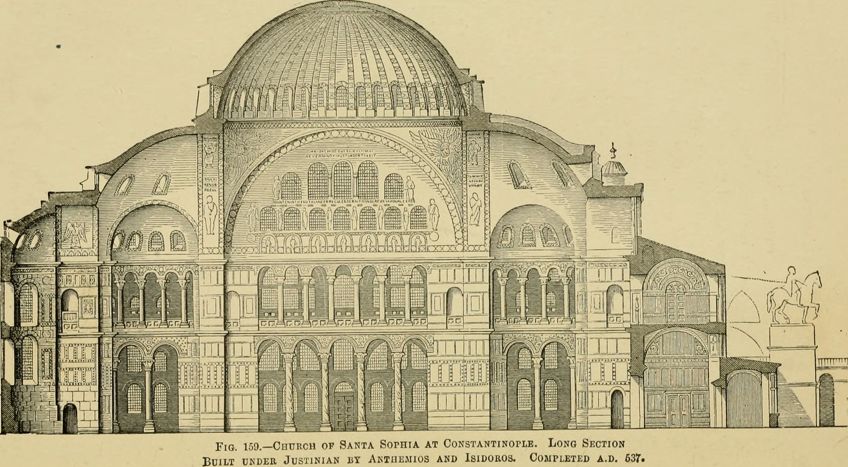
This 1888 longitudinal section of Hagia Sophia is a later analytical image. The building’s main dome, half-domes, exedrae, piers, and windowed surfaces distribute forces while creating a layered interior. Its engineering should not be separated from ceremonial movement, acoustics, light, and decoration.
Manuscripts, Ivory, Metalwork, and Textiles
Portable arts carried Byzantine imagery across distances. Manuscripts joined script, page design, pigment, and precious bindings; ivories supplied diptychs, triptychs, boxes, and reliefs; enamels and metalwork served liturgy and display; patterned silks circulated as garments, furnishings, relic wrappings, and diplomatic gifts. Small scale could demand exceptional material and technical investment.
Famous Byzantine Artworks and Monuments
Hagia Sophia
Hagia Sophia in Constantinople is the best-known Byzantine building. Its present structure was completed in 537, although earthquakes and repairs changed the dome and fabric. Its marble surfaces, vaults, galleries, windows, and mosaics created a ceremonial setting whose meanings shifted across centuries. The surviving Middle Byzantine mosaics were added after the end of Iconoclasm, so “built in 537” does not date every visible artwork inside.
Justinian and His Court at San Vitale
The sixth-century sanctuary mosaic at San Vitale in Ravenna presents Justinian, clergy, officials, and soldiers in a tightly ordered ceremonial group. Justinian carries a Eucharistic vessel, and overlapping bodies place imperial, military, and ecclesiastical authority in deliberate relation. Ravenna was part of Justinian’s western imperial project, not a suburb of Constantinople.
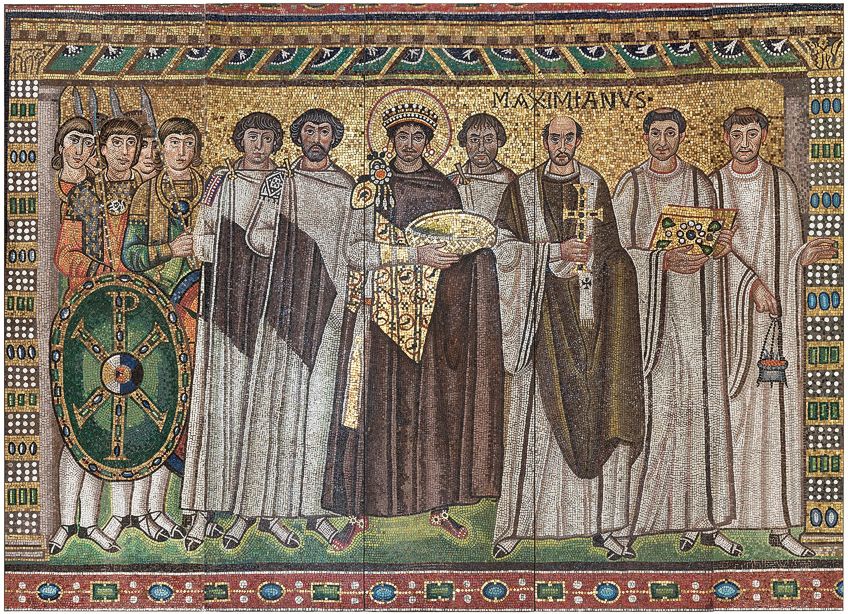
The supplied image does not photograph the original wall mosaic at San Vitale. Its current Metropolitan Museum record identifies the object as an early 20th-century glass-and-stone reproduction of the sixth-century original. The CC0 credit applies to this Met reproduction image, and the distinction is essential for accurate object identification.
The Menologion of Basil II
The Menologion of Basil II (Vatican Library, Vat. gr. 1613) was produced in Constantinople around 985–1000. It is a richly illuminated collection of readings for saints’ days and feasts, associated with Emperor Basil II. Named painters recorded in the manuscript complicate the stereotype that Byzantine artists were always anonymous.
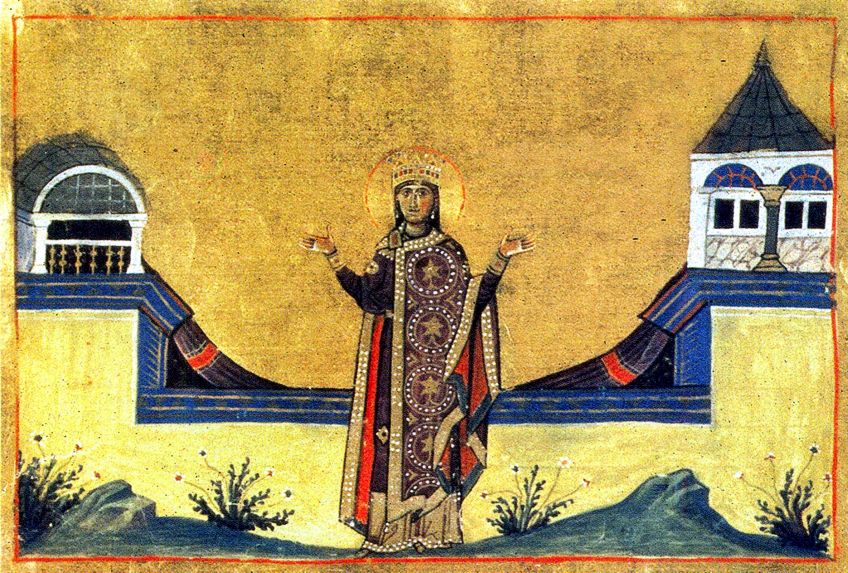
The image of Saint Theophano is a manuscript miniature, not an 11th-century textile as the supplied caption states. The depicted garment can inform the history of Byzantine dress, but representation and material object must not be confused. The linked record identifies Theophano Martiniake, wife of Leo VI, and connects the image to the manuscript’s illuminators.
How to Analyze Byzantine Art
Begin by identifying what you are actually looking at: an original object, architectural space, modern restoration, reproduction, historic photograph, or later illustration. Check date, place, material, present collection, source record, and whether the caption refers to the artwork or to the photograph.
Next, study function and setting. Was the object used on an altar, carried in procession, read at court, touched in private prayer, displayed in a palace, or fixed high in a dome? Describe scale, gaze, gesture, inscription, color, light, surface, and spatial hierarchy before assigning symbolism. Compare iconographic conventions without assuming that repetition makes works identical.
Finally, place the work within political and religious history without letting events explain everything. Iconoclasm, imperial patronage, the Fourth Crusade, trade, migration, monastic networks, and Ottoman rule changed conditions of production and survival. Technical evidence, conservation history, and regional scholarship can challenge older narratives centered only on Constantinople.
Frequently Asked Questions About Byzantine Art
What Is Byzantine Art?
Byzantine art is the visual culture of the medieval Eastern Roman Empire and related communities. It includes architecture, mosaics, frescoes, icons, manuscripts, ivory, metalwork, textiles, and objects made from 330 to 1453, with influential post-Byzantine continuations.
What Are the Main Periods of Byzantine Art?
The usual framework is Early Byzantine, Middle Byzantine, and Late Byzantine art. Iconoclasm from the eighth to ninth centuries and Latin rule in Constantinople from 1204 to 1261 are major disruptions within that chronology.
Why Do Byzantine Paintings Look Flat?
Some Byzantine images reduce deep illusionistic space to emphasize sacred presence, hierarchy, and legibility. Others use modeling, landscape, architecture, movement, and emotion. “Flat” describes certain visual choices, not the full tradition or a lack of skill.
What Is the Difference Between an Icon and a Mosaic?
An icon is a sacred image defined mainly by its function and subject; it is often a portable panel but can exist in other media. A mosaic is a technique that forms an image from tesserae. A mosaic can therefore function as an icon.

Isabella studied at the University of Cape Town in South Africa and graduated with a Bachelor of Arts majoring in English Literature & Language and Psychology. Throughout her undergraduate years, she took Art History as an additional subject and absolutely loved it. Building on from her art history knowledge that began in high school, art has always been a particular area of fascination for her. From learning about artworks previously unknown to her, or sharpening her existing understanding of specific works, the ability to continue learning within this interesting sphere excites her greatly.
Her focal points of interest in art history encompass profiling specific artists and art movements, as it is these areas where she is able to really dig deep into the rich narrative of the art world. Additionally, she particularly enjoys exploring the different artistic styles of the 20th century, as well as the important impact that female artists have had on the development of art history.
Learn more about Isabella Meyer and the Art in Context Team.
Cite this Article
Isabella, Meyer, “Byzantine Art – Traversing the Byzantine Empire Art Period.” Art in Context. June 17, 2021. URL: https://artincontext.org/byzantine-art/
Meyer, I. (2021, 17 June). Byzantine Art – Traversing the Byzantine Empire Art Period. Art in Context. https://artincontext.org/byzantine-art/
Meyer, Isabella. “Byzantine Art – Traversing the Byzantine Empire Art Period.” Art in Context, June 17, 2021. https://artincontext.org/byzantine-art/.


As a fellow iconographer working in egg tempera, I truly appreciate your commitment to the ancient methods. It is rare to see such a dedicated use of traditional levkas and natural pigments to achieve that unique translucent depth. You perfectly capture the essence of the icon as a ‘liturgical window’ where light is not reflected, but radiated from within. It’s inspiring to see this living tradition preserved with such technical and spiritual integrity.
Thank you for your thoughtful comment and for sharing your perspective as a fellow iconographer. The enduring traditions of Byzantine iconography continue to inspire artists and viewers alike, and it is fascinating to see how these centuries-old techniques remain relevant today.
The use of natural pigments, traditional materials, and time-honoured methods not only preserves a rich artistic heritage but also reflects the deeper spiritual symbolism that makes iconography unique. The concept of the icon as a “window” to the divine has been central to its significance throughout history, and it is encouraging to see this tradition appreciated and carried forward by contemporary practitioners.
Thank you for contributing to the discussion and for your dedication to this remarkable art form.