


AI Helped Map Changes in William Merritt Chase’s A Comfortable Corner

Artificial intelligence helped conservators investigate William Merritt Chase’s A Comfortable Corner, but it did not reconstruct the circa-1888 painting. A computer-assisted comparison flagged differences between an early photograph and the present canvas for human examination; the newly treated work returns to public view at the Parrish Art Museum on November 14.
What AI Actually Did for A Comfortable Corner
The Parrish’s collection record identifies A Comfortable Corner, also known as The Blue Kimono, as an oil on canvas measuring 57 by 44 1/2 inches. A woman reclines in a deep blue kimono with a fan in an elaborately furnished interior. The museum’s exhibition announcement calls it a highlight of one of the largest public holdings of Chase’s work.
The investigation began with two records of different moments: the painting as it reached the conservation studio and an early black-and-white photograph believed to predate a major 1960s treatment. Suzanne Siano’s team at Modern Art Conservation used AI to combine the historical photograph with a current color image. Siano told The Art Newspaper that AI helped the team assemble the comparison faster than it could have done manually in Photoshop.
| Evidence | What it can establish |
|---|---|
| Present paint surface | The canvas’s condition and visible retouching before the latest treatment. |
| Pre-1960s photograph | Details and a wider visible composition at one earlier date, but not original color. |
| AI-assisted composite | Locations where the two images diverge; it does not prove why they differ. |
| UV and magnified examination | Whether a flagged passage is consistent with overpaint, varnish, damage, or Chase’s own revision. |
That hierarchy matters. The composite was a navigation aid, not a substitute for the painting, and the historical photograph was neither high-resolution nor necessarily a record of the canvas’s earliest state. Siano’s team assessed the flagged areas with ultraviolet imaging, magnification, knowledge of Chase’s materials, and comparisons with other works. The published information does not name the AI software or explain how the two images were registered, so the composite is not a reproducible technical map on the evidence now available.

The Painting Had Already Been Treated Twice
The treatment history can be dated more precisely than a general reference to “earlier restoration.” A 2024 Bank of America project booklet, published when conservation funding was announced, says the painting was treated before it entered the Parrish collection in 1961 and again under the museum’s aegis in 1968.
- Before 1961: An initial treatment had already occurred before the Littlejohn Collection painting entered the Parrish.
- 1968: Another treatment was carried out under museum supervision.
- September 2024: The Parrish announced a conservation grant and named Siano to lead the project.
- By 2026, Modern Art Conservation had examined and treated the canvas under Siano’s leadership, with Shauna Young and Alice Copley also named by the Parrish.
- November 14, 2026: The painting went back on public display in the Parrish exhibition.
By the latest campaign, the canvas carried a heavy, coarse lining, blotchy inpainting, retouching, and uneven varnishes that had discolored or changed the texture of some passages. The 2024 plan called for removing degraded varnish and old retouching, adding a protective varnish, removing metal strips at the edges, and reinforcing those areas as needed. Those are physical conservation measures; they are separate from the AI comparison that helped direct examination.
The early photograph showed a curl of hair beneath the sitter’s ear that was no longer visible, along with screen details that had faded or disappeared and delicate passages replaced by heavier marks. It also suggested that more of the composition was once visible, possibly because edges were later folded around a smaller stretcher or because damaged margins were taken out of view.
The most telling find was Chase’s faint signature in the carpet. Parts appeared to sit beneath later overpaint. Siano proposed that the artist’s abbreviated, abstract lettering may have been mistaken for the carpet pattern during an earlier intervention. That remains a conservator’s interpretation, not a documented motive. The team also found pentimenti—changes by Chase himself—that the old photograph did not make apparent, which is precisely why difference alone cannot identify restoration damage.
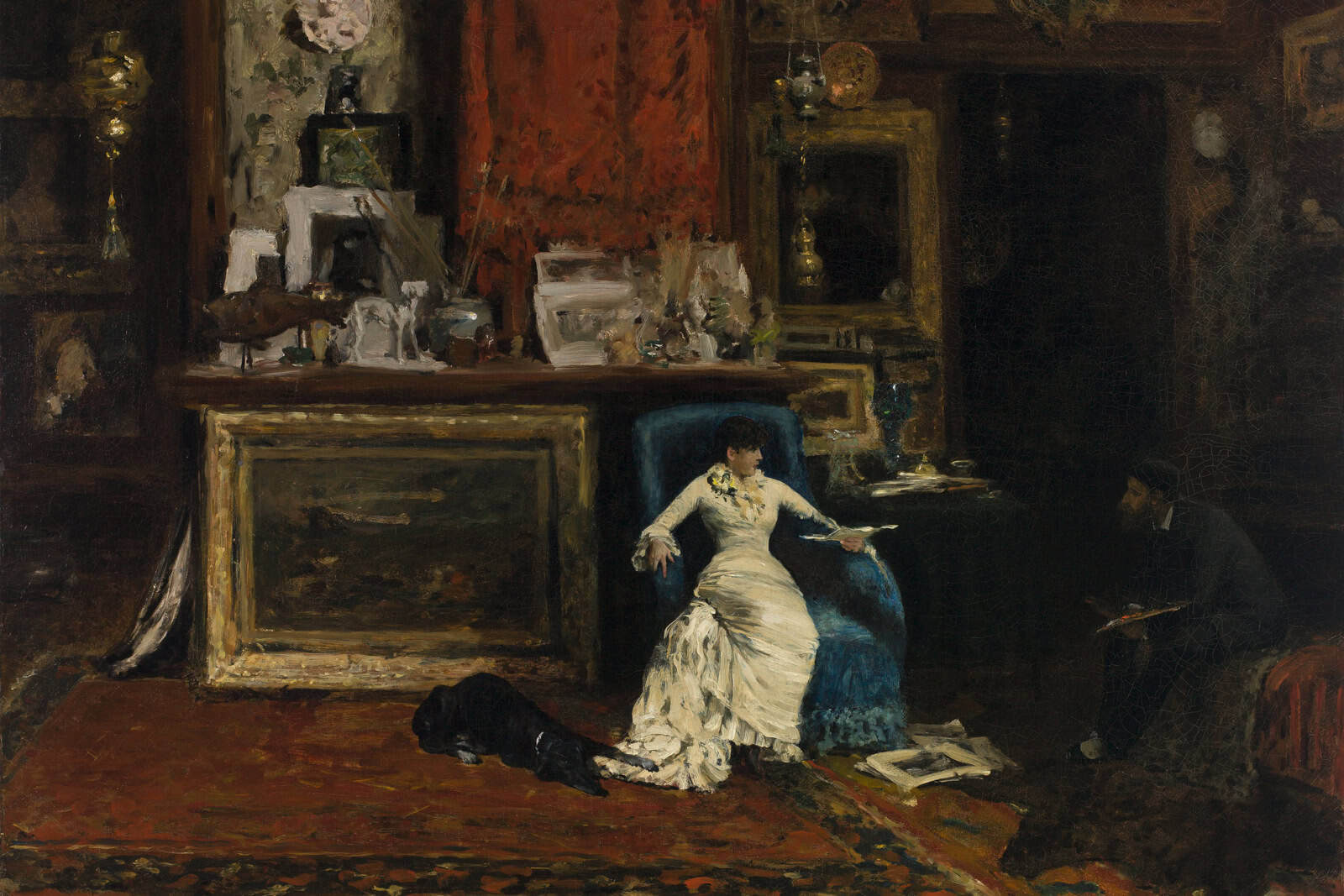
William Merritt Chase, The Tenth Street Studio, 1880. Saint Louis Art Museum. Public domain.
Why the Kimono, Fan, and Screen Matter
The conservation questions affect more than surface neatness. In the broader career of William Merritt Chase, the painting belongs to a period when he staged figures among the textiles, furnishings, pictures, and collectible objects that filled his interiors. Here the kimono, white uchiwa fan, and decorative screen place the sitter within the Western fashion for Japanese art and design commonly described as Japonisme.
Those objects do different visual work. The blue robe supplies the figure’s dominant color; the pale fan punctuates her hands; the screen and patterned carpet extend decoration into the surrounding room. The painting therefore does not isolate a likeness against a neutral background. It makes the sitter part of an arranged interior, where costume, furniture, and pattern carry as much interpretive weight as facial identity.
That makes the reported losses unusually consequential. A missing hair curl changes the boundary between sitter and setting. Weakened screen passages reduce one of the picture’s clearest Japanese references. Overpaint across the carpet can obscure both pattern and authorship because the signature occupies that decorative field. The black-and-white photograph can document shapes and tonal relationships at an earlier stage, but it cannot establish the original colors of lost passages. An AI composite made from it cannot supply color evidence that the source does not contain.
The Restored Painting Is Back on View
A Comfortable Corner appears in William Merritt Chase and Walter Granville-Smith: American Impressionists of the East End, open at the Parrish in Water Mill, New York, from November 14, 2026, through March 21, 2027. The display includes photographs and video made before, during, and after treatment, allowing visitors to distinguish the physical canvas from the tools used to study it.
That presentation is especially useful because the conservation story is not a simple before-and-after reveal. The 2024 plan targeted old varnish, retouching, and edge problems, while the later account makes clear that the team did not reinstate every difference shown by the composite.
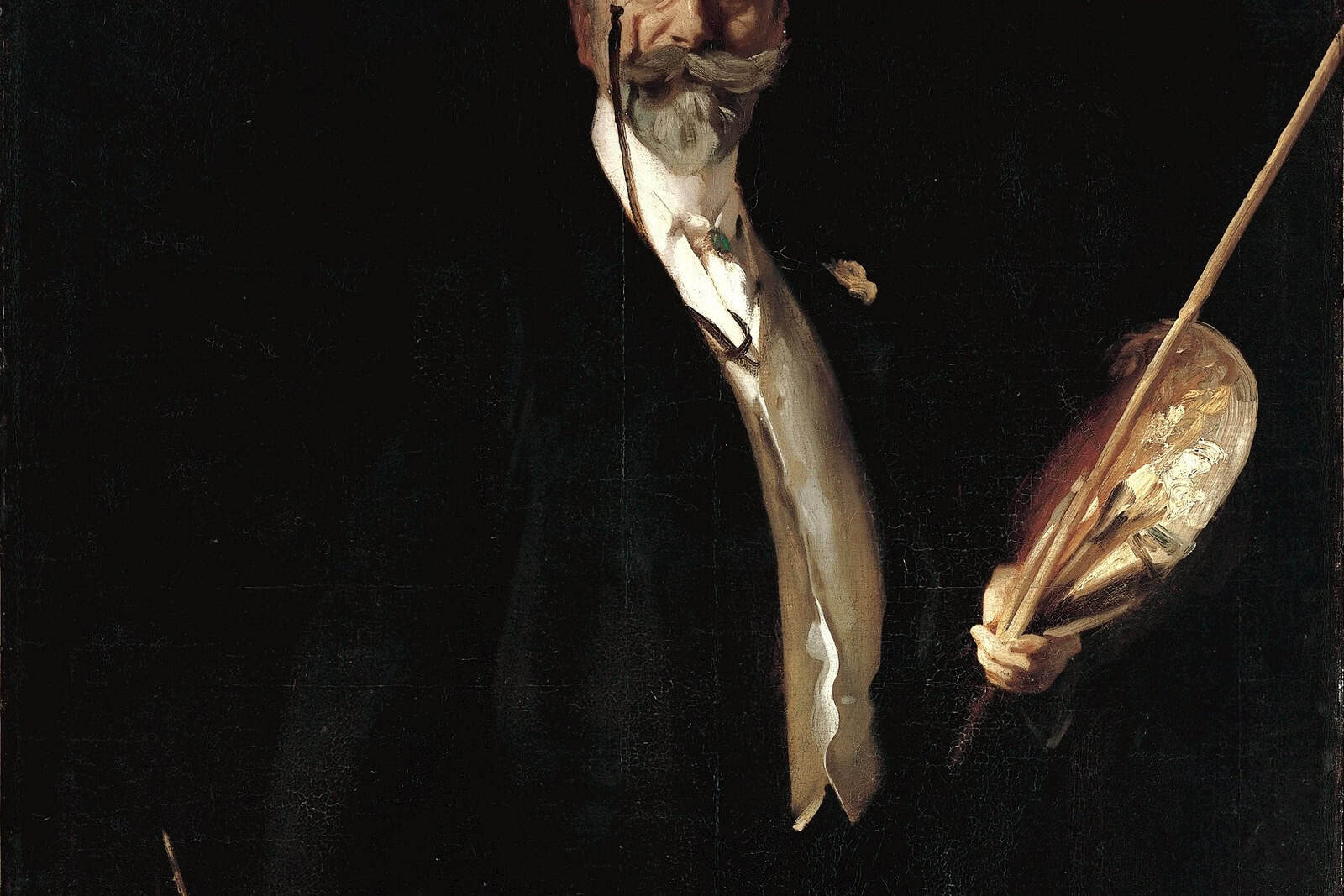
John Singer Sargent, William M. Chase, N. A., 1902. The Metropolitan Museum of Art. Public domain.
A Faster Comparison, Not an AI Restoration
The documentary record establishes that the 1968 campaign was not the painting’s first treatment; another intervention occurred before its 1961 accession. It also establishes that AI accelerated the alignment and comparison of two images, while ultraviolet examination, magnification, material knowledge, and human judgment guided conservation decisions.
The evidence does not establish the exact original appearance of every lost passage, the reason the visible format became smaller, or which earlier campaign caused each change. The pre-1960s photograph records one historical state, not an untouched original. What returned to view is a conservatively treated painting informed by AI-assisted comparison—not a machine-generated reconstruction.

Isabella studied at the University of Cape Town in South Africa and graduated with a Bachelor of Arts majoring in English Literature & Language and Psychology. Throughout her undergraduate years, she took Art History as an additional subject and absolutely loved it. Building on from her art history knowledge that began in high school, art has always been a particular area of fascination for her. From learning about artworks previously unknown to her, or sharpening her existing understanding of specific works, the ability to continue learning within this interesting sphere excites her greatly.
Her focal points of interest in art history encompass profiling specific artists and art movements, as it is these areas where she is able to really dig deep into the rich narrative of the art world. Additionally, she particularly enjoys exploring the different artistic styles of the 20th century, as well as the important impact that female artists have had on the development of art history.
Learn more about Isabella Meyer and the Art in Context Team.
Choose Art in Context as a preferred source to see more of our reporting in Google Top Stories and other Google Search experiences.
Cite this Article
Isabella, Meyer, “AI Helped Map Changes in William Merritt Chase’s A Comfortable Corner.” Art in Context. November 13, 2026. URL: https://artincontext.org/william-merritt-chase-comfortable-corner-ai-conservation/
Meyer, I. (2026, 13 November). AI Helped Map Changes in William Merritt Chase’s A Comfortable Corner. Art in Context. https://artincontext.org/william-merritt-chase-comfortable-corner-ai-conservation/
Meyer, Isabella. “AI Helped Map Changes in William Merritt Chase’s A Comfortable Corner.” Art in Context, November 13, 2026. https://artincontext.org/william-merritt-chase-comfortable-corner-ai-conservation/.


