

Ireland’s Possible Ice Age Cave Art Still Has No Date

Researchers surveying 28 caves in south-west Ireland have identified eight sites with markings that warrant closer study. The team says at least some marks are human-made, but no scientific result yet supports the widely repeated claim that they are 15,000 years old or Ireland’s first Ice Age cave art.
Eight Caves, but No Ice Age Date Yet
During summer 2026 fieldwork, the Lost Land Bridge Project used an AI-assisted research system called LIACARA to narrow a much larger landscape to 28 candidate caves. Project director Genevieve von Petzinger, rock-art specialist George Nash, researcher Barbara Oosterwijk and caving specialists then inspected the sites in person. Eight contained marks the team considered worth further investigation; their precise locations are being withheld to protect them.
Newstalk joined the expedition in June. The project’s own public evidence record says finger trails in one documented cave were, in the team’s judgment, made by people. These “finger flutings” were drawn through moonmilk, a soft deposit of tiny calcite crystals and water on limestone. The wider survey also recorded red and black pigment, scratched lines and forms that researchers think may include animal silhouettes. Those are field observations and interpretations, not dates.
A BBC report published September 4 and updated September 5 described the eight sites as having rock art dating to at least 15,000 years ago and said Ireland’s first known people were most likely from Wales. The project record published with Newstalk’s September 13 documentary is materially more cautious: it calls an Ice Age date provisional, says sampling and analysis are only beginning, and says a walkable Wales–Ireland land bridge has not been demonstrated. The Art Newspaper used the appropriate conditional on September 18: if the marks date to roughly 15,000 to 10,000 years ago, they could become Ireland’s first known cave art from the last Ice Age.
| Status | Evidence on September 19 |
|---|---|
| Observed | Twenty-eight caves were inspected; eight have marks requiring closer study. |
| Team assessment | Finger trails in one documented cave were made by human hands. |
| Provisional | Some marks may be Palaeolithic, and some outlines may depict animals. |
| Not established | A 15,000-year date, Ice Age authorship across all eight caves, and a crossing from Wales. |
The distinction is central to the art claim. A deliberate groove can be ancient, medieval or modern; identifying human action does not by itself place the mark within Ice Age visual culture.

Aillwee Cave in County Clare, shown as regional cave context; it is not identified as one of the eight undisclosed survey sites. Photograph by Olliebailie, via Wikimedia Commons, licensed under Creative Commons Attribution-Share Alike 4.0 International; cropped.
What the Planned Tests Can Actually Establish
The testing program is strong because its methods answer different questions. It will be strongest if dates and material identifications are tied to individual marks rather than used to age the eight-cave group as a whole.
Radiocarbon dating of charcoal can supply a direct age for sampled carbon if the black material truly belongs to a mark. It cannot date an engraving or mineral ochre, and the result dates the charcoal itself; contamination or the use of old wood can separate that date from the moment of drawing. Replicate samples and a secure physical relationship to the image therefore matter.
Raman spectroscopy identifies substances from their molecular signatures. It may distinguish charcoal from manganese black and identify iron oxides in red ochre; imaging, microscopy and complementary chemistry are needed to assess whether color was applied and how it relates to later deposits. It does not produce a calendar date. As another recent rock-art materials study shows, Raman results become meaningful when combined with microscopy, chemistry and the object’s layer structure.
Uranium-thorium dating can date calcite that formed over a mark. If the physical sequence is unambiguous, an overlying crust gives the underlying image a minimum age: the image must already have existed when the calcite began to grow. A peer-reviewed study of Iberian cave art demonstrates that logic. It does not automatically date the image to the same moment as the crust, and contamination or mixed calcite growth can complicate a result.
Ancient-DNA sampling could test whether biological material survives in the finger trails and whether any recovered sequences are genuinely ancient and human. This is experimental evidence, not an authorship shortcut. A June 2026 Nature Communications study, which included Nash and von Petzinger, recovered ancient human DNA from some Iberian cave-wall samples but did not conclusively connect that DNA to the making of the art. DNA also does not provide the precise radiometric age that the Irish claim requires.
Together, the methods can build a chain: photography establishes form and superposition; Raman identifies materials; radiocarbon dates suitable charcoal; uranium-thorium constrains a mark beneath calcite; and DNA may identify ancient contact. Agreement among independent lines would be far more persuasive than resemblance to known Ice Age flutings alone.
The Benchmark Is a Bear Bone, Not a Painting
Ireland already has accepted evidence for people during the late Ice Age. A brown-bear kneecap from Alice and Gwendoline Cave in County Clare bears cut marks made while the bone was fresh. In 2016, University College London reported two independent radiocarbon results: 12,810–12,590 and 12,810–12,685 calibrated years before present. Their overlap underpins the widely used shorthand of about 12,500 years ago.
That bone is evidence of human presence, not image-making. A separate reindeer bone from County Cork has been proposed as evidence of human activity about 33,000 years ago, but that reading remains disputed. The bear patella therefore remains the useful accepted comparison.
The proposed 15,000-to-10,000-year window crosses that benchmark. A mark near the old end would predate the bear bone by millennia; one near the recent end would not. Until individual dates are returned, “5,000 years earlier” is a hypothesis, not a finding.
If testing confirms a Palaeolithic date and intentional image-making, the Clare marks would expand the map of European prehistoric art into a country where no Ice Age cave-art tradition is currently accepted. The art could also establish human presence at its own cave. It would not, by itself, prove that its maker came from Wales.
The route hypothesis remains a separate geological and archaeological question. Sea level was much lower at the last Ice Age’s coldest stage, but Newstalk’s project record says nobody has shown that the proposed corridor was continuously dry enough to cross on foot. A dated image in Clare would establish a person in Clare; origin and itinerary would require additional evidence.
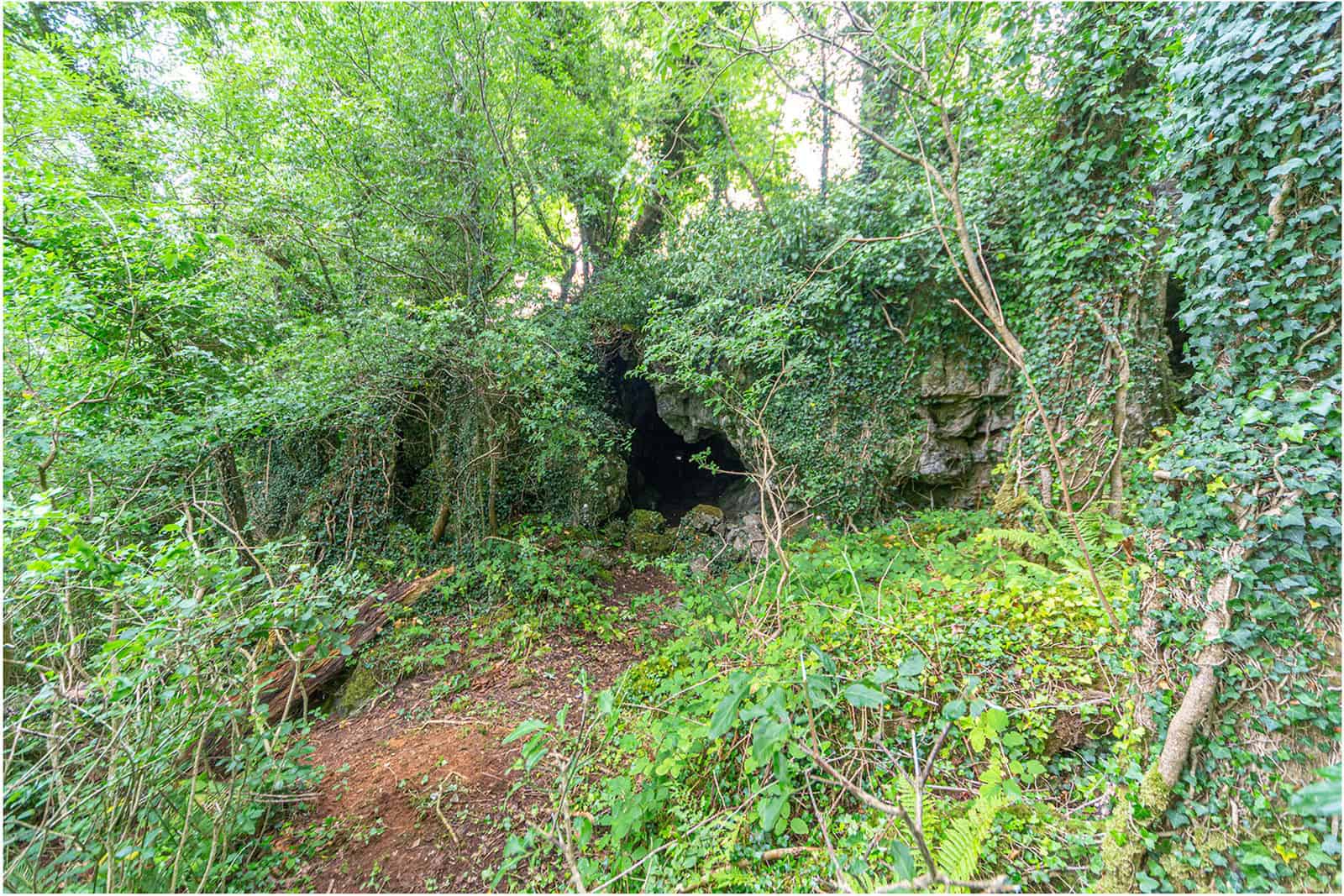
The exterior of Alice and Gwendoline Cave, source of the accepted butchered-bear-bone benchmark—not one of the eight undisclosed survey sites. Photograph by Thorsten Kahlert, via Wikimedia Commons, licensed under Creative Commons Attribution 4.0 International; cropped.
Ireland’s Cave Marks: What Is Now Established
The Lost Land Bridge Project’s public record establishes a survey of 28 Clare caves, eight sites with marks selected for further study, and a team assessment that finger trails in one documented cave are human-made.
No laboratory date yet establishes that any of the marks is 15,000 years old. The BBC’s September 4–5 wording treats the age and Welsh origin too firmly; the project’s September 13 record and The Art Newspaper’s September 18 conditional account match the present evidence.
The planned tests can identify pigments, directly date suitable charcoal, set minimum ages for marks beneath calcite and look for ancient human DNA. None alone can prove the age, maker and migration route of every mark across all eight caves.
The age of each marked surface, whether the pigments and engravings belong to one period, whether the apparent animals are intentional images, and how their makers reached Ireland all remain unknown.

Isabella studied at the University of Cape Town in South Africa and graduated with a Bachelor of Arts majoring in English Literature & Language and Psychology. Throughout her undergraduate years, she took Art History as an additional subject and absolutely loved it. Building on from her art history knowledge that began in high school, art has always been a particular area of fascination for her. From learning about artworks previously unknown to her, or sharpening her existing understanding of specific works, the ability to continue learning within this interesting sphere excites her greatly.
Her focal points of interest in art history encompass profiling specific artists and art movements, as it is these areas where she is able to really dig deep into the rich narrative of the art world. Additionally, she particularly enjoys exploring the different artistic styles of the 20th century, as well as the important impact that female artists have had on the development of art history.
Learn more about Isabella Meyer and the Art in Context Team.
Choose Art in Context as a preferred source to see more of our reporting in Google Top Stories and other Google Search experiences.
Cite this Article
Isabella, Meyer, “Ireland’s Possible Ice Age Cave Art Still Has No Date.” Art in Context. September 19, 2026. URL: https://artincontext.org/ireland-ice-age-cave-art-dating-pending/
Meyer, I. (2026, 19 September). Ireland’s Possible Ice Age Cave Art Still Has No Date. Art in Context. https://artincontext.org/ireland-ice-age-cave-art-dating-pending/
Meyer, Isabella. “Ireland’s Possible Ice Age Cave Art Still Has No Date.” Art in Context, September 19, 2026. https://artincontext.org/ireland-ice-age-cave-art-dating-pending/.


