

The Gleaners by Jean-François Millet: Painting Analysis

Jean-François Millet’s 1857 oil painting The Gleaners turns three small acts of fieldwork into the organizing rhythm of an entire landscape. Follow the women’s movement from bending to gathering to rising, and the distant harvest begins to reveal a carefully arranged social world. Looking closely also helps separate what the canvas shows from the political meanings that viewers have attached to it.
| Artist: | Jean-François Millet |
| Primary title: | Des glaneuses |
| Common English title: | The Gleaners |
| Date: | 1857 |
| Medium: | Oil on canvas |
| Dimensions: | 83.5 by 110 cm |
| Accession number: | RF 592 |
| Current collection: | Musée d’Orsay, Paris |
| Object identity: | The original 1857 oil painting |
How to Look at The Gleaners
Begin with the three women arranged across the foreground. Their bodies occupy much of the lower half of the canvas, while the large harvest operation behind them has been compressed into a band of small figures, stacks, sheaves, and equipment. Millet makes the gleaners physically close to the viewer but separates them from the field’s visible abundance.

Next, let your eye travel along the ground. The women search among sparse remnants rather than working amid the gathered crop. From there, look toward the busy distance and then to the mounted figure at the far right. This route moves from repetitive manual labor to organized production and supervision without requiring a written narrative.
The Three-Part Motion
The three poses contain a sequence of time within a still image. The woman at the left bends deeply and reaches down. The central figure remains low as she picks up grain. The woman on the right has begun to straighten, although she still leans forward and keeps her attention near the earth. Read from left to right, the bodies suggest bending, gathering, and rising.
This is not a progression toward rest. The last pose can lead back to the first, creating a visual loop. Each woman appears caught at a different point in the same repeated task. The rhythm explains the physical demands of gleaning more directly than a dramatic facial expression would.
Millet also avoids turning one worker into the scene’s individual heroine. The women work side by side, but they do not exchange glances or form a conversational group. Their downward focus keeps the action tied to the small pieces of grain beneath them.
Distance, Light, and Social Scale
The painting’s most striking spatial decision is its abrupt change of scale. The foreground bodies look solid and weighty; the harvesters behind them have become tiny marks within the landscape. This sharp difference pushes the plentiful crop farther into the distance and gives the three gleaners unusual visual importance.
That importance does not translate into material abundance. Haystacks, sheaves, a cart, and numerous workers fill the background, while the women collect individual ears missed by the main harvest. Nearness and size give them presence, but the composition keeps the gathered wealth elsewhere.
Slanting sunset light picks out hands, necks, shoulders, and curved backs. These illuminated areas make the strain of each posture easier to read. Farther away, forms lose definition in a powdery golden haze. The contrast between firm foreground bodies and softened distance guides attention while expanding the apparent depth of the field.
The mounted man at the right provides another point of separation. The Musée d’Orsay describes him as probably an estate steward responsible for supervising the harvest and its rules. He remains small and distant, yet his elevated position distinguishes oversight from the stooped labor in front.
From Studies to the 1857 Canvas
The Gleaners did not emerge from a single encounter in a field. The Musée d’Orsay describes the painting as the culmination of about ten years of Millet’s research into the gleaner theme. Surviving drawings and a related etching show that he repeatedly reconsidered the workers’ silhouettes, spacing, and relationship to the harvested landscape.
These related works clarify the design process, but none is the same physical object as accession RF 592. A drawing, print, earlier treatment, or later impression should not be labeled as the original 1857 painting merely because it contains similar bent figures.
Millet at Barbizon
Millet moved to Barbizon in 1849. His sustained attention to agricultural workers developed there into one of the most recognizable parts of his art. That biographical setting matters because it explains why gleaning belonged to a continuing investigation of rural labor rather than serving as an isolated subject.

Millet is closely associated with the Realism art movement, which gave contemporary people and work the seriousness previously expected of more elevated subjects. He did not need a legendary event to structure The Gleaners. Repeated gestures, compressed distance, and the contrast between scarcity and plenty supplied the painting’s tension.

Placing Millet among other French painters also helps explain what was unusual about his choice. Rather than dressing ordinary labor in historical costume, he built the composition around recognizable rural workers from his own century.
From Print to Canvas
The Louvre preserves numerous studies associated with the 1857 painting, including a black-crayon sheet identified as a separate study. Such drawings reveal Millet working through the bending silhouettes and their distribution across the picture. They are evidence of preparation, not smaller editions of the finished canvas.

Millet also produced a separate etching around 1855 to 1856. The Metropolitan Museum of Art’s impression is an etching on chine collé, meaning that the printed image sits on a thin sheet attached to a heavier support. It belongs to the first of two states, a term printmakers use for a distinct stage in the development of a printing plate.
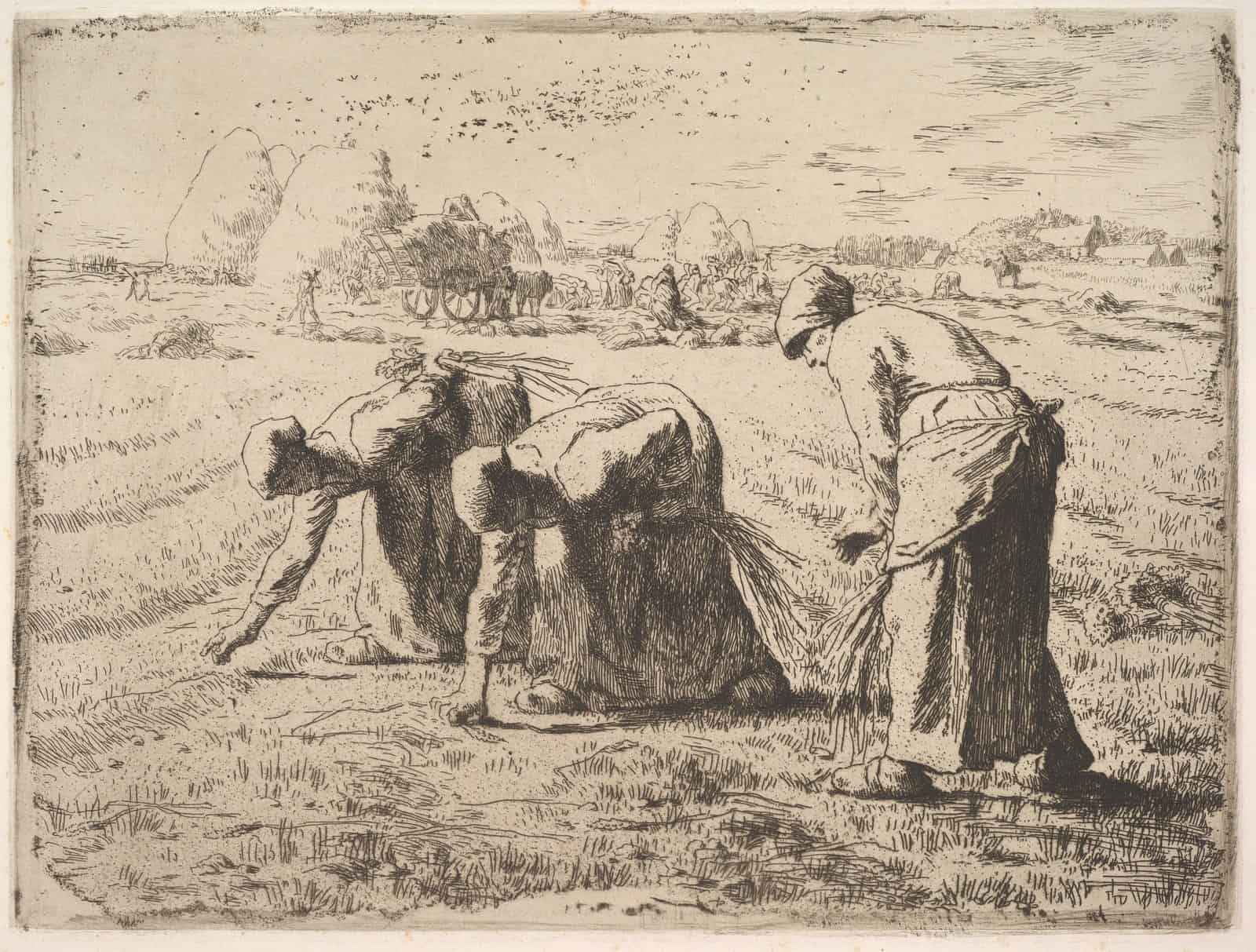
The etching already presents the gleaners in a horizontal arrangement, but its identity is unambiguous: it is a printed work rather than the oil painting. Line carries much of its visual structure. The canvas adds color, broader bodily mass, slanting light, and the softened atmosphere that separates the foreground from the distant harvest.
A practical recognition test begins with medium and dimensions. The original is an oil painting on canvas measuring 83.5 by 110 cm and carrying accession number RF 592. A work on paper, a monochrome impression, a vertically arranged treatment, or an object with another museum number is related material rather than the Musée d’Orsay canvas.
Realism and the Salon of 1857
Millet exhibited The Gleaners at the Paris Salon of 1857. The Salon was a central public venue for living artists, and its exhibitions generated extensive criticism. Official artistic education still privileged subjects drawn from history, mythology, and the Bible, so the scale and seriousness granted to contemporary rural labor challenged established expectations.
The painting’s controversy cannot be understood from subject alone. Millet combined an image of poverty with a compositional presence that critics associated with far more prestigious subjects. The gleaners are not incidental staffage, or small figures included merely to animate a landscape. They control the viewer’s first encounter with the field.
What Gleaning Meant
Gleaning meant collecting grain left behind after the principal harvest. Millet shows the women gathering missed ears one by one late in the day. The Musée d’Orsay identifies them with the rural working class and describes them as poor laborers admitted after the main work under established rules and supervision.
The difference between harvesting and gleaning is essential. The numerous distant workers handle the field’s organized yield, while the foreground women search the stubble for remnants. This distinction explains why their task appears both painstaking and materially limited.
Millet does not illustrate the process as a diagram. He makes its conditions understandable through posture and space. Bent backs convey repetition and effort; isolated pieces of grain indicate a small return; the busy background establishes how much has already been gathered elsewhere.
Why the Painting Unsettled Critics
Some critics at the 1857 Salon interpreted the painting as politically subversive. Its large rural workers, visible poverty, and contrast between gleaned remnants and distant plenty could be read through contemporary fears about social unrest. Those responses document the political climate surrounding the painting’s reception.
They do not, however, prove that Millet encoded a specific political program. A hostile review records what a critic believed the image threatened or represented. It is not direct evidence of the artist’s private intention. Keeping that distinction in view prevents reception history from becoming an invented confession by Millet.
The formal choices help explain why the political reading was available. The women are given substantial visual weight, but no reward, rescue, or sentimental climax interrupts their work. Their task simply continues. That refusal to turn rural hardship into a reassuring story could make an everyday scene feel confrontational.
Meaning Without Overclaiming
A close reading can support several interpretations without reducing the painting to one coded message. Repetitive strain, foreground austerity, distant abundance, and the probable steward create a visible structure of social separation. Viewers may reasonably connect that structure with poverty, inequality, dignity, or political tension, provided these remain interpretations grounded in observable details.

The common search for hidden meanings in paintings can encourage overconfident answers. The Gleaners does not require a secret identity or concealed symbol to carry meaning. Its force begins with openly displayed relationships among bodies, labor, distance, and harvested wealth.
What the Museum Record Supports
The museum record supports a direct account of the women’s work. They gather overlooked ears of wheat near sunset, and their three postures show successive stages of a repeated action. Behind them lies a more abundant and highly organized harvest, while the mounted figure probably supervises work and rules.
From those facts, one can interpret the composition as a contrast between access and exclusion. The gleaners share the same field as the harvesters, yet scale and distance place them in separate visual zones. Their bodies dominate the foreground even as their economic return appears meager. Millet therefore makes them impossible to ignore without claiming that they control the landscape around them.
The figures’ visual weight can support a reading of dignity. They have rhythm and compositional authority. Yet that interpretation should not be confused with comfort. Their deep bends and constant attention to the ground keep physical hardship present.
What the Image Cannot Identify
The three women are not documented as named individuals. Their faces are difficult to distinguish, and the painting supplies too little information to reconstruct personal biographies. Calling them portraits of particular people would go beyond the evidence.
The rider also has no documented personal identity. “Probable estate steward” describes his likely function in the scene; it is not a name or proof that Millet portrayed a known landowner. His role is legible because of his mounted, supervisory position, while his identity remains unresolved.
Nor does the canvas document one specific recorded harvest. It presents a carefully developed composition based on a subject Millet studied for years. The scene can reveal how he represented rural labor and how viewers interpreted it, but it cannot serve as a record of a precisely identified day, property, or group of workers.
From Private Collections to the Musée d’Orsay
The physical history of the canvas matters because it separates the original from reproductions and related works. Its documented chain of ownership also shows how a painting that first circulated privately entered a national collection.
Provenance in Brief
The earliest documented provenance places the painting in the Binder collection. Paul Tesse owned it by 1865, and Ferdinand Bischoffsheim held it from 1867 until 1889. It then passed to Madame Pommery.
In 1890, Pommery donated The Gleaners to the French state while reserving its use during her lifetime. The work was assigned to the Musée du Louvre and remained under Louvre custody until the reorganization that brought it to the Musée d’Orsay in 1986.
Identifying the Original Today
The original The Gleaners belongs to the Musée d’Orsay in Paris. Its stable museum identifier is RF 592. That number is more reliable for distinguishing the object than a translated title because catalogues and labels may use Des glaneuses, Les glaneuses, or The Gleaners.
Current collection and current display are not quite the same thing. Gallery placement can change when museums rotate works, reorganize rooms, or lend objects. Anyone planning a visit should identify the painting by artist, date, medium, dimensions, and accession number rather than relying only on an old room reference.
The same test prevents common online confusion. The circa 1855 to 1856 etching, the black-crayon study, other preparatory sheets, and earlier treatments of gleaners are separate objects. They illuminate the path to the painting but do not share the identity RF 592.
Why The Gleaners Matters
The painting’s importance rests partly on how decisively it reorganizes an ordinary subject. Rural labor receives the compositional weight associated with major public art, even though the scene contains no named hero, miraculous event, or dramatic turning point. Three repeated motions are enough to hold the foreground and define the pace of the image.
Its changing reception is equally instructive. The hostile readings of 1857 were not the final verdict on Millet. By the Paris Exposition Universelle of 1867, his work, including The Gleaners, received a better response, and he was awarded a medal. The shift shows how quickly a disturbing contemporary subject could move toward institutional acceptance.
From Hostility to Acceptance
The two moments should not be flattened into a simple story of rejection followed by universal admiration. The Salon criticism demonstrates that some viewers found the painting socially threatening. The 1867 recognition shows that Millet’s standing had risen within a decade. Together, they reveal a changing field of public interpretation rather than a fixed reputation.
This reception history also changes how the canvas looks today. Familiarity can make the three women seem calm or picturesque, but the first hostile responses remind viewers that their scale and poverty once carried sharper political implications. The later medal, meanwhile, warns against assuming that controversy kept Millet outside official recognition.
A Visual Language Other Artists Carried Forward
Millet’s images of rural labor circulated internationally and gave later artists a model for treating agricultural work with seriousness. His influence did not require exact copies of The Gleaners. Artists could adapt the broad silhouettes, strenuous postures, and emphasis on repeated work to new media and settings.
Vincent van Gogh offers the clearest documented example of sustained admiration. He repeatedly studied and adapted Millet’s rural subjects and visual language. That relationship supports a specific line of influence, but it does not mean that every later image of farm labor descends directly from this one canvas.
The Gleaners remains especially useful as a lesson in looking. Start with the three poses, compare their sparse ground with the busy distance, follow the sunset light across their bodies, and locate the rider at the edge. This sequence reveals why the painting could appear socially charged without asking a speculative story to do the work of visual evidence.
Frequently Asked Questions
These answers clarify the women’s activity and identities, the painting’s political reception, and how to locate the original canvas.
What Are the Women Collecting in The Gleaners?
They are gathering individual ears of wheat missed after the main harvest. This practice, called gleaning, offered poor rural workers access to the field’s remnants under rules and supervision.
Why Are the Gleaners’ Faces Hard to See?
Their bent postures direct attention toward the ground, and Millet does not individualize them as named portraits. The available records do not identify any of the women.
Is The Gleaners a Political Painting?
Some Salon critics read it as politically subversive, and its contrasts support interpretations concerning poverty and inequality. No verified evidence establishes a declared political program or single definitive message from Millet.
Where Is the Original The Gleaners Displayed?
The original 1857 oil painting is in the Musée d’Orsay collection in Paris under accession number RF 592. Its gallery location may change, so visitors should confirm current display information with the museum.

Alicia du Plessis is a multidisciplinary writer. She completed her Bachelor of Arts degree, majoring in Art History and Classical Civilization, as well as two Honors, namely, in Art History and Education and Development, at the University of KwaZulu-Natal, South Africa. For her main Honors project in Art History, she explored perceptions of the San Bushmen’s identity and the concept of the “Other”. She has also looked at the use of photography in art and how it has been used to portray people’s lives.
Alicia’s other areas of interest in Art History include the process of writing about Art History and how to analyze paintings. Some of her favorite art movements include Impressionism and German Expressionism. She is yet to complete her Masters in Art History (she would like to do this abroad in Europe) having given it some time to first develop more professional experience with the interest to one day lecture it too.
Alicia has been working for artincontext.com since 2021 as an author and art history expert. She has specialized in painting analysis and is covering most of our painting analysis.
Learn more about Alicia du Plessis and the Art in Context Team.
Cite this Article
Alicia, du Plessis, “The Gleaners by Jean-François Millet: Painting Analysis.” Art in Context. October 12, 2026. URL: https://artincontext.org/the-gleaners-by-jean-francois-millet/
du Plessis, A. (2026, 12 October). The Gleaners by Jean-François Millet: Painting Analysis. Art in Context. https://artincontext.org/the-gleaners-by-jean-francois-millet/
du Plessis, Alicia. “The Gleaners by Jean-François Millet: Painting Analysis.” Art in Context, October 12, 2026. https://artincontext.org/the-gleaners-by-jean-francois-millet/.


