

Robert Lazzarini’s Venice Pavilion Works in Boston

Five days after opening in Boston, Robert Lazzarini’s “metes and bounds” has given a public museum afterlife to works conceived for his abandoned 2026 U.S. Pavilion proposal. The records now available show that the MassArt Art Museum exhibition includes works conceived for the Venice proposal, but they do not establish how completely the Boston show carries that plan over.
What “Metes and Bounds” Actually Carries Over
The MassArt Art Museum exhibition opened September 30, 2026, in the Sandra & David Bakalar Gallery and runs through February 28, 2027. Admission is free. The museum says it includes newly produced works originally conceived for the U.S. Pavilion and presents familiar American symbols altered through Lazzarini’s mathematical distortions.
MAAM’s public material does not describe the Boston show as a complete transfer of the Venice plan. Its June press release names and pictures one individual work, American flag ii (2022), while saying that additional newly produced Venice works are included. The artist’s published “History Maker” proposal identifies a substantially broader program. A comparison of the two public records makes the limits clear:
| Venice proposal | MAAM’s online disclosure by Oct. 5 |
|---|---|
| eagle, 16 feet across | Not individually named |
| lectern | Not individually named |
| George Washington | Not individually named |
| American flags | American flag ii pictured |
| cannon | Not individually named |
| Waldseemüller map | Not individually named |
| bear trap; an alligator | Not individually named |
“Not individually named” is not evidence that a work is absent from the gallery. It means MAAM has not published a full checklist on its exhibition page or in its June announcement. The defensible finding is narrower: the proposal discloses eight object types across seven headings, including an unspecified plural number of flags, while the museum’s online record identifies only the 2022 flag by title.
The Waldseemüller work shows how wide the proposal’s historical range was meant to be. Lazzarini planned a twelve-sheet print derived from the 1507 map that first placed the name “America” on the Western Hemisphere, then subjected that already flattened model of the world to further distortion.
The exhibition title borrows the language of surveying boundaries, but it also describes Lazzarini’s recurring operation: he preserves the identity and material cues of an object while making its geometry unreliable. In Boston, that process survives. The sequence described in the artist’s excerpted and revised proposal text cannot yet be matched to a complete checklist for the MAAM exhibition.

Opening day at the U.S. Pavilion at the 2026 Venice Biennale, where Alma Allen ultimately exhibited after Lazzarini’s plan collapsed. Photo by Jennifer 8. Lee/WikiPortraits via Wikimedia Commons, CC BY-SA 4.0; cropped.
A Site-Specific Pavilion Plan Without Its Site
“History Maker” was designed for the U.S. Pavilion’s architecture. The proposal calls the building Palladian in style and modeled after Monticello, treating its symmetrical plan and central rotunda as symbols of stability and civic order. The exterior would have carried the exception to Lazzarini’s usual one-to-one scale: a distorted eagle flag finial enlarged to sixteen feet and leaning on one wing. A raised seventeenth-century-style lectern was assigned to the rotunda.
The planned George Washington was equally dependent on scale and context. Lazzarini proposed a full-size bronze recasting of John Quincy Adams Ward’s 1883 statue at Federal Hall, altered through voxel modeling. The source monument marks the site associated with Washington’s first presidential inauguration; in Venice, its deformed presidential body would have occupied a building used to represent the United States abroad.
Lazzarini’s method complicates the usual split between digital art and handmade sculpture. The proposal says he scans images or objects, reshapes their geometry with 3D software, and then works with specialist fabricators to remake them in the source materials. The flags remain sewn fabric; the proposed Washington would remain bronze. Digital modeling is the means, not the final display format.
Relocation therefore changes more than the address. In the national pavilion, the architecture would have made distorted authority the visitor’s physical environment. In MAAM’s Bakalar Gallery, whatever subset has been realized is encountered as a museum exhibition about national symbolism rather than as the official national presentation itself. That distinction is an editorial conclusion drawn from the two venues and the artist’s own site plan, not a claim made by MAAM.
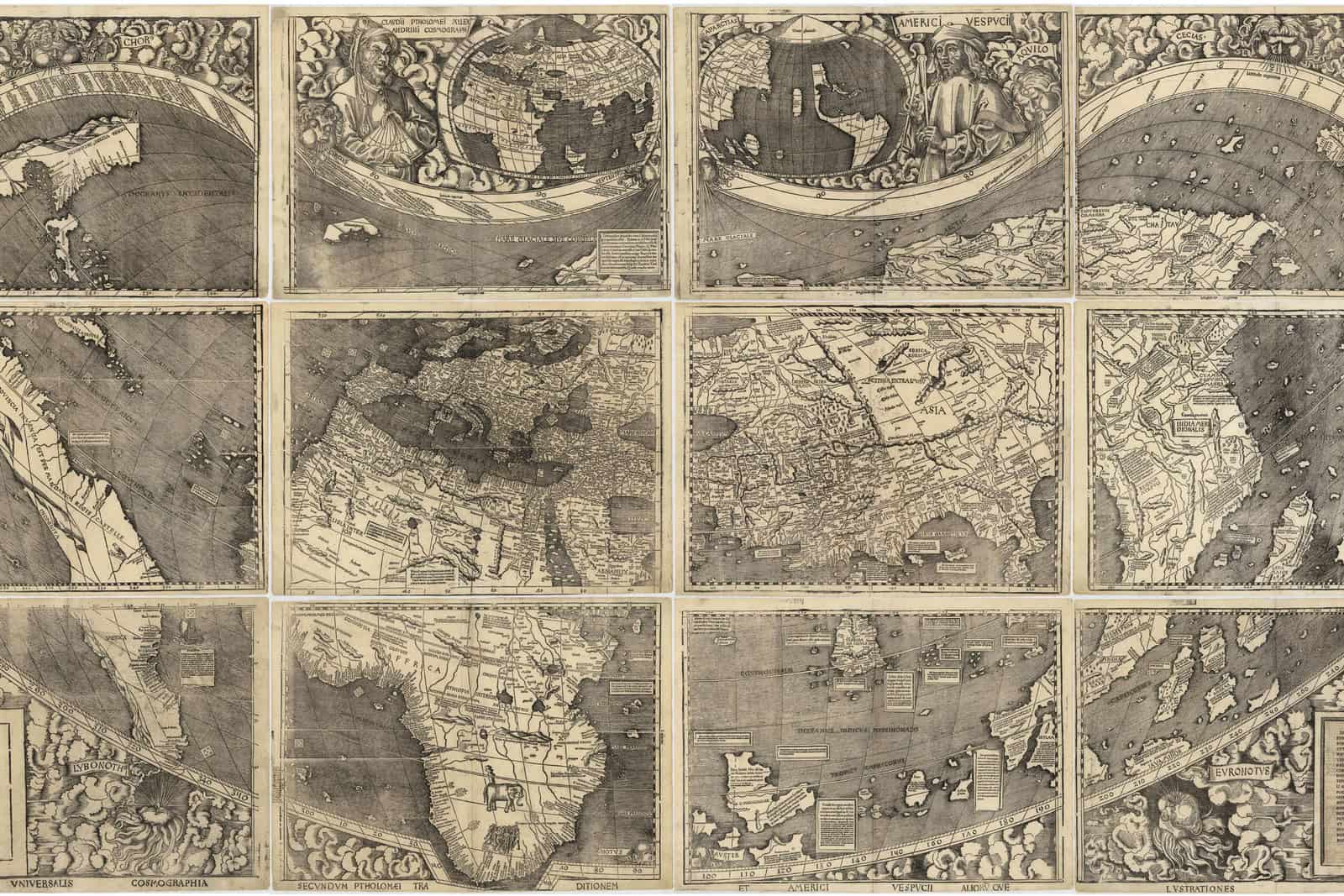
Martin Waldseemüller’s 1507 world map, a source object named in Lazzarini’s proposal. Martin Waldseemüller / Library of Congress via Wikimedia Commons; public domain.
How the U.S. Pavilion Commission Collapsed
The dates are important. The Washington Post published its investigation on November 5, 2025, about events that had occurred two months earlier. It reported that the State Department told Ravenal in early September that the proposal had been selected, but the commission was withdrawn roughly three weeks later, before a public announcement.
An institutional sponsor was not optional. The Post reported that artists typically team with a respected institution to handle logistics and fundraising, and that Lazzarini and Ravenal still needed one although they planned to raise funds independently. Ravenal had arranged for the University of South Florida to serve that role. According to the Post, contract negotiations failed in late September after USF faced responsibility for costs beyond the federal contribution. Ravenal put the project budget near $5 million and the university’s potential exposure near $4.75 million; USF said the short notice, schedule, and multimillion-dollar obligations informed its decision.
That account comes from the curator and university statements reported by the newspaper, not from a public State Department award notice. The department did not comment to the Post at the time. That matters because Lazzarini was privately notified of selection but was never publicly installed as the official 2026 representative.
By the Biennale’s opening, the outcome was no longer uncertain. The Associated Press reported on May 7, 2026, that a later effort to connect the Lazzarini project with the newly formed American Arts Conservancy also failed. Alma Allen’s “Call Me the Breeze,” commissioned by Jeffrey Uslip with that organization, became the exhibition inside the U.S. Pavilion.
MassArt announced its Lazzarini show on June 11 and opened it on September 30. Boston did not reverse the State Department outcome; it created a separate institutional route for at least part of the work.

John Quincy Adams Ward’s 1883 George Washington, the monument Lazzarini proposed to recast at full scale. Photo by KimOnClinton via Wikimedia Commons, CC BY-SA 4.0.
What the Boston Setting Changes
For Lazzarini’s project, the move exchanges a national-pavilion role for a free exhibition at a public art school’s non-collecting museum. That is a loss of international scale, but it also removes the expectation that the objects must stand as an official statement about the country during its 250th-anniversary year.
That shift sharpens an unresolved tension in the proposal. Its text sometimes describes American expansion, military power, and sacrifice in affirmative terms: the cannon protects ideals, while wilderness objects evoke settlers overcoming danger. Yet Lazzarini’s formal language makes those emblems buckle, droop, or become difficult to locate in stable space. The art does not simply illustrate the proposal’s prose; its distortions can work against the certainty of that prose.
American flag ii is the clearest publicly identified example in Boston. It keeps the recognizable stars, stripes, cloth, and scale associated with a military funeral flag, but compound waves deny the rectangle its ordinary stability. The object remains materially credible while its symbolic ground appears to move. That friction—not the administrative controversy—is the reason the Venice project still has an artistic life at MAAM.
Eight Object Types Proposed; MAAM Names One Online
- MAAM establishes that “metes and bounds” opened on September 30 and includes newly produced works conceived for the 2026 U.S. Pavilion.
- Lazzarini’s published proposal establishes a seven-heading program spanning eight named object types, from a flag finial and lectern to a map, cannon, trap, and alligator image; it does not establish how many are now in Boston.
- The Post’s November 2025 report and AP’s May 2026 follow-up establish the sequence reported by named participants: private selection, collapse of institutional sponsorship, a failed replacement arrangement, and Alma Allen’s eventual pavilion.
- MAAM has not published a complete exhibition checklist, so the exact overlap between “History Maker” and “metes and bounds”—and the future of the unlisted proposed works—remains unknown.

Isabella studied at the University of Cape Town in South Africa and graduated with a Bachelor of Arts majoring in English Literature & Language and Psychology. Throughout her undergraduate years, she took Art History as an additional subject and absolutely loved it. Building on from her art history knowledge that began in high school, art has always been a particular area of fascination for her. From learning about artworks previously unknown to her, or sharpening her existing understanding of specific works, the ability to continue learning within this interesting sphere excites her greatly.
Her focal points of interest in art history encompass profiling specific artists and art movements, as it is these areas where she is able to really dig deep into the rich narrative of the art world. Additionally, she particularly enjoys exploring the different artistic styles of the 20th century, as well as the important impact that female artists have had on the development of art history.
Learn more about Isabella Meyer and the Art in Context Team.
Choose Art in Context as a preferred source to see more of our reporting in Google Top Stories and other Google Search experiences.
Cite this Article
Isabella, Meyer, “Robert Lazzarini’s Venice Pavilion Works in Boston.” Art in Context. October 5, 2026. URL: https://artincontext.org/robert-lazzarini-venice-pavilion-works-boston/
Meyer, I. (2026, 5 October). Robert Lazzarini’s Venice Pavilion Works in Boston. Art in Context. https://artincontext.org/robert-lazzarini-venice-pavilion-works-boston/
Meyer, Isabella. “Robert Lazzarini’s Venice Pavilion Works in Boston.” Art in Context, October 5, 2026. https://artincontext.org/robert-lazzarini-venice-pavilion-works-boston/.


