

Pipo Nguyen-Duy Dies at 64, Leaving Photographs of War, Exile, and Home

Vietnamese American photographer and Oberlin College professor Pipo Nguyen-duy has died at 64. He was found shot to death at his Ohio home on October 28, but his artistic record reaches far beyond the circumstances: for three decades, he used staged photography to ask how war, migration, race, and the search for home shape who is allowed to appear in Western pictures.
Pipo Nguyen-Duy Died at 64 in Oberlin
An Oberlin College statement confirmed Nguyen-duy’s “violent passing” after two people were discovered at an off-campus home on Wednesday, October 28. College president Carmen Twillie Ambar described him as a beloved professor of studio art and photography who had taught at Oberlin since 1998.
Nguyen-duy’s wife, Tran Thi Phong, also died at the home. An updated police account reported by Lorain Daily identified Nguyen-duy as 64 and Phong as 56; the police department’s first release had incorrectly listed her as 47. Authorities charged Nguyen-duy’s adult child with murder, felonious assault, and evidence tampering. Those charges are allegations, no court has determined guilt, and police have said the investigation remains open.
The criminal case explains the immediate shock at Oberlin. It does not explain the work Nguyen-duy leaves behind, which repeatedly transformed personal displacement into carefully staged encounters with art history.

A Refugee Experience Became a Photographic Language
Nguyen-duy was born in Hue, Vietnam, in 1962. He described growing up within about 30 kilometers of the demilitarized zone and hearing gunfire throughout his early life. In 1975, at 13, he entered the United States as a political refugee. He earned a bachelor’s degree in economics from Carleton College in 1983, spent time practicing as a Buddhist monk in northern India, and later worked in New York’s East Village.
Photography arrived there less as a predetermined profession than as a usable language. In a 2021 interview with Ideastream Public Media, Nguyen-duy recalled observing the creative life around him before finding a medium for his own stories. He eventually left New York for graduate study in photography at the University of New Mexico.
That route matters because his art was never simply autobiographical. Nguyen-duy learned the inherited structures of European painting, nineteenth-century portrait photography, and American landscape imagery, then treated those structures as roles that could be recast. His photographs belong to conceptual photography, but their ideas are carried by costume, gesture, scenery, and the artist’s own conspicuous presence.

Rice fields outside Huế, Vietnam, 2007. Photo by thalling55, via Wikimedia Commons, CC BY 2.0.
AnOther Western Put an Asian Immigrant Inside the Myth
In the 1995–1998 series AsSimulation, Nguyen-duy posed inside reconstructions of Renaissance and Baroque images, shifting between masculine and feminine roles while making the awkwardness of cultural assimilation visible. CLAMP returned to that early body of work in a 2025 solo exhibition, showing that it was not merely a student-era preface but a key to his later practice.
Sources date AnOther Western differently, but surviving works and exhibition records place the series from at least 1998 into the early 2000s. Nguyen-duy appeared as gunslinger, musician, and gentleman rather than accepting the period stereotypes assigned to Asian immigrants. In his statement for the series, he said the pictures challenged the authority of the Western myth through humor and irony.
The important move was not just insertion. Nguyen-duy made the old photographic style itself part of the subject: the small scale, antique toning, costume, and formal pose all advertised how historical authority is manufactured. An immigrant body occupied the center, but the real target was the visual convention that had once made such a body seem out of place.
East of Eden Joined Post-9/11 Anxiety to Vietnam
The surviving records differ by one year on when East of Eden began. In a 2019 artist interview, Nguyen-duy dated the three-part project to 2003–2013. The Sharjah Art Foundation’s object record gives 2002–2013. The discrepancy is unresolved, but both records establish a decade-long project rather than a single Vietnam series.
Its sequence is clearer than its starting year. Nguyen-duy first staged ominous scenes in the United States, using the American landscape’s old association with Eden to translate the anxiety he felt after September 11 into terms his American-born children and audience could recognize. Beginning in 2005, he carried the project into Vietnam. There he photographed war amputees and other survivors against regenerated fields, holding bodily evidence of war together with landscapes that looked healed.
A final chapter, (My) East of Eden, staged children at play in rural Vietnam in 2012 and 2013. Nguyen-duy connected that chapter to the childhood he believed war had taken from him. The pictures are narrative photography, not neutral records: school uniforms, toy weapons, bicycles, ponds, and choreographed gestures turn memory into a scene that can be revised.
The 2011 Guggenheim Fellowship recognized East of Eden: Vietnam and enabled further work in the country. The award sits at the project’s midpoint, not its conclusion. Read in order, the three chapters move from American fear, to Vietnamese wounds, to children inhabiting a landscape that no longer looks ruined. That progression is Nguyen-duy’s strongest formal argument: recovery does not erase history, but it changes who can act inside its frame.

Allen Memorial Art Museum at Oberlin College, which displayed Pipo Nguyen-duy’s photography in 2017. Photograph by Daderot, via Wikimedia Commons, Public domain; cropped.
Home Remained the Question
Later projects changed the camera’s position without abandoning that argument. In Hotel Window, made in Vietnam from 2015 to 2017, Nguyen-duy photographed life in an alley from behind curtains and glass. During a 16-day quarantine in Vietnam in 2020, he photographed temporary rooms, partial views, and routines shared by strangers. The theatrical director of East of Eden became a constrained observer, but the question remained: can a person who is read as an outsider in both Vietnam and the United States still make a home through looking?
His work was active in public when he died. CLAMP’s current exhibition record lists two of his historic cyanotypes of botanical specimens from Claude Monet’s garden in Giverny in Nature Represented and Reproduced. CLAMP gives the run as September 10 through October 31, 2026; Artsy lists an October 30 close. The gallery’s own date is the more authoritative record.
Teaching supplied another form of continuity. Nguyen-duy served on the Oberlin faculty from 1998 until his death and chaired studio art. His fall 2026 courses included introductory black-and-white photography and an intermediate project seminar. He said teaching and studio work were inseparable: classroom conversations pushed the art forward, while teaching gave him community and stability. Oberlin’s Allen Memorial Art Museum also displayed his photography in a 2017 exhibition about historical memory, stereotyping, and exchanges between Asia and the West.
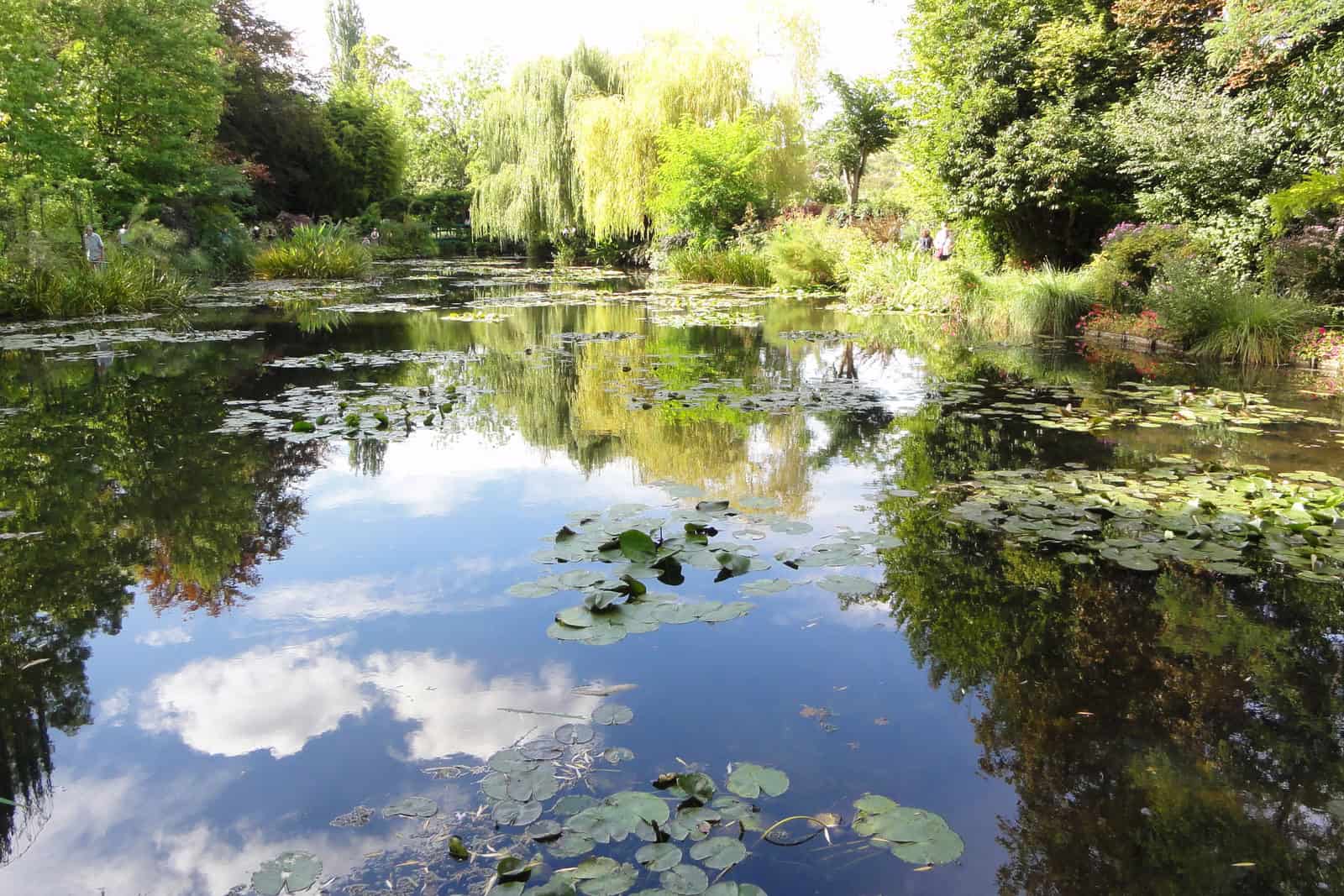
Claude Monet’s garden at Giverny, France. Photo by Sergey Prokopenko, via Wikimedia Commons, CC BY-SA 3.0.
From Tintype Myths to an Exhibition Still on View
Several details place Nguyen-duy’s career and death in context:
- His mature practice began with staged self-portraits about assimilation in the 1990s, before East of Eden made war memory and landscape its central materials.
- Institutional records disagree on whether East of Eden began in 2002 or 2003, but they agree that it ended in 2013 after three distinct chapters.
- At the time of his death, two Giverny cyanotypes were in a New York group exhibition that CLAMP says remains open through October 31.
- An updated police release corrected Tran Thi Phong’s age from 47 to 56; the criminal charges remain pending.
Oberlin has promised future gatherings but has not announced dates.

Isabella studied at the University of Cape Town in South Africa and graduated with a Bachelor of Arts majoring in English Literature & Language and Psychology. Throughout her undergraduate years, she took Art History as an additional subject and absolutely loved it. Building on from her art history knowledge that began in high school, art has always been a particular area of fascination for her. From learning about artworks previously unknown to her, or sharpening her existing understanding of specific works, the ability to continue learning within this interesting sphere excites her greatly.
Her focal points of interest in art history encompass profiling specific artists and art movements, as it is these areas where she is able to really dig deep into the rich narrative of the art world. Additionally, she particularly enjoys exploring the different artistic styles of the 20th century, as well as the important impact that female artists have had on the development of art history.
Learn more about Isabella Meyer and the Art in Context Team.
Choose Art in Context as a preferred source to see more of our reporting in Google Top Stories and other Google Search experiences.
Cite this Article
Isabella, Meyer, “Pipo Nguyen-Duy Dies at 64, Leaving Photographs of War, Exile, and Home.” Art in Context. October 30, 2026. URL: https://artincontext.org/pipo-nguyen-duy-dies-64/
Meyer, I. (2026, 30 October). Pipo Nguyen-Duy Dies at 64, Leaving Photographs of War, Exile, and Home. Art in Context. https://artincontext.org/pipo-nguyen-duy-dies-64/
Meyer, Isabella. “Pipo Nguyen-Duy Dies at 64, Leaving Photographs of War, Exile, and Home.” Art in Context, October 30, 2026. https://artincontext.org/pipo-nguyen-duy-dies-64/.


