

Greece and Bulgaria Complete Exchange of 48 Church Treasures

Greece and Bulgaria completed the physical exchange of 48 ecclesiastical objects and human remains identified by Greek authorities as belonging to Tsar Samuel on October 3. The church treasures are back in Greece after more than a century under a reciprocal-deposit memorandum that, according to Bulgarian Education Minister Georgi Valchev, leaves each state’s ownership unchanged.
What Greece Received in the October 3 Exchange
At the Museum of Byzantine Culture in Thessaloniki, the two countries’ culture ministers signed delivery-and-receipt protocols in the presence of Greek Prime Minister Kyriakos Mitsotakis and Bulgarian Prime Minister Rumen Radev. An October 3 statement from the Greek prime minister’s office confirms that the ceremony implemented the agreement announced four days earlier.
The returned group consists of 48 objects from the Panagia Eikosifoinissa Monastery, the Timios Prodromos Monastery of Serres, and the Holy Metropolis of Serres and Nigrita. The ceremony statement names sacred icons, crosses, vestments, reliquaries, and an episcopal throne. That list is descriptive rather than a published object-by-object catalogue, so it should not be treated as a complete count by type.
Greek officials say the objects were removed in 1917, during the First World War, and subsequently displayed or stored at Bulgaria’s National History Museum. Their movement from a national historical collection toward the religious institutions from which they came changes more than their location: it restores the connection between portable works, liturgical use, and the communities that held them before the wartime removal.
The collection will first be seen together in a temporary presentation in Thessaloniki. That short museum interval gives the public a rare chance to view the returned objects as a single provenance group before they are divided among their three institutions of origin.

A Transfer Chronology Spanning 109 Years
The documented sequence begins in 1917 with the removal of the Greek ecclesiastical objects to Sofia. Excavations at the Basilica of Saint Achilleios began in 1965, and Moutsopoulos discovered four burials there in 1969. Greece’s Culture Ministry says the remains later identified as Samuel’s, together with the other anthropological material from the four burials, were held in recent years at the Museum of Byzantine Culture.
Mitsotakis said the first bilateral discussions took place in the 1970s between Greek prime minister Konstantinos Karamanlis and Bulgarian leader Todor Zhivkov. That establishes a negotiation of roughly half a century; it does not mean the terms remained unchanged throughout that period.
On September 29, 2026, Culture Ministers Lina Mendoni and Evtim Miloshev signed a memorandum of understanding. On October 3, the delivery protocols were signed and the objects physically changed custody. These are separate events: September 29 is the agreement date, while October 3 is the completed handover that makes the story new.
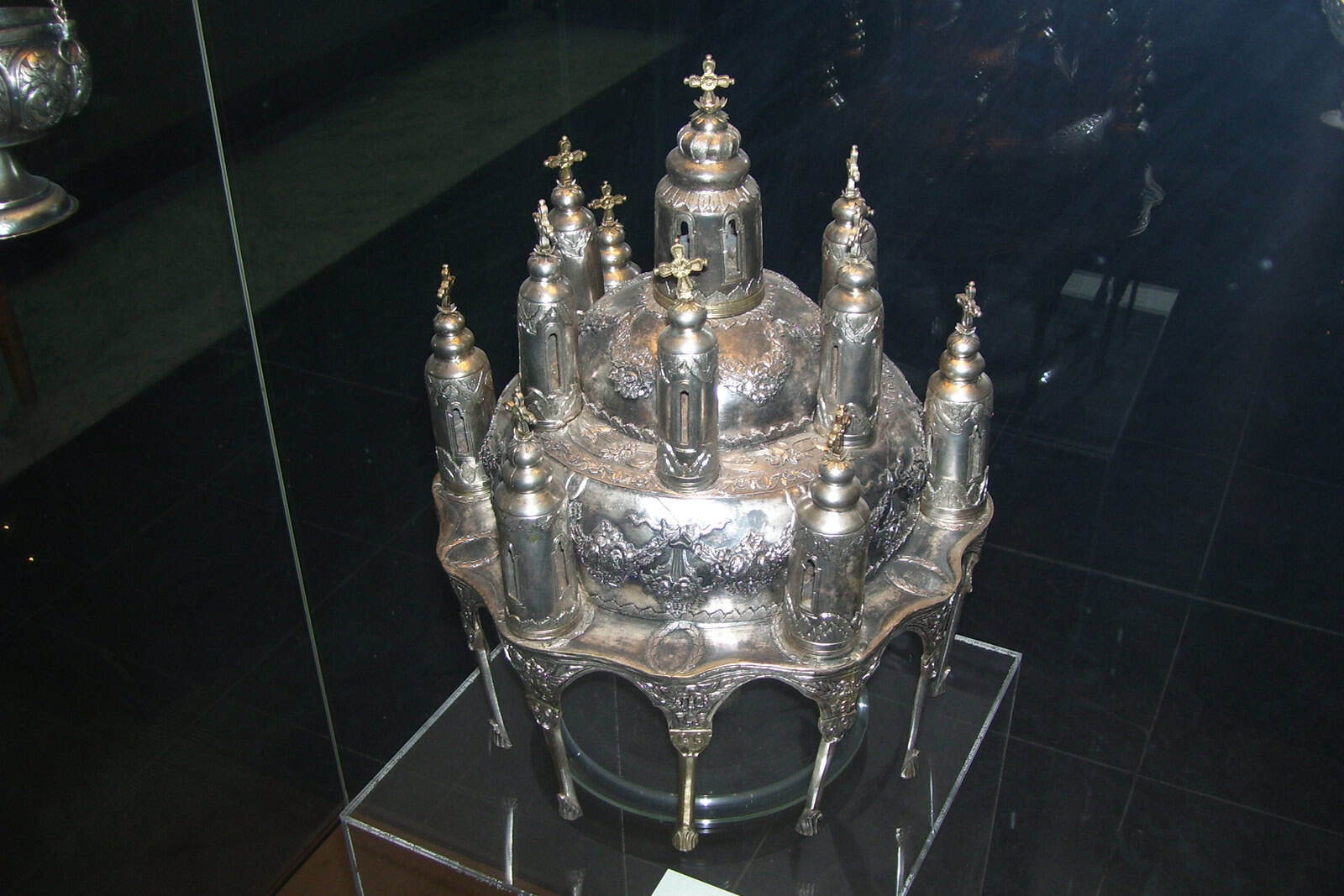
An eighteenth-century silver artophorion from Panagia Eikosifoinissa Monastery, photographed at Bulgaria’s National Historical Museum in 2011. Photo: Мико / Wikimedia Commons, CC BY-SA 3.0.
Why the Agreement’s “Mutual Deposit” Wording Matters
The Greek government’s September 29 announcement describes the memorandum as providing for the mutual “deposit” of historically significant relics. Four days later, the prime minister’s office used the language of return and repatriation. Those formulations are compatible as statements of purpose, but they do not answer the same question.
“Return” describes where the objects went. “Deposit” describes a custody mechanism. The published government notices do not state whether legal ownership changed, whether either deposit has a fixed duration, or what conditions govern withdrawal. Without the memorandum’s full operative text, calling the transaction an unconditional ownership transfer would go beyond the record now available. The most precise description is a completed physical handover carried out under an agreement publicly characterized as reciprocal deposit.
Mitsotakis invoked the Parthenon Sculptures during the ceremony, arguing that monuments and historical objects should not be treated as spoils of war. The analogy explains Greece’s diplomatic message, but the two cases are structurally different. This exchange is reciprocal, concerns a defined group from named institutions, and has been accepted by both governments. Greece’s position on the sculptures has instead rejected a proposed British Museum loan formula and, separately, temporary loans of Parthenon fragments in Frankfurt. The comparison does not alter the custody language of the Greek-Bulgarian memorandum.

Panagia Eikosifoinissa Monastery, one of the three institutions receiving objects returned from Bulgaria. Photograph by Makedonas62 via Wikimedia Commons, licensed under Creative Commons Attribution-Share Alike 4.0 International; cropped.
Where the Objects Go After November 5
The 48 objects will remain on view at the Museum of Byzantine Culture through November 5, 2026. The Greek government says they will then be delivered to Panagia Eikosifoinissa, Timios Prodromos, and the Metropolis of Serres and Nigrita according to provenance. November 5 is therefore the end of the group display, not the end of the return process.
The remains identified as Samuel’s followed a different route. The Associated Press reported that they reached Sofia aboard a military aircraft, received state honors, and were taken in procession to the Church of Saint Sophia. Greece’s official account says the transfer also included anthropological material from all four sarcophagi, a detail broader than the shorthand description of “Samuel’s remains.”
This agreement is not a complete settlement of every disputed or mutually significant object. The September 29 statement says negotiations will continue to identify historical material of mutual interest that was excluded from the present arrangement. It does not name those objects or give a timetable.
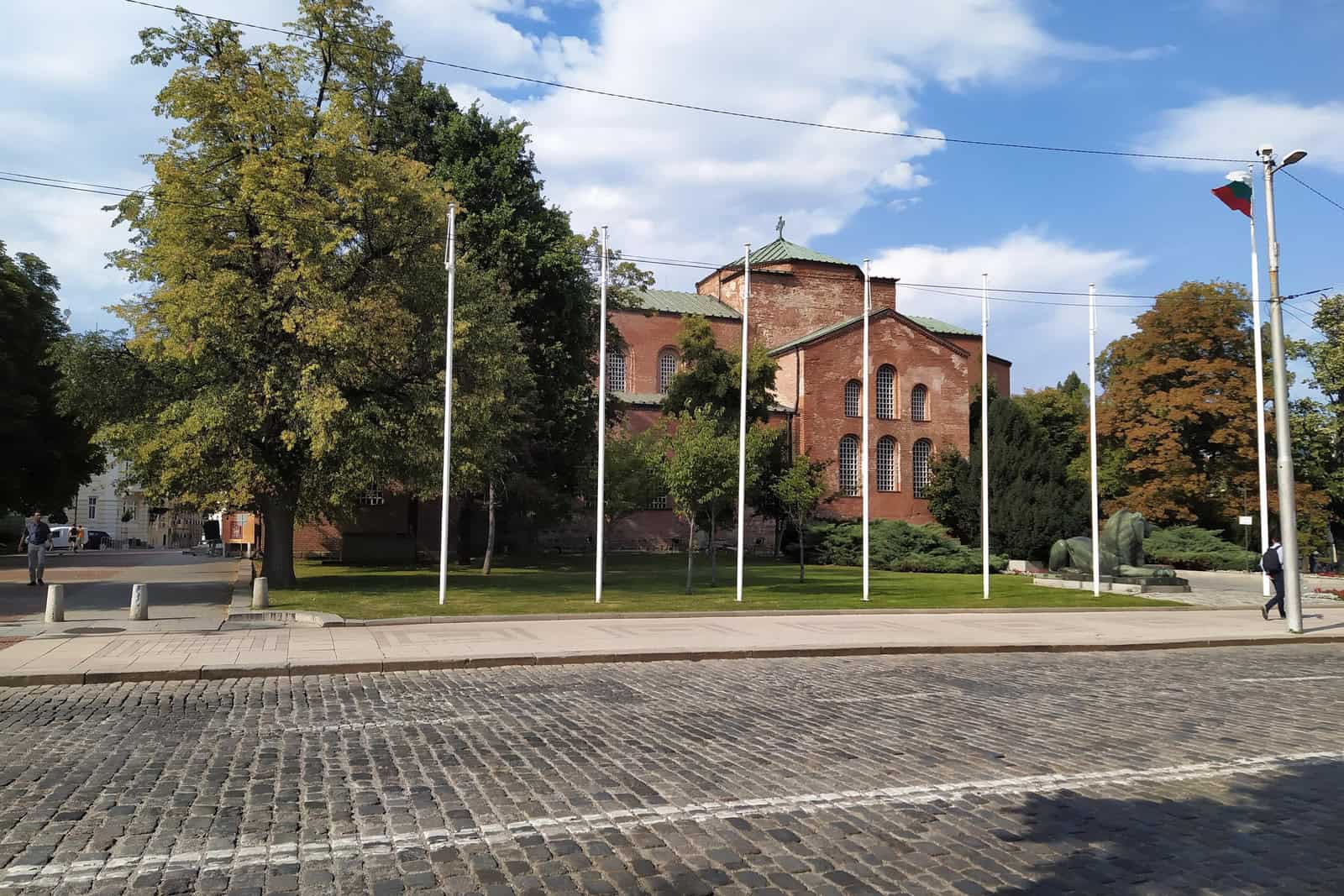
Saint Sophia Church in Sofia, the destination of the remains attributed to Tsar Samuel. Photo: Radosław Botev / Fundacja Nomos / Wikimedia Commons, CC BY 3.0 PL.
Forty-Eight Objects Returned, Further Negotiations Pending
The October 3 protocols establish that 48 ecclesiastical objects physically returned to Greece and that the remains attributed by Greek authorities to Tsar Samuel moved to Bulgaria. Official records place the objects’ removal in 1917, their later custody at Bulgaria’s National History Museum, and their next transfer to three Greek religious institutions after the Thessaloniki display closes on November 5.
The public record does not yet establish an unconditional change of legal title: the memorandum is officially described as a reciprocal deposit. Nor does the announced group of 48 close the wider provenance question, because both governments have expressly kept negotiations open for additional, as-yet unnamed material.

Isabella studied at the University of Cape Town in South Africa and graduated with a Bachelor of Arts majoring in English Literature & Language and Psychology. Throughout her undergraduate years, she took Art History as an additional subject and absolutely loved it. Building on from her art history knowledge that began in high school, art has always been a particular area of fascination for her. From learning about artworks previously unknown to her, or sharpening her existing understanding of specific works, the ability to continue learning within this interesting sphere excites her greatly.
Her focal points of interest in art history encompass profiling specific artists and art movements, as it is these areas where she is able to really dig deep into the rich narrative of the art world. Additionally, she particularly enjoys exploring the different artistic styles of the 20th century, as well as the important impact that female artists have had on the development of art history.
Learn more about Isabella Meyer and the Art in Context Team.
Choose Art in Context as a preferred source to see more of our reporting in Google Top Stories and other Google Search experiences.
Cite this Article
Isabella, Meyer, “Greece and Bulgaria Complete Exchange of 48 Church Treasures.” Art in Context. October 3, 2026. URL: https://artincontext.org/greece-bulgaria-48-church-treasures-exchange-2026/
Meyer, I. (2026, 3 October). Greece and Bulgaria Complete Exchange of 48 Church Treasures. Art in Context. https://artincontext.org/greece-bulgaria-48-church-treasures-exchange-2026/
Meyer, Isabella. “Greece and Bulgaria Complete Exchange of 48 Church Treasures.” Art in Context, October 3, 2026. https://artincontext.org/greece-bulgaria-48-church-treasures-exchange-2026/.


