


Palazzo Grassi Will Permanently Display 106 Pinault Works

Palazzo Grassi will replace its rotating-exhibition model with a permanent display of 106 works from the Pinault Collection on March 21, 2027. The shift gives one of Venice’s major contemporary-art venues a long-term collection narrative—and makes a selection representing barely one percent of François Pinault’s holdings unusually consequential.
Palazzo Grassi’s Permanent Pinault Display Opens in 2027
The announcement was published on October 15, 2026; the change itself is scheduled for March 21, 2027. ANSA reported that Palazzo Grassi has hosted 27 exhibitions since François Pinault opened it as his collection’s first public venue in 2006. The Italian wire described the new presentation as permanent and said it would contain more than 100 significant works.
A more detailed account by Philippe Dagen in Le Monde gives the exact figures: 106 works by 54 artists, primarily active from the 1960s onward. It also says Punta della Dogana in Venice and the Bourse de Commerce in Paris will continue to stage exhibitions lasting several months.
That division marks a clear break with the institution’s own account of its Venetian program, which describes both Palazzo Grassi and Punta della Dogana as venues built around a succession of temporary solo and group exhibitions. Palazzo Grassi often concentrated on monographic shows, while the larger spaces at Punta della Dogana were particularly suited to collective exhibitions and monumental works.
The institution’s short film shows the palace and the adaptable galleries that served that earlier model:
The video’s description still identifies Palazzo Grassi as a site for temporary Pinault Collection exhibitions. From March 2027, that sentence will describe the building’s first two decades rather than its main function.
| Venue | Previous model | Role from March 2027 |
|---|---|---|
| Palazzo Grassi | Rotating solo and group shows | Permanent 106-work display |
| Punta della Dogana | Temporary exhibitions | Temporary model continues |
| Bourse de Commerce | Rotating thematic and solo shows | Temporary model continues |
“Permanent” should not be read as “unchangeable.” In the statement carried by ANSA, Pinault said the aim was to give selected works a durable place without freezing the collection. No rotation schedule has yet been announced, so permanence currently describes the presentation’s institutional status, not a promise that every object will stay in the same room indefinitely.

106 Works Represent Barely One Percent of the Collection
The scale of the selection becomes clearer against the collection itself. Pinault Collection’s official overview says the holdings exceed 10,000 works and range across painting, video, sculpture, photography, installation, and performance. Dividing 106 by 10,000 produces 1.06 percent; because the collection is larger than that denominator, the permanent display represents less than 1.06 percent of its objects.
The artist count is selective in a different way. The Bourse de Commerce describes the wider collection as containing work by about 350 artists, while the Palazzo Grassi hang has 54. Official Pinault pages variously put the collection at nearly 350 and nearly 400 artists, making the 54 represented at Palazzo Grassi roughly 14 to 15 percent of the total. The result is not a compact survey of everything Pinault owns. It is a concentrated statement about which works and relationships the collection wants visitors to encounter repeatedly.
That distinction matters. Temporary exhibitions can revise a thesis with the next season; a permanent presentation accumulates authority through repetition. A work that remains visible becomes a reference point for guides, students, tourists, and future installations. The small numerical share therefore understates the display’s influence: these 106 works will function as the public face of a collection nearly one hundred times larger.
How the Palazzo Grassi Hang Builds a Canon
The announced sequence is thematic rather than simply chronological. The first floor will connect Italian Arte Povera with international Minimalism through artists including Mario Merz, Giovanni Anselmo, Michelangelo Pistoletto, Jannis Kounellis, Dan Flavin, Richard Serra, and Robert Ryman. The route then moves toward Pop and appropriation through Kiki Kogelnik, Martial Raysse, Sigmar Polke, Sturtevant, and Jeff Koons.
Individual works interrupt those categories. Maurizio Cattelan’s Him presents Adolf Hitler at a child’s scale, kneeling as if in prayer; his La Nona Ora depicts Pope John Paul II struck down by a meteorite. Other rooms pair Julie Mehretu with David Hammons and bring together paintings by Marlene Dumas, Kerry James Marshall, and Peter Doig. Photography by Barbara Kruger and William Eggleston leads toward Ed Ruscha’s 1997 acrylic-on-paper work The End.
This is where the permanent model carries its largest art-historical consequence. A curatorial selection creates meaning through sequence and adjacency: Arte Povera becomes a starting grammar, Minimalism an international counterpart, and Pop and appropriation a later turn toward images already circulating in culture. Painting and photography then extend that narrative rather than appearing as neutral media categories.
That structure is coherent, but it is not a comprehensive history of art since the 1960s. It converts the collector’s recurring preferences into a durable public canon. That is not a criticism of private collecting so much as the essential lens through which the display should be read: the authority comes from long-term visibility, while the selection remains François Pinault’s view of the period.
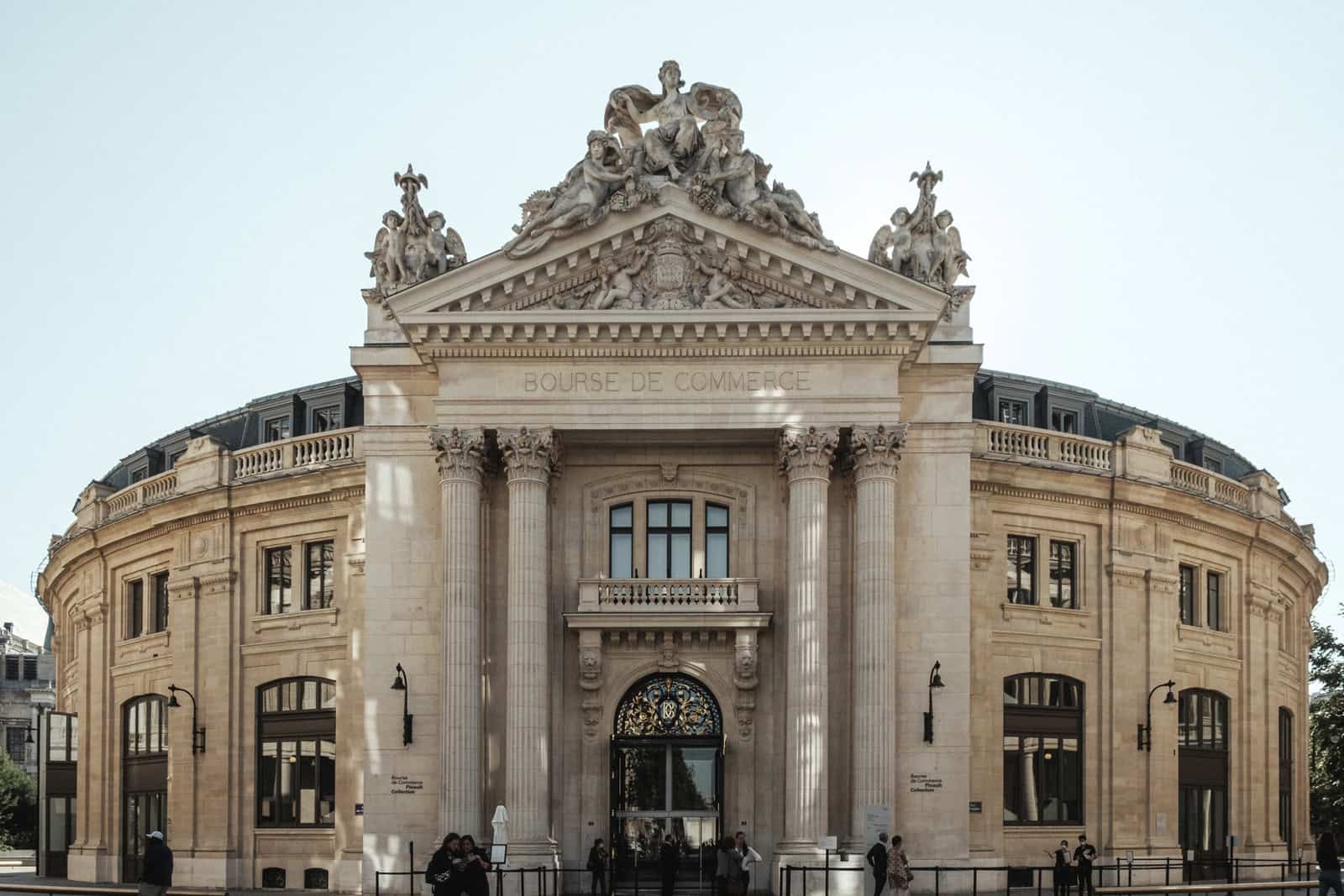
The Bourse de Commerce in Paris. Photograph by Maxime Gruss via Wikimedia Commons, licensed under CC BY-SA 4.0; cropped.
The Other Pinault Venues Will Keep Rotating
Punta della Dogana and the Bourse de Commerce preserve the network’s capacity for change. Punta della Dogana, opened in 2009 after Tadao Ando’s conversion of the former maritime customs complex, offers long galleries and a central concrete cube capable of holding installations that would be difficult to absorb into Palazzo Grassi’s more domestic palace plan.
The Paris venue states that its galleries follow a regular rotation of thematic exhibitions, solo shows, and artist-led projects. Keeping that program temporary allows the collection to test different narratives, commission new work, and bring stored holdings back into view even after one Venetian venue settles into a longer-term arrangement.
The emerging model is therefore not a wholesale retreat from temporary exhibitions. It is a three-part system with a fixed center at Palazzo Grassi and rotating programs at Punta della Dogana and the Bourse de Commerce.
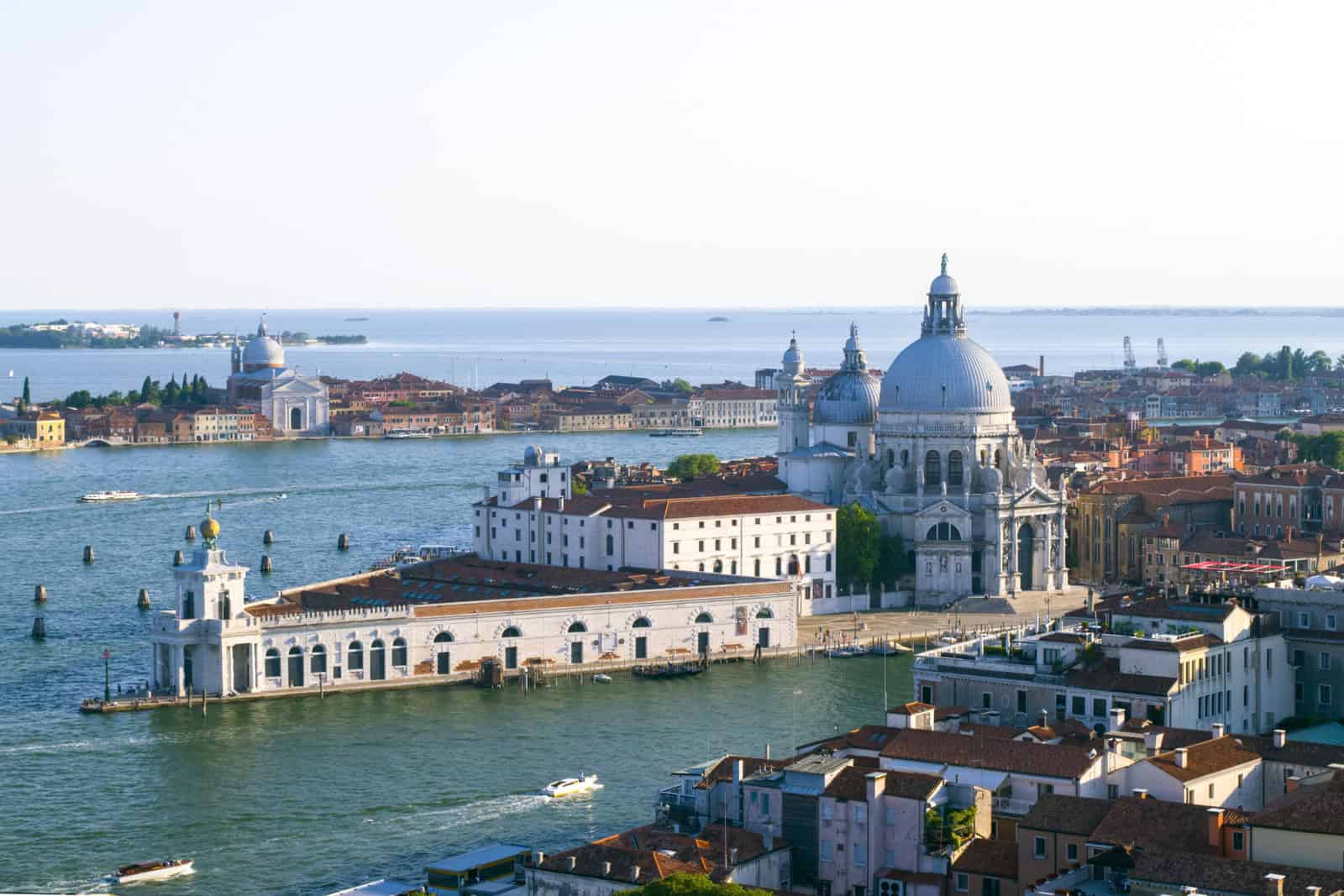
Punta della Dogana in Venice. Photograph by Ekaterina Vladinakova via Wikimedia Commons, released under the CC0 1.0 Universal Public Domain Dedication; cropped.
One Permanent Display, Not a Permanent Network
- ANSA establishes March 21, 2027, as the opening date and records 27 Palazzo Grassi exhibitions since 2006.
- Le Monde establishes the exact scale—106 works by 54 artists—and identifies the principal movements, artists, and floor-by-floor sequence.
- Pinault Collection’s own records put the holdings above 10,000 works, making the display less than 1.06 percent of the collection by object count.
- The change applies to Palazzo Grassi, while Punta della Dogana and the Bourse de Commerce continue with temporary exhibitions.

Isabella studied at the University of Cape Town in South Africa and graduated with a Bachelor of Arts majoring in English Literature & Language and Psychology. Throughout her undergraduate years, she took Art History as an additional subject and absolutely loved it. Building on from her art history knowledge that began in high school, art has always been a particular area of fascination for her. From learning about artworks previously unknown to her, or sharpening her existing understanding of specific works, the ability to continue learning within this interesting sphere excites her greatly.
Her focal points of interest in art history encompass profiling specific artists and art movements, as it is these areas where she is able to really dig deep into the rich narrative of the art world. Additionally, she particularly enjoys exploring the different artistic styles of the 20th century, as well as the important impact that female artists have had on the development of art history.
Learn more about Isabella Meyer and the Art in Context Team.
Choose Art in Context as a preferred source to see more of our reporting in Google Top Stories and other Google Search experiences.
Cite this Article
Isabella, Meyer, “Palazzo Grassi Will Permanently Display 106 Pinault Works.” Art in Context. October 15, 2026. URL: https://artincontext.org/palazzo-grassi-permanent-pinault-collection-2027/
Meyer, I. (2026, 15 October). Palazzo Grassi Will Permanently Display 106 Pinault Works. Art in Context. https://artincontext.org/palazzo-grassi-permanent-pinault-collection-2027/
Meyer, Isabella. “Palazzo Grassi Will Permanently Display 106 Pinault Works.” Art in Context, October 15, 2026. https://artincontext.org/palazzo-grassi-permanent-pinault-collection-2027/.


