
Oskar Kokoschka: Expressionism, Exile, and a Life in Art

Oskar Kokoschka made portraits feel physically unsettled, cityscapes pulse with movement, and ancient myths answer modern crises. His route from Vienna’s design workshops through war, travel, exile, Britain, and Switzerland reveals a practice that extended far beyond restless brushwork. A closer look shows how gesture, space, and even a painting’s ownership history can carry a life story.
Who Was Oskar Kokoschka?
Oskar Kokoschka was a painter, printmaker, writer, dramatist, stage designer, and teacher associated with Austrian Expressionist painting. Expressionism was an early twentieth-century approach that used forceful color, distorted forms, and visible marks to communicate experience rather than reproduce natural appearances. Born in Pöchlarn on March 1, 1886, Kokoschka moved from applied design into unconventional portraiture, expanded his subjects through travel, and later used allegory and myth to address political and cultural crises. He died in Montreux on February 22, 1980.

The Expressionist label is useful, but it does not contain his entire career. Kokoschka worked in decorative design, painting, literature, theater, book illustration, and education. Portraits established his early reputation, while landscapes, city views, political allegories, monumental compositions, prints, and stage projects kept changing the scale and public purpose of his work.
His national affiliations also followed Europe’s changing political map. He was born in Austria, acquired Czechoslovak citizenship during his years in Prague, and became a British citizen in 1947. Austria granted him honorary citizenship in 1974. These affiliations should not be confused with his residences, which included extended periods in Vienna, Dresden, Prague, Britain, and Villeneuve in Switzerland.
Life at a Glance
Kokoschka entered Vienna’s School of Arts and Crafts in 1904 and studied there until 1909. Commissions from the Wiener Werkstätte, or Vienna Workshops, introduced him to applied design while he was still a student. His projects and controversial appearances at the 1908 and 1909 Kunstschau exhibitions soon drew attention beyond the school.
Patronage and publishing widened his reach around 1910. Adolf Loos helped him obtain portrait commissions, while Herwarth Walden published his writing and drawings through the Berlin periodical and gallery network Der Sturm. A relationship with Alma Mahler began in 1912 and informed The Bride of the Wind, painted in 1913.
Military service during World War I left Kokoschka seriously injured. After convalescing in Dresden, he became a professor at the city’s Academy of Art in 1919. He requested leave during 1923 and 1924, then began extended travel in 1924 through Europe, Asia Minor, and North Africa. These journeys produced a substantial body of landscapes and panoramic city views.
Kokoschka moved to Prague in 1934, where he met Olda, his future wife, and acquired Czechoslovak citizenship. Nazi authorities attacked his work, and eight of his paintings appeared in the 1937 Degenerate Art exhibition. He moved to Britain in 1938, became a British citizen after the war, and later settled in Villeneuve. In 1953, he founded an international summer academy in Salzburg known as the School of Seeing or School of Vision.
From Vienna Design to Expressionist Portraiture
Kokoschka’s early development did not follow a simple path from classroom training to easel painting. It began where illustration, typography, decoration, performance, and fine art overlapped. That environment gave him practical experience while also creating conventions against which he could push.
Training and the Wiener Werkstätte
The School of Arts and Crafts trained designers for a world in which images appeared on useful and reproducible objects as well as on gallery walls. Kokoschka received Wiener Werkstätte commissions during his studies, but his work soon exceeded the decorative expectations attached to those assignments.

The Dreaming Boys, made in 1907 and 1908, began as a Wiener Werkstätte commission. Its square format retained a clear connection to Viennese design, yet the project helped announce a more personal direction. Kokoschka dedicated it to Gustav Klimt, and it debuted at the 1908 Kunstschau.
The dedication placed the young artist in relation to a leading figure of Viennese modernism without making Kokoschka a copyist. Klimt’s decorative organization and the reform culture surrounding the Vienna Secession formed part of the setting in which Kokoschka emerged. His increasingly abrasive figures and exposed surfaces, however, moved away from ornamental unity.
The 1908 and 1909 Kunstschau appearances helped establish his controversial reputation. In 1909, the performance of his drama Murderer, Hope of Women caused a public scandal. The episode matters because it shows that his break with convention was not limited to painting. He was already treating words, bodies, costumes, and staged action as connected forms of expression.
Adolf Loos, Der Sturm, and the Break from Decoration
Architect Adolf Loos became an important patron and helped Kokoschka secure portrait commissions. These commissions gave the artist sustained access to sitters while he developed a less conventional approach to likeness. He did not abandon recognizable faces, but he made pose, distance, surface, and gesture carry as much weight as facial description.

Herwarth Walden offered a different kind of support. Through Der Sturm, Walden published Kokoschka’s drama and drawings and connected him with Berlin’s avant-garde, the experimental artists and writers who challenged established conventions. The relationship provided a route between Vienna and a broader modern-art network without determining what Kokoschka painted.
The 1909 double portrait Hans Tietze and Erica Tietze-Conrat makes the change visible. Kokoschka painted the two sitters separately, which contributes to the distance between them in the finished composition. Thin layers of color create a hazy atmosphere, while lines scratched into the wet paint give the surface a nervous physical presence. Recognizable faces remain, but hands, posture, and the unfilled space between the couple resist the polish of a conventional society portrait.
Alma Mahler, War, and the Dresden Years
The years surrounding World War I brought together an intense relationship, a major painting, severe injuries, and a decisive professional change. Alma Mahler belongs to this chronology, but Kokoschka’s long career cannot be reduced to their relationship.
Alma Mahler and The Bride of the Wind
Kokoschka’s relationship with Alma Mahler began in 1912 and ended in 1915. During it, he painted The Bride of the Wind, also known as The Tempest, in 1913. The large canvas joined intimate subject matter to a setting that appears unstable and in motion.
A surviving 1913 study shows the couple in a comparatively static embrace. In the finished painting, their bodies remain intertwined, but the surrounding field becomes more dynamic. Kokoschka turned a private pair into the still center of a wider disturbance.
Alma Mahler’s identity supplies essential biographical context, yet the picture’s effect also depends on its complete painted field. The surroundings do not merely frame the figures. Their circulating forms intensify the sensation created by the couple’s contrasting poses.
World War I and the Dresden Academy
The relationship ended in 1915. During World War I, Kokoschka volunteered for an Austrian dragoon regiment and was seriously wounded in 1915. In 1916, while serving at Isonzo, he was affected by another nearby explosion. The surviving institutional chronologies differ on whether his enlistment preceded or followed the final separation from Mahler, so the events cannot be placed in a more exact sequence.

Kokoschka convalesced in Dresden, which became more than a temporary place of recovery. In 1919, he was appointed professor at the Dresden Academy of Art. The position gave him an institutional role after military service and placed teaching alongside his work as an artist and writer.
During 1923 and 1924, Kokoschka requested leave from the academy. In 1924, he departed on extended travels rather than simply recording a formal resignation from his professorship. The new phase was defined by movement between places, and landscapes and city views became increasingly important alongside portraiture.
Travel, Exile, and Political Painting
Movement meant different things at different stages of Kokoschka’s life. During the 1920s, travel enlarged his visual range. In the 1930s, migration became inseparable from political danger and exile.

Cityscapes and the Traveling Years
After taking leave from Dresden, Kokoschka traveled extensively through Europe, Asia Minor, and North Africa. These journeys generated a substantial body of landscapes and panoramic city views. Place was no longer simply the setting in which he happened to work. It became a recurring subject.
London, Waterloo Bridge from 1926 shows what this change meant in practice. Kokoschka used a high, bird’s-eye viewpoint from his hotel, with the Thames cutting through the city below. A bright palette lights the riverfront buildings, while streets and river traffic appear to surge through the panorama. Instead of presenting London as a row of landmarks, he organized the city as a connected field of architecture, water, light, and movement.
The painting also demonstrates how travel changed the scale of his attention. Early portraits concentrate on the distance or contact between a few people. A city view requires buildings, terrain, atmosphere, and traffic to coexist across a much broader surface. Kokoschka carried his interest in unstable space from the human figure into the modern metropolis.
This traveling period prevents a narrow view of Kokoschka as exclusively a Viennese portraitist. His encounters with different cities and regions did more than add color to his biography. They established landscape and city painting as principal parts of his practice.
Prague, Nazi Persecution, and Britain
Kokoschka moved to Prague in 1934. There he met Olda, who later became his wife, and acquired Czechoslovak citizenship. The Prague years continued his work with urban views, but political pressure soon transformed the conditions under which he lived and exhibited.
Nazi authorities classified Kokoschka’s modern art as “degenerate.” Eight paintings were displayed in the 1937 Degenerate Art exhibition, and hundreds of his works were caught up in the broader campaign against modern art. Kokoschka moved to Britain in 1938, just before the outbreak of World War II.
In Britain, he produced political allegories in which recognizable people and objects carried meanings beyond the literal scene. Anschluss: Alice in Wonderland from 1942 offers a concrete example. The Leopold Museum identifies three men as British politician Neville Chamberlain, a Nazi soldier, and a bishop, arranged like the monkeys that refuse to see, hear, or speak. To the right, a naked Alice stands behind barbed wire while Vienna burns in the distance. The invented scene turns the annexation of Austria and the Allied policy of appeasement into a staged political accusation.
The city views and wartime allegories use crowded space for different purposes. In London, Waterloo Bridge, movement joins the parts of a living metropolis. In Anschluss: Alice in Wonderland, compressed figures and symbols make political responsibility difficult to evade. Exile changed not only where Kokoschka worked, but also how directly he connected painted space with public events.
He became a British citizen in 1947. The postwar period also brought major exhibitions in Basel, Zurich, Venice, Boston, New York, and London. This international visibility did not erase his experience of displacement, but it changed his public position from persecuted exile to an artist presented across major cultural centers.
How to Look at Kokoschka’s Art
Kokoschka is often recognized by agitated brushwork, but brushwork alone is an unreliable test. A more useful method combines surface, pose, spatial structure, and historical context. It begins with visible features before moving toward interpretation.
Portrait Surfaces and Restless Space
Begin with the surface. In Hans Tietze and Erica Tietze-Conrat, thin color allows the image to feel airy and exposed rather than heavily modeled. Scratched lines interrupt the painted skin. The viewer can follow not only what the marks describe, but also the physical sequence of brushing, dragging, and incising.
Next, examine the relationship between the figures. The Tietzes were painted in separate sittings, and their poses do not lock into an easy domestic unit. Space remains active between them. This distance can suggest tension or separate inner lives, but the effect begins with posture and composition rather than a diagnosis of either sitter.
Hands and arms deserve particular attention. Kokoschka often made gesture structurally important, whether two bodies intertwine, a pair of sitters remain apart, or crossed arms block access to a self-portrait. Gesture can establish connection, distance, resistance, or motion before the viewer interprets a face.
A practical viewing sequence is therefore:
- Look at whether the paint is thin, dense, brushed, or scratched.
- Trace the sitters’ hands, arms, and lines of sight before reading their faces.
- Ask whether the surrounding space feels stable, compressed, tilted, or in motion.
- Identify the visible feature that supports any psychological or political reading.
This sequence makes Kokoschka’s work easier to recognize without reducing every rough mark to anxiety or every altered pose to a diagnosis.
Close Reading: The Bride of the Wind
The Bride of the Wind is an oil painting from 1913 measuring 180.4 by 220.2 centimeters. Its scale allows the reclining couple to dominate the canvas, but their closeness does not create calm. The figures form a compact center while the surrounding strokes and bands of color produce a larger sense of circulation.
The surviving preparatory study sharpens this observation. In the study, Kokoschka and Alma Mahler appear in a comparatively static embrace. In the completed painting, the surrounding field becomes more dynamic. The change shifts attention from the lovers alone to the relationship between their bodies and the turbulent environment.
Look first at the pair as a single interlocking shape, then follow the movement around them. The eye repeatedly returns to the couple but cannot remain there. The space refuses to behave like a stable bedroom, landscape, or conventional portrait setting. Kokoschka made intimacy and instability occupy the same composition.
The painting also has an important history after 1913. It entered the Kunsthalle Hamburg but was confiscated there in 1937 during the Nazi campaign against modern art. Kunstmuseum Basel acquired it in 1939. Its present place in Basel therefore results not only from collecting taste but also from the forced movement of art under the Nazi regime.
That provenance, meaning the documented history of ownership and transfer, adds another layer without changing what is physically painted. A work born from a private relationship later became an object condemned and displaced by state policy. Its biography demonstrates why collection history can be as consequential as subject matter when interpreting modern art.
From a Defiant Self-Portrait to Prometheus
Self-Portrait of a Degenerate Artist from 1937 answers persecution through pose as well as title. Kokoschka revised the arms so that they appear firmly crossed. The National Galleries of Scotland reads this change as defiant, an interpretation supported by the title and the painting’s historical setting. In the wooded background, a deer and a running figure prevent the composition from becoming a simple isolated bust.
The 1950 Prometheus Triptych expanded Kokoschka’s work to a monumental architectural scale. Commissioned for the entrance-hall ceiling of Count Antoine Seilern’s London home, it combines mythological and biblical scenes across three panels. Its turbulent brushwork and steep, plunging perspectives recall Baroque ceiling painting, a seventeenth-century tradition designed to make painted figures and spaces appear to rise, fall, or open beyond the architecture.
The Courtauld interprets the triptych as a warning about intellectual arrogance. That reading draws on its iconography, the figures and stories represented in an artwork, as well as the steep perspectives that seem to tip the scene toward the viewer. Compared with the compact resistance of the self-portrait, Prometheus spreads conflict across an entire overhead environment.
Together, these works show why no single stylistic password identifies Kokoschka. Scratched portrait surfaces, intertwined figures, crossed arms, falling perspectives, and turbulent settings serve different purposes. Recognition depends on seeing how physical marks organize the relationship between a subject and the space around it.
Teaching, Late Work, and Legacy
Kokoschka’s late career was not a quiet withdrawal into retrospective honors. Painting, printmaking, theater, writing, and teaching continued to overlap, while his long residence in Switzerland served as a base for international work.
The School of Seeing
In 1953, Kokoschka founded an international summer academy in Salzburg known as the School of Seeing or School of Vision. The name placed close observation at the center of the educational project. Its summer format brought teaching into his mature career without turning him into a permanent academy professor again.
That same year, Kokoschka settled in Villeneuve beside Lake Geneva. It became his longest continuous place of residence, but not merely a retirement address. His international career continued from Switzerland through exhibitions, commissions, publications, and educational work.
Kokoschka also continued producing prints and illustrated books and remained active in theater through writing and designs for sets and costumes. His autobiography appeared in 1971, giving his literary practice a late form of life review. Austria awarded him honorary citizenship in 1974, six years before his death.
The School of Seeing offers a useful key to his larger contribution. Across media, Kokoschka asked viewers to notice relations that polished surfaces can conceal: the distance between two sitters, the force of a revised gesture, the movement surrounding a couple, or the instability created by a steep perspective. His teaching gave that sustained act of looking an institutional form.
The Fondation and Surviving Archives
After Kokoschka’s death in 1980, Olda Kokoschka took a central role in preserving his work and records. She established the Fondation Oskar Kokoschka in 1988. The foundation became part of a broader archival structure rather than concentrating every object and document in one place.
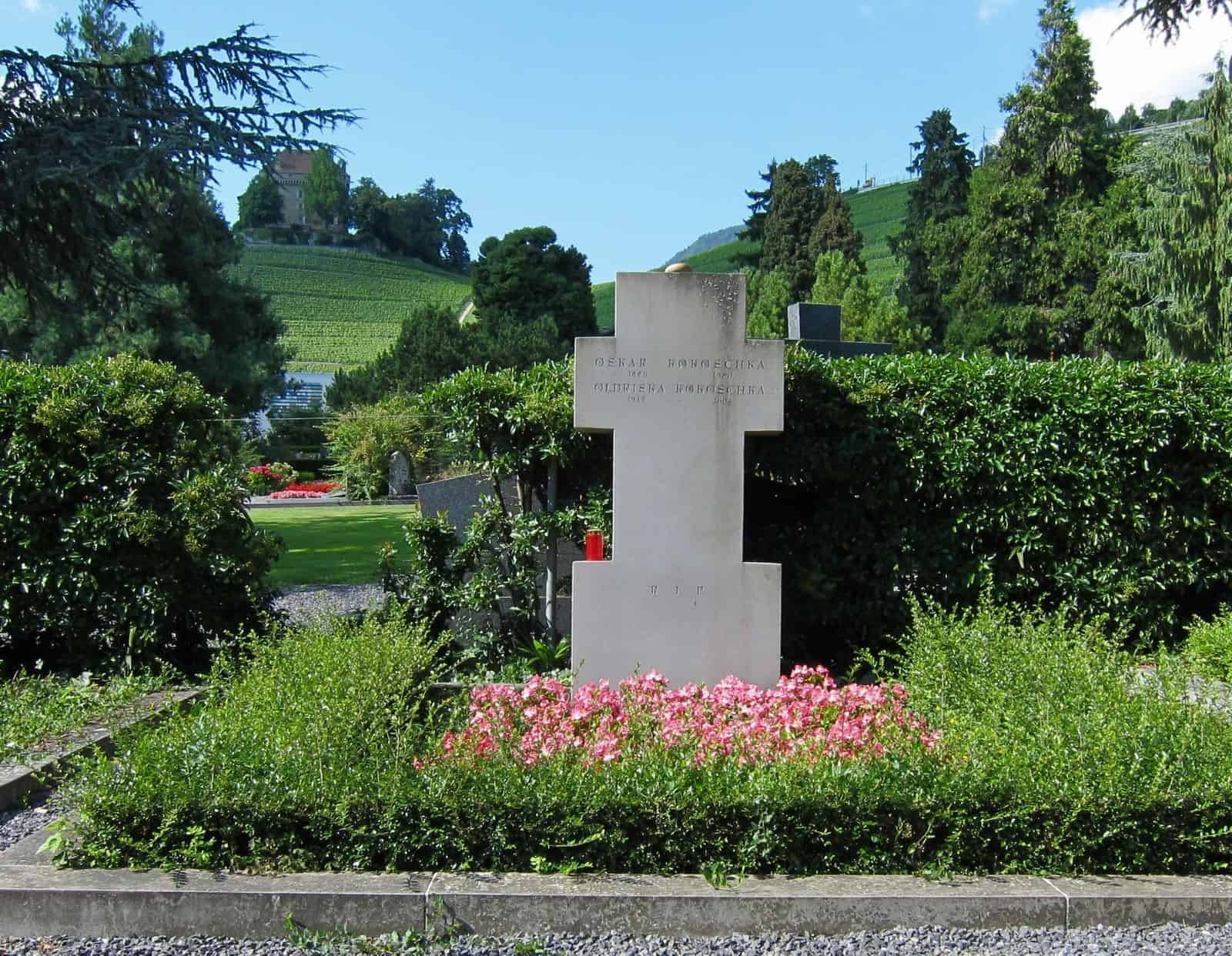
The documented distribution placed art holdings in Vevey, the literary estate in Zurich, and photographs and Kokoschka’s library in Vienna. His converted birthplace in Pöchlarn serves separately as a museum devoted to his life and work.
Public collections preserve major paintings, including The Bride of the Wind in Basel, the Tietze double portrait in New York, and the Prometheus Triptych in London. Self-Portrait of a Degenerate Artist is privately owned and displayed on long-term loan to the National Galleries of Scotland in Edinburgh.
This distribution reflects the shape of Kokoschka’s life. His work developed through changing cities, patrons, schools, political systems, and citizenships, and its surviving record now depends on cooperation across several countries. A Kokoschka work can be approached through its physical construction, its place in his shifting career, and the documented route by which it reached its current home.
Frequently Asked Questions
These concise answers clarify Kokoschka’s citizenship, range of media, educational work, and surviving collections.
Was Oskar Kokoschka Austrian, Czechoslovak, or British?
Kokoschka was born in Austria and is closely associated with Austrian modern art. He acquired Czechoslovak citizenship during his Prague period and became a British citizen in 1947. These legal affiliations do not establish that he belonged to the later Czech state. Austria granted him honorary citizenship in 1974.
What Did Kokoschka Create Besides Paintings?
His practice included drawings, watercolors, prints, illustrated books, plays, essays, and designs for theatrical sets and costumes. He also worked as a teacher and published an autobiography in 1971.
What Was Kokoschka’s School of Seeing?
It was the international summer academy Kokoschka founded in Salzburg in 1953. Also called the School of Vision, it made direct observation and artistic teaching a formal part of his late career.
Where Are Kokoschka’s Works and Archives Preserved?
Major paintings are held by public collections in cities including Basel, New York, and London. The privately owned 1937 self-portrait is on long-term loan in Edinburgh. Art holdings from the estate went to Vevey, the literary estate to Zurich, and photographs and the library to Vienna, while Kokoschka’s birthplace in Pöchlarn operates as a museum.

Isabella studied at the University of Cape Town in South Africa and graduated with a Bachelor of Arts majoring in English Literature & Language and Psychology. Throughout her undergraduate years, she took Art History as an additional subject and absolutely loved it. Building on from her art history knowledge that began in high school, art has always been a particular area of fascination for her. From learning about artworks previously unknown to her, or sharpening her existing understanding of specific works, the ability to continue learning within this interesting sphere excites her greatly.
Her focal points of interest in art history encompass profiling specific artists and art movements, as it is these areas where she is able to really dig deep into the rich narrative of the art world. Additionally, she particularly enjoys exploring the different artistic styles of the 20th century, as well as the important impact that female artists have had on the development of art history.
Learn more about Isabella Meyer and the Art in Context Team.
Cite this Article
Isabella, Meyer, “Oskar Kokoschka: Expressionism, Exile, and a Life in Art.” Art in Context. October 9, 2026. URL: https://artincontext.org/oskar-kokoschka/
Meyer, I. (2026, 9 October). Oskar Kokoschka: Expressionism, Exile, and a Life in Art. Art in Context. https://artincontext.org/oskar-kokoschka/
Meyer, Isabella. “Oskar Kokoschka: Expressionism, Exile, and a Life in Art.” Art in Context, October 9, 2026. https://artincontext.org/oskar-kokoschka/.