

Old Acropolis Museum Reopens After 19 Years

The Old Acropolis Museum reopened on Nov. 23, 2026, after 19 years out of public use, restoring Greece’s first purpose-built museum building to an exhibition role. Four displays now join archaeological storage, digital interpretation and an open conservation laboratory, turning the 1874 institution into more than a smaller counterpart to the modern museum below the Acropolis.
Why the Old Acropolis Museum Reopening Matters
Prime Minister Kyriakos Mitsotakis inaugurated the renovated museum on Monday, the same day it reopened to visitors. The Greek government’s opening-day account says the project reversed a 2019 plan for only limited reuse of the building.
Designed by Panagis Kalkos, the low stone structure was deliberately set into the ground southeast of the Parthenon so that it would not compete with the monument above it. Its importance is not scale but purpose: it was the first building commissioned by the modern Greek state specifically as a museum.
Most of the celebrated sculptures once shown there were moved to the new Acropolis Museum after the old building closed in 2007. The reopened institution has therefore been given a different curatorial job. It combines examples of ancient Greek art with the storage, documentation and conservation systems that determine what can be studied and displayed.
Mitsotakis also used the inauguration to repeat Greece’s demand for the reunification of the Parthenon Sculptures and said no agreement could recognize foreign ownership. That position is consistent with Greece’s rejection of a loan-based arrangement, but the reopening itself is not a new home for the removed marbles. Its confirmed program is centered on Acropolis fragments, finds from Athens, digital interpretation and contemporary art.

Four Exhibitions, Plus Storage and Visible Conservation
The official program names one permanent exhibition and three temporary or special presentations. Together, the government says, the reopened displays include more than 800 finds from excavations in Athens.
| Display | Format | Focus |
|---|---|---|
| Permanent exhibition | Archaeology | Lost Acropolis buildings, votive offerings and inscriptions |
| Athens: City and Idea | Temporary archaeology | Finds spanning the city’s long history |
| What You Leave Behind Is Not What Is Engraved | Contemporary art | Michael Rakowitz on diaspora, memory and displacement |
| Parthenon Alive | Digital | An AI-assisted reconstruction of the Parthenon frieze |
The west wing now functions as organized archaeological storage for architectural elements, fragments from lost Acropolis buildings and inscribed stones. Unlike a closed back-of-house storeroom, it is also presented as part of the museum’s public identity. A conservation laboratory has a viewing area from which visitors can watch Culture Ministry technicians working on ancient objects.
Rakowitz’s installation is not incidental decoration. NEON’s joint press release identifies it as the final part of a trilogy with the Culture Ministry and says it is the first contemporary-art exhibition presented on the Acropolis Hill. The commission is scheduled for 2026–2028 and uses objects, materials and testimony to address displacement and the narratives that objects acquire when they move between contexts.
Taken together, the storage, open laboratory and four displays make the reopening an institutional change rather than a nostalgic reconstruction of the old galleries. Visitors are being shown not only finished displays but also how an archaeological collection is ordered, interpreted and cared for.
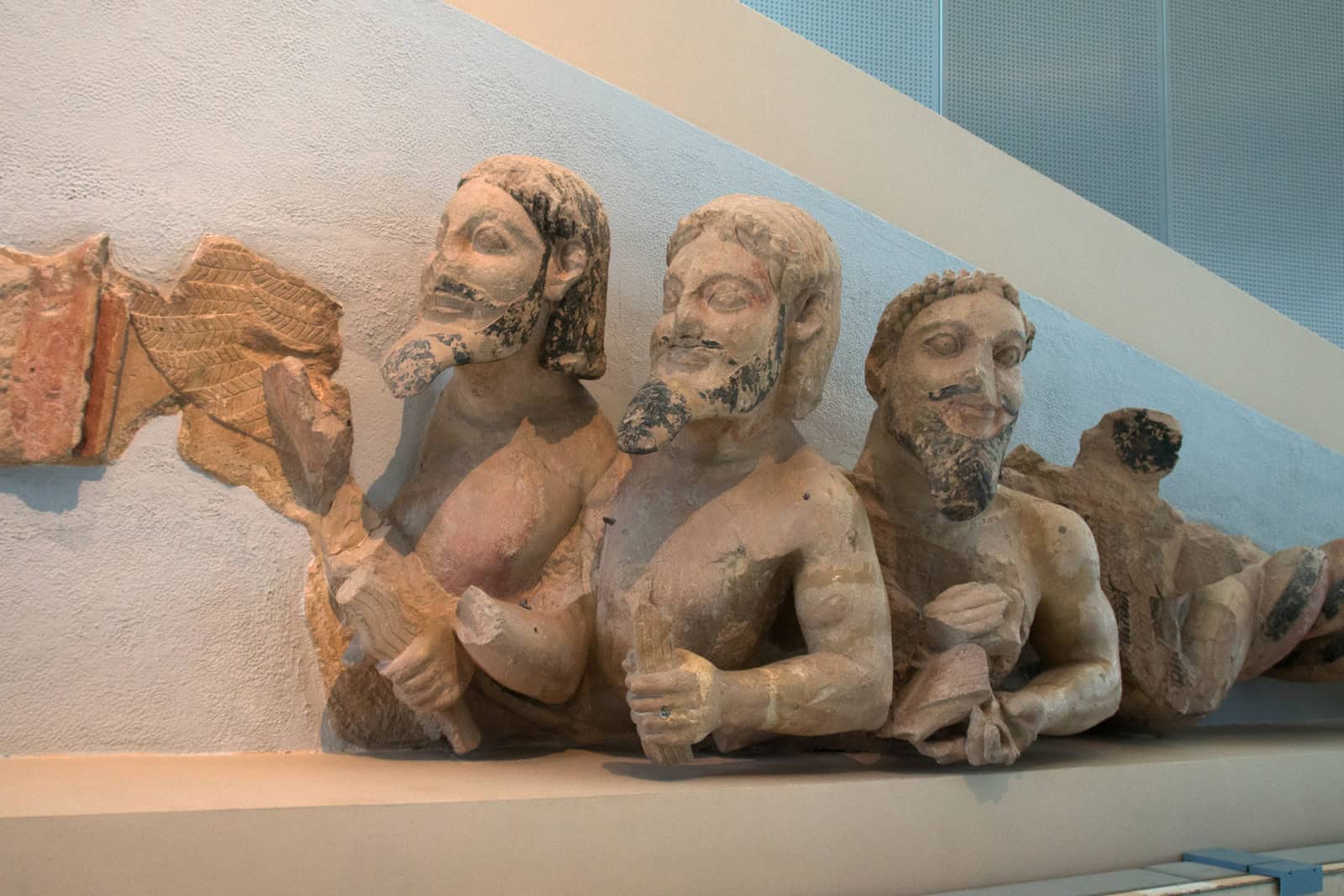
The three-bodied Daemon from the Hekatompedon’s west pediment, about 570 BCE, now in the Acropolis Museum. Photograph by Zde via Wikimedia Commons, licensed under CC BY-SA 4.0; cropped.
From an 1865 Foundation Stone to a 2026 Return
Construction began in 1865, and the museum was completed and opened in 1874. Its subdued profile was intentional: the roofline was kept below the base of the Parthenon’s columns. As excavations produced more material, a “Small Museum” annex was added in 1888; it was later demolished.
The main building was expanded and its older rooms renovated in 1953 to designs by Patroklos Karantinos. Archaeologist and museum director Giannis Miliadis then supervised a new arrangement of the collection, completed in 1964. Those successive interventions matter because the building reopening in 2026 is not an untouched nineteenth-century interior; it is a museum that has already been repeatedly adapted to changing archaeological and display needs.
The museum closed in 2007 as cranes transferred its major sculptures and other works to the new Acropolis Museum. It subsequently served administrative and storage functions, and from 2017 it stored antiquities found on the Acropolis. The government presents 2019 as a turning point, although a 2020 Culture Ministry answer to Parliament says the 2015–2018 plan already included a reopened museum space, a visitor-accessible store and an open conservation laboratory. Monday’s inauguration completes that seven-year policy arc, even though the building’s institutional history reaches back 152 years.

An architectural element from an Archaic temple of Athena, possibly the Hekatompedon, dated to about 570 BCE and photographed in the Old Acropolis Museum. Photograph by Zde via Wikimedia Commons, licensed under CC BY-SA 4.0; cropped.
Three Budget Numbers That Do Not Mean the Same Thing
Opening-day reporting gives a three-part museum-project funding breakdown—about €6.2 million from Attica regional programs, more than €2 million from national sources and €2 million from private donations—plus the separate Acropolis-wide figure above €35 million.
- To Vima reports €5,856,117 as the budget for the museum project co-funded through the Attica 2021–2027 operational program.
- The Associated Press reports €6.2 million as the cost of the seven-year restoration, funded by public money and private donations.
- The prime minister’s office says more than €35 million has been allocated since summer 2019 to restoration, conservation, protection, presentation and accessibility projects across the Acropolis.
AP’s rounded number is €343,883 above the exact program budget reported by To Vima, a difference of about 5.9 percent. One figure is labeled a co-funded project budget; the other is described as a restoration cost that included private donations. The available accounts do not establish that they cover identical expenses, so presenting €6.2 million as a simple rounding of €5,856,117 would overstate what the sources show.
The figure above €35 million has a clearly broader denominator. It covers multiple interventions across the Acropolis, not only the Old Acropolis Museum. It should not be used as the price of this museum’s restoration.

The Old Acropolis Museum entrance on the Acropolis in 2015. Photograph by HerrAdams via Wikimedia Commons, licensed under CC BY-SA 4.0; cropped.
What Is Now Established
The Old Acropolis Museum returned to public exhibition use on Nov. 23, 2026, after closing in 2007, and the government identifies a 2019 reuse decision as the turning point. The reopening creates four distinct displays while making storage and conservation visible parts of the visitor experience.
The Culture Ministry says the museum project drew about €6.2 million from the two Attica program periods, more than €2 million from national sources and €2 million from private donations; that breakdown conflicts with AP’s €6.2 million total. The government’s figure above €35 million belongs to wider Acropolis works and is not a museum-only total.
The regular visiting schedule and the price of a separate museum ticket were not stated in the opening-day government notice. Elculture lists the Old Museum’s routine hours as 8 a.m.–5 p.m. in winter and 8 a.m.–8 p.m. in summer; the standalone ticket price still awaits confirmation by Hellenic Heritage.

Isabella studied at the University of Cape Town in South Africa and graduated with a Bachelor of Arts majoring in English Literature & Language and Psychology. Throughout her undergraduate years, she took Art History as an additional subject and absolutely loved it. Building on from her art history knowledge that began in high school, art has always been a particular area of fascination for her. From learning about artworks previously unknown to her, or sharpening her existing understanding of specific works, the ability to continue learning within this interesting sphere excites her greatly.
Her focal points of interest in art history encompass profiling specific artists and art movements, as it is these areas where she is able to really dig deep into the rich narrative of the art world. Additionally, she particularly enjoys exploring the different artistic styles of the 20th century, as well as the important impact that female artists have had on the development of art history.
Learn more about Isabella Meyer and the Art in Context Team.
Choose Art in Context as a preferred source to see more of our reporting in Google Top Stories and other Google Search experiences.
Cite this Article
Isabella, Meyer, “Old Acropolis Museum Reopens After 19 Years.” Art in Context. November 23, 2026. URL: https://artincontext.org/old-acropolis-museum-reopens-after-19-years/
Meyer, I. (2026, 23 November). Old Acropolis Museum Reopens After 19 Years. Art in Context. https://artincontext.org/old-acropolis-museum-reopens-after-19-years/
Meyer, Isabella. “Old Acropolis Museum Reopens After 19 Years.” Art in Context, November 23, 2026. https://artincontext.org/old-acropolis-museum-reopens-after-19-years/.


