


Jogen Chowdhury Dies at 87: His Language of Line

Jogen Chowdhury, the Indian modernist who made contour and cross-hatching carry the psychological weight of the human body, died in Kolkata on October 25 at age 87. His death closes a career that joined drawing, painting, collection stewardship, teaching, and institution-building without reducing any one of them to a sideline.
Jogen Chowdhury Died in Kolkata on October 25
Chowdhury died at Ruby General Hospital at 10:15 a.m. on Sunday, October 25, according to the hospital statement carried by Press Trust of India. The hospital said he had been receiving chemotherapy for myeloproliferative neoplasm, a rare blood cancer, and had been admitted on October 16.
Records differ on his date of birth. The Rajya Sabha’s official biographical record gives February 16, 1939, while DAG’s permanent artist timeline gives February 15. Current reports also differ. The parliamentary record and The Indian Express’s Kolkata report support February 16; either date makes him 87 when he died.
He was born in Daharpara in Faridpur, then part of undivided Bengal and now in Bangladesh. His family’s displacement to Calcutta after Partition was not merely an item in his biography. Chowdhury later connected the darkness and crisscrossing lines in his art to the poorly lit refugee household in which he read by hurricane lamp. That account, preserved in the catalogue cited by Sotheby’s, ties material memory to technique.

From Partition and Paris to a Personal Modernism
Chowdhury studied at the Government College of Art and Craft in Calcutta from 1955 to 1960. A French government scholarship then took him to the École Nationale Supérieure des Beaux-Arts and Stanley William Hayter’s Atelier 17 in Paris from 1965 to 1967. European modernism and printmaking expanded his means, but his mature art did not simply import a European style.
After returning to India in 1968, he worked as a textile designer at the Weavers’ Service Centre in Madras until 1972. Pattern, repetition, cloth, and the way fabric presses against flesh remained important to his visual language. The line could behave like an outline, a wrinkle, a strand of hair, or a woven structure, allowing the same mark to define a body and unsettle it.
In 1972 he became Keeper of Art at Rashtrapati Bhavan, remaining through 1987. A President of India record confirms both those dates and that several of his paintings entered the presidential collection. He joined Kala Bhavana at Visva-Bharati in 1987, moving from stewardship of a national collection to the training of artists at Santiniketan.
Chowdhury’s modernism grew through several kinds of looking: at displaced people in Calcutta, at European art and printmaking, at textiles in Madras, and at the ceremonial portraits and collection inside India’s presidential residence. His place within Indian art therefore lies less in a tidy synthesis of “East” and “West” than in a sustained effort to make observed bodies register memory, desire, vulnerability, and power.
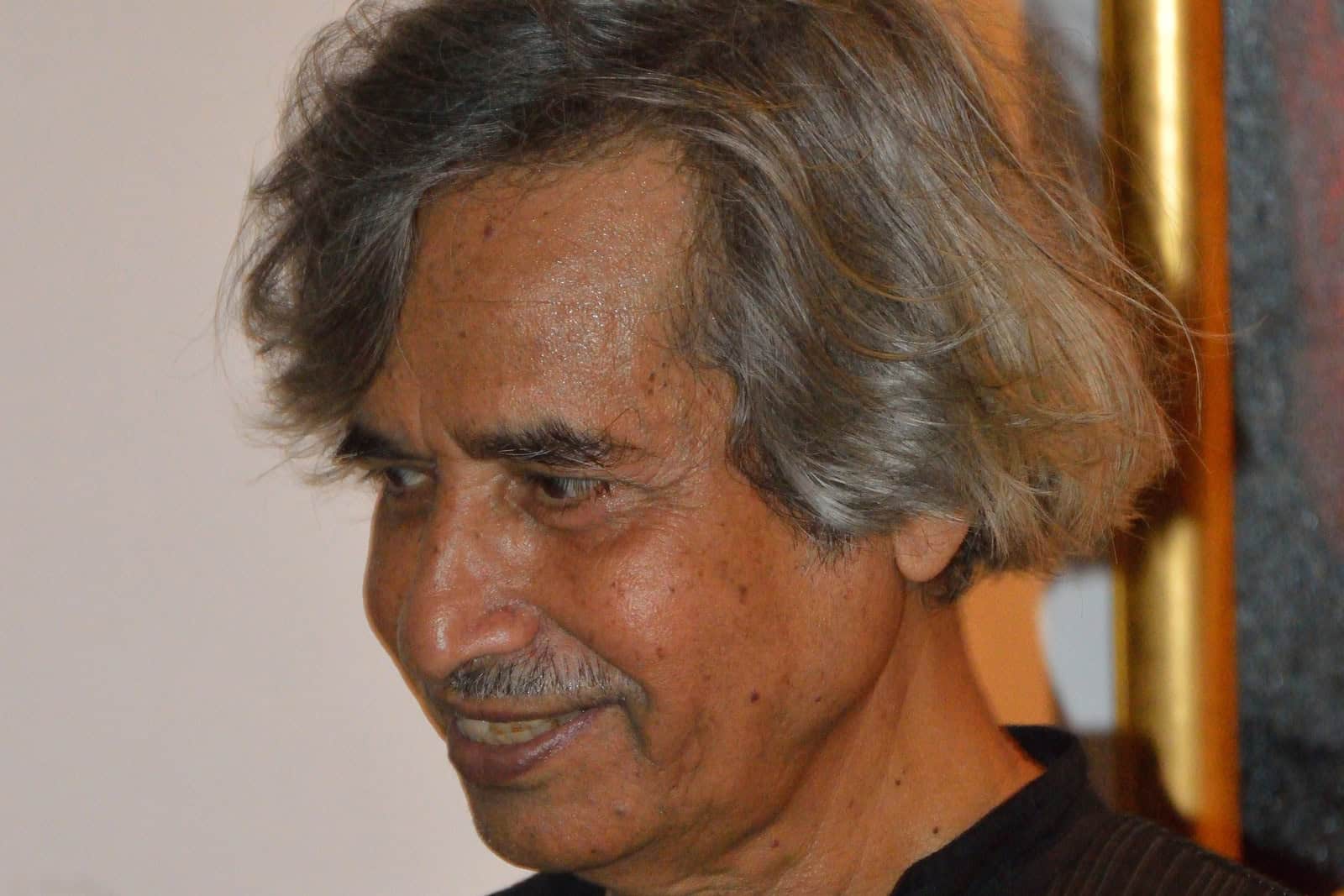
Jogen Chowdhury at the Academy of Fine Arts, Kolkata, in 2012. Photograph by Biswarup Ganguly, via Wikimedia Commons, licensed under CC BY 3.0.
What His Cross-Hatched Bodies Actually Do
Cross-hatching usually describes intersecting lines used to build shadow and volume. In Chowdhury’s hands, the technique does more. Dense nets of ink can make skin appear veined, hairy, bruised, or under pressure; the lines model flesh while denying it the polished wholeness of an academic nude. Readers unfamiliar with the method can see the basic mechanics in this guide to cross-hatching, but Chowdhury’s achievement was to turn a drawing device into emotional and social structure.
His contours are equally important. A long, fluid boundary gives a figure coherence, while swelling stomachs, compressed limbs, enlarged hands, and slack folds push it toward caricature. Sparse or black grounds remove ordinary coordinates. With no convincing room to stabilize the body, posture and surface have to carry the scene. Pastel does not dissolve the line; it gives the distorted form weight.
Day Dreaming makes the system legible at large scale. The 1979 work measures 152 by 182 centimeters and combines ink and pastel on lacquered paper. Sotheby’s permanent lot record documents a Fundação Bienal de São Paulo label on the reverse and lists the work as exhibited at the São Paulo Bienal in 1979. Its blank or dark pictorial field concentrates attention on the central figure, while cross-hatching supplies both modeling and friction.
That record also resolves a small but persistent chronology problem. DAG’s artist timeline places Chowdhury’s São Paulo appearance in 1978. The Bienal’s own archive dates its 15th edition from October 3 to December 16, 1979, and the label recorded on Day Dreaming also says 1979. The institution’s dates and the object record therefore outweigh the 1978 entry.
A Career Built Through Collections and Teaching
Chowdhury’s legacy is not confined to signature works such as Day Dreaming, The Tiger in the Moonlit Night, and the Reminiscences of a Dream series. The National Gallery of Modern Art records works including Couple II and Reminiscences of Dream No. 18 in its holdings, while the presidential secretariat confirms his presence in the Rashtrapati Bhavan collection.
He also helped create the infrastructure around art. He co-edited the journal Art Today, taught at Kala Bhavana, supported younger artists, and opened Charubasona: Jogen Chowdhury Centre for Arts in Kolkata in 2019 to preserve and show works spanning his development. From 2014 to 2020 he served in the Rajya Sabha. In 2014, Rashtrapati Bhavan brought him back as the first participant in its artist-in-residence program.
These roles were not separate from the studio practice. A curator handles the physical and historical life of objects; a teacher turns private decisions into communicable knowledge; an institution builder decides what later audiences will be able to see. Chowdhury’s public career extended the same concern that animates his figures: how bodies and artworks acquire meaning inside structures of power.
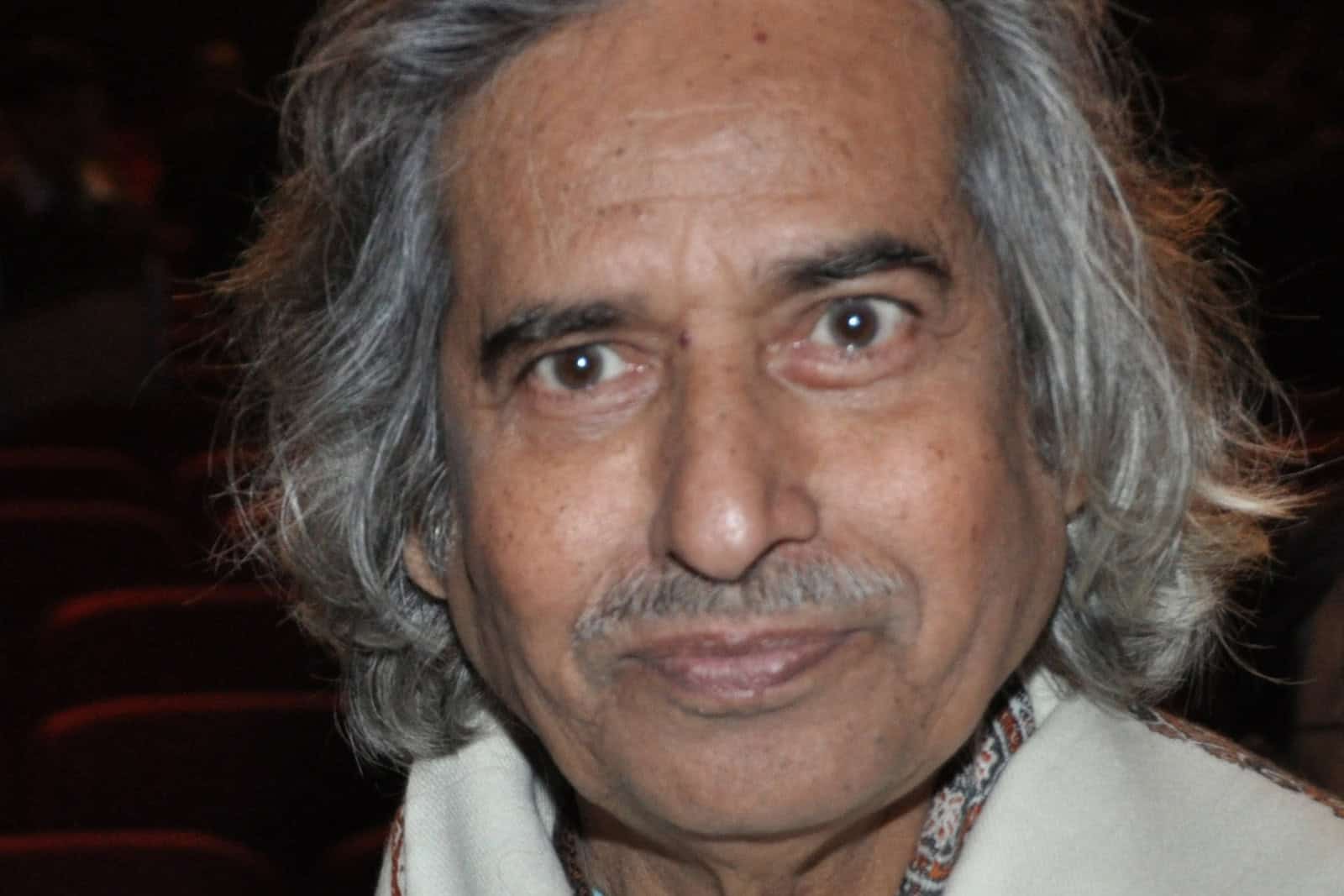
Jogen Chowdhury at Science City, Kolkata, in 2010. Photograph by Biswarup Ganguly, via Wikimedia Commons, licensed under CC BY-SA 3.0.
The Dates and Records That Now Stand
The official parliamentary biography gives February 16, 1939, as Chowdhury’s birth date, while DAG records February 15; either date puts him at 87 when he died. The Bienal archive and the reverse label on Day Dreaming date his São Paulo appearance to 1979, while DAG lists 1978.

Isabella studied at the University of Cape Town in South Africa and graduated with a Bachelor of Arts majoring in English Literature & Language and Psychology. Throughout her undergraduate years, she took Art History as an additional subject and absolutely loved it. Building on from her art history knowledge that began in high school, art has always been a particular area of fascination for her. From learning about artworks previously unknown to her, or sharpening her existing understanding of specific works, the ability to continue learning within this interesting sphere excites her greatly.
Her focal points of interest in art history encompass profiling specific artists and art movements, as it is these areas where she is able to really dig deep into the rich narrative of the art world. Additionally, she particularly enjoys exploring the different artistic styles of the 20th century, as well as the important impact that female artists have had on the development of art history.
Learn more about Isabella Meyer and the Art in Context Team.
Choose Art in Context as a preferred source to see more of our reporting in Google Top Stories and other Google Search experiences.
Cite this Article
Isabella, Meyer, “Jogen Chowdhury Dies at 87: His Language of Line.” Art in Context. October 26, 2026. URL: https://artincontext.org/jogen-chowdhury-dies-87/
Meyer, I. (2026, 26 October). Jogen Chowdhury Dies at 87: His Language of Line. Art in Context. https://artincontext.org/jogen-chowdhury-dies-87/
Meyer, Isabella. “Jogen Chowdhury Dies at 87: His Language of Line.” Art in Context, October 26, 2026. https://artincontext.org/jogen-chowdhury-dies-87/.


