


Seven Flavian Heirs Ask Paris Court to Undo Pissarro Sale

Seven heirs of Jewish banker Salomon Flavian have asked a Paris court to annul the 2024 Sotheby’s sale of Camille Pissarro’s Darse de pêche et bassin Duquesne, Dieppe, après-midi ensoleillée. They say most of the family was not consulted; Sotheby’s and Mondex dispute the alleged wartime seizure, and Sotheby’s also contests French jurisdiction. A ruling is expected in November.
A 2024 Settlement Now Faces Seven Heirs
The hearing took place on September 18, 2026. In a report published six days later, The Art Newspaper said the seven plaintiffs were seeking to reverse the June 25, 2024 London sale, which realized £1.2 million. The report put the expected decision date at November 5.
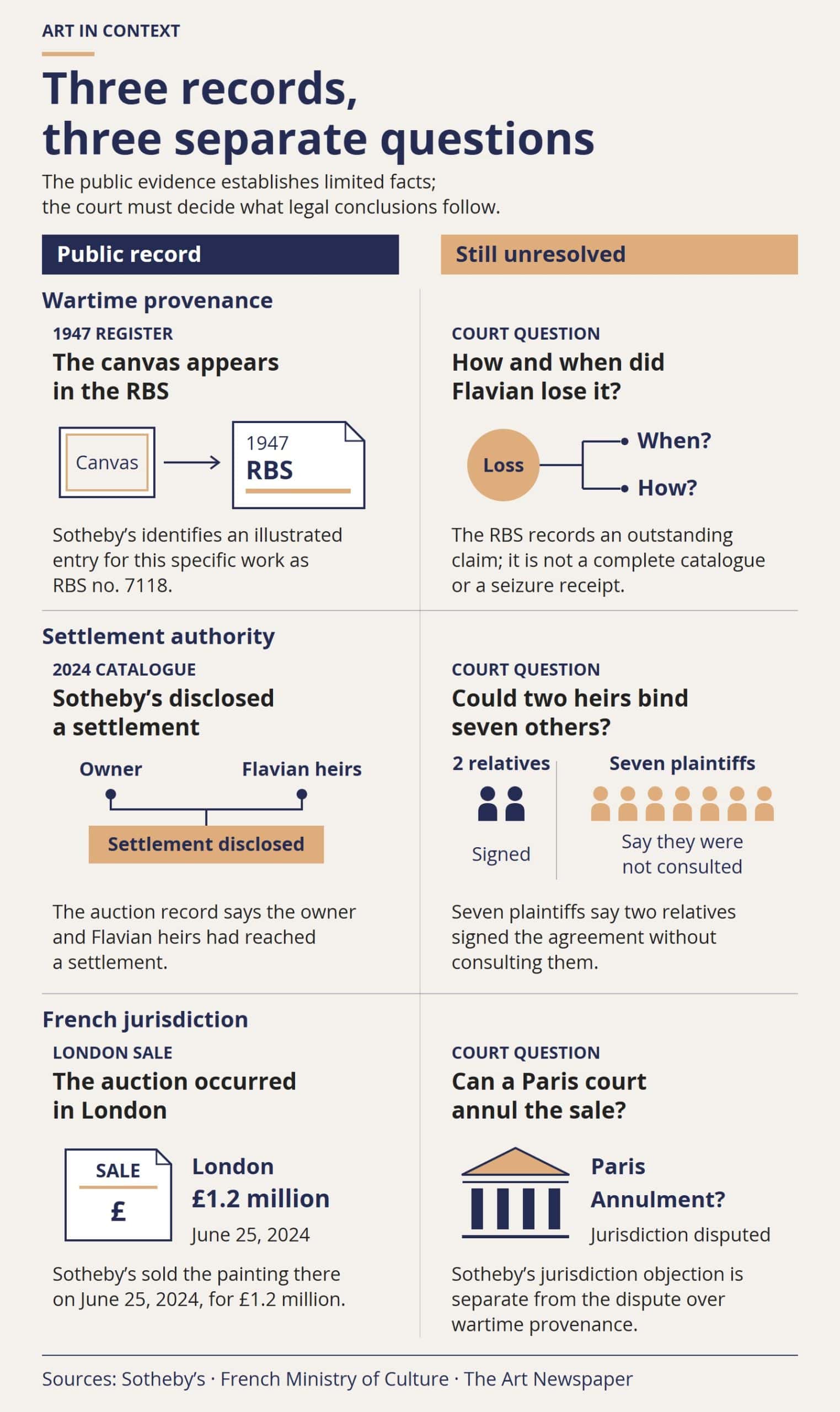
The public Sotheby’s catalogue entry explicitly acknowledges the cloud over the lot. It names Flavian in the provenance, cites the painting’s 1947 inclusion in France’s looted-property register, and says the work was offered under a settlement between the current owner and Flavian’s heirs. It does not identify the settlement’s signatories or define which heirs it covered.
According to the court report, legal files show that Gilles and Nicolas Flavian, represented by restitution company Mondex, waived their rights under an agreement with the seller. The seven plaintiffs say they were not consulted. The same report describes an October 17, 2024 Mondex letter telling other family members that an 8% share of the net sale price had been accepted in their name and referring to a 16% commission owed by the two signatories. Those figures and the account of consent are claims drawn from the reported files; the court has not yet ruled on their legal effect.
What the Auction Record Establishes
The oil on canvas measures 65.3 by 81.2 centimeters and is signed and dated 1902. It belongs to the late Dieppe views of Camille Pissarro, who painted the harbor, fishing dock, and market from an elevated room during his summer stay. Sotheby’s exhibition history places the disputed canvas in the 1992–93 traveling exhibition The Impressionist and the City: Pissarro’s Series Paintings.
A related 1902 canvas, The Fish Market, Dieppe: Grey Weather, Morning, shows how Pissarro treated the working port as a repeated modern motif. It is not the work in litigation, a distinction that matters because several Dieppe canvases have similar titles and viewpoints.
The auction provenance supplies a clear chronology, but its two prewar transfer dates are catalogue assertions rather than newly published transaction documents.
| Date | Record |
|---|---|
| March 20, 1935 | Sold at Hôtel Drouot, lot 9; Salomon Flavian is listed as buyer. |
| By 1937 | Sotheby’s lists dealer Paul Rosenberg as owner. |
| By 1939 | Collector Edward Le Bas is listed as having acquired it from Rosenberg. |
| 1947 | Published in Répertoire des biens spoliés, volume II, no. 7118, illustrated. |
| 1985 | Sold at Sotheby’s New York; the catalogue then states “Acquired from the above.” |
| June 25, 2024 | Sold in London following the stated settlement. |
This sequence reveals the central evidentiary gap. If the transfer to Rosenberg occurred by 1937 and the sale to Le Bas followed by 1939, the painting had left Flavian before the 1941 seizure of his collection. If those entries conflate records, omit Flavian’s continuing ownership, or reflect a coerced or otherwise defective transfer, the 1947 registration carries different weight. The dates do not resolve themselves merely because they appear in a later auction catalogue.
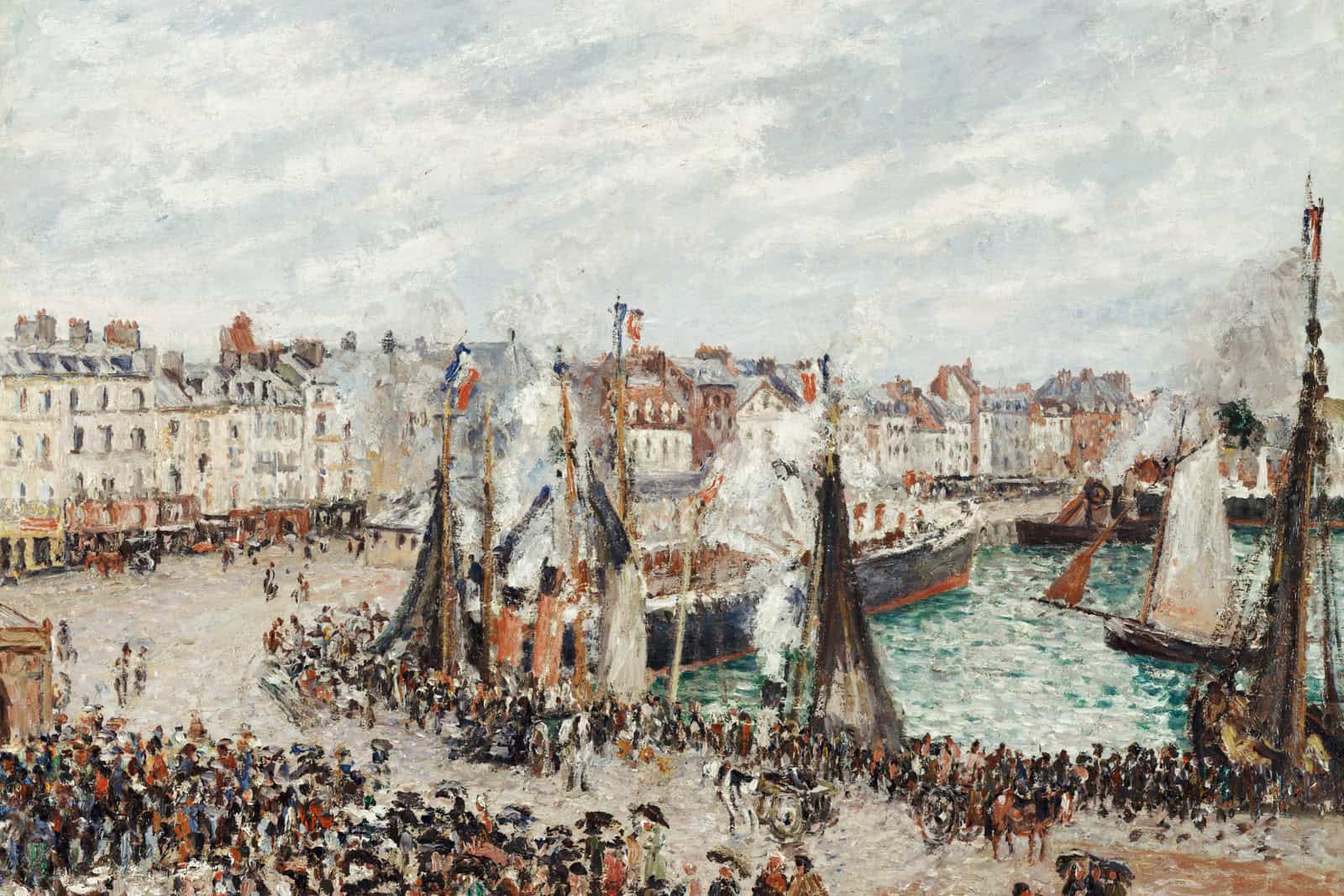
The Fish Market, Dieppe: Grey Weather, Morning (1902) by Camille Pissarro. Dallas Museum of Art via Wikimedia Commons, CC0 1.0 Universal Public Domain Dedication. This is a related Dieppe canvas, not the disputed work.
Why the 1947 Register Does Not End the Inquiry
Sotheby’s citation to RBS number 7118 is important, but the French government defines what that register can establish. The Ministry of Culture says the Répertoire des biens spoliés was published from 1947 to 1949 to circulate information about objects then claimed and not yet returned. It also warns that the multivolume work is incomplete and contains identification, attribution, and clerical errors.
The sound conclusion is therefore narrow: this Pissarro was recorded in the 1947 volume as an illustrated, unrestituted claim associated with wartime loss. The entry records a contemporaneous postwar claim, but it does not by itself document the date, agency, or mechanics of the painting’s removal.
The defendants rely on a different record set. Sotheby’s and Mondex told the court that research commissioned by the seller found no match for this canvas among ERR confiscation lists for 45 paintings and sculptures taken from Flavian. The researcher reportedly concluded that Rosenberg may instead have sold it to Le Bas around 1938. Corinne Hershkovitch, the plaintiffs’ lawyer, challenged that reconstruction, arguing that Rosenberg’s records were imprecise and may refer to another Pissarro acquired by Le Bas.
| Evidence | What it does—and does not—show |
|---|---|
| 1947 RBS entry | Shows a postwar claim still unresolved then; it is not a seizure receipt. |
| ERR-list absence | Counts against a documented ERR seizure of this canvas; it is not proof of a voluntary prewar sale. |
| 2024 settlement line | Shows Sotheby’s represented that a settlement existed; it does not disclose its scope or authority. |
The two wartime sources are not mirror images. Inclusion in the RBS and absence from the cited ERR lists answer different questions, while the disputed Rosenberg-to-Le Bas transfer is the bridge that would reconcile them. A comparable recent Nazi-looted portrait restitution case likewise showed why locating an artwork and establishing who may settle a claim are separate tasks.
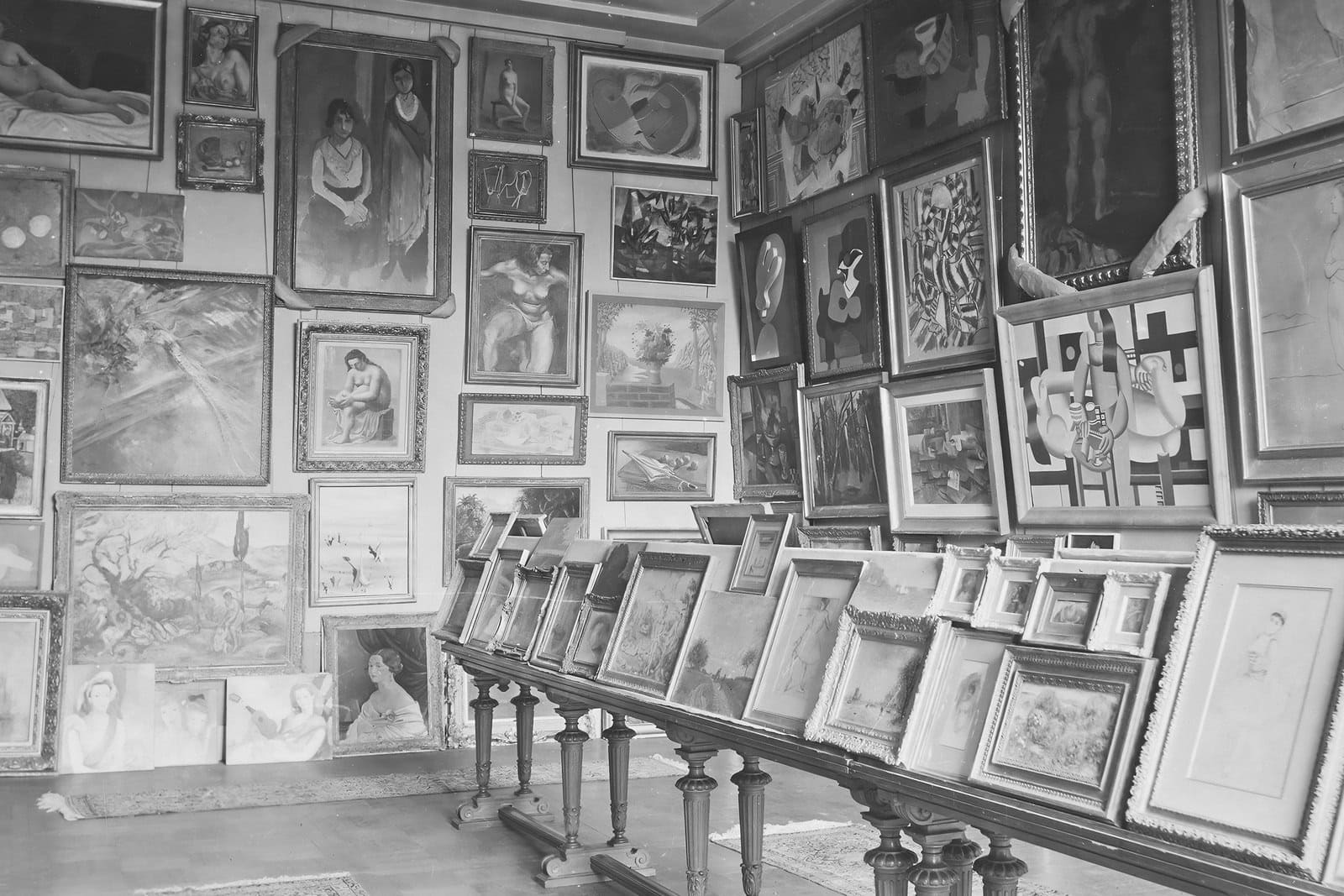
The Jeu de Paume’s Salle des Martyrs in Paris, July 30, 1940, with artworks handled by the ERR. Unknown photographer, Archives du ministère des Affaires étrangères via Wikimedia Commons, public domain. The photograph does not depict the disputed Pissarro.
The Court Must Decide Authority as Well as Provenance
Even a definitive provenance finding would not alone answer whether the 2024 agreement bound the entire family. The plaintiffs’ position is that two relatives could not consent for seven others who were not consulted. Mondex disputes the allegation that the canvas was looted and says it had received no payment from the transaction, according to The Art Newspaper. No published ruling has yet accepted either account.
Sotheby’s has raised a threshold objection. Its lawyer, Remi Sermier, argued that a French court lacks jurisdiction over a London sale between parties said to have no connection with France. That argument concerns the forum, not the truth of the wartime provenance. The court could therefore face three distinct decisions: what happened to the painting before 1941, whom the 2024 agreement bound, and whether Paris is the proper place to decide.
The public auction record does not name the 2024 buyer or the consignor and does not give the painting’s present location. Annulment could affect title and the sale contract, but the consequences will depend on the court’s reasoning and cannot be inferred before judgment.
What Is Established Before the Ruling
Four findings can be stated without prejudging the case:
- Sotheby’s own provenance places the painting with Salomon Flavian after the March 1935 Drouot sale.
- The same catalogue cites RBS no. 7118, confirming that the specific canvas appeared as an illustrated item in France’s 1947 looted-property register.
- The catalogue’s claim of transfers to Rosenberg by 1937 and Le Bas by 1939 is the factual hinge, and the plaintiffs dispute the reconstruction behind it.
- The 2024 catalogue disclosed a settlement, but the reported legal files identify only two family signatories while seven other heirs now challenge its reach.
Still unresolved are whether the painting left Flavian before the 1941 seizure, whether the two signatories could bind the other heirs, and whether a French court can undo the London sale.

Isabella studied at the University of Cape Town in South Africa and graduated with a Bachelor of Arts majoring in English Literature & Language and Psychology. Throughout her undergraduate years, she took Art History as an additional subject and absolutely loved it. Building on from her art history knowledge that began in high school, art has always been a particular area of fascination for her. From learning about artworks previously unknown to her, or sharpening her existing understanding of specific works, the ability to continue learning within this interesting sphere excites her greatly.
Her focal points of interest in art history encompass profiling specific artists and art movements, as it is these areas where she is able to really dig deep into the rich narrative of the art world. Additionally, she particularly enjoys exploring the different artistic styles of the 20th century, as well as the important impact that female artists have had on the development of art history.
Learn more about Isabella Meyer and the Art in Context Team.
Choose Art in Context as a preferred source to see more of our reporting in Google Top Stories and other Google Search experiences.
Cite this Article
Isabella, Meyer, “Seven Flavian Heirs Ask Paris Court to Undo Pissarro Sale.” Art in Context. September 25, 2026. URL: https://artincontext.org/pissarro-sale-flavian-heirs-paris-court/
Meyer, I. (2026, 25 September). Seven Flavian Heirs Ask Paris Court to Undo Pissarro Sale. Art in Context. https://artincontext.org/pissarro-sale-flavian-heirs-paris-court/
Meyer, Isabella. “Seven Flavian Heirs Ask Paris Court to Undo Pissarro Sale.” Art in Context, September 25, 2026. https://artincontext.org/pissarro-sale-flavian-heirs-paris-court/.


