

Leonor Fini – Her Life, Paintings, Theater, and Legacy

Leonor Fini made paintings that feel like stages where sphinxes watch, masks unsettle familiar identities, and power shifts between observer and observed. Her work occupied the imaginative territory around Surrealism, yet she refused to let a movement define her. Following her across painting, theater, books, and carefully staged self-presentation reveals an artist who treated independence as a working method.
Who Was Leonor Fini?
Leonor Fini was an Italian painter, designer, illustrator, and author born in Buenos Aires on August 30, 1907. Raised in Trieste, she developed her career through Milan, Paris, Monte Carlo, Rome, and the Corsican village of Nonza. She died in Aubervilliers, in the Paris metropolitan area, on January 18, 1996.

Fini is best known for figurative paintings populated by sphinxes, chimeras, masks, commanding women, and androgynous figures. These subjects allowed her to stage encounters in which identity appears changeable and customary gender roles become unstable. Her paintings belong to a larger practice that also included portraits, costumes, sets, illustrated books, fiction, and the construction of her own public image.
Leonor Fini at a Glance
Fini’s chronology shows how changes of place repeatedly opened new possibilities in her work. The dates below mark professional and creative turning points rather than every event in her life.

| Period | Turning point | Why it matters |
|---|---|---|
| 1907 | Born in Buenos Aires | Fini was born on August 30 and moved to Trieste during infancy. |
| 1920s | Formation in Trieste and Milan | Arturo Nathan offered early guidance, and Fini later studied with Achille Funi. |
| Early 1930s | Move to Paris | The move probably occurred in 1931. She entered an international circle while maintaining an independent position. |
| 1936 | Major Surrealist exhibitions | Her work appeared in important international presentations, including MoMA’s Fantastic Art, Dada, Surrealism. |
| 1940 to 1946 | Monte Carlo, Rome, and Paris | Wartime relocations were followed by a return to Paris and an extensive postwar design career. |
| 1946 to 1969 | Intensive theater work | Fini designed sets or costumes for more than 70 Paris productions. |
| 1954 to 1980 | Annual summers in Nonza | A former Franciscan monastery became a recurring residence and workplace. |
| 1976 to 1979 | Three published novels | Fiction expanded a literary practice that already included approximately 50 illustrated books. |
| 1994 to 1996 | Final working years | Fini continued painting until roughly two years before her death. |
| 2019 to 2027 | Archive and museum reassessment | Her papers entered Yale, opened for research in 2026, and new Frankfurt and Paris exhibitions were announced. |
Why Her Place in Modern Art Is Hard to Label
Fini participated in landmark exhibitions associated with Surrealism, befriended people within its Paris circle, and worked within some of the same imaginative territory. She nevertheless declined formal affiliation. Calling her simply a Surrealist therefore captures an important context but obscures the independence she defended.
Her art also drew on older and neighboring traditions. Museum accounts place it in dialogue with Italian Mannerism, Renaissance art, French Symbolism, Romanticism, and the strange spaces associated with Metaphysical painting. Fini did not exchange one fixed school for another. She combined elements from several traditions with the practical knowledge gained through theater and illustration.
A Life Built Across Cities
Each city in Fini’s life supplied a different kind of education. Trieste offered an intellectually mixed environment, Milan brought contact with painters and artistic circles, and Paris provided international exhibitions and collaborators. Rome, Monte Carlo, and Nonza later became more than temporary addresses: they changed the conditions under which she lived and worked.
Buenos Aires and Cosmopolitan Trieste
Fini left Buenos Aires for Trieste during infancy. The port city had a multilingual cultural life, and visitors to her household included writers James Joyce, Umberto Saba, and Italo Svevo. This setting placed literature and visual culture within ordinary social experience rather than behind an institutional boundary.
The painter Arturo Nathan became an early mentor. Fini did not follow the standard path through a conventional academy, but she was not isolated from instruction. She received guidance and developed through contact with working artists. The familiar description of her as entirely self-taught compresses this more useful account of her formation.
Milan Training and the Move to Paris
In Milan, Fini studied with Achille Funi and encountered artists connected with Novecento Italiano and Metaphysical painting. Novecento artists renewed their engagement with Italian figurative traditions, while Metaphysical painting used still spaces and unexpected combinations to make ordinary scenes feel uncanny. These contacts form part of Fini’s education, but they do not establish formal membership in either group.
Fini moved to Paris in the early 1930s, probably in 1931. There she formed relationships with artists and writers including Victor Brauner, Paul Éluard, Meret Oppenheim, and Max Ernst. Paris gave her access to an international avant-garde, meaning artists working at the experimental edge of established culture. It also sharpened a distinction that remained important throughout her career: participating in a circle did not require obedience to its program.
Monte Carlo, Rome, and the 1946 Return
World War II broke the continuity of Fini’s Paris life. She relocated to Monte Carlo in 1940 and moved to Rome with Stanislao Lepri in 1943. She returned to Paris in 1946, the year that began her especially active postwar period in theater and costume design.
Konstanty A. Jeleński joined Fini and Lepri in Paris in 1952. The three formed a long-term domestic and creative household. Their shared life belongs to Fini’s history because it sustained relationships among painting, criticism, literature, design, and an international social world. It should not be turned into speculation about private motives that the work itself cannot prove.
Summers in Nonza
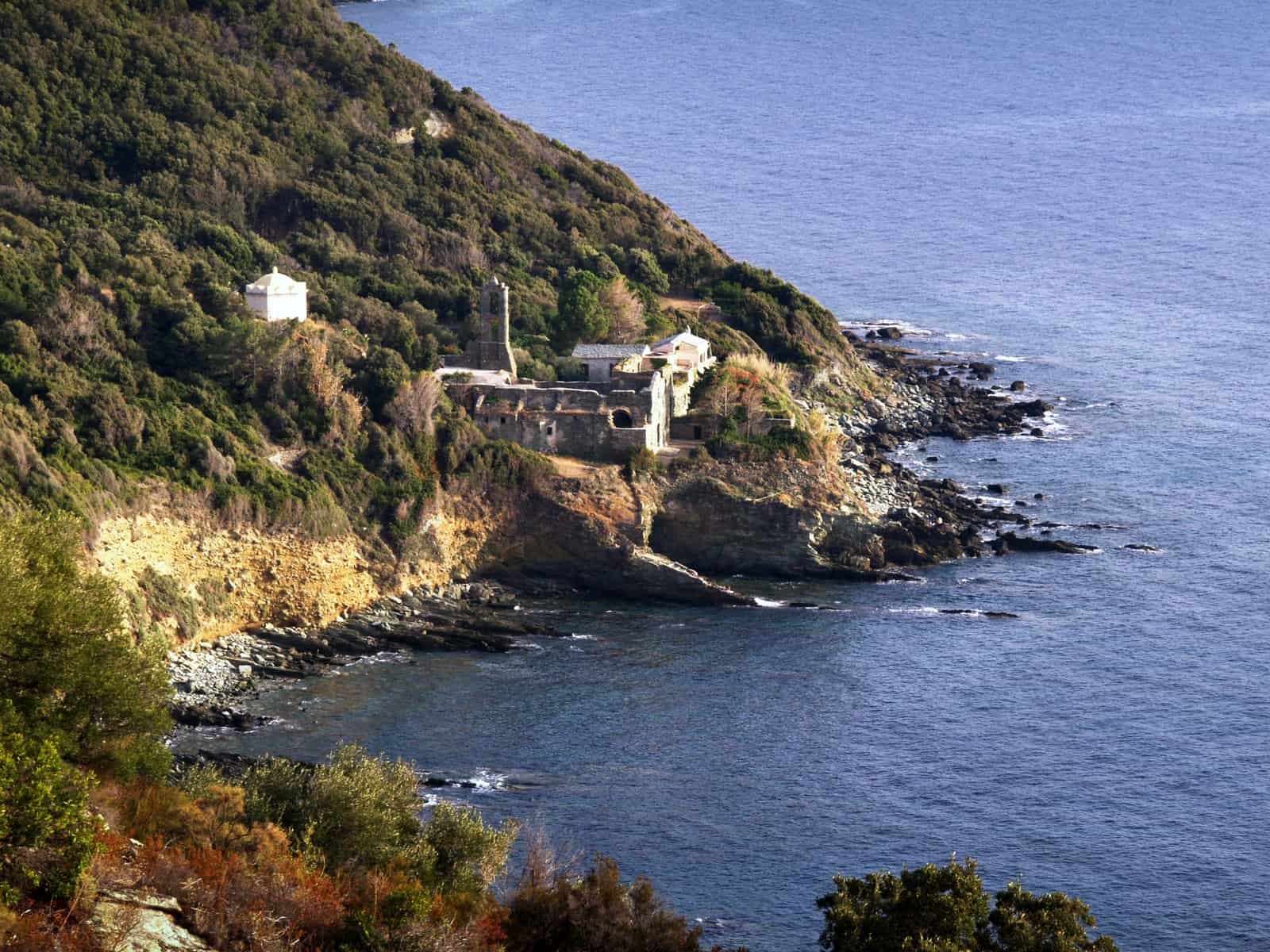
From 1954 to 1980, Fini rented a former Franciscan monastery in Nonza, Corsica. She lived there annually for roughly four months, generally from June through September. The regularity matters: Nonza was a long-running workplace rather than an occasional retreat.
The change between Paris and Corsica created two rhythms within the same career. Paris supported theater commissions, publishing, exhibitions, and social connections. Nonza offered a recurring seasonal environment in which living and working occupied the same setting. This movement between places mirrors the flexibility of a practice that never separated painting completely from design, writing, or performance.
An Independent Artist Near Surrealism
The question of whether Fini was a Surrealist has no useful one-word answer. Her exhibition history places her near the movement, and her friendships connected her closely to its participants. Her own position, however, remained resistant to formal membership and to the authority claimed by André Breton.
Exhibiting With Surrealists Without Joining
In 1936, Fini appeared in significant international Surrealist presentations, including the International Surrealist Exhibition in London and the Museum of Modern Art’s Fantastic Art, Dada, Surrealism in New York. These events placed her work before audiences encountering Surrealism as an international phenomenon.
Participation was not equivalent to enrollment. Fini objected to Breton’s dogmatism and misogyny and declined to affiliate formally with the movement he led. She later described her relationship as a companionship with Surrealism. That phrasing recognizes shared territory while preserving the distance she considered necessary.
Old Masters, Symbolism, and Planned Construction
Fini’s imagery cannot be explained through Surrealism alone. Italian Mannerism offered models of elongated bodies, deliberate artifice, and unstable space. French Symbolism treated suggestive images as more important than straightforward description. Renaissance and Romantic art provided further points of reference that she could quote, alter, or place inside a modern fantasy.
Her surviving graphite Study for The Shepherdess of the Sphinxes also demonstrates the role of preparation in her work. The drawing establishes an arrangement that the finished painting develops into a theatrical encounter. Fantasy and careful construction operate together rather than as opposites.
Friendship Is Not Membership
Fini’s connections with Ernst, Brauner, Éluard, Oppenheim, and other Surrealist artists explain why she appears in histories of the movement. They do not justify treating every resemblance as documented influence or every fantasy figure as a coded statement of belief. Social history, exhibition history, and formal affiliation describe different relationships.
This distinction makes her work easier to see. Instead of asking whether a painting satisfies a movement’s rules, a viewer can examine how Fini stages authority, uncertainty, and transformation. Her independence was not a withdrawal from modern art. It was a way of taking part without surrendering control over the terms.
Painting, Portraiture, and Theater
Fini developed a recognizable world without restricting herself to one medium. Figures pose as if a curtain has just risen, architecture opens onto uncertain spaces, and costumes make identity appear constructed rather than permanent. The same theatrical intelligence links her easel paintings to portraits, masks, stage designs, and books.
Sphinxes, Androgyny, and the Reversed Gaze
Sphinxes are among Fini’s most persistent subjects, alongside chimeras, witches, fairies, narcissists, masks, and stones. She identified personally with the sphinx, and the creature gave her a form through which female agency and transformation could be pictured. It could observe, guard, challenge, or remain unreadable.
Fini’s strong women and androgynous figures also disrupt familiar roles. A figure who might conventionally serve as a passive model can instead control the encounter, while another resists a simple classification as masculine or feminine. The gaze becomes structural: who is watching, who is displayed, and who seems to hold knowledge can change within a single scene.
No one symbol supplies a universal key. A sphinx beside a commanding figure functions differently from the small, secluded creature in Little Hermit Sphinx. Looking at scale, position, pose, and setting produces a firmer reading than assigning the same private meaning to every appearance.
Portraits, Masks, and Self-Presentation
Portraiture allowed Fini to approach identity as a performance shaped by clothing, pose, gesture, and setting. Her theatrical self-portraits do not merely record a face. They present a role while making the construction of that role visible.
Masks intensify the uncertainty. They can conceal a face, replace it, or make the uncovered face seem equally staged. Fini’s public self-presentation extended this concern beyond the canvas, linking dress and appearance to her work in costume. It is more accurate to treat that self-fashioning as an artistic practice than to turn it into an unsupported psychological diagnosis.
Stage, Screen, and Illustrated Books
Fini’s theatrical work was a sustained professional activity. Between 1946 and 1969, she designed sets or costumes for more than 70 Paris productions, in addition to projects for opera and ballet. Her screen work included costume design for films such as Federico Fellini’s 8½.
Stage design demanded practical decisions about bodies in space, sightlines, fabric, movement, and the moment of revelation. Those concerns help explain the thresholds, ceremonial poses, and arranged encounters found in her paintings. This connection does not reduce the paintings to set designs. It shows how work in one medium trained her attention in another.
Books formed another major branch of the practice. Fini illustrated approximately 50 volumes and later published three novels: Mourmour in 1976, L’Onéiropompe in 1978, and Rogomelec in 1979. Painting, performance, and literature were therefore parallel activities within a career that repeatedly moved images across formats.
Major Works to Know
Three works from different decades show how Fini changed the function of the figure while retaining her interest in staging. The Shepherdess of the Sphinxes organizes a relationship of command, Little Hermit Sphinx creates a scene of isolation and uncertain scale, and La Mémoire infidèle turns the act of remembering another artwork into its subject.
The Shepherdess of the Sphinxes (1941)
Fini made a graphite Study for The Shepherdess of the Sphinxes in 1941 as preparation for the finished painting now held by the Peggy Guggenheim Collection in Venice. The surviving study is important because it demonstrates a planned process behind an image that may initially look like an unmediated fantasy.
Begin with the title. A shepherdess conventionally tends and directs a flock, but Fini replaces ordinary animals with sphinxes. The substitution makes the relationship between the central role and the surrounding creatures the painting’s organizing problem. Authority belongs not to a male hero confronting a monster, but to a female figure positioned in relation to multiple hybrid beings.
The move from graphite study to finished painting also joins two sides of Fini’s practice. Drawing establishes the arrangement, while the completed image turns that arrangement into a theatrical encounter. The fantasy depends on construction: roles, positions, and attention have been deliberately assigned.
Little Hermit Sphinx (1948): A Close Reading
Little Hermit Sphinx is a 1948 oil painting in Tate’s collection. Its setting contains an open doorway crowded by vegetation, deteriorating surfaces, a suspended organic form that Fini identified as a human lung, and a small sphinx among leaves. These details offer a clear route into the painting without requiring a fixed symbolic code.
First, notice the doorway. It provides a view through the architecture, yet vegetation complicates passage and blurs the division between built space and organic growth. The damaged surfaces make the setting feel exposed rather than sheltering. A doorway that should organize entrance and exit instead creates uncertainty about what lies inside or outside.
Next, compare scale and placement. The sphinx is small and low among the leaves, while the human lung hangs in open space. The creature named in the title is not the largest or most immediately legible form. The bodily fragment, detached from a visible body, occupies a position that attracts attention but does not resolve the scene.
The eye therefore moves among three kinds of threshold: the architectural opening, the boundary between ruin and growth, and the separation of an organ from a body. Fini does not provide a narrative that locks those elements together. The painting creates tension by making each object specific while leaving their relationship unsettled.
La Mémoire infidèle (1979): Memory Inside a Painting
In La Mémoire infidèle, a mannequin-like dandy looks at a barely recognizable painting placed inside Fini’s composition. That interior image refers to her companion work Le crépuscule du matin, which ultimately draws on a fresco by the Renaissance painter Bernardo Luini. The work, later donated to Ferrara, turns art-historical memory into a visible chain of transformations.
The title translates as “Unfaithful Memory,” and the structure shows what that can mean. Fini does not simply copy the earlier fresco. She filters it through another work of her own, then depicts a viewer confronting its altered trace. Memory becomes an active remaking rather than perfect storage.
The comparison with the earlier sphinx paintings is revealing. In 1941, the figure’s role organizes a hierarchy. In 1948, the small creature occupies an unstable environment. By 1979, the principal encounter occurs between a viewer and an image already layered with earlier art. The staged scene remains, but quotation and recollection now drive its tension.
Recognition, Archives, and Legacy
Fini achieved substantial professional recognition during her lifetime. She worked across major European cultural centers, maintained a demanding postwar design career, and received retrospectives in Belgium, Italy, Japan, and France. She continued painting until approximately 1994, two years before her death.
Success in Her Lifetime and Later Marginalization
Fini’s later limited recognition should not be confused with an absence of success during her life. Her exhibitions, commissions, publications, and retrospectives establish a long public career.
Her record does not fit a biography organized around painting alone. Sets, costumes, illustrated books, and fiction occupied decades of her working life, while the paintings developed related concerns with pose, role, and staging. Seeing these activities together clarifies the scale and continuity of her practice.
The Yale Papers and New Research
The Beinecke Rare Book and Manuscript Library received the principal Leonor Fini Papers from her estate in 2019 and 2021, followed by later additions. The principal series opened for research in March 2026. This archive makes it possible to examine her painting, design, publishing, professional relationships, and household within a connected record.
That access matters because familiar labels can now be tested against working documents and chronology. Questions about training, collaboration, theater production, literary activity, and relationships no longer need to depend solely on repeated biographical anecdotes. The archive also encourages study of Fini as a cross-media professional rather than as the maker of a few isolated fantasy paintings.
The 2026-2027 Museum Reassessment
A major exhibition is scheduled at Schirn Kunsthalle Frankfurt from October 23, 2026, through February 21, 2027. A Paris presentation at the Musée d’Art Moderne de Paris is announced for March 26 through August 15, 2027. Together with the newly accessible archive, these exhibitions mark a renewed institutional examination of Fini’s long career.
The timing allows museums and scholars to connect familiar images with less frequently integrated parts of her practice. Painting can be studied beside theater, costume, portraiture, illustration, literature, and self-presentation. This broader frame offers a more accurate measure of her contribution than auction results or the claim that she was simply forgotten.
What Fini’s Contribution Changed
Fini demonstrated that proximity to an avant-garde need not require submission to its leadership. She used the exhibition networks and experimental possibilities around Surrealism while defending a position shaped equally by older art, design work, literature, and her own decisions about public identity.
Her work also supplies a practical recognition tool. Look for three operations: a setting staged like a threshold, a role whose expected power has shifted, and an older image or familiar creature transformed through a new context. A sphinx may become a subject rather than an obstacle, a portrait may reveal its own performance, and a remembered fresco may return as a painting inside a painting. Those changes, more than any single label, hold Fini’s varied practice together.
Frequently Asked Questions About Leonor Fini
Fini’s independent position makes short labels especially easy to misread. These answers separate movement affiliation from exhibition history, academy training from artistic guidance, and museum ownership from current display.
Was Leonor Fini a Surrealist?
Fini exhibited with Surrealists and maintained friendships within their circle, but she did not formally join the movement. Her objections to André Breton’s dogmatism and misogyny make “independent artist near Surrealism” a more precise description.
Was Leonor Fini Self-Taught?
She did not attend a conventional art academy, but “entirely self-taught” is misleading. Arturo Nathan mentored her, and she studied with Achille Funi in Milan.
Why Did Leonor Fini Paint Sphinxes?
Fini identified with the sphinx and repeatedly used it in scenes concerned with female agency, transformation, watching, and uncertain identity. Its function changes from work to work, so scale, pose, and setting are more useful than assigning it one universal meaning.
Where Can You See Leonor Fini’s Art?
Museum collections include Little Hermit Sphinx at Tate, The Shepherdess of the Sphinxes at the Peggy Guggenheim Collection in Venice, and La Mémoire infidèle in Ferrara. Collection ownership does not guarantee that a work is currently on display, so visitors should check each museum’s schedule before traveling.

Isabella studied at the University of Cape Town in South Africa and graduated with a Bachelor of Arts majoring in English Literature & Language and Psychology. Throughout her undergraduate years, she took Art History as an additional subject and absolutely loved it. Building on from her art history knowledge that began in high school, art has always been a particular area of fascination for her. From learning about artworks previously unknown to her, or sharpening her existing understanding of specific works, the ability to continue learning within this interesting sphere excites her greatly.
Her focal points of interest in art history encompass profiling specific artists and art movements, as it is these areas where she is able to really dig deep into the rich narrative of the art world. Additionally, she particularly enjoys exploring the different artistic styles of the 20th century, as well as the important impact that female artists have had on the development of art history.
Learn more about Isabella Meyer and the Art in Context Team.
Cite this Article
Isabella, Meyer, “Leonor Fini – Her Life, Paintings, Theater, and Legacy.” Art in Context. September 13, 2026. URL: https://artincontext.org/leonor-fini/
Meyer, I. (2026, 13 September). Leonor Fini – Her Life, Paintings, Theater, and Legacy. Art in Context. https://artincontext.org/leonor-fini/
Meyer, Isabella. “Leonor Fini – Her Life, Paintings, Theater, and Legacy.” Art in Context, September 13, 2026. https://artincontext.org/leonor-fini/.


