

Wassily Kandinsky’s Betonte Ecken Sells for Record $85.8 Million

Christie’s sold Wassily Kandinsky’s Betonte Ecken (1922–23) for $85.78 million in New York on November 17, setting a new auction record for the artist. The price nearly doubled his previous high, but the painting’s $74 million hammer price—not the fee-inclusive total—is the number that belongs beside its presale estimate.
Kandinsky’s $85.8 Million Record, Properly Compared
Christie’s result released on November 17, the day of the auction, identifies Betonte Ecken as the top lot in its 20th Century Evening Sale. The auction house gives the exact price as $85,780,000 and the full sale total as $626,621,400, both including fees. Gustav Klimt’s Litzlbergkeller followed at $82.33 million.
Auction prices require one technical distinction. The hammer price is the winning bid when the auctioneer closes the lot; the buyer’s premium and any applicable fees are added afterward. The Art Newspaper reported on November 18 that the Kandinsky made $74 million at hammer and $85.8 million with fees. It reported the corresponding sale totals as $521 million at hammer and $627 million with fees.
Matched consistently, the painting supplied 13.69% of Christie’s exact fee-inclusive evening total. On the hammer figures reported by The Art Newspaper, its share was 14.20%. Either calculation shows that one canvas contributed roughly one-seventh of a sale containing 74 offered lots; the small difference between the percentages reflects the effect of premiums across differently priced lots.
The same discipline is needed for the old record. Christie’s uses $44.8 million for Murnau mit Kirche II, while the Associated Press reported the 2023 result as £37.2 million, then equivalent to $44.9 million. That is a rounding and exchange-rate difference, not a different sale. Against Christie’s $44.8 million benchmark, the new fee-inclusive price is 1.915 times as large, an increase of 91.5%.
The $85.78 million total also should not be compared directly with the $60 million to $80 million presale estimate, because auction estimates exclude the buyer’s premium. The $74 million hammer price landed inside that range. The sale set a record; the bidding itself did not pass the high estimate.

Why Betonte Ecken Is More Than a Price
The Christie’s catalogue record dates the painting to December 1922–January 1923 and gives its dimensions as 51 1/8 inches square, or 130 by 130 centimeters. Kandinsky had joined the Bauhaus faculty in June 1922. The school’s attempt to join art, craft, design, and architecture—explored in our history of Bauhaus art—made an unusually apt setting for his ambition to make color and form operate together like a total work of art.
Seen closely, the composition is organized by instability. Two broad diagonals create a loose X around a central blue form, but circles, checkerboards, bars, and pointed planes keep interrupting any single reading. The center pushes the eye outward; the title, usually translated as “Accentuated Corners,” redirects attention to the edges. Kandinsky did not abandon feeling when his forms became more geometric. He changed the means by which a painting could generate it.
The musical analogy is most useful as a description of pacing rather than illustration. Small repeated marks behave like quick notes, long diagonals establish sustained movement, and the colored clusters produce changes in visual volume. Readers comparing the artist’s prewar and Bauhaus periods across Kandinsky’s paintings can see that geometry did not make his work static; it gave rhythm sharper intervals.
Kandinsky began On White II the following month and completed it between February and April 1923. The two works share circles, lines, and angular forms, yet their grounds behave differently: Betonte Ecken uses a subtly tinted field, while On White II sets its forms against a more absolute white. That comparison makes the record painting’s achievement clearer. Its pale ground is not empty space but an active interval between competing shapes.
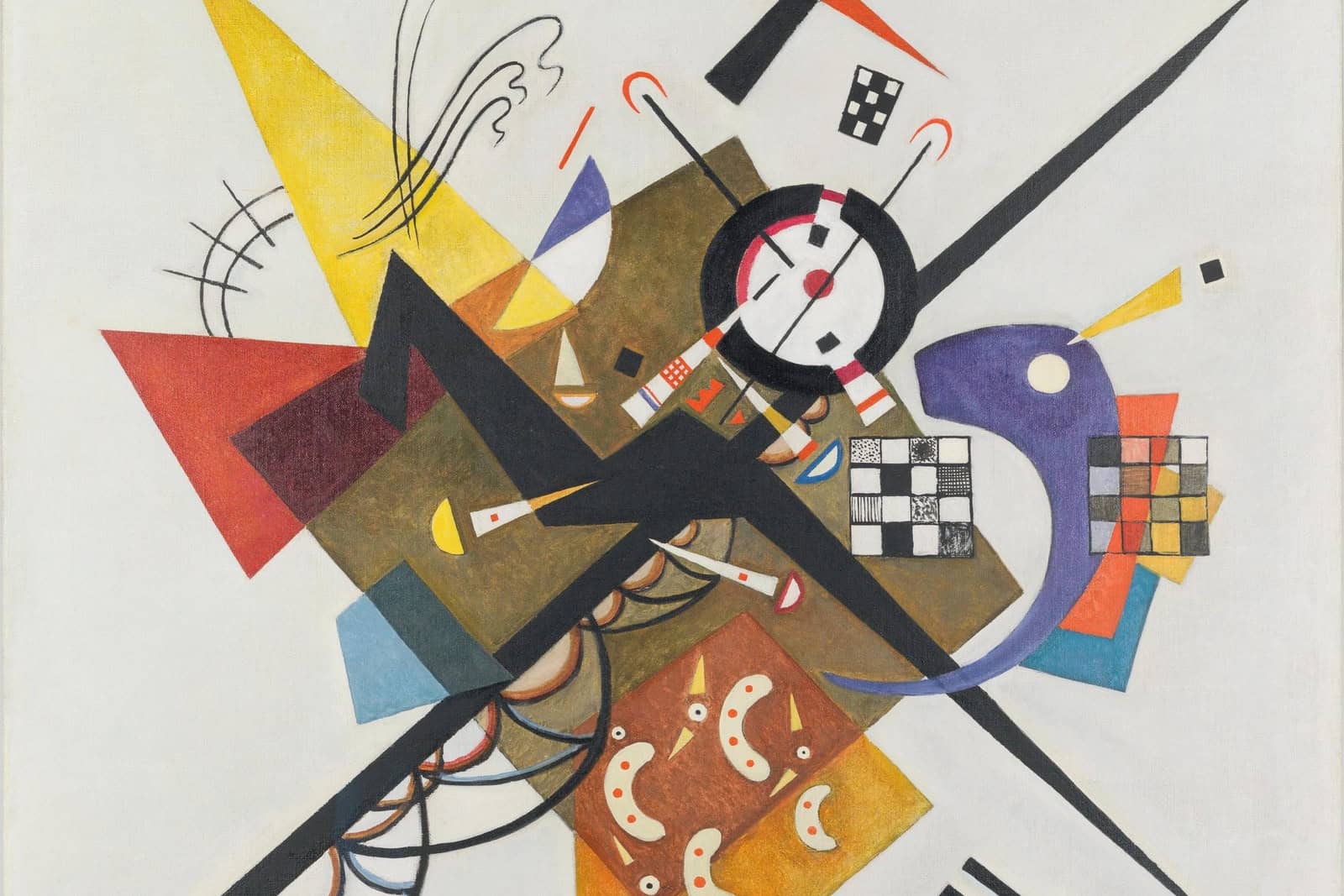
On White II (1923) by Wassily Kandinsky. Hosted by Wikimedia Commons; Creative Commons Public Domain Mark 1.0.
From Hilla Rebay to a Forty-Year Private Collection
The catalogue’s provenance gives Betonte Ecken a public institutional history before its long private ownership. Hilla Rebay acquired it in 1929. Solomon R. Guggenheim later acquired it from her, and the Solomon R. Guggenheim Foundation received it as a gift in 1941. The foundation sold it at Sotheby’s in London in 1964; after another change of ownership, the consignor at Christie’s acquired it at Sotheby’s New York in May 1986.
That sequence means the November 17 auction was the painting’s first public sale in 40 years. It was not, however, absent from view for all of that period. Christie’s exhibition history places it in the Museum Barberini’s Kandinsky’s Universe in Potsdam in 2025 and the Fondation Louis Vuitton’s Calder: Rêver en équilibre in Paris in 2026.
The Rebay and Guggenheim connection makes the work part of the history through which non-objective painting reached an American museum audience. It does not by itself explain the price, and Christie’s release attributes the result only to competition among multiple clients. Neither the auction house’s public result nor the independent sale report identifies the buyer.

Betonte Ecken (1922–23) by Wassily Kandinsky. Hosted by Wikimedia Commons; Creative Commons Public Domain Mark 1.0.
What the Kandinsky Sale Establishes
The verified record is $85.78 million with fees, 91.5% above Christie’s stated $44.8 million benchmark and almost exactly 1.92 times that earlier price. The work accounted for 13.69% of the $626.62 million fee-inclusive sale, or 14.20% when both lot and sale are measured at hammer.
The $74 million hammer result was within the $60 million to $80 million estimate, so the public total cannot support a claim that bidding exceeded the high estimate. Christie’s provenance establishes a 1941 gift to the Guggenheim Foundation, a 1964 deaccession, and an unbroken line to the owner who bought the painting in 1986. What remains unknown is who bought Betonte Ecken in 2026 and whether the painting will continue to appear in public exhibitions.

Isabella studied at the University of Cape Town in South Africa and graduated with a Bachelor of Arts majoring in English Literature & Language and Psychology. Throughout her undergraduate years, she took Art History as an additional subject and absolutely loved it. Building on from her art history knowledge that began in high school, art has always been a particular area of fascination for her. From learning about artworks previously unknown to her, or sharpening her existing understanding of specific works, the ability to continue learning within this interesting sphere excites her greatly.
Her focal points of interest in art history encompass profiling specific artists and art movements, as it is these areas where she is able to really dig deep into the rich narrative of the art world. Additionally, she particularly enjoys exploring the different artistic styles of the 20th century, as well as the important impact that female artists have had on the development of art history.
Learn more about Isabella Meyer and the Art in Context Team.
Choose Art in Context as a preferred source to see more of our reporting in Google Top Stories and other Google Search experiences.
Cite this Article
Isabella, Meyer, “Wassily Kandinsky’s Betonte Ecken Sells for Record $85.8 Million.” Art in Context. November 19, 2026. URL: https://artincontext.org/kandinsky-betonte-ecken-auction-record-2026/
Meyer, I. (2026, 19 November). Wassily Kandinsky’s Betonte Ecken Sells for Record $85.8 Million. Art in Context. https://artincontext.org/kandinsky-betonte-ecken-auction-record-2026/
Meyer, Isabella. “Wassily Kandinsky’s Betonte Ecken Sells for Record $85.8 Million.” Art in Context, November 19, 2026. https://artincontext.org/kandinsky-betonte-ecken-auction-record-2026/.


