

Aragón Clears Transfer of Eight Sijena Paintings From MNAC

Aragón’s Huesca heritage commission has authorized the transfer of eight medieval Sijena mural panels from Barcelona’s Museu Nacional d’Art de Catalunya (MNAC). The approval removes the obstacle that stopped a July attempt, but it does not confirm Aragón’s proposed October 19 start or settle the more difficult fate of 35 fire-damaged chapter-house fragments.
What Aragón Authorized—and What It Did Not
On October 9, 2026, the Provincial Cultural Heritage Commission of Huesca approved the deinstallation, packing, transport, and unpacking of the eight works displayed in room 17 of the MNAC. The commission’s decision, reported by Radio Huesca, says the procedures in the contractor’s schedule were considered adequate. It also requires each action to be coordinated with technicians designated by Aragón and communicated to them in advance.
Aragón announced work from October 19 through November 5. The MNAC immediately described those dates as provisional: it had not yet received the formal notice and said it would reprogram the operation only after that notice arrived. The authorization therefore clears a regulatory gate; it is not evidence that a mutually confirmed timetable exists.
The approved plan concerns SIT, the specialist company hired by the MNAC, and the eight secular panels alone. It does not authorize a move of the 35 fragments installed in room 16, determine that those fragments can travel by the same method, or decide their eventual installation.

Eight Secular Panels Are Not the 35 Chapter-House Fragments
The distinction is material, not merely administrative. The MNAC’s permanent collection record describes the secular group as eight fresco panels transferred to canvas. Made around 1200, they once formed a continuous frieze high on the walls of a rectangular room between the monastery church and cloister. Their scenes of courts, knights, castles, animals, and a naval battle place them within the visual world of Romanesque art, even though their subject matter is not devotional.
The catalog gives the assembled group a height of about 43 inches and a combined width of roughly 74 feet. That long, shallow format matters to the move: these are individual supports carrying former mural paintings, rather than a wall surface traveling intact.
| Set | What the record shows |
|---|---|
| Secular paintings | Eight canvas-mounted panels in MNAC room 17, dated circa 1200. The October 9 authorization covers this group. |
| Chapter-house paintings | Thirty-five fragments in room 16, damaged and color-altered by the 1936 fire. They remain outside this authorization. |
Aragón’s official procedural history says the final judgment requires the return of all 43 pieces—eight secular panels and 35 chapter-house fragments—and that Spain’s Supreme Court upheld that outcome on May 27, 2025. But a judgment covering both groups does not make their conservation problems identical. The MNAC says the secular works were not burned and lack the technical impediments it identifies in the chapter-house ensemble.
Pedro Olloqui, Aragón’s director general of culture, argued on October 9 that the two groups have an equivalent physical and chemical condition and that the first transfer could guide the second. The public announcement of the commission’s decision says it found SIT’s procedures for the room-17 panels adequate. The narrower decision establishes that the submitted method is acceptable for the eight room-17 panels.
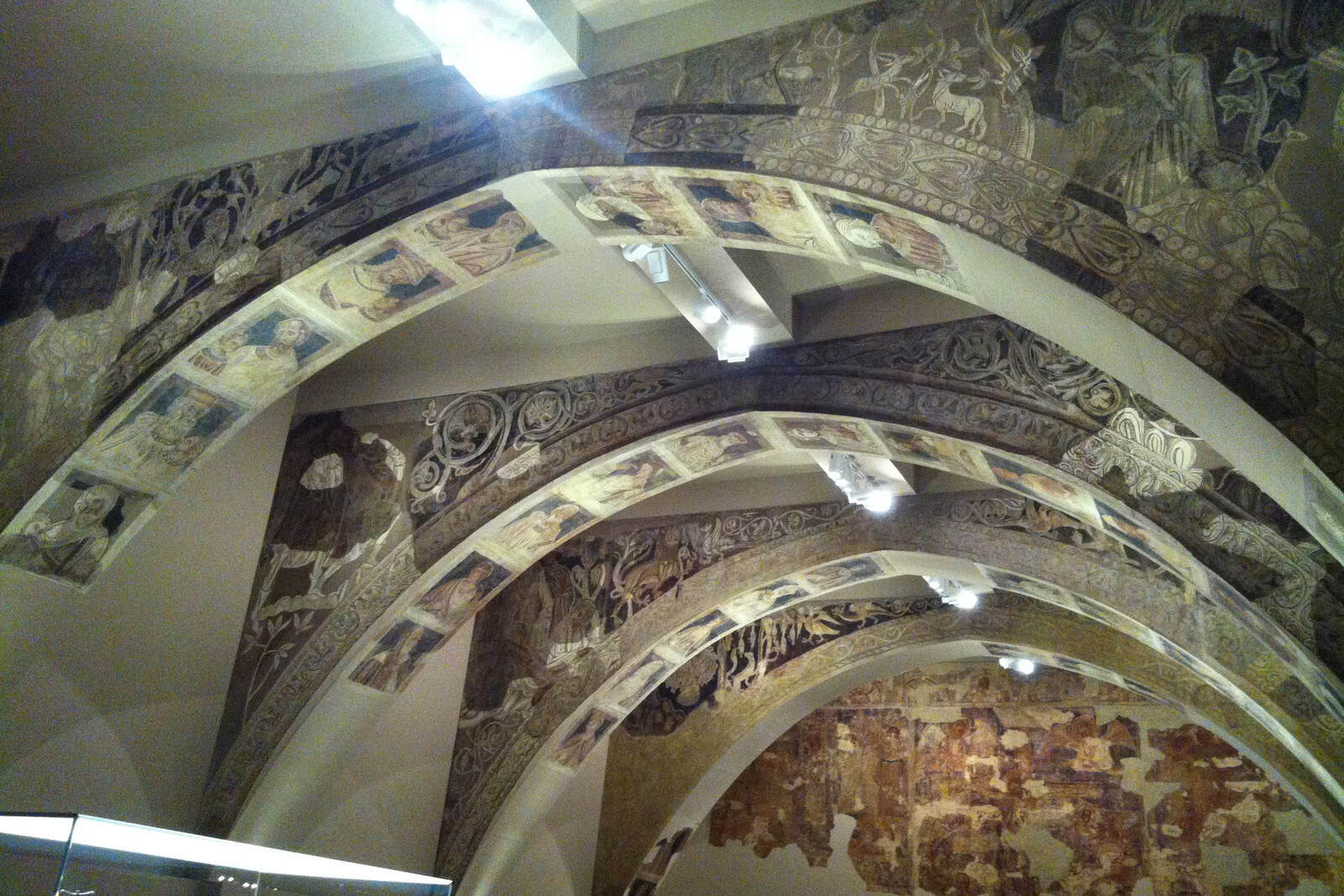
Chapter-house paintings from Santa María de Sijena displayed at the MNAC. Photograph by Kippelboy, via Wikimedia Commons, licensed under Creative Commons Attribution-Share Alike 3.0 Unported.
Why the July Move Failed, and What Changed
The MNAC had planned to begin dismantling the secular panels on July 6 and complete their return before August. The work never started. Aragón said the museum had not supplied the technical project and current condition information needed for the regional heritage review; the museum’s account emphasized that Huesca’s prior approval was still missing.
Those descriptions are not mutually exclusive. The July 1 demand published by Aragón asked for the deinstallation, packing, transport, and unpacking project, an updated conservation study, any proposed consolidation, and a work calendar. It said the provincial commission had to authorize the intervention.
By October 9, the commission had reviewed information on the panels’ condition, deinstallation, packing and transport systems, contractor, schedule, and nail-to-nail insurance. The plan reported in Aragónese media calls for condition checks and localized consolidation where needed, custom packing, monitored temperature and humidity, and at least 24 hours of acclimatization before unpacking at Sijena. A €1.7 million figure attached to the operation is insurance coverage, not an announced market valuation of the murals.

Courtly and battle scenes from the Profane Paintings of Sijena, by an unknown Aragonese artist, circa 1200. Wikimedia Commons, public domain. Cropped.
The Public Dates Do Not Yet Form One Schedule
Aragón’s October 19-to-November 5 window spans 18 calendar days when both endpoints are counted. The MNAC, however, says the work can take four to five weeks once dismantling begins and that completion before the end of November is desirable because SIT’s contract then expires. Taken literally, the two descriptions do not match.
That mismatch does not establish that either side is wrong. Some preparation could occur before physical removal, and a contractor’s detailed sequence may define milestones differently from a public announcement. It does establish that November 5 should be treated as Aragón’s target, not as a confirmed arrival date. El País reported both the target and the museum’s longer estimate on October 9.
The receiving location also remains less final than the word “return” may suggest. Aragón says the panels will first go to a hanging system installed in the monastery’s former dormitory area. El Español reported on October 9 that placing the panels in the monastery after transport would take an as-yet-undetermined amount of time.
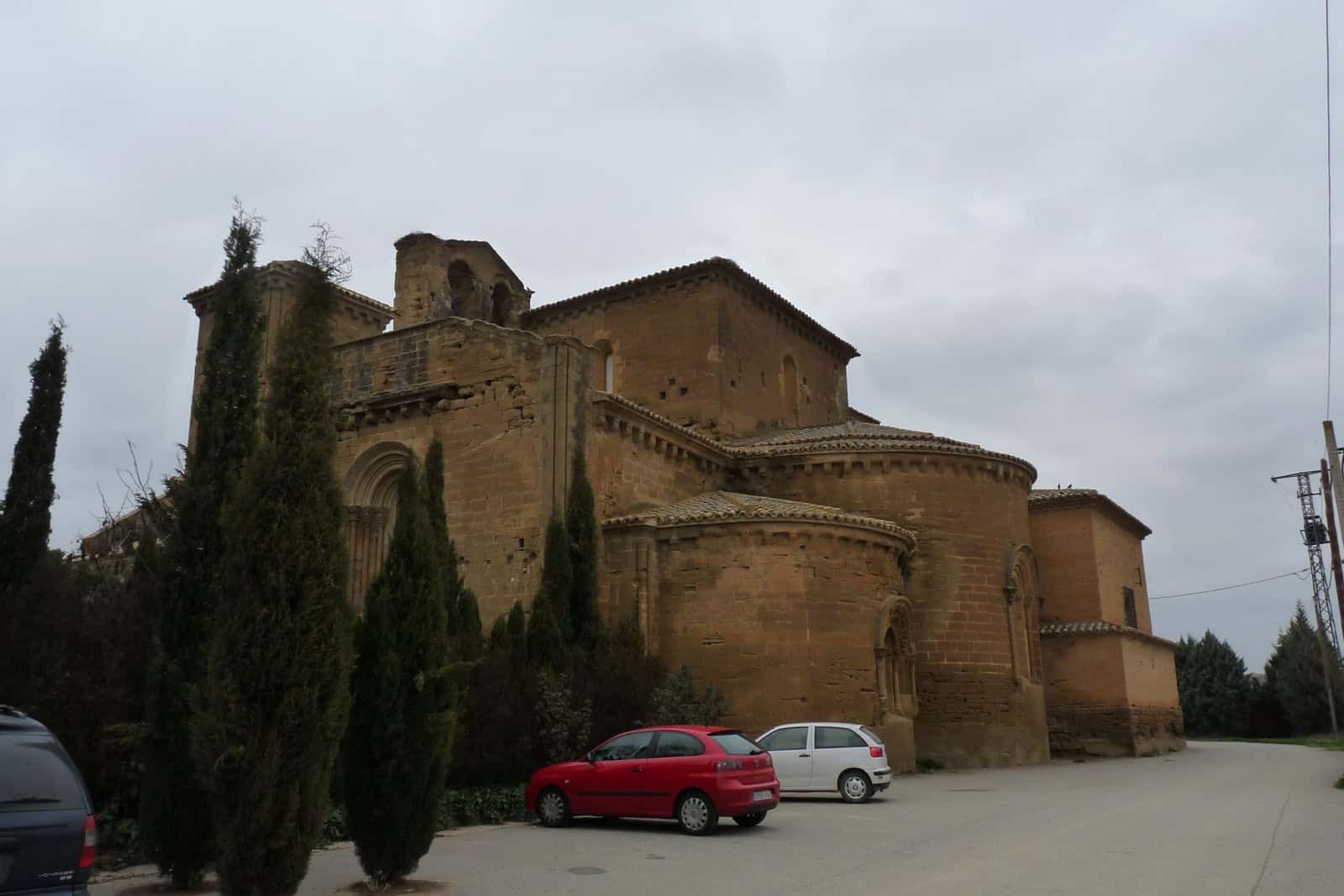
Royal Monastery of Santa María de Sigena. Photograph by Ecelan, via Wikimedia Commons, licensed under CC BY-SA 3.0.
Eight Panels Cleared, 35 Fragments Still Contested
The October 9 decision establishes that Huesca has approved a defined handling plan for the eight secular Sijena panels, subject to coordination with Aragón’s technicians. The MNAC’s own catalog establishes that the works are eight canvas-mounted fresco panels made around 1200, a more precise description than a categorical “13th-century” label.
The October 19 start and November 5 arrival remain provisional because the museum had not received formal notice when they were announced, and the 18-day public window does not match its four-to-five-week estimate. Nothing in this authorization resolves the conservation dispute over the separate 35 fire-damaged chapter-house fragments.

Isabella studied at the University of Cape Town in South Africa and graduated with a Bachelor of Arts majoring in English Literature & Language and Psychology. Throughout her undergraduate years, she took Art History as an additional subject and absolutely loved it. Building on from her art history knowledge that began in high school, art has always been a particular area of fascination for her. From learning about artworks previously unknown to her, or sharpening her existing understanding of specific works, the ability to continue learning within this interesting sphere excites her greatly.
Her focal points of interest in art history encompass profiling specific artists and art movements, as it is these areas where she is able to really dig deep into the rich narrative of the art world. Additionally, she particularly enjoys exploring the different artistic styles of the 20th century, as well as the important impact that female artists have had on the development of art history.
Learn more about Isabella Meyer and the Art in Context Team.
Choose Art in Context as a preferred source to see more of our reporting in Google Top Stories and other Google Search experiences.
Cite this Article
Isabella, Meyer, “Aragón Clears Transfer of Eight Sijena Paintings From MNAC.” Art in Context. October 9, 2026. URL: https://artincontext.org/sijena-paintings-transfer-mnac-aragon-authorization/
Meyer, I. (2026, 9 October). Aragón Clears Transfer of Eight Sijena Paintings From MNAC. Art in Context. https://artincontext.org/sijena-paintings-transfer-mnac-aragon-authorization/
Meyer, Isabella. “Aragón Clears Transfer of Eight Sijena Paintings From MNAC.” Art in Context, October 9, 2026. https://artincontext.org/sijena-paintings-transfer-mnac-aragon-authorization/.


