


French Galleries Demand Compensation From Art Basel Paris

French gallery representatives are demanding compensation after Art Basel Paris ended its 2026 edition two days early, according to two publications that say they reviewed an October 28 letter. The closure erased 16 of the fair’s 24 scheduled public hours, and dealer estimates indicate that those lost hours carried far more weight for emerging exhibitors than for the largest international galleries.
The Compensation Demand Came Five Days After the Closure
Art Basel Paris was scheduled to admit the general public from 11 a.m. to 7 p.m. on Friday, October 23, Saturday, October 24, and Sunday, October 25. Its invitation-only previews and Thursday vernissage took place, but the fair closed at 7 p.m. Friday because of anticipated demonstrations and threats of action around the Grand Palais.
The letter described by Monopol was sent to fair director Karim Crippa on October 28. Artnet News separately reported seeing a copy. The outlets say the Comité Professionnel des Galeries d’Art (CPGA) represents 57 of the fair’s 211 exhibitors and that its president, Philippe Charpentier, signed with 14 other dealers. That puts the group at 27 percent of exhibitors, a substantial bloc but not the whole fair.
The signatories reportedly accepted Saturday’s closure as prudent but questioned why the fair also remained closed Sunday. They asked Art Basel for concrete compensation proposals and said the association had not been consulted. An Art Basel spokesperson told Monopol that the decision followed discussions with galleries and relevant authorities, including the Paris Police Prefecture.
Those two accounts are not necessarily mutually exclusive. Consultation with some galleries would not establish that Art Basel consulted the CPGA as an organization, or all 57 exhibitors it represents. The fair has not published a list of the galleries involved in its discussions.
The letter itself is not public. Le Journal des Arts reported on November 2 that the CPGA declined to confirm the letter’s existence or discuss its contents. The compensation demand is therefore supported by two outlets that say they saw the document, not by a public CPGA statement.

The Missing Weekend Was Not the Same Loss for Every Gallery
Art Basel’s published 2026 schedule allotted eight public hours to each of three days. Ending after Friday removed two-thirds of the fair’s officially designated public-opening hours, although paid vernissage access was also available Thursday.
That calculation helps explain why a large headline sales total cannot measure the closure’s effect. By Wednesday evening, exhibitors had reported 306 works sold for $148 million, according to Monopol, with roughly $10 million paintings by Gerhard Richter and Georg Baselitz leading the list. Another $14.3 million was reported later. Those figures are voluntary disclosures dominated by high-value transactions; they are not a complete ledger of fair sales.
The more useful evidence is the reported share of business attached to public days. Victor Gisler of Zurich’s Mai 36 put those days at 15 to 25 percent of his gallery’s total Paris revenue. Emanuel Layr of Vienna estimated about 10 percent for an established program but 30 to 40 percent for young and emerging galleries. Hannes Schmidt of Berlin’s Schiefe Zähne said two or three additional sales of works priced up to roughly €8,000 would have moved his first Art Basel Paris presentation from break-even into profit.
These are dealer estimates, not audited losses, and they do not establish what compensation is owed. They do establish why equal lost time can produce unequal exposure: a gallery that sold most of its inventory during previews lost prospective foot traffic, while one counting on lower-priced weekend transactions could lose its path to profitability.

The Grand Palais in Paris, photographed in July 2026. Photo: Matthias Süßen / Wikimedia Commons, CC BY-SA 4.0.
Ticket Refunds Are Separate From Exhibitor Compensation
Art Basel’s public Paris page now says refund arrangements are in place for eligible ticket holders. That resolves at least part of the visitor question. It does not announce a booth-fee refund, credit, solidarity payment, or other relief for exhibitors.
Crippa told exhibitors on October 29 that the closure affected galleries in different ways and promised a concrete update in the coming days, according to Monopol. As of November 3, Art Basel’s public materials still address ticket holders rather than exhibitor compensation. The distinction matters: admission refunds replace an undelivered visitor service, while galleries are asking Art Basel to absorb some portion of business losses and participation costs.
The public sales numbers cannot supply a fair reimbursement formula. Revenue is not profit, a reported sale may have been negotiated before the fair, and the same booth can carry different shipping, staffing, insurance, and artist-production costs. Any relief designed around the largest reported transactions would miss the businesses the CPGA says were most exposed.
The Paris Contract Sets the Legal Floor
The legal position will depend on the 2026 Paris exhibitor agreement, its choice-of-law clause and any applicable mandatory law. Monopol reported that Art Basel would not say whether it was treating the closure as force majeure. The publication also cited a 2023 Miami Beach rule allowing premature closure while keeping the exhibitor liable for the full booth fee, but that is not proof that the Paris contract contains the same language.
Irina Tarsis of the Center for Art Law gave Monopol a conditional assessment: if the Paris terms authorize closure without notice for force-majeure reasons, legal recourse may be limited. She had not seen the Paris agreement. Until its relevant clauses are disclosed, claims that galleries are legally entitled to refunds—or legally barred from them—go beyond the available evidence.
Art Basel nevertheless has a precedent for discretionary relief. In 2021 it created a one-time CHF 1.5 million solidarity fund for its Basel show. Art Basel said 175 of 272 exhibitors declined their share, allowing participating galleries to receive a 35 percent reduction. The company expressly called that fund a one-off response to pandemic-era travel risk, so it shows a mechanism Art Basel has used, not an obligation to repeat it.
The parent company’s balance sheet does not answer the contract question either. Artnet News reported that MCH Group’s first-half net profit had quadrupled to CHF 18.4 million from CHF 4.4 million. MCH’s September 17 issuer release gives CHF 18.6 million and CHF 5.3 million—about 3.5 times the prior-year result, not four times. More importantly, the group result does not disclose Art Basel Paris’s profit or determine what the fair owes exhibitors.
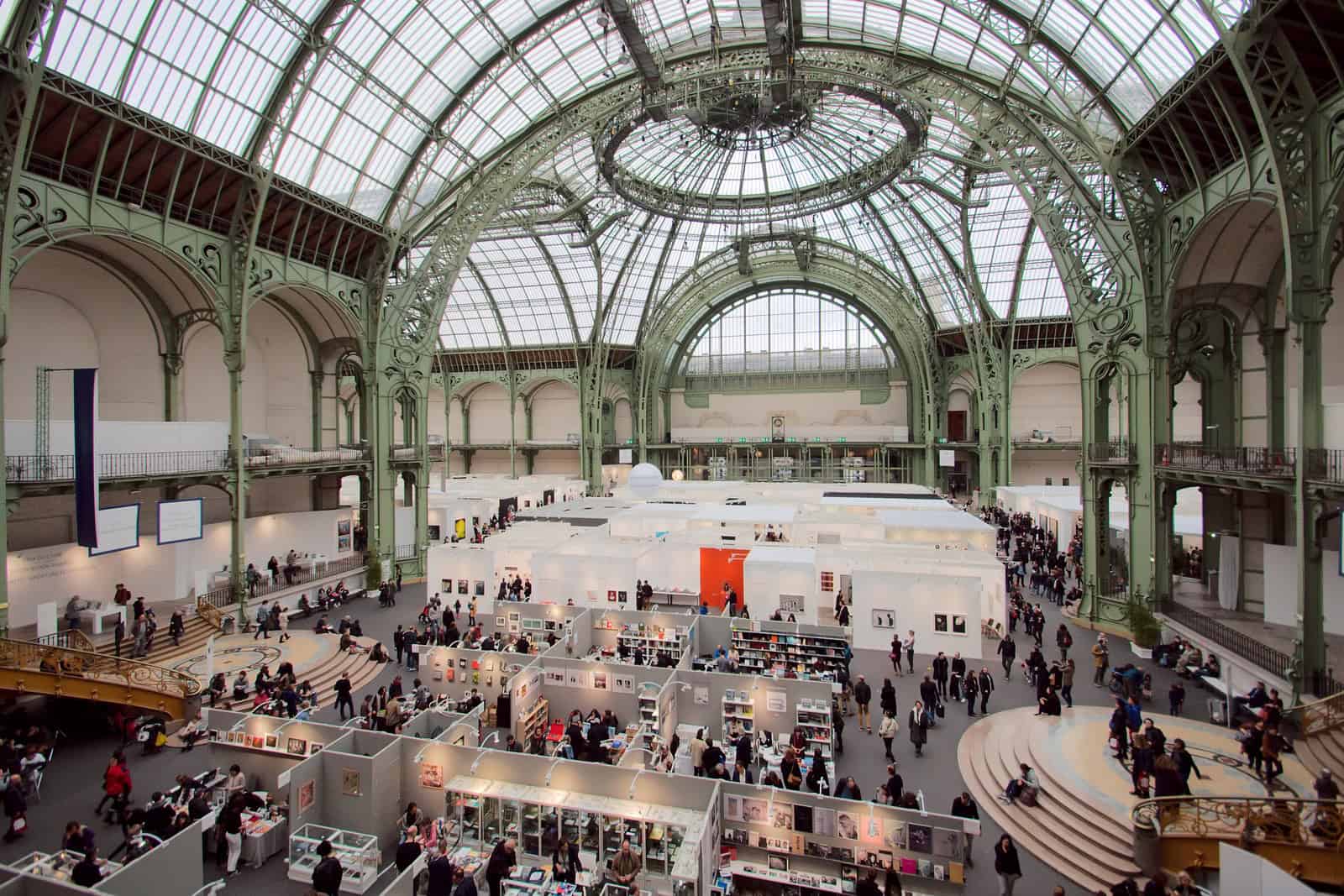
Paris Photo 2016 inside the Grand Palais; this is a contextual view of the venue, not the 2026 Art Basel edition. Photo: Frédéric Bisson / Wikimedia Commons, CC BY 2.0.
Sixteen Public Hours Lost, With Compensation Still Undecided
Art Basel’s own schedule establishes that the early ending canceled 16 of 24 public hours after the previews had already taken place. Dealer estimates reported by Monopol place Mai 36’s share on all public days at 15 to 25 percent and the weekend share for young and emerging galleries at 30 to 40 percent, illustrating the closure’s uneven effects.
Monopol and Artnet News both say they saw the October 28 compensation letter, while the CPGA has declined to confirm it publicly. Art Basel has arranged refunds for eligible visitors and acknowledged different effects on galleries, but it has not publicly committed to exhibitor relief.
The unknown Paris contract remains the legal hinge. The 2021 Basel solidarity fund establishes that Art Basel can distribute voluntary relief after uneven losses; it does not establish that Paris exhibitors are entitled to it.

Isabella studied at the University of Cape Town in South Africa and graduated with a Bachelor of Arts majoring in English Literature & Language and Psychology. Throughout her undergraduate years, she took Art History as an additional subject and absolutely loved it. Building on from her art history knowledge that began in high school, art has always been a particular area of fascination for her. From learning about artworks previously unknown to her, or sharpening her existing understanding of specific works, the ability to continue learning within this interesting sphere excites her greatly.
Her focal points of interest in art history encompass profiling specific artists and art movements, as it is these areas where she is able to really dig deep into the rich narrative of the art world. Additionally, she particularly enjoys exploring the different artistic styles of the 20th century, as well as the important impact that female artists have had on the development of art history.
Learn more about Isabella Meyer and the Art in Context Team.
Choose Art in Context as a preferred source to see more of our reporting in Google Top Stories and other Google Search experiences.
Cite this Article
Isabella, Meyer, “French Galleries Demand Compensation From Art Basel Paris.” Art in Context. November 3, 2026. URL: https://artincontext.org/art-basel-paris-gallery-compensation-demand/
Meyer, I. (2026, 3 November). French Galleries Demand Compensation From Art Basel Paris. Art in Context. https://artincontext.org/art-basel-paris-gallery-compensation-demand/
Meyer, Isabella. “French Galleries Demand Compensation From Art Basel Paris.” Art in Context, November 3, 2026. https://artincontext.org/art-basel-paris-gallery-compensation-demand/.


