Colors That Start With Q: 16 HEX and RGB Color Codes

Q may be the hardest letter in the color alphabet, but it still opens onto smoky grays, softened whites, blue, rose, magenta, and earth brown. The useful trick is knowing whether a name comes from a web standard, a paint maker, a digital catalog, or a physical pigment or dye. This guide gives you 16 copyable Q color references, explains their limits, and shows how to use them without mistaking a screen swatch for paint.
What Counts as a Color That Starts With Q?
The direct answer is that usable Q colors exist, but their names do not belong to one universal system. The 16 references below come from proprietary paint records and attributable digital catalogs. Historical dyes and artist pigments add other important Q names, although those physical materials do not have one definitive screen value.

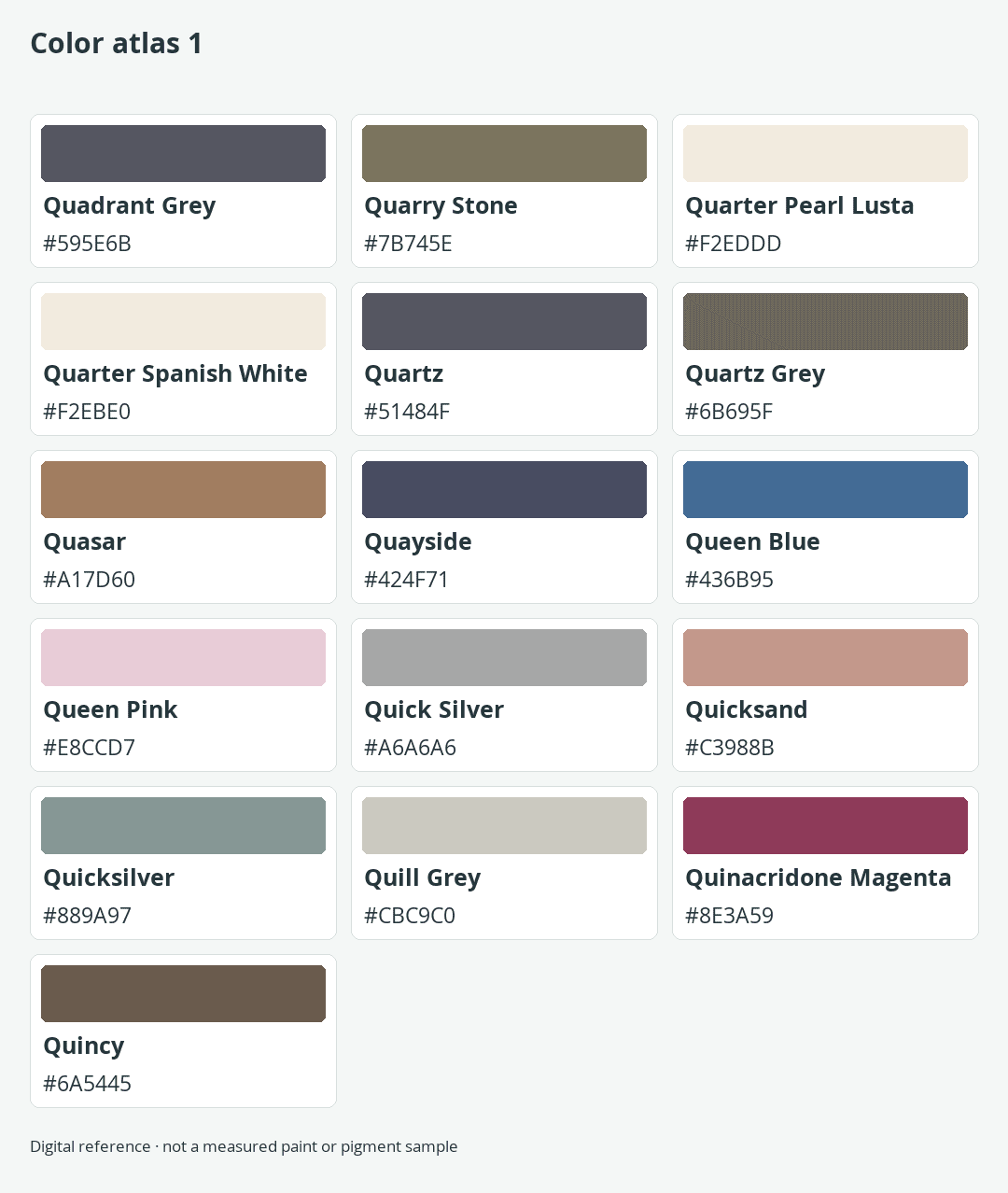
Each digital entry uses one complete six-digit HEX code. The three pairs in that code specify red, green, and blue in order, and the displayed RGB numbers are derived from the same value. This keeps the code, numbers, and visible swatch in agreement.
No CSS Named Color Starts With Q
The complete CSS Color 4 named-color table has no keyword beginning with Q. A browser will not recognize declarations such as color: queenblue or background: quartz as named colors. To use one of these references on a website, enter its explicit HEX value, such as #436B95 for the catalog reference called Queen Blue.
This distinction matters because a digital catalog name is not automatically part of the CSS language. CSS keywords form a defined set, while creative and commercial catalogs can introduce their own names. Readers new to these distinctions can use a broader basic color theory guide to review hue, value, saturation, and the differences among color models.
Standard, Proprietary, Historical, and Descriptive Names
A proprietary name belongs to a manufacturer or product system. Resene’s current Q index, for example, displays 36 names on its first page, including many entries in its Quarter family. These are useful paint references, but they are not universal web keywords. The maker also cautions that an electronic swatch represents a color rather than serving as a specification sample.
A catalog reference associates a creative name with a digital value. Colorex and privately maintained color registers can provide reproducible HEX codes, but their labels should not be mistaken for government or industry standards. Descriptive family terms in this guide, such as blue-gray or warm off-white, simply help readers recognize a swatch.
Historical color-language systems solve a different problem. The American ISCC-NBS work appeared as NBS Circular 553 in 1955 and was revised as NBS Special Publication 440 in 1976 by Kenneth L. Kelly and Deane B. Judd. Its framework divided the color solid into 267 named blocks. Those blocks and older dictionary names are system-specific references, and a historical name may correspond to more than one color rather than one modern sRGB code.
The table focuses on 16 distinct digital references. Physical dyes and pigment families appear separately because assigning them a single HEX value would misrepresent the material.
Q Colors at a Glance
The table is ordered alphabetically by displayed name. HEX controls every RGB value and swatch. The status column identifies the system behind the selected value, while the family and practical-note columns describe its appearance and possible use rather than assigning a universal meaning.
| Name | HEX | RGB | Source or Status | Color Family | Practical Note | Color |
|---|---|---|---|---|---|---|
| Quadrant Grey | #595E6B | 89, 94, 107 | Private Color Register catalog; non-standard | Cool dark gray | A subdued structural neutral | |
| Quarry Stone | #7B745E | 123, 116, 94 | Private Color Register catalog; non-standard | Olive brown | An earthy supporting color | |
| Quarter Pearl Lusta | #F2EDDD | 242, 237, 221 | Archived Resene 2010 reference | Warm off-white | A soft pale background | |
| Quarter Spanish White | #F2EBE0 | 242, 235, 224 | Current Resene paint reference | Warm off-white | A light neutral with a peach cast | |
| Quartz | #51484F | 81, 72, 79 | Colorex catalog reference | Dark plum-gray | A deep neutral for accents | |
| Quartz Grey | #6B695F | 107, 105, 95 | Colorex catalog reference | Olive gray | A balanced muted neutral | |
| Quasar | #A17D60 | 161, 125, 96 | Private Color Register catalog; non-standard | Warm medium brown | A grounded wood-like accent | |
| Quayside | #424F71 | 66, 79, 113 | Private Color Register catalog; non-standard | Dark slate blue | A restrained cool anchor | |
| Queen Blue | #436B95 | 67, 107, 149 | Colorex catalog reference | Muted medium blue | A clear but softened blue accent | |
| Queen Pink | #E8CCD7 | 232, 204, 215 | Colorex catalog reference | Pale rose | A gentle warm background | |
| Quick Silver | #A6A6A6 | 166, 166, 166 | Colorex catalog reference | Neutral middle gray | A hue-free supporting neutral | |
| Quicksand | #C3988B | 195, 152, 139 | Archived Resene 2010 reference | Dusty warm rose | A muted warm focal color | |
| Quicksilver | #889A97 | 136, 154, 151 | Private Color Register catalog; non-standard | Blue-green gray | A cool mineral-like neutral | |
| Quill Grey | #CBC9C0 | 203, 201, 192 | Archived Resene 2010 reference | Light warm gray | A quiet pale supporting color | |
| Quinacridone Magenta | #8E3A59 | 142, 58, 89 | Colorex digital reference | Deep rose-magenta | A screen reference, not a pigment specification | |
| Quincy | #6A5445 | 106, 84, 69 | Archived Resene 2010 reference | Deep warm brown | A dark natural-looking anchor |
Quadrant Grey to Quartz Grey
The opening group leans heavily toward neutrals. Quadrant Grey is cool and dark, while Quarry Stone shifts toward olive brown. Quarter Pearl Lusta and Quarter Spanish White are the lightest entries, but neither is a pure digital white. Their slight warmth can reduce the stark effect of a white page or provide a soft ground for darker artwork.
Quartz and Quartz Grey show how a shared root name does not guarantee a shared hue. The selected Quartz value has a plum cast, whereas Quartz Grey is more olive and subdued. The full name and exact code must stay together.
Quasar to Queen Pink
Quasar introduces a medium brown that can bridge pale neutrals and darker earth tones. Quayside and Queen Blue create the clearest cool-color sequence in the collection: Quayside is the darker slate, while Queen Blue is lighter and more visibly blue. Queen Pink supplies a pale warm counterpoint without becoming highly saturated.
These names are memorable, but the names alone cannot predict a reliable color. Another catalog can use Queen Pink or Quartz for a different value. Copy the HEX code whenever visual consistency matters.
Quick Silver to Quincy
Quick Silver and Quicksilver remain separate because the catalogs assign them different spellings and different values. Quick Silver is a neutral gray with equal red, green, and blue components. Quicksilver is darker and carries a blue-green cast. They are not interchangeable despite looking identical when spoken aloud.
Quicksand and Quinacridone Magenta provide the strongest warm chromatic notes in the latter half of the table. Quill Grey can temper either one, while deep brown Quincy offers a warmer alternative to black. The selected Quinacridone Magenta code is useful for a screen palette, but its relationship to physical paint needs additional context.
Why Q Color Codes Can Differ Between Sources
A color name is an identifier only within the system that defines it. Manufacturers revise catalogs, digital collections select their own reference values, and physical materials respond differently from emitted screen light. Two trustworthy systems can therefore use the same or similar name without producing identical sRGB numbers.
Quarter Spanish White as a Versioned Example
The current Resene record for Quarter Spanish White gives #F2EBE0, or RGB 242, 235, 224. The archived 2010 dataset instead records RGB 235, 226, 210, equivalent to #EBE2D2. The older reference is slightly darker and warmer.
This is catalog-version drift, not a mathematical contradiction. The name must travel with its maker, edition, and selected digital value. For current screen work, use the current code shown in the main table. If reproducing an older design, preserve the archived value specified in that project rather than silently replacing it.
Screen Swatches Are Not Paint Samples
An RGB display produces color additively by combining emitted red, green, and blue light. Paint works subtractively, with pigments absorbing parts of the illumination and reflecting what remains. Because these media create color differently, a screen swatch does not uniquely reproduce physical paint.
Resene derives electronic values from measured master samples, but it also notes that some physical colors fall outside the sRGB gamut. A screen code therefore provides a useful preview or design reference, not a unique reproduction of a painted surface. Use a current physical sample when selecting real paint.
The Material Stories Behind Q Colors
Some Q names identify colorants rather than fixed digital colors. The quinacridone family includes different pigment identifiers and formulations, while Quercitron results vary with mordants and bark material, and Quinoline Yellow has forms with different solubility. A single universal HEX code would erase those documented differences.

Quinacridone Magenta in Paint and on Screen
Quinacridone describes a family of synthetic organic pigments spanning orange, red, magenta, and violet. Manufacturer naming is not fully consistent. Documented products have used both PV19 and PR122 in connection with the name Quinacridone Magenta, while other quinacridone identifiers include PR202, PR209, and PO48 or PO49.
One concrete example is Winsor & Newton Professional Watercolour Quinacridone Magenta. That transparent, deep violet-red product specifies PR122. A different tube labeled with similar words can use another formulation, so painters should read the pigment index code as well as the marketing name.
The table’s #8E3A59 swatch is a selected catalog reference for digital design. It does not claim to reproduce every PR122 paint, every quinacridone mixture, or a dried watercolor wash.
Quercitron and Black Oak Bark
Quercitron is a yellow natural dye extracted from black oak bark. It was introduced in England in 1775. Its result depends on the bark material and the mordant, a substance used to help a dye attach to fibers. Aluminum or tin, chrome, and iron mordants can shift the outcome among yellow, tan, and olive-green tones.
That variability is the reason Quercitron does not appear in the exact-value table. Assigning it one HEX code would convert a changing dye process into a false digital standard.
Quinoline Yellow as a Family of Dyes
Quinoline Yellow is a synthetic greenish-yellow dye discovered in 1882. Its spirit-soluble SS and water-soluble WS forms have different solubility, and the family encompasses multiple shades. Formulation and use therefore matter more than a single screen approximation.
Quinoline Yellow is a valid answer to a broad question about Q colorants, but it is not one universally defined sRGB color. For practical digital work, select a documented HEX value that fits the project and label it as an approximation rather than as the dye’s only true appearance.
How to Use Q Colors in Design and Art
Start with the medium in which the finished work will appear. Digital designers can build repeatable palettes from the table’s exact HEX codes. Painters should treat those swatches as planning cues and make physical tests with the actual products.
Pair Q Colors by Value and Contrast
Names create associations, but visible relationships make a palette work. Compare value first, meaning how light or dark a color appears, and then consider hue and saturation. A color wheel helps locate hue relationships, while a guide to complementary colors can help when a palette needs stronger separation.
Three compact starting palettes show how the Q references can take different roles:
- Soft neutral interface: Use Quarter Spanish White
#F2EBE0as the dominant field, Quartz Grey#6B695Fas a supporting neutral, and Quayside#424F71as the accent. - Cool restrained scheme: Begin with Quill Grey
#CBC9C0, add Quicksilver#889A97, and reserve Queen Blue#436B95for focal elements. - Warm rose scheme: Combine Queen Pink
#E8CCD7with Quicksand#C3988B, then use Quincy#6A5445for visual weight.
These are aesthetic starting points, not automatic text-color recommendations. The proportions can be changed, but preserving clear differences in lightness usually makes the hierarchy easier to read.
Test Text Contrast
WCAG 2.2 Level AA calls for a contrast ratio of at least 4.5:1 for normal text and 3:1 for large text. Do not judge compliance from a name such as dark gray or pale pink. Test the exact foreground and background codes at the final text size.
Color also cannot be the only visual method used to communicate information. If Queen Blue marks a selected button, add a label, icon, border, underline, or other visible state. If Quicksand indicates an error in a chart, pair it with text or a symbol. This allows readers who do not distinguish the color difference to receive the same information.
Mix Quinacridone Magenta as Paint, Not as HEX
A HEX code cannot be mixed into acrylic or watercolor. Use the pigment information on the tube and test the paint in the same binder, dilution, and surface planned for the finished work. General guidance on mixing paint colors can help with controlled test charts, while watercolor artists can review the particular behavior involved in mixing watercolors.
In its acrylic system, GOLDEN combines Quinacridone Magenta with Phthalo Blue to develop violets, purples, deep reds, and maroons. Its guide combines the magenta with Benzimidazolone Yellow Medium for reds and oranges. These are manufacturer-specific material directions, not universal recipes for every paint carrying the same color name.
Keep a record of the products and proportions used in each test. GOLDEN describes its Quinacridone Magenta as transparent and notes its tinting strength. Evaluate that manufacturer’s paint as a material, while keeping the digital code as a separate screen reference.
Frequently Asked Questions
These answers clarify how Q color names function in CSS, paint catalogs, digital references, pigments, and dyes.
Are There Any CSS Colors That Start With Q?
No CSS named-color keyword begins with Q. Use an explicit value such as a six-digit HEX code when adding one of these colors to a stylesheet.
Is Quinacridone Magenta One Exact Color?
No. The name is used within a pigment family, and manufacturers have associated it with different pigment identifiers and formulations. A catalog HEX value is only a selected digital reference, not a complete physical specification.
Why Are So Many Q Colors Called Quarter Something?
Quarter appears repeatedly in Resene’s proprietary naming vocabulary. It identifies entries within that catalog, not a universal color standard or a guaranteed cross-brand mixing formula. Keep the complete product name and catalog edition attached to the value.
Why Do Q Color Lists Use Different HEX Codes?
Lists may draw from different catalogs, manufacturers, historical records, or editions. Some also assign modern values to material colorants that never had one fixed sRGB definition. Check the stated system and copy the exact HEX code rather than relying on the name alone.
Download the digital color reference sheets: Color atlas 1

Matthew Matthysen is an educated multidisciplinary artist and illustrator. He successfully completed his art degree at the University of Witwatersrand in South Africa, majoring in art history and contemporary drawing. The focus of his thesis was to explore the philosophical implications of the macro and micro-universe on the human experience. Matthew uses diverse media, such as written and hands-on components, to explore various approaches that are on the border between philosophy and science.
Matthew organized various exhibitions before and during his years as a student and is still passionate about doing so today. He currently works as a freelance artist and writer in various fields. He also has a permanent position at a renowned online gallery (ArtGazette) where he produces various works on commission. As a freelance artist, he creates several series and successfully sells them to galleries and collectors. He loves to use his work and skills in various fields of interest.
Matthew has been creating drawing and painting tutorials since the relaunch in 2020. Through his involvement with artincontext.org, he has been able to deepen his knowledge of various painting mediums. For example, watercolor techniques, calligraphy and lately digital drawing, which is becoming more and more popular.
Learn more about Matthew Matthysen and the Art in Context Team.
Cite this Article
Matthew, Matthysen, “Colors That Start With Q: 16 HEX and RGB Color Codes.” Art in Context. October 28, 2026. URL: https://artincontext.org/colors-that-start-with-q/
Matthysen, M. (2026, 28 October). Colors That Start With Q: 16 HEX and RGB Color Codes. Art in Context. https://artincontext.org/colors-that-start-with-q/
Matthysen, Matthew. “Colors That Start With Q: 16 HEX and RGB Color Codes.” Art in Context, October 28, 2026. https://artincontext.org/colors-that-start-with-q/.