

Cadmium Yellow: Color Codes, Paint Types, and Mixing

Cadmium yellow can describe a brilliant screen color, a family of genuine cadmium pigments, or a modern substitute in a paint tube. Those meanings are related, but they are not interchangeable. This guide shows how to identify the color, read paint labels, mix it with purpose, and build practical digital palettes.
What Color Is Cadmium Yellow?
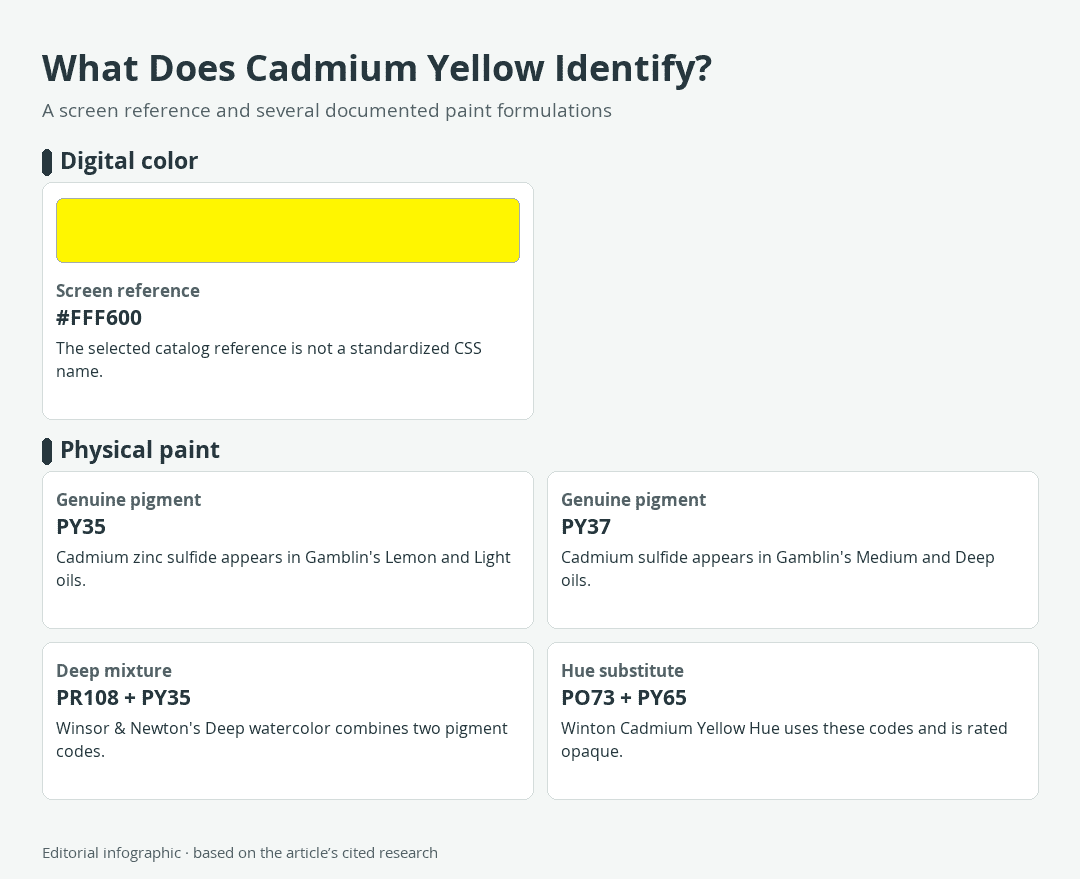
Cadmium yellow is a strong, high-energy yellow associated with artists’ paints made from cadmium compounds. For digital work, #FFF600 is a useful representative reference for a bright, saturated yellow.
Download the complete color reference sheet (PNG): Color atlas 1
| Name | HEX | RGB | Color |
|---|---|---|---|
| Selected Digital Reference | #FFF600 | 255, 246, 0 |
This swatch represents an sRGB screen color. It is not a measurement of every paint sold as cadmium yellow, and it cannot predict how a physical paint will look under different lighting, over a dark ground, or after mixing.
The Selected Digital Reference
The HEX value #FFF600 converts to RGB 255, 246, 0. Red is at full intensity, green is close to full intensity, and blue is absent. That combination creates a very luminous yellow on an sRGB display.
Cadmium yellow is not one of the standardized CSS named colors used by web browsers. To reproduce this selected reference in a website or digital illustration, specify its HEX or RGB value directly instead of writing cadmiumyellow and expecting a browser to recognize it.
Why Cadmium Yellow Has More Than One Color Code
Digital color catalogs do not agree on a universal value for the name. One catalog associates cadmium yellow with #FFF600, while another uses #FDDA0D, a darker and more orange-leaning yellow. These are descriptive catalog choices, not competing measurements of a single standardized material.
Physical paint varies even more. A manufacturer may offer Lemon, Light, Medium, or Deep versions, and two products with the same descriptive name can contain different pigments. When exact digital reproduction matters, use the stated HEX value. When choosing paint, read the pigment codes and product properties instead.
The Pigment’s History and Behavior
The familiar color name comes from a family of inorganic pigments rather than one fixed shade. In current manufacturer records, PY37 identifies cadmium sulfide, while PY35 identifies cadmium zinc sulfide. Changes in composition and preparation can shift the yellow from lemon-like to warmer, deeper versions.

From Chemical Discovery to Artists’ Paint
Cadmium was discovered in 1817, but that date does not mark the immediate arrival of widely available cadmium artist colors. Pigment production developed later, around 1840. The distinction matters because the history of a chemical element and the history of a usable artists’ material are not the same story.
Cadmium yellows eventually offered painters strong color and substantial covering power. Modern product records commonly classify genuine cadmium oil colors as opaque, although the behavior of a particular tube still depends on its formulation, medium, film thickness, and application.
What Paintings Reveal About Cadmium Yellow
Technical examination shows how artists used the pigment in specific situations. Analysis of Claude Monet’s Water-Lilies identified cadmium yellow in surface paint and in mixtures with viridian, a green pigment. The research places Monet’s adoption of cadmium yellow around the early 1880s and notes that preparation conditions could affect its shade.
In Pablo Picasso’s 1907 Les Demoiselles d’Avignon, cadmium yellow appears as underpainting beneath the face of the crouching figure. That placement demonstrates that the pigment did not serve only as a conspicuous final highlight. It could also participate in the layered construction of a painting.
Historical behavior must be interpreted formulation by formulation. Research on the approximately 1910 version of Edvard Munch’s The Scream found that moisture and mobile chlorine compounds were important in oxidation, a chemical reaction that altered the studied cadmium-sulfide paint, while light played a smaller role in that case. The finding should not be generalized into a claim that every historical or modern cadmium yellow changes in the same way.
Cadmium Yellow Paint Variants and Hue Substitutes
Names such as Lemon, Light, Medium, and Deep help organize a manufacturer’s range, but they do not establish universal formulas. Pigment codes reveal more than the front-of-tube color name.
Lemon, Light, Medium, and Deep
One current oil range classifies Cadmium Yellow Lemon and Light as cool colors made with PY35. Its Medium and Deep versions are warm colors made with PY37. All four are listed as opaque. Lightfastness describes resistance to color change under light, and the manufacturer gives each of these named products its Lightfastness I rating.
| Manufacturer and Medium | Paint Name | Pigment Code | Listed Appearance | Other Listed Property |
|---|---|---|---|---|
| Gamblin artist-grade oil | Cadmium Yellow Lemon | PY35 | Opaque, cool | Lightfastness I |
| Gamblin artist-grade oil | Cadmium Yellow Light | PY35 | Opaque, cool | Lightfastness I |
| Gamblin artist-grade oil | Cadmium Yellow Medium | PY37 | Opaque, warm | Lightfastness I |
| Gamblin artist-grade oil | Cadmium Yellow Deep | PY37 | Opaque, warm | Lightfastness I |
| Winsor & Newton professional watercolor | Cadmium Yellow Deep | PR108 + PY35 | Opaque | Excellent lightfastness |
| Winsor & Newton Winton oil | Cadmium Yellow Hue | PO73 + PY65 | Opaque | Non-cadmium formulation |
The comparison exposes two useful label-reading lessons. First, Deep may be a single-pigment PY37 paint in one range but a PR108 and PY35 mixture in another. Second, the word hue identifies a substitute formulation, yet it does not automatically mean transparent or weak. The listed Winton substitute is opaque despite using PO73 and PY65 rather than the cadmium codes above.
Reading Genuine and Hue Labels
Start with the Color Index pigment code, usually printed as letters and numbers such as PY35. Then check opacity, lightfastness, medium, and any manufacturer warnings. Do not infer composition from Lemon or Deep alone, and do not assume that two paints called Cadmium Yellow Hue will mix identically.
Safety directions also belong to the individual product. The documented Cadmium Yellow Deep watercolor carries a warning not to apply it by spray. Follow the label and safety data sheet for the exact paint you own, particularly when an application method could create airborne material.
A genuine cadmium paint and a substitute may fill similar palette roles while differing in tinting strength, undertone, opacity, or mixing response. Make a fresh test when changing brand, medium, or formulation rather than relying on the shared color name.
Mixing and Using Cadmium Yellow
Cadmium yellow is most useful when treated as a specific paint with a known bias, not as a generic primary color. Color bias describes the direction a color leans. A cooler yellow leans toward green, while a warmer yellow leans toward orange.

Choosing Yellow and Blue for Greens
A manufacturer’s watercolor demonstration pairs Ultramarine Green Shade with Cadmium Lemon to produce a cleaner green. It pairs French Ultramarine with Cadmium Yellow Deep for a more muted green. These examples show how the biases of both ingredients influence the result, but they are not universal mixing ratios.
A documented oil-paint example reaches a deep, warm moss green by combining PY37 with PB29, the pigment code used for ultramarine blue in that formulation. This warmer route can be useful for foliage, shadowed grass, and earthy landscape passages where a brilliant green would feel disconnected from surrounding colors.
For your own comparison, place equal-sized samples of a cool and warm cadmium yellow on a test sheet. Mix each with the same blue, using similar increments. Record the product names and pigment codes. This controlled exercise makes color bias easier to see than a general rule about which yellow “always” creates the best green. For a wider foundation, the guide to mixing paint colors explains how hue choices alter mixtures.
Lightening, Muting, and Testing Your Paint
Adding white makes a tint, adding gray makes a tone, and adding black makes a shade. These are physical paint operations, not instructions for generating HEX values. White may also reveal an undertone that is difficult to notice in a thick mass of yellow paint.
Work in small, measured steps because a strong addition can overwhelm the original color. A useful test sheet records the paint name, medium, pigment code, additions, surface, and dry appearance. Include an unmixed sample for comparison. Oils, acrylics, and watercolors do not necessarily settle, dry, or cover in the same way.
Thinning or diluting a paint changes how much of the ground shows through, but it does not turn an opaque pigment into a different pigment. Likewise, mixing paints already on a palette does not manufacture cadmium sulfide or cadmium zinc sulfide. It creates a mixture of the materials that were present in those paints.
Coverage and Transparent Alternatives
To compare coverage, draw a black line on a suitable test surface and brush each paint across it at a similar thickness. An opaque paint hides the line more strongly, while a transparent paint allows more of it to remain visible. This test is comparative, so keep the brush load, surface, and application as consistent as practical.
If transparency is important, choose a product documented for that property instead of trying to infer it from the yellow’s name. Gamblin lists Hansa Yellow Medium, made with PY74, as semi-transparent. It is an alternative with its own behavior, not a chemically equivalent version of cadmium yellow.
Opacity can help with direct highlights and strong shape coverage. A more transparent yellow can be preferable for glazing or luminous layers. The useful choice depends on the painting method, which is why pigment and opacity information deserve as much attention as the color printed on the tube.
Cadmium Yellow Color Combinations and Readable Design
Digital palettes operate through specified sRGB values rather than physical pigments. The seven companions below are standardized CSS named colors. Cadmium Yellow is the article’s selected catalog reference, not a CSS color name or a digital measurement of paint.

Eight Digital Color References
| Name | HEX | RGB | Color |
|---|---|---|---|
| Cadmium Yellow | #FFF600 | 255, 246, 0 | |
| Navy | #000080 | 0, 0, 128 | |
| Purple | #800080 | 128, 0, 128 | |
| Teal | #008080 | 0, 128, 128 | |
| White | #FFFFFF | 255, 255, 255 | |
| Black | #000000 | 0, 0, 0 | |
| Ivory | #FFFFF0 | 255, 255, 240 | |
| Dark Green | #006400 | 0, 100, 0 |
Navy supplies deep value contrast without the starkness of black. Dark Green connects the yellow accent to a natural-looking, lower-value field. Purple offers a strong opposing relationship, while teal shifts the combination toward a cool, graphic effect. For more on opposing hues as a design principle, see the guide to complementary colors.
Three Palettes With Clear Roles
Clean editorial palette: White provides the dominant field, Navy supports headings and large shapes, and Cadmium Yellow marks calls to action or small focal details.
| Role | Name | HEX | RGB | Color |
|---|---|---|---|---|
| Dominant | White, Editorial Field | #FFFFFF | 255, 255, 255 | |
| Supporting | Navy, Editorial Support | #000080 | 0, 0, 128 | |
| Accent | Cadmium Yellow, Editorial Accent | #FFF600 | 255, 246, 0 |
Grounded interior palette: Ivory softens the background, Dark Green anchors furniture or broad surfaces, and Cadmium Yellow supplies controlled accents.
| Role | Name | HEX | RGB | Color |
|---|---|---|---|---|
| Dominant | Ivory, Interior Field | #FFFFF0 | 255, 255, 240 | |
| Supporting | Dark Green, Interior Support | #006400 | 0, 100, 0 | |
| Accent | Cadmium Yellow, Interior Accent | #FFF600 | 255, 246, 0 |
Bold graphic palette: Teal takes the dominant role, Purple supports smaller blocks or secondary information, and Cadmium Yellow provides the sharpest accent.
| Role | Name | HEX | RGB | Color |
|---|---|---|---|---|
| Dominant | Teal, Graphic Field | #008080 | 0, 128, 128 | |
| Supporting | Purple, Graphic Support | #800080 | 128, 0, 128 | |
| Accent | Cadmium Yellow, Graphic Accent | #FFF600 | 255, 246, 0 |
These roles are editorial suggestions rather than measured preferences or claims about universal emotional responses. Scale matters: a small yellow accent can command attention, while a large yellow field can dominate the entire composition. Broader color theory principles can help balance hue, value, and saturation across a layout.
Checking Text Contrast
Black text on #FFF600 produces a contrast ratio of about 18.4:1. White text on the same yellow produces only about 1.14:1. The first pairing comfortably clears the WCAG Level AA minimum for ordinary text, while the second fails even the lower threshold for qualifying large text.
WCAG Level AA calls for at least 4.5:1 contrast for ordinary text and 3:1 for qualifying large text, subject to its stated exceptions. Use black or another verified dark color for essential copy on the selected yellow. Do not rely on the brightness of a combination by eye, since two colors can look dramatically different while still offering inadequate text contrast.
Frequently Asked Questions
These brief answers address common questions about cadmium yellow paint, substitutes, digital references, and durability.
Does Adding White Make Cadmium Lemon?
No. Adding white creates a tint of the paint already on the palette. A manufacturer’s Cadmium Yellow Lemon may use a different pigment formulation, such as the documented PY35 paint, so it cannot be reproduced simply by lightening another cadmium yellow.
Can a Paint Store Match Cadmium Yellow From HEX Alone?
A HEX code can provide a digital target, but it cannot fully specify physical paint. Pigments, binder, opacity, surface, film thickness, lighting, and application all affect the result. A store can use #FFF600 as a starting reference, but a dried sample under the intended lighting offers a more useful physical check.
Can Cadmium Yellow Hue Replace Genuine Paint in a Mixture?
It may fill a similar visual role, but the mixture can change because a hue substitute uses different pigments. Test its tinting strength, bias, opacity, and mixtures before replacing a genuine cadmium paint throughout an existing palette.
Does Excellent Lightfastness Mean a Paint Can Never Change?
No. A manufacturer’s lightfastness rating applies to a named modern product under defined testing conditions. It does not guarantee that every historical formulation, application, or environment will behave identically, and it does not eliminate other causes of change such as moisture or interactions among materials.

Demi Bucklow is an independent artist and photographer living in Cape Town, South Africa. Since graduating from the University of Cape Town in 2018 from Michaelis School of Fine Art with a degree specializing in fine art photography, she currently works as a freelance artist, content creator and writer. Demi’s particular interests explore a range of multimedia illustration, collage art, photography and videography, darkroom processing and stop-motion animation. Her work is an exploration of nature and its phenomenon – somewhere between art and space.
Artistic practice presents the ability to communicate a vision. It is through techniques of pointillism and realism that form, and substance are explored as a metaphor for matter; super-imposing a thousand marks and points until an image is formed before our eyes. From illustrations to surrealist landscapes, Demi translates corporeality – mixing the obtuse and vacuous with the astute and expressive which leads to a mixture of irrevocable pondering over what is and what could be.
Learn more about the Art in Context Team.
Cite this Article
Demi, Bucklow, “Cadmium Yellow: Color Codes, Paint Types, and Mixing.” Art in Context. October 9, 2026. URL: https://artincontext.org/cadmium-yellow/
Bucklow, D. (2026, 9 October). Cadmium Yellow: Color Codes, Paint Types, and Mixing. Art in Context. https://artincontext.org/cadmium-yellow/
Bucklow, Demi. “Cadmium Yellow: Color Codes, Paint Types, and Mixing.” Art in Context, October 9, 2026. https://artincontext.org/cadmium-yellow/.


