

Austria Renews HEAR Act Challenge Over 12 Egon Schiele Works

Austria, the Albertina Museum, and the Leopold Museum filed an October 30 response renewing their constitutional challenge to the amended HEAR Act in a New York dispute over twelve Egon Schiele works claimed by Fritz Grünbaum’s heirs. The filing extends the fight over which defenses a court may consider; it does not decide the works’ ownership.
What the October 30 Filing Actually Contests
The federal docket feed records the defendants’ response as entry 221, filed October 30, 2026, in Reif v. Republic of Austria. The court had granted leave to file the response on October 27. A separate notice of appearance, entry 222, followed on October 30; it was not a ruling on the constitutional dispute.
The response addresses arguments submitted by the United States and by Senators John Cornyn and Richard Blumenthal. Austria and the two museums maintain that Congress exceeded its authority when it amended the Holocaust Expropriated Art Recovery Act to exclude laches and other defenses from covered claims.
Their Tenth Amendment theory is that the federal statute leaves the substantive restitution claim to state law while displacing state defenses. Their Article III theory focuses on judicial power: eliminating laches, they argue, prevents a judge from examining whether an allegedly unreasonable delay caused lost evidence or unfair prejudice and therefore intrudes on the court’s responsibility to decide the case.
| Issue | Positions before the court |
|---|---|
| Tenth Amendment | The defendants say Congress displaced state rules without creating federal restitution law. The senators invoke Congress’s war and interstate and foreign commerce powers. |
| Article III | The defendants say barring laches constrains judicial fact-finding. The law’s defenders say Congress may change governing rules without deciding ownership facts. |
| Result for the art | The constitutional dispute concerns both whether the claims can reach the merits and whether barring laches improperly constrains merits fact-finding; neither side’s argument establishes provenance or title. |
The senators’ position and the earlier procedural history are detailed in Art in Context’s report on their September amicus brief. Judge John G. Koeltl is not bound by an amicus submission, and the October response remains advocacy by the defendants rather than a judicial finding.
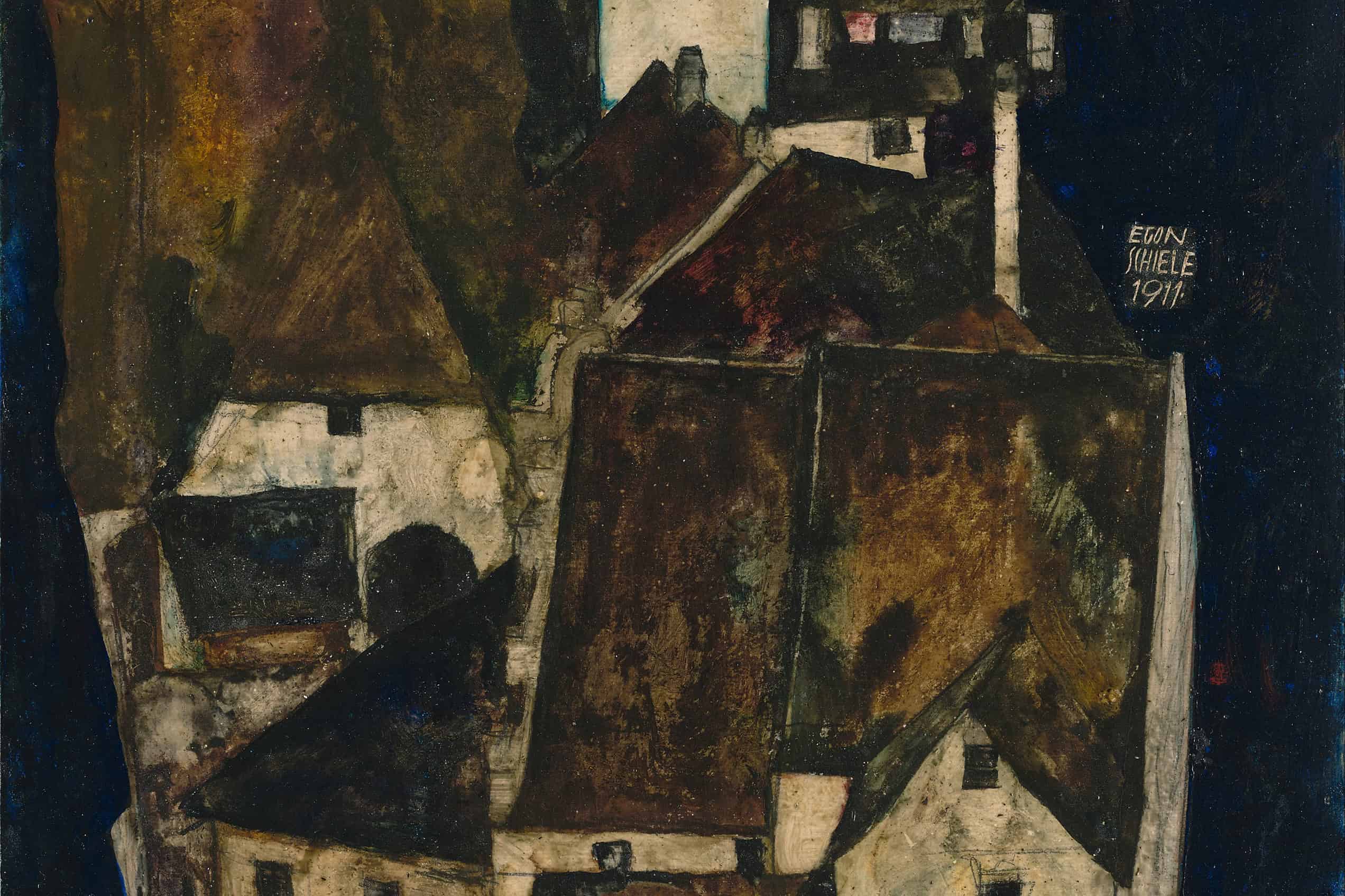
Egon Schiele, Dead City III (1911), held by the Leopold Museum, via Wikimedia Commons. Cropped. Public domain.
Four Months of Filings Changed the Case’s Stakes
The relevant sequence begins with Congress, not with the October response. The enacted text of Public Law 119-82 applies its amendments to claims pending on April 13, 2026, as well as later claims.
| Date | Development |
|---|---|
| April 13 | The amended HEAR Act became law. |
| May 13 | The court lifted the stay in the museum case. |
| September 18 | Cornyn and Blumenthal submitted their amicus brief. |
| September 21 | The court allowed the senators’ brief. |
| October 20 | The United States submitted its constitutional defense. |
| October 27 | The court allowed the defendants to respond. |
| October 30 | Austria and the museums filed that response. |
The short title says “Holocaust Expropriated Art Recovery Act of 2025,” but that is not its enactment date. The public law was approved on April 13, 2026. It removed the original sunset, barred specified time-based defenses such as laches and adverse possession, excluded several non-merits discretionary grounds for dismissal, and added language concerning claims against foreign states.
Twelve Schiele Works, Divided Between Two Museums
The filed 2022 complaint identifies ten works at the Leopold Museum and two at the Albertina. The titles below follow that pleading; listing a work does not establish that the heirs or the museum has superior title.
| Claimed work | Museum named in complaint |
|---|---|
| Dead City III | Leopold |
| Self-Portrait with Grimace | Leopold |
| Standing Man in Red Shawl | Leopold |
| Red Blouse | Leopold |
| Embracing Nudes | Leopold |
| Intertwined Nudes | Leopold |
| Seated Girl with Yellow Cloth | Leopold |
| Devotion | Leopold |
| Standing Girl with Orange Stockings | Leopold |
| Self-Portrait as Penitent | Leopold |
| Aunt and Nephew | Albertina |
| Seated Female Nude on Red Drape | Albertina |
The group is not a fungible lot. It combines the compressed oil cityscape of Dead City III with drawings and works on paper centered on the angular bodies, exposed gestures, and tense contours associated with Egon Schiele’s art. The two Albertina works are therefore a distinct part of both the legal claim and the artistic record.
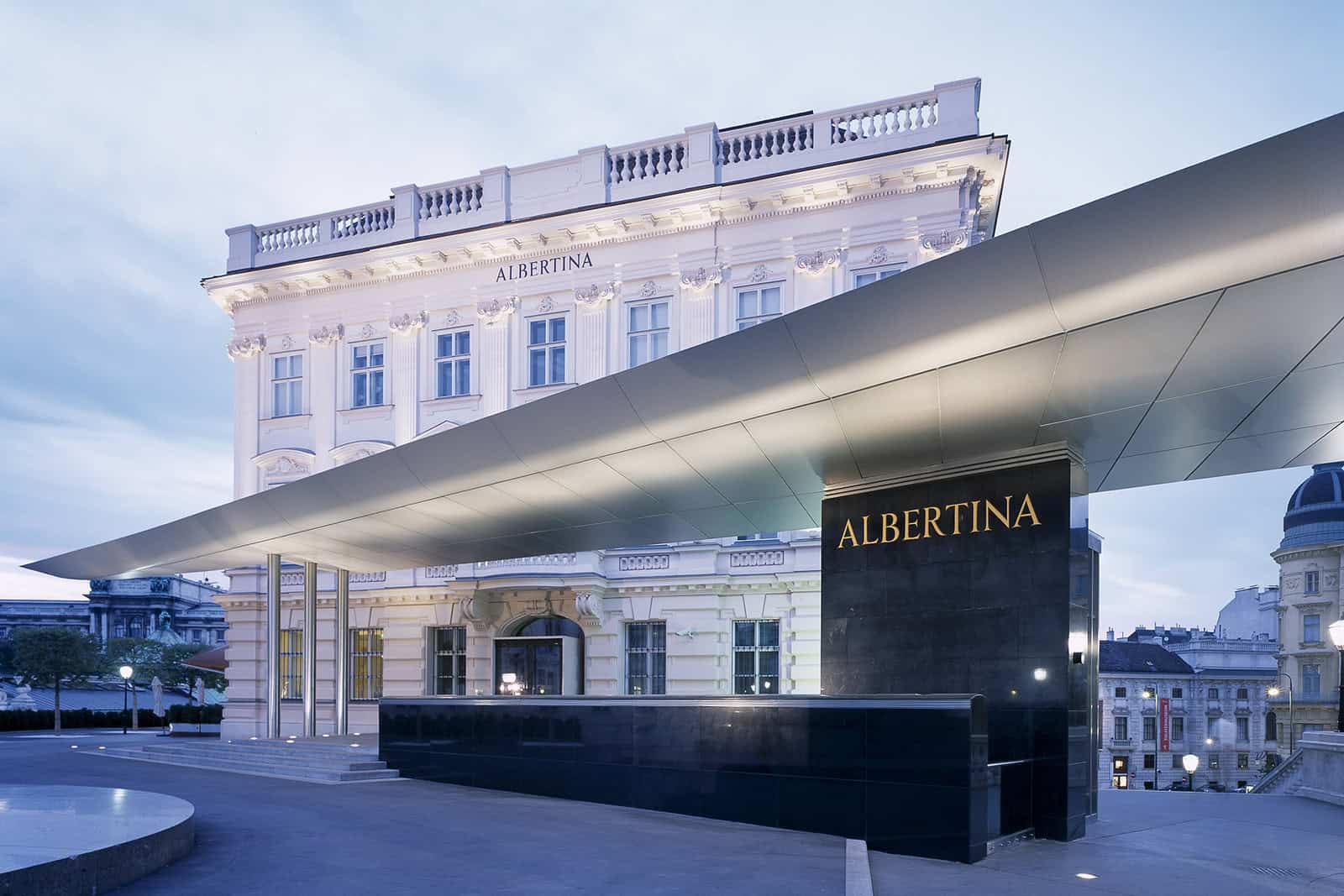
The Albertina Museum in Vienna, photographed by Harald Eisenberger / AlbertinaPresse, via Wikimedia Commons. Cropped. CC BY-SA 4.0.
The Leopold Museum’s Dossier Does Not Treat Every Work Alike
A 2010 provenance dossier published by the Leopold Museum makes the evidentiary problem more specific. It states that no comprehensive, consensual reconstruction of the collection’s ownership transfers after 1938 then existed and that the exact composition of Grünbaum’s collection in 1938 was not fully clear.
The dossier records a Nazi-era valuation of 446 artworks. Five Schiele oils were identified by title, while fifty-five colored drawings, twenty pencil drawings, and one etching were grouped without individual titles. That difference matters: an oil such as Dead City III can be matched by name, while an untitled sheet may require comparison with exhibition catalogues, dealer records, measurements, and later catalogue-raisonné numbers.
The museum dossier consequently separates Leopold works into different evidentiary categories: works demonstrably from the Grünbaum collection, works presumed to have come from it, and works for which the dossier found no connection. The heirs’ complaint reaches a broader conclusion, relying on a 1925 Würthle catalogue, 1928 correspondence, mid-century dealer catalogues, and other records to claim all twelve.
Those competing records concern provenance, but provenance alone is not identical to legal title. The museums maintain that Grünbaum’s sister-in-law, Mathilde Lukacs, sold works through Swiss dealer Eberhard W. Kornfeld in the 1950s; the heirs dispute her authority to convey title. The Art Newspaper documented those opposing accounts when it reported the lawsuit. The federal court has not adjudicated either chain of title for these twelve works.
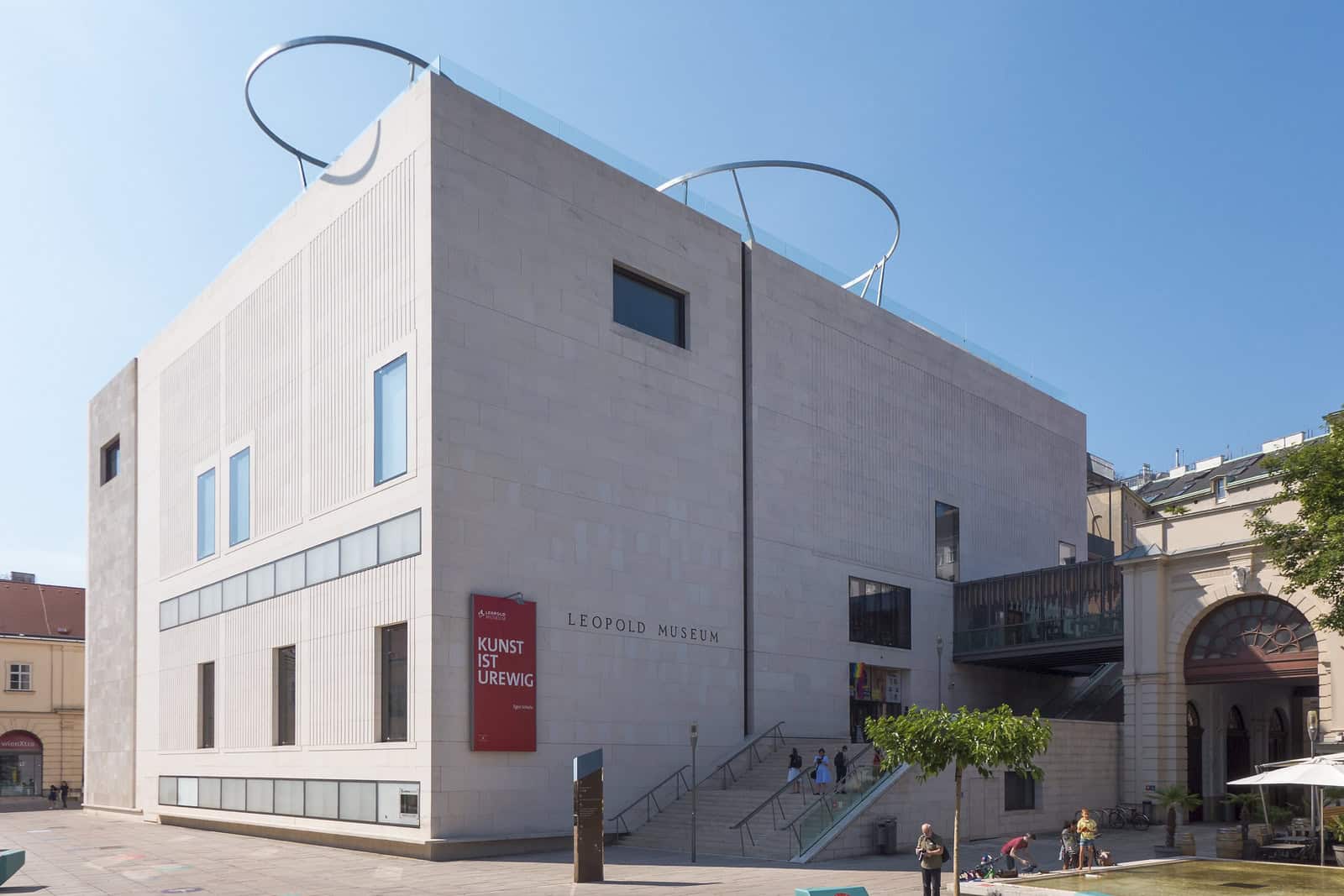
The Leopold Museum in Vienna, photographed by Gugerell, via Wikimedia Commons. Cropped. CC0 1.0.
Twelve Works Remain in Place, With No Ownership Ruling
The record now supports five bounded findings.
- Austria and the museums filed their response on October 30 after receiving permission on October 27.
- The response renews Article III and Tenth Amendment objections; it is not a judgment declaring the HEAR Act unconstitutional.
- Public Law 119-82 was enacted on April 13, 2026, applies to pending claims, and expressly excludes named time-based and non-merits defenses.
- The complaint assigns ten claimed Schiele works to the Leopold Museum and two to the Albertina, while the Leopold dossier does not place every work in the same provenance category.
- The federal court has not decided constitutionality, jurisdiction, or title, while the parties continue to dispute parts of the works’ provenance. The museums retain the works unless a court order or settlement changes that position.

Isabella studied at the University of Cape Town in South Africa and graduated with a Bachelor of Arts majoring in English Literature & Language and Psychology. Throughout her undergraduate years, she took Art History as an additional subject and absolutely loved it. Building on from her art history knowledge that began in high school, art has always been a particular area of fascination for her. From learning about artworks previously unknown to her, or sharpening her existing understanding of specific works, the ability to continue learning within this interesting sphere excites her greatly.
Her focal points of interest in art history encompass profiling specific artists and art movements, as it is these areas where she is able to really dig deep into the rich narrative of the art world. Additionally, she particularly enjoys exploring the different artistic styles of the 20th century, as well as the important impact that female artists have had on the development of art history.
Learn more about Isabella Meyer and the Art in Context Team.
Choose Art in Context as a preferred source to see more of our reporting in Google Top Stories and other Google Search experiences.
Cite this Article
Isabella, Meyer, “Austria Renews HEAR Act Challenge Over 12 Egon Schiele Works.” Art in Context. October 31, 2026. URL: https://artincontext.org/austria-hear-act-challenge-egon-schiele-works/
Meyer, I. (2026, 31 October). Austria Renews HEAR Act Challenge Over 12 Egon Schiele Works. Art in Context. https://artincontext.org/austria-hear-act-challenge-egon-schiele-works/
Meyer, Isabella. “Austria Renews HEAR Act Challenge Over 12 Egon Schiele Works.” Art in Context, October 31, 2026. https://artincontext.org/austria-hear-act-challenge-egon-schiele-works/.


