American Realism: History, Artists, and Major Works

A slushy New York street, a bloodied operating theater, and a glowing midnight diner can all belong to American Realism, even though they look nothing alike. The label names less a fixed house style than a shifting effort to make American life, its places, work, leisure, and tensions, matter in art. Following its turning points and learning what to look for reveals why brushy, precise, rural, and urban works can share a realist purpose without forming one seamless movement.
What American Realism Means
In visual art, American Realism is a broad historical label for art that engages recognizably American people, places, institutions, and experiences. Its most common narrow meaning refers to Robert Henri and the artists later associated with the Ashcan School. Broader accounts reach backward to selected 19th-century examples and forward to Regionalism, Social Realism, Edward Hopper, and midcentury realist painting.

Those meanings should not be collapsed into one movement with fixed membership and exact start and end dates. A useful scope ladder separates them:
- Narrow use: Henri and the urban painters commonly grouped under the Ashcan School label.
- Expanded historical use: earlier examples such as Thomas Eakins, followed by Regionalism, Social Realism, and other representational currents of the 1930s and 1940s.
- Broadest use: a recurring realist tendency in American art, including later forms that did not share an organization, technique, or political program.
The middle definition is often the most helpful. It preserves the importance of the Ashcan circle while allowing readers to compare urban, rural, political, and psychological forms of realism without pretending they were all one school.
The Narrow Meaning: Henri and the Ashcan School
The Ashcan School was not a formally organized academy with a manifesto or official roster. The name gained currency after the painters’ formative activity and describes a loose network rather than a disciplined institution. Its best-known artists examined modern New York through street scenes, tenements, public amusements, boxing matches, and other subjects drawn from contemporary city life.
Many of these painters favored dark colors, broad forms, and gestural brushwork, meaning visible, energetic strokes. Their experience in newspaper illustration helped sharpen their interest in immediate events and economical visual storytelling. These characteristics are useful recognition clues, but they do not define every work that can reasonably be called American Realist.
The Broader Meaning: A Recurring American Realist Tendency
A broader view treats realism as a recurring choice rather than a single inherited surface. Eakins could confront viewers with the physical reality of surgery. Grant Wood could present Midwestern people and buildings through crisp control. Hopper could reduce a diner to geometric planes, electric light, and troubling emptiness. Each artist made recognizable experience carry artistic weight, but they did so under different historical conditions.

This wider framework also prevents one city from standing for the nation. Philadelphia teaching networks, New York exhibitions, Midwestern Regionalism, federal art programs, and midcentury institutional collecting all affected how realist work was produced and understood.
Nine Turning Points
- 1875: Eakins painted The Gross Clinic, bringing a modern surgical procedure and its bodily detail into a monumental composition.
- 1892: Henri began mentoring four Philadelphia newspaper illustrators who later formed the first Ashcan generation in New York.
- 1902: Snow in New York made an ordinary winter side street, rather than a picturesque view, the center of attention.
- 1908: The Eight exhibited together and challenged established exhibition structures, although they did not represent one unified style.
- 1913: The Armory Show brought more radical European modernism before a broad American public and changed what counted as newly experimental art.
- 1930: American Gothic appeared as Regionalism gained prominence through representational images of rural and small-town America.
- 1933 to 1934: The Public Works of Art Project funded 3,750 artists and 15,600 works before other New Deal programs expanded federal arts patronage.
- 1942: Nighthawks used architecture, light, and empty space to turn a recognizable diner into an image of urban separation.
- 1959: A Whitney Museum exhibition of the Sara Roby Foundation collection gave multiple forms of realism a national platform while Abstract Expressionism commanded critical attention.
How to Recognize American Realism
Recognition begins with what a work asks viewers to notice, not with how closely it resembles a photograph. American Realist artists often chose contemporary people, ordinary surroundings, familiar labor, leisure, or public institutions. They then shaped that material through selection, composition, paint handling, color, and emotional emphasis.
Realism is therefore compatible with obvious brushstrokes, compression, simplification, and satire. A painting does not stop being realist because the artist has reorganized space or made paint conspicuous. The more useful question is how those choices interpret an experience grounded in the observable world.
Subject Matter: Ordinary Life Made Consequential
An everyday subject may become important through scale and attention. Henri’s side street receives the concentration once reserved for a scenic view. Bellows packs city residents into forceful arrangements. Wood places two Midwestern figures before a rural house with the formality of a ceremonial portrait. Hopper studies the psychological pressure of a nearly empty public interior in Nighthawks.
None of these subjects is neutral. Choosing what enters the frame also determines what remains unseen. Yet a scene of workers, poverty, or urban crowding does not automatically announce a reform program. Political intention must be established from the individual work and its context.
Handling and Palette: No Single Realist Surface
Henri’s textured strokes and subdued colors allow snow, mud, buildings, and roadway to register as physical matter. Wood’s controlled surface produces a different kind of attention, giving faces, clothing, tools, and architecture an almost insistent clarity. In Nighthawks, Hopper simplifies forms and regulates light so strictly that architecture appears to govern the people inside it.
These differences make photographic finish a poor test. Painterly energy can suggest the speed and friction of a street, while sharp edges can make a familiar setting feel still or strange. Technique serves the artist’s view of reality rather than proving realism by itself.
A Three-Question Recognition Test
- What part of lived experience has been selected? Identify the people, place, activity, or institution before assigning a movement label.
- How has the artist organized attention? Follow perspective, cropping, light, color, brushwork, repeated shapes, and the distribution of occupied and empty space.
- What attitude does the treatment create? Decide whether the work mainly observes, dramatizes, satirizes, mourns, celebrates, or presses for social change. Support that conclusion with visible evidence and known context.
This method accommodates several realist styles while resisting a common mistake: assuming that recognizable subject matter equals literal transcription.
From Eakins to the Ashcan School
This phase shows why the broader and narrower meanings of American Realism must remain distinct. Eakins belongs here as an earlier example under the broad definition, while Henri’s teaching circle and independent exhibitions establish the more direct Ashcan history.
Thomas Eakins and Modern Experience
Under the broad definition of American Realism, Thomas Eakins provides an earlier example rather than a documented member of the later Ashcan circle. Painted in 1875 for the approaching 1876 Centennial, The Gross Clinic depicts a modern surgical demonstration led by Dr. Samuel Gross. The operation’s blood and physical immediacy helped provoke contemporary shock, and the painting was rejected from the Centennial’s fine-arts display.
The work does not simply record a medical procedure. Its concentrated lighting draws attention toward the surgeon and exposed body, while the surrounding observers turn the operation into public instruction. Eakins showed that contemporary professional life could sustain a large, serious painting without being cleansed of uncomfortable detail.
Robert Henri’s Philadelphia Circle
Beginning in 1892, Henri mentored Philadelphia illustrators William Glackens, George Luks, Everett Shinn, and John Sloan. They later moved to New York and became the first generation associated with Ashcan art. Their newspaper experience supported alert observation and economical visual storytelling.
Henri’s own Snow in New York demonstrates the approach without turning it into a formula. Its perspective leads along a plain side street, but textured paint and a somber palette deny the scene the decorative charm expected of a conventional snow picture. The street feels used and inhabited even without a theatrical incident.
The Eight, Independence, and the Armory Show
Henri organized the 1908 exhibition of The Eight as a challenge to established exhibition structures. The name described eight exhibitors, not a permanent movement with one style, and the group was broader than the core Ashcan circle. The 1910 Exhibition of Independent Artists extended this push for alternatives to established systems.
The Armory Show of 1913 altered the situation again. By presenting more radical European modernism to a large American audience, it moved the frontier of newly experimental art beyond the position occupied by Ashcan painters and American Impressionists. Urban realism did not end, but it no longer represented the newest challenge to convention.
Regional, Social, and Midcentury Realisms
The urban Ashcan story is central, but it cannot stand for every American form of realism. During the Depression and the following decades, representational artists worked across distinct regional, political, and psychological currents.

Regionalism and Rural America
Regionalism was prominent from roughly 1930 to 1945 and emphasized representational scenes of rural, small-town, and Midwestern life. Grant Wood, Thomas Hart Benton, and John Steuart Curry were among its leading artists.
Wood’s precisely finished images could mix apparent respect for local life with satire. Regionalism’s subjects also shifted attention away from New York streets and toward rural and small-town places as material for national art.
Social Realism and New Deal Patronage
Social Realism became especially prominent during the 1930s. It used accessible images of recognizable people and places to expose injustice and address the hardships of poor and working-class communities, often with an explicit aim of protest or reform. That purpose distinguishes the movement from realism used mainly for observation or psychological interpretation.
New Deal patronage was a funding structure, not another name for Social Realism. The Public Works of Art Project ran from December 1933 through June 1934, supporting 3,750 artists and producing 15,600 works. Later federal initiatives, including the Federal Art Project and programs that commissioned work for public buildings, expanded public settings for American art.
Hopper and the Persistence of Realist Painting
Edward Hopper demonstrates the continuing range of American realist painting through Nighthawks. In that work, he simplifies an all-night diner into a controlled arrangement of geometry and electric light. Four recognizable figures occupy the interior, but the empty street and missing visible entrance intensify their separation.
Institutional support also continued after abstraction became dominant in critical discussion. The Sara Roby Foundation began collecting American art in the mid-1950s, and a 1959 Whitney Museum exhibition presented several kinds of realist art. The event did not create one new movement. It showed that realist practice and patronage remained active beyond the Ashcan era.
Six Works That Make the Range Visible
Comparing representative works makes the range of American Realism clearer than a list of shared traits. Each example anchors recognizable experience in a different visual structure.
The Gross Clinic by Thomas Eakins
Eakins turns a modern surgical lesson into a monumental public drama. Dr. Gross commands attention amid the darkened setting, while the exposed operation prevents professional authority from becoming an abstract idea. Medicine appears as skilled knowledge enacted upon a vulnerable body.
The subject carried historical stakes in 1875. Its modernity and bloody detail contributed to its rejection from the Centennial fine-arts display, revealing how an unidealized contemporary subject could test the boundaries of official art. The work is realist not merely because anatomy is recognizable, but because it makes an unsettling modern institution worthy of sustained attention.
Snow in New York by Robert Henri
Henri organizes this 1902 street through one-point perspective, in which receding lines appear to meet at one distant point. Thick, textured strokes give substance to dirty snow and wet ground, while the restricted palette suppresses decorative pleasure. Nothing depends on a famous landmark or picturesque effect.
The painting’s importance lies in that refusal of spectacle. A side street becomes consequential through viewpoint and handling. Its loose surface records neither every architectural detail nor a fleeting optical impression; it constructs an encounter with the material city.
Cliff Dwellers and Both Members of This Club by George Bellows
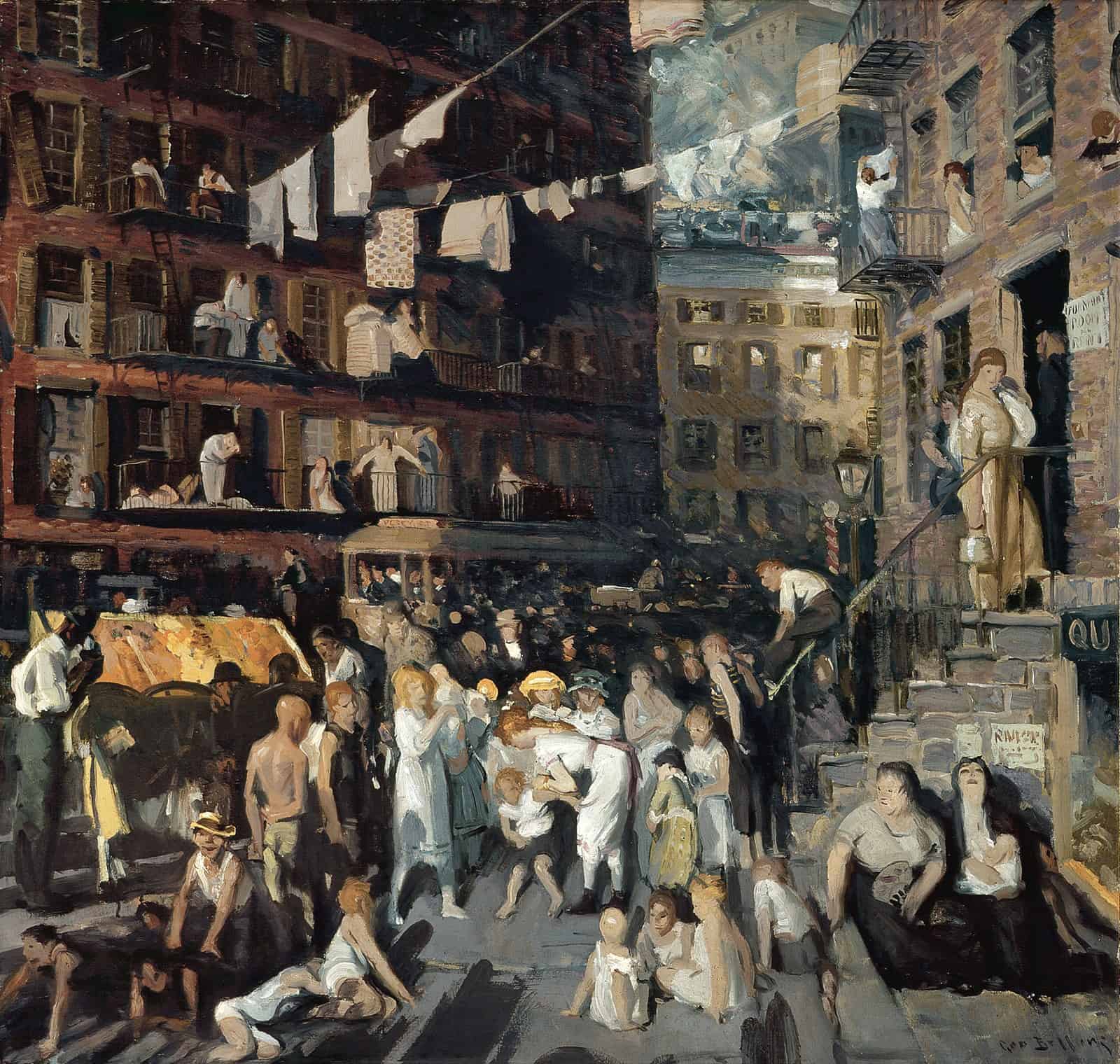
Cliff Dwellers from 1913 compresses a crowded Lower East Side street into a dense field of bodies, buildings, lines, and movement. Bellows worked wet paint into wet paint, helping the scene feel active rather than neatly cataloged. The crowding invites social questions, but the painting’s political meaning is not unequivocal. Urban density alone does not prove a reform message.
Both Members of This Club from 1909 offers a sharper case for social commentary. Bellows depicts an interracial boxing match with forceful, visible brushwork and a packed audience. The title refers to the legal device used to evade New York’s ban on public prizefighting by declaring the fighters club members. Here the spectacle of violence, racial tension, law, and entertainment supports a more pointed social reading.
The pair provides a useful lesson. Similar energy and urban subject matter can carry different degrees of political intention, so interpretation must proceed work by work.
American Gothic by Grant Wood
Painted in 1930, American Gothic shifts the geographic and technical focus. Two frontal figures stand before a rural house in a precisely controlled scene. Repeated vertical forms connect clothing, faces, the pitchfork, and the building, making people and property seem tightly ordered.
Wood’s realism does not settle into simple praise or ridicule. His treatment of Midwestern subjects could combine celebration with satire, and the painting’s stern arrangement sustains that tension. Its hard finish and frontal stillness contrast with Ashcan paint handling without weakening its claim to realist observation.
Nighthawks by Edward Hopper
In the 1942 painting Nighthawks, four figures occupy an all-night diner surrounded by dark streets. The broad window exposes them to view, yet no visible entrance offers an easy path inside. Counter, glass, walls, and pavement create a precise enclosure.
Hopper does not need busy action to describe modern life in this work. Electric light and empty exterior space intensify the separation among the people and between the diner and the street. Recognizable architecture becomes an emotional mechanism, demonstrating how simplification can convey a modern reality more effectively than exhaustive detail.
American Realism vs. Social Realism
The two terms overlap, but they do not name the same thing. American Realism can describe a broad and historically fluid tendency. Social Realism is more specifically associated with accessible imagery directed toward injustice, hardship, protest, or reform.
| Point of comparison | American Realism | Social Realism |
|---|---|---|
| Scope | A broad label with narrow and expanded historical uses | A more purpose-driven social and political current |
| Typical aim | Observation, interpretation, satire, psychological insight, or commentary | Attention to injustice with an intended protest or reform dimension |
| Subjects | City streets, rural communities, work, leisure, institutions, interiors, and portraits | Workers, poverty, inequality, oppression, and other contested social conditions |
| Style | No single surface; it can be brushy, controlled, or simplified | Usually recognizable figures and settings, but not one required technique |
| How to apply the label | Clarify whether the narrow Ashcan or broader historical meaning is intended | Establish political purpose from the work and its context |
Shared Subjects and Recognizable Figures
Both categories can include tenements, crowded streets, workers, or public entertainment. Both generally retain recognizable figures and settings. That shared vocabulary explains why Ashcan paintings are sometimes labeled Social Realist without enough attention to their individual purposes.
The Decisive Difference: Observation Versus Reform
The Ashcan artists were not collectively organized as reformers or makers of radical propaganda. They could focus on difficult urban conditions without prescribing a political response. Social Realism, by contrast, is defined more directly by its effort to expose injustice and encourage social change.
Subject matter is therefore necessary evidence but not sufficient proof. A crowded tenement street may observe, dramatize, or criticize. Titles, composition, documented statements, exhibition context, and the work’s treatment of its subjects help determine which reading is justified.
Where the Labels Overlap
Overlap occurs when an artist working in a broader realist mode gives a particular image an explicit social charge. Bellows’s Both Members of This Club supports such a reading, while Cliff Dwellers requires more caution. The labels should describe what a work does, not impose one political identity upon every image by the artist.
Legacy and Later Uses of Realism
Realism continued after losing its earlier experimental position, but it took several forms rather than following one continuous movement. The Armory Show marks a change in status, while later art based on recognizable people and places and the Sara Roby Foundation demonstrate continued artistic and institutional support.
Realism After 1913
The 1913 Armory Show changed the position of Ashcan painting without making realism obsolete. Artists continued to depict recognizable people and places as Regionalism, Social Realism, and Hopper’s psychologically charged scenes offered different responses to American life. Their coexistence argues for plural realist traditions rather than a single line of descent.
Midcentury Support
The Sara Roby Foundation began collecting American art in the mid-1950s, and its 1959 Whitney exhibition supported several forms of realism while Abstract Expressionism held greater critical prestige. Such support preserved space for varied representational practices, but it did not turn every midcentury artist working from recognizable subjects into a member of one American Realist movement.
That distinction is the larger lesson of the term’s history. American Realism persisted as a choice to engage observable life, but its artists did not share one organization, political purpose, geographic center, or surface style.
Frequently Asked Questions
The boundaries of American Realism become clearer when practical questions are answered without forcing every artist into one school. The answers below connect technique, geography, and federal patronage to the distinctions developed above.
Why Does American Realist Art Sometimes Look Loose Rather Than Photographic?
Realism concerns an artwork’s engagement with recognizable experience, not the concealment of every brushstroke. Loose handling can communicate movement, weather, crowding, or physical force. Henri and Bellows used visible paint to interpret their subjects rather than to reproduce them mechanically.
Did American Realism Happen Only in New York?
No. New York was crucial to Ashcan art and its exhibitions, but Philadelphia shaped Henri’s early teaching network, Regionalism centered rural and Midwestern subjects, and federal programs supported artists and public commissions on a national scale.
How Did Federal Art Programs Change American Realist Art?
They employed artists, financed thousands of works, and brought art into public buildings and shared civic settings. This enlarged both production and access. These were patronage programs rather than one artistic movement.

Jordan Anthony is a film photographer, curator, and arts writer based in Cape Town, South Africa. Anthony schooled in Durban and graduated from the University of the Witwatersrand, Johannesburg, with a Bachelor of Art in Fine Arts. During her studies, she explored additional electives in archaeology and psychology, while focusing on themes such as healing, identity, dreams, and intuitive creation in her Contemporary art practice. She has since worked and collaborated with various professionals in the local art industry, including the KZNSA Gallery in Durban (with Strauss & Co.), Turbine Art Fair (via overheard in the gallery), and the Wits Art Museum.
Anthony’s interests include subjects and themes related to philosophy, memory, and esotericism. Her personal photography archive traces her exploration of film through abstract manipulations of color, portraiture, candid photography, and urban landscapes. Her favorite art movements include Surrealism and Fluxus, as well as art produced by ancient civilizations. Anthony’s earliest encounters with art began in childhood with a book on Salvador Dalí and imagery from old recipe books, medical books, and religious literature. She also enjoys the allure of found objects, brown noise, and constellations.
Learn more about Jordan Anthony and the Art in Context Team.
Cite this Article
Jordan, Anthony, “American Realism: History, Artists, and Major Works.” Art in Context. October 20, 2026. URL: https://artincontext.org/american-realism/
Anthony, J. (2026, 20 October). American Realism: History, Artists, and Major Works. Art in Context. https://artincontext.org/american-realism/
Anthony, Jordan. “American Realism: History, Artists, and Major Works.” Art in Context, October 20, 2026. https://artincontext.org/american-realism/.